Have you ever wondered about an hour vs a hour when writing a sentence such as “I’ll be there in ___ hour”? This small grammar question can be surprisingly confusing because the word hour starts with the letter h.
Since h is usually a consonant, you might think a hour is correct. However, English articles depend on pronunciation rather than simply on spelling. The h in hour is silent, so the word begins with a vowel sound. That is why an hour is the correct expression in standard English.
In this guide, I’ll explain an hour vs a hour in simple language, show you practical examples, explain the pronunciation rule, discuss common mistakes, and provide an easy way to remember the correct form. By the end, you will know exactly when to use an hour and why a hour is incorrect. Crowler vs Growler | Genius vs Genious | Life vs Lives
Quick Answer: An Hour vs A Hour
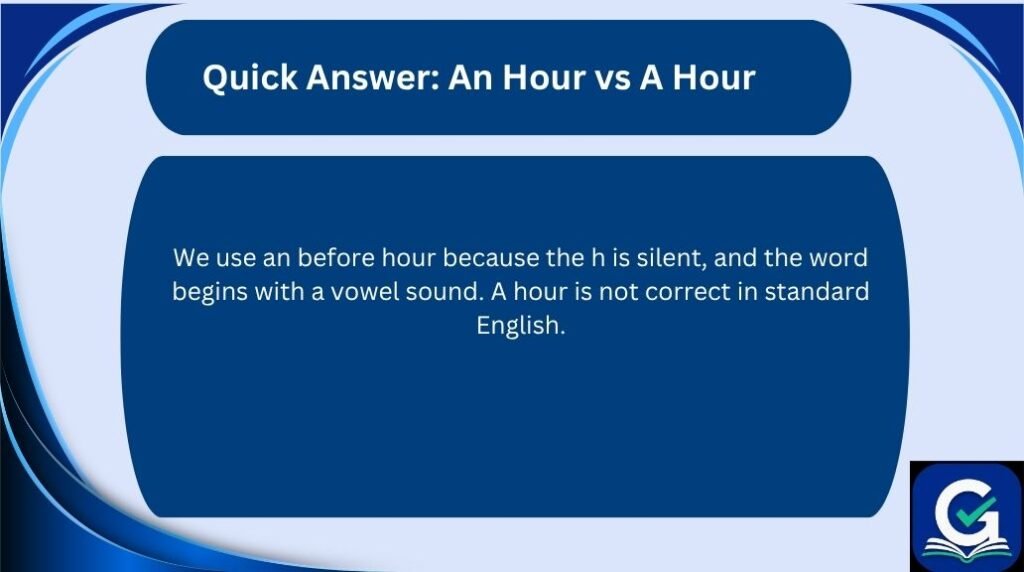
The correct expression is an hour.
We use an before hour because the h is silent, and the word begins with a vowel sound. A hour is not correct in standard English.
- ✅ an hour
- ❌ a hour
Example:
I will call you in an hour.
If you are still confused about an hour vs a hour, remember that pronunciation—not spelling—determines the article.
Understanding the Basics
The difference between an hour vs a hour comes down to one simple grammar rule:
Use “a” before a consonant sound and “an” before a vowel sound.
Many English learners remember a shorter version of this rule:
“Use a before consonants and an before vowels.”
That version can be helpful, but it is not completely accurate because letters and sounds do not always match.
For example:
- a house — the h is pronounced.
- an hour — the h is silent.
- a university — the u begins with a /y/ sound.
- an umbrella — the u begins with a vowel sound.
This is why understanding pronunciation is essential when learning an hour vs a hour.
Comparison Table
| Form | Type | Meaning | Example | Correct/Incorrect |
|---|---|---|---|---|
| an hour | Indefinite article + noun | One hour or approximately 60 minutes | I waited an hour. | ✅ Correct |
| a hour | Indefinite article + noun | Intended to mean one hour | I waited a hour. | ❌ Incorrect |
| one hour | Number + noun | Exactly one hour | The class lasted one hour. | ✅ Correct |
| an hour ago | Time expression | Approximately one hour before now | She left an hour ago. | ✅ Correct |
| in an hour | Time expression | Approximately one hour from now | I’ll return in an hour. | ✅ Correct |
The answer to an hour vs a hour is therefore straightforward: use an hour in standard English.
Why “An Hour” Is Correct
The word hour is pronounced without an initial /h/ sound.
When you say hour, it begins with a vowel sound, approximately like:
ow-er
Because the first sound is a vowel sound, English uses an.
Therefore:
an + hour = an hour
The spelling may make the word look as though it should take a, but spelling is not what determines the article.
The Silent H Rule
The silent h is the main reason learners get this expression wrong.
Compare these words:
- house → h is pronounced
- happy → h is pronounced
- hotel → h is pronounced
- hour → h is silent
- honest → h is silent
- honor → h is silent
- heir → h is silent
That gives us:
- a house
- a happy child
- a hotel
- an hour
- an honest person
- an honor
- an heir
The same sound-based principle explains all of these choices.
Correct Meanings and Uses
The phrase an hour is used in several common ways. Learning these patterns will make correct usage more natural.
An Hour for Duration
We use an hour to describe how long something lasts.
Examples:
I studied for an hour.
The meeting lasted an hour.
She waited for an hour.
The movie is about an hour long.
In these sentences, an hour identifies a period of approximately 60 minutes.
An Hour for Future Time
Use in an hour when something is expected to happen approximately one hour from now.
Examples:
I’ll call you in an hour.
The bus should arrive in an hour.
We’ll be home in an hour.
Here, in an hour refers to a future point approximately 60 minutes from the present.
An Hour Ago
Use an hour ago when talking about something that happened approximately 60 minutes before now.
Examples:
He left an hour ago.
I sent the email an hour ago.
She called me an hour ago.
The standard structure is:
an hour + ago
Not:
❌ a hour ago
But:
✅ an hour ago
For an Hour
The expression for an hour emphasizes duration.
Examples:
We talked for an hour.
I exercised for an hour.
They waited for an hour.
The word for tells the reader or listener how long the activity continued.
About an Hour
Use about an hour when the duration is approximate.
Examples:
The trip will take about an hour.
I spent about an hour cleaning.
The repair should take about an hour.
This is useful when you do not know the exact number of minutes.
The Pronunciation Test
One of the easiest ways to solve an hour vs a hour is to say the word aloud.
Say:
hour
Now ask yourself:
Can I hear the H?
No.
The word starts with a vowel sound.
Therefore:
an hour ✅
This test is useful because it removes the distraction caused by the written letter h.
Test Tip
Whenever you are unsure whether to use a or an, ignore the spelling temporarily.
Instead:
- Say the word aloud.
- Listen to the first sound.
- If it is a vowel sound, use an.
- If it is a consonant sound, use a.
For hour, the first sound is a vowel sound.
So:
an hour
is the correct choice.
Examples of Correct Usage
Here are several examples that show how an hour works naturally:
- I need an hour to finish the assignment.
- She waited for an hour outside.
- We will arrive in an hour.
- He left an hour ago.
- The meeting lasted an hour.
- Give me an hour to prepare.
- The drive takes about an hour.
- I have been working for an hour.
- They spent an hour discussing the issue.
- The lesson lasted nearly an hour.
If you are checking an hour vs a hour, every example above demonstrates the standard form.
An Hour vs A Hour in Everyday Conversation
In everyday American English, an hour is extremely common.
People naturally say:
“Give me an hour.”
“I’ll be back in an hour.”
“It took an hour.”
“I’ve been waiting for an hour.”
“We have an hour before the movie starts.”
These phrases are so common that native speakers usually use them automatically.
For English learners, repeated exposure to phrases like these can help develop a natural sense of article usage.
An Hour vs A Hour in Professional Writing
The difference between an hour vs a hour also matters in professional communication.
Imagine writing an email to your manager:
I need an hour to complete the final review.
This sentence sounds natural and professional.
Now compare:
I need a hour to complete the final review.
The meaning is understandable, but the article is grammatically incorrect.
Professional Examples
I’ll send the revised report in an hour.
The presentation should take an hour.
Please give me an hour to review the proposal.
The meeting lasted an hour.
I expect the analysis to take about an hour.
Correct article usage contributes to polished professional writing.
An Hour vs A Hour in Creative Writing
Writers also use an hour when describing time, suspense, or character experiences.
For example:
After an hour of walking, they finally reached the cabin.
Another example:
He had only an hour to find the missing key.
The phrase can create a sense of time pressure.
A writer might also use it to slow down a scene:
She sat beside the window for an hour, watching the rain fall across the empty street.
The grammar does not change simply because the writing is creative.
An Hour vs A Hour in Texting and Social Media
Informal writing may contain abbreviations, slang, emojis, and shortened sentences, but the standard article rule remains the same.
Examples:
Be there in an hour! 😊
I’ve been waiting for an hour 😩
Only an hour left! ⏰
Give me an hour and I’ll handle it.
Even if people make casual typing mistakes, an hour remains the correct standard form.
Real-Life Case Study: A Workplace Email
Imagine that Alex is preparing a report for a supervisor. The report is almost finished, but Alex needs another 60 minutes to review the final details.
Alex writes:
Hi Jordan,
I need an hour to complete the final review. I’ll send the finished report as soon as it is ready.
Thanks,
Alex
This is clear and professional.
Now imagine that Alex writes:
I need a hour to complete the final review.
The reader can still understand the meaning, but the article is incorrect.
Why Did the Mistake Happen?
Alex may have focused on the first written letter:
hour
Because h is usually associated with consonant sounds, Alex may have automatically selected a.
But the pronunciation is:
hour → vowel sound
Therefore:
an hour is correct.
This real-life situation shows why an hour vs a hour can be confusing even when the rule itself is simple.
Grammar Rules Explained
The indefinite articles a and an are used before singular countable nouns when we are talking about something nonspecific.
The correct article depends on the sound that follows.
Use “A” Before a Consonant Sound
Examples include:
- a dog
- a book
- a car
- a teacher
- a house
- a university
- a European country
Notice that university begins with the letter u, but it is pronounced with a /y/ sound:
yoo-niversity
Because /y/ is a consonant sound, we say:
a university
Use “An” Before a Vowel Sound
Examples include:
- an apple
- an egg
- an orange
- an idea
- an umbrella
- an hour
- an honest person
- an honor
The pronunciation determines the article.
Merriam-Webster’s pronunciation guidance demonstrates that English spelling does not always provide a complete indication of pronunciation. This is why article selection must take the spoken sound into account.
Why “A Hour” Is Incorrect
The expression a hour is incorrect in standard English because a is used before a consonant sound, while hour begins with a vowel sound.
Think of the structure:
an + hour
This produces:
an hour
Using a produces:
a hour
That combination does not follow the standard pronunciation-based article rule.
So, when considering an hour vs a hour, the correct choice is:
✅ an hour
Similar Words With Silent H
Learning other silent-h words can reinforce the rule.
An Honest Person
She is an honest person.
The h in honest is silent.
An Honor
It was an honor to meet the author.
Again, the initial h is silent.
An Heir
He is an heir to the family estate.
The h is silent.
An Hour
I waited for an hour.
The same rule applies.
These examples form a useful pattern:
silent H → vowel sound → an
Common Mistakes
There are several reasons people make mistakes with this grammar point.
Fast Typing
When people type quickly, they often choose articles automatically.
Seeing the letter h can cause someone to type a without thinking about pronunciation.
Autocorrect
Autocorrect and grammar-checking software can sometimes miss small errors or make suggestions based on incomplete context.
It is better to understand the rule rather than rely completely on software.
Lack of Knowledge
Some learners have never been taught that a/an depends on sound.
They may learn:
“A comes before consonants.”
That explanation is incomplete.
The more accurate rule is:
A comes before consonant sounds, and an comes before vowel sounds.
Confusing Letters With Sounds
This is the main issue behind an hour vs a hour.
The word begins with:
h
But it sounds as though it begins with:
ow
Therefore, the article follows the sound.
Similar Grammar Confusions
The following table contains other common English mistakes that learners may encounter.
| Common Confusion | Correct Form | Reason |
|---|---|---|
| a hour / an hour | an hour | The H is silent |
| a honest person / an honest person | an honest person | The H is silent |
| an university / a university | a university | Begins with a /y/ sound |
| an European / a European | a European | Begins with a /y/ sound |
| it’s / its | its for possession | It’s means “it is” or “it has” |
| your / you’re | you’re = you are | Different grammatical functions |
| their / they’re | they’re = they are | Different meanings |
| then / than | than for comparisons | Different uses |
| there / their / they’re | Depends on meaning | Place, possession, or contraction |
These examples demonstrate why English learners should consider pronunciation, meaning, and grammatical function rather than relying only on spelling.
How to Avoid the Mistake
You can prevent the a hour mistake with a few simple habits.
Memorize the Phrase
Instead of remembering only the word hour, remember the complete phrase:
an hour
This makes the correct article easier to recall.
Say It Aloud
If you say:
“a hour”
you may notice that it sounds awkward.
Now say:
“an hour”
The second version flows naturally.
Remember the Silent H
Think:
hour = vowel sound
That immediately points you toward an.
Learn Similar Examples
Memorize these together:
- an hour
- an honest person
- an honor
- an heir
Then compare them with:
- a house
- a hotel
- a happy child
This contrast makes the pronunciation rule easier to remember.
Why This Grammar Rule Matters
It may seem like a very small issue, but correct article usage has practical benefits.
Clarity
Correct grammar helps readers process sentences naturally.
Professionalism
Accurate English is particularly valuable in resumes, emails, reports, academic work, and business communication.
Digital Communication
People communicate through websites, messages, social media, applications, and online forms. Small grammar mistakes can affect the overall impression of written content.
Stronger English Skills
Understanding an hour vs a hour also teaches a broader lesson about English pronunciation.
Once you understand that articles depend on sound, many other confusing examples become easier.
A useful rule to remember is:
“Listen to the sound, not just the spelling.”
Special Exception and Edge Cases
For ordinary English, there is no standard grammatical exception that makes a hour correct.
If hour appears in a brand name, title, username, quotation, or another proper name with unusual wording, the original wording may need to be preserved. That would be a naming or stylistic issue, not a change to the normal grammar rule.
When hour means a period of 60 minutes in a standard English sentence, use:
an hour
Therefore, the answer to an hour vs a hour does not normally change because of formality, context, or writing style.
Quick Memory Trick
Here is a very simple trick:
Think About the Sound
Say:
hour
It sounds like:
“ow-er”
The h is not pronounced.
So:
an hour ✅
Now compare:
house
The h is pronounced.
So:
a house ✅
This contrast makes the rule easy to remember.
The One-Line Formula
Silent H + vowel sound = AN
This formula works perfectly for hour.
Quick Recap Checklist
| Question | If Yes → Use |
|---|---|
| Does the word begin with a vowel sound? | an |
| Is the H in hour silent? | an hour |
| Are you talking about one period of approximately 60 minutes? | an hour |
| Are you writing standard English? | an hour |
| Does the word begin with a pronounced consonant sound? | Usually a |
Practice Example 1
I’ll call you in ___ hour.
Answer: an hour
Correct sentence:
I’ll call you in an hour.
Practice Example 2
The meeting lasted ___ hour.
Answer: an hour
Correct sentence:
The meeting lasted an hour.
Practice Example 3
She left ___ hour ago.
Answer: an hour
Correct sentence:
She left an hour ago.
Final Reminder
If you are trying to decide an hour vs a hour, do not focus on the letter h.
Focus on the sound.
The h is silent, so use:
an hour
FAQs
Is it “an hour” or “a hour”?
“An hour” is correct. The h in hour is silent, so the word begins with a vowel sound. Therefore, standard English uses an.
Why do we say “an hour”?
We say an hour because the choice between a and an is based on pronunciation. Since hour begins with a vowel sound, an is the correct indefinite article.
Is “a hour” ever grammatically correct?
In ordinary standard English, no. When hour means a period of time, the standard form is an hour. An unusual brand name, title, or intentionally nonstandard expression could preserve different wording, but that does not change the normal grammar rule.
Is the H silent in “hour”?
Yes. The initial h in hour is silent in standard English pronunciation. Because the word begins with a vowel sound, we say an hour.
Do we say “an hour ago” or “a hour ago”?
The correct phrase is “an hour ago.”
Example:
She called me an hour ago.
Do we say “in an hour” or “in a hour”?
The correct expression is “in an hour.”
Example:
I’ll finish the project in an hour.
Conclusion
The answer to an hour vs a hour is clear once you understand the sound-based rule behind English articles. The correct expression is an hour because the h in hour is silent. Although the word begins with the letter h, it begins with a vowel sound when spoken. That is why an, rather than a, is used.
Remember that English articles are based on pronunciation, not simply spelling. The same principle explains phrases such as an honest person, an honor, and an heir, while words with a pronounced h, such as house and happy, use a.
Whenever you are uncertain, say the word aloud and listen to its first sound. This simple technique can help you make the correct choice quickly.
So, when you see the question an hour vs a hour, there is one answer to remember:
✅ An hour
Silent H + vowel sound = AN. ⏰
Once this rule becomes familiar, you will never need to hesitate over an hour vs a hour again.

I’m Jordan Hayes, a proofreading and editing writer at Gramfino, focused on clear and accurate English.
I enjoy finding common writing mistakes and sharing simple ways to make sentences stronger and easier to read.
[…] can help you write more confidently in school, at work, online, and in everyday communication. 😊 An Hour vs A Hour | Crowler vs Growler | Genius vs […]