Have you ever typed a sentence and suddenly wondered whether you need counsel vs council? You are not alone. These two words sound exactly alike when spoken, but they have different spellings, meanings, and grammatical functions.
That makes them easy to confuse, especially when you are writing quickly, using autocorrect, or working in a professional setting. The good news is that the difference becomes simple once you connect each word with its main purpose. Counsel usually refers to advice, guidance, or a lawyer, and it can work as both a noun and a verb. Council, on the other hand, refers to a group or assembly that meets to discuss, advise, govern, or make decisions.
In this guide, I’ll explain counsel vs council with clear definitions, examples, grammar rules, practical situations, and easy memory tricks so you can choose the right word confidently every time. 😊 Surprise vs Suprise | An Hour vs A Hour | Crowler vs Growler
Quick Answer: Counsel vs Council
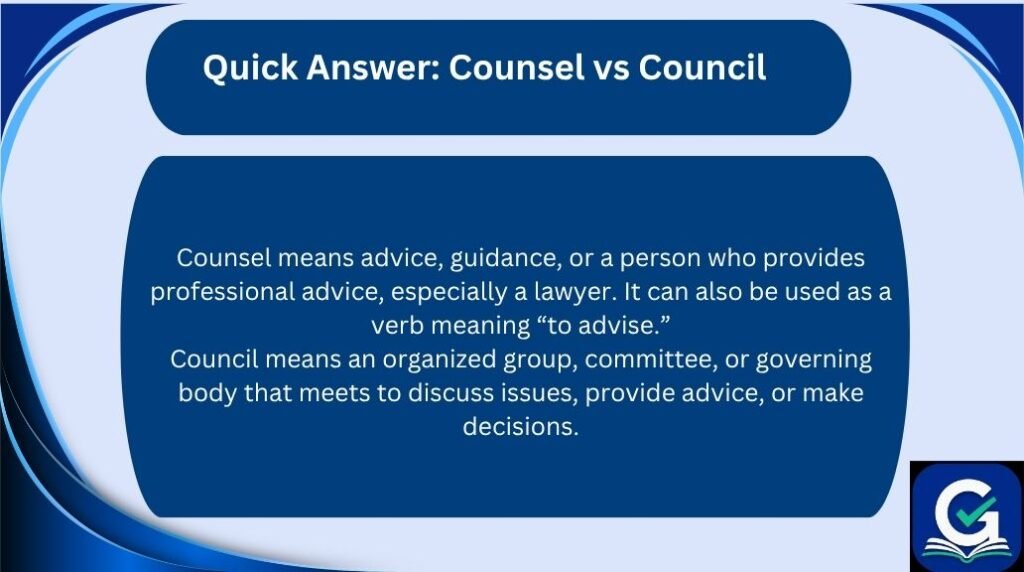
Counsel means advice, guidance, or a person who provides professional advice, especially a lawyer. It can also be used as a verb meaning “to advise.”
Council means an organized group, committee, or governing body that meets to discuss issues, provide advice, or make decisions.
Easy rule: If you mean advice or advising, use counsel. If you mean a group or governing body, use council. Merriam-Webster identifies both words as homophones because they have the same pronunciation but different spellings and meanings.
Understanding the Basics
The easiest way to understand counsel vs council is to focus on what each word represents.
Counsel is connected with advice, guidance, consultation, and legal representation. It can be a noun or a verb.
Council is connected with a group of people who meet for discussion, advice, administration, or decision-making. It is primarily a noun, although it can also function attributively before another noun, as in “council meeting” or “council member.”
Comparison Table
| Form | Type | Meaning | Example | Correct/Incorrect |
|---|---|---|---|---|
| counsel | Noun | Advice or guidance | She sought counsel from her mentor. | ✅ Correct |
| counsel | Noun | A lawyer or legal representative | His counsel presented the evidence. | ✅ Correct |
| counsel | Verb | To advise someone | The teacher counseled the student. | ✅ Correct |
| council | Noun | An organized group or governing body | The city council approved the plan. | ✅ Correct |
| council | Noun | A meeting or assembly | The council met on Tuesday. | ✅ Correct |
| council | Adjective-like modifier | Relating to a council | She attended a council meeting. | ✅ Correct |
| council | Verb | Intended to mean “advise” | The manager council the employee. | ❌ Incorrect |
| counsel | Noun | A governing group | The city counsel approved the law. | ❌ Incorrect |
The key distinction is simple: counsel gives advice; a council is a group.
What Does “Counsel” Mean?
Counsel has several related meanings, but they all revolve around advice, guidance, consultation, or professional representation.
Merriam-Webster lists counsel as both a noun and a verb. As a noun, it can mean advice, consultation, or a lawyer. As a verb, it means to advise or consult.
1. Counsel as Advice
When counsel means advice or guidance, it is a noun.
For example:
She sought counsel from her parents before making the decision.
Here, counsel means advice.
Another example:
His counsel helped me make a better choice.
Again, counsel means guidance or advice.
2. Counsel as a Lawyer
In legal English, counsel can refer to a lawyer who represents or advises a client.
For example:
The defendant spoke with legal counsel before the hearing.
Here, counsel refers to a lawyer or legal representative.
You may also see phrases such as:
- legal counsel
- defense counsel
- counsel for the plaintiff
- counsel for the defendant
- attorney and counsel
Merriam-Webster specifically recognizes counsel as a legal term for a lawyer engaged in managing or trying a case or advising and representing a client.
3. Counsel as a Verb
Counsel can also function as a verb meaning to advise.
For example:
The therapist counseled the couple about communication.
The verb tells us what the therapist did: provided advice or guidance.
Another example:
Her manager counseled her to improve her communication skills.
Here, counseled means advised.
Merriam-Webster gives “advise” as the core verb meaning of counsel.
4. “Keep Your Own Counsel”
You may encounter the expression keep your own counsel.
It means to keep your thoughts, plans, or opinions private.
For example:
He decided to keep his own counsel until the investigation was complete.
This expression is more formal and is particularly common in literary or formal writing.
What Does “Council” Mean?
Council is a noun used for a group or assembly of people who come together to discuss matters, provide advice, govern, or make decisions. Merriam-Webster includes meanings such as an assembly for consultation or discussion and an advisory or legislative body.
1. Council as a Governing Body
One of the most familiar examples is city council.
For example:
The city council approved the new transportation plan.
The council is a group of officials responsible for making decisions about the city.
Other examples include:
- city council
- town council
- student council
- security council
- advisory council
- governing council
2. Council as a Group
A council does not always have to be a government body.
For example:
The student council organized a charity event.
Here, council refers to a group of students who represent the student body and make decisions or organize activities.
Another example:
The advisory council recommended several changes.
The advisory council is a group that provides recommendations.
3. Council as a Meeting
Council can also refer to a meeting or assembly.
For example:
The council gathered to discuss the proposal.
The word describes the organized group or its formal gathering.
Counsel vs Council: The Core Difference
The difference can be reduced to one question:
Are you talking about advice or a group?
If you mean advice, guidance, consultation, or a lawyer, choose counsel.
I asked my lawyer for counsel.
If you mean a group of people who meet to discuss or decide something, choose council.
The city council voted on the proposal.
This distinction is also reflected in Merriam-Webster’s explanation: counsel refers to advice, an adviser or lawyer, or the act of advising, while council refers to an advisory, legislative, administrative, or deliberative body.
Why Are Counsel and Council So Confusing?
The biggest reason is pronunciation.
Counsel and council are pronounced alike in standard English. That makes them homophones.
They sound approximately like:
KOUN-səl
But their spellings and meanings are different.
This creates a special problem in writing. If someone says:
“I need legal counsel.”
You can hear the meaning from context, but you cannot see which spelling they mean until the word is written.
Merriam-Webster explicitly classifies these words as homophones rather than homographs because they share pronunciation but have different spellings and meanings.
A Simple Memory Trick
Here is an easy trick:
Counsel = Consult
Both counsel and consult relate to getting or giving advice.
Think:
Counsel → consultation → advice
Council = Committee
Think:
Council → committee → group
For example:
- I need counsel. → I need advice.
- I attended the council meeting. → I attended a meeting of a group.
Another useful clue is the letter C in council:
C = Committee
It is not a perfect linguistic rule, but it can be a useful writing reminder.
Correct Meanings and Uses
Counsel as a Noun
When used as a noun, counsel can mean advice or guidance.
Her counsel was valuable during the difficult situation.
Sentence breakdown:
- Her = possessive determiner
- counsel = noun
- was = verb
- valuable = adjective
Here, counsel means advice.
More examples
I followed my doctor’s counsel.
The athlete sought counsel from her coach.
His wise counsel prevented a serious mistake.
Counsel as a Legal Noun
In legal contexts, counsel often means a lawyer.
The defendant met with counsel before the trial.
Here, counsel does not mean general advice. It refers to the lawyer representing or advising the defendant.
More examples
Defense counsel questioned the witness.
The company hired outside counsel.
She requested legal counsel.
This is an especially important use because confusing counsel and council can make legal writing look unprofessional.
Counsel as a Verb
When you need a verb meaning advise, use counsel.
The manager counseled the employee about workplace conduct.
The verb can appear in different forms:
- counsel
- counsels
- counseled
- counseling
For US English, counseled and counseling are standard spellings. Merriam-Webster also lists the British-style variants counselled and counselling.
Council as a Noun
Use council for an organized group.
The council discussed the new policy.
Here, council is the subject of the sentence and refers to a group.
More examples
The city council met last night.
The student council planned the event.
The advisory council issued a recommendation.
Several council members opposed the proposal.
Test Tip: Replace the Word
One of the easiest ways to check your sentence is to replace the word.
Try “advice”
If advice fits, use counsel.
She asked for ___ before making a decision.
Replace it:
She asked for advice before making a decision.
Therefore:
She asked for counsel before making a decision. ✅
Try “group”
If group fits, use council.
The ___ voted on the proposal.
Replace it:
The group voted on the proposal.
Therefore:
The council voted on the proposal. ✅
Try “advise”
If you need a verb meaning “advise,” use counsel.
The doctor will ___ the patient.
“Advise” fits, so:
The doctor will counsel the patient. ✅
This test works surprisingly well.
Counsel vs Council in Real-Life Situations
Understanding definitions is useful, but seeing the words in realistic situations makes the difference easier to remember.
Case Study: A Workplace Email
Imagine a company has formed a group to discuss employee policies.
An employee writes:
“The company counsel will meet Friday to discuss the new policy.”
This sentence may be confusing because counsel could mean lawyers or advice.
If the employee means a committee or group, council is the appropriate word:
“The company council will meet Friday to discuss the new policy.”
Now imagine the employee is talking about a lawyer:
“The company’s legal counsel will review the policy.”
Here, counsel is correct because the sentence refers to a lawyer.
The difference
Council = group
Counsel = lawyer or advice
Context determines the correct spelling.
Grammar Rules for Counsel and Council
There is an important grammatical difference between the two words.
Counsel Can Be a Verb
This is one of the strongest clues.
The teacher counseled the student.
Correct. ✅
The teacher counciled the student.
Incorrect in standard English. ❌
Council is not the standard verb for “to advise.” Merriam-Webster lists counsel as both noun and verb, while council is listed as a noun and can also function as a modifier in expressions such as “council meeting.”
So if your sentence needs an action meaning advise, choose counsel.
Counsel Can Mean a Lawyer
This is another important grammar and vocabulary clue.
She spoke with counsel.
Depending on context, counsel can refer to a lawyer.
You might also write:
She spoke with legal counsel.
But you would not normally use council when referring to an individual lawyer.
Council Refers to a Group
If the word refers to an organized body, council is usually the correct choice.
The council approved the recommendation.
The word can also modify another noun:
council member
council meeting
council office
council decision
This attributive use is recognized in dictionary descriptions of council.
Counsel vs Council in Different Contexts
Everyday Conversation
In everyday speech, the words sound identical, so the difference usually does not cause a problem.
For example:
“I asked my parents for counsel.”
When spoken, the listener understands the meaning from context.
But when writing the sentence, spelling matters.
Professional Writing
Professional writing requires greater accuracy.
Consider these:
The city council approved the budget. ✅
The company sought legal counsel. ✅
The manager counseled the employee. ✅
Using the wrong spelling can distract readers and make your writing appear careless.
This matters especially in:
- business emails
- reports
- legal documents
- government documents
- academic writing
- applications
- workplace communication
Creative Writing
Writers may use counsel in formal, historical, or literary contexts.
For example:
The king sought counsel before entering the battle.
Here, counsel gives the sentence a formal tone.
Council can describe an assembly:
The council gathered beneath the old stone hall.
Both words can appear in the same story:
The king called the council and asked for their counsel.
This sentence is an excellent demonstration of the difference.
Council = the group.
Counsel = the advice.
Social Media and Texting
On social media, people often type quickly. Because counsel and council sound the same, mistakes are easy.
For casual texting, readers may understand what you mean from context. Still, using the correct spelling is a good habit.
For example:
“I need some counsel before I decide.”
is correct when you mean advice.
“The student council is hosting a fundraiser.”
is correct when referring to the group.
Common Mistakes With Counsel and Council
Why do people make this mistake?
1. Fast Typing
When you already know what you want to say, your brain may focus on meaning rather than spelling.
You may type:
“I asked for council.”
even though you mean:
“I asked for counsel.”
2. Autocorrect
Autocorrect can sometimes reinforce a word that is spelled correctly but wrong for the context.
Both counsel and council are legitimate English words, so a spell-checker may not identify the problem.
3. Lack of Knowledge
Some writers simply have not learned the distinction.
Because the words sound identical, it is natural to assume they have the same meaning.
4. Similar Meanings
The confusion becomes even stronger because both words can be connected to advice or consultation.
A council can give advice, while counsel can mean advice. The difference is that one is the group, while the other is the advice or adviser.
Similar Grammar Confusions
Counsel and council are part of a much larger group of commonly confused English words.
| Confusing Words | Correct Difference |
|---|---|
| its / it’s | its = possessive; it’s = it is/it has |
| your / you’re | your = possessive; you’re = you are |
| there / their / they’re | place / possession / they are |
| advice / advise | advice = noun; advise = verb |
| affect / effect | affect usually = verb; effect usually = noun |
| then / than | then = time/order; than = comparison |
| accept / except | accept = receive; except = exclude |
| principal / principle | principal = person/main; principle = rule or belief |
| counsel / council | advice/lawyer/advise; organized group |
Learning these distinctions improves both everyday and professional writing.
Why This Difference Matters
You might wonder whether one misspelled word really matters.
In casual communication, probably not much. But in formal writing, it can affect clarity and credibility.
1. Clarity
Correct word choice tells readers exactly what you mean.
Compare:
I spoke to the counsel.
with:
I spoke to the council.
The first may mean you spoke to a lawyer or adviser. The second suggests you spoke to a group.
One letter changes the meaning.
2. Professionalism
A spelling mistake involving a commonly confused word can make professional communication look less polished.
This is especially important when writing:
- legal correspondence
- business proposals
- academic assignments
- government applications
- workplace emails
3. Digital Communication
Online writing has made spelling more important, not less.
Emails, websites, social posts, applications, and documents can be read by hundreds or thousands of people. Correct word choice helps your message remain clear.
“Clear writing makes the intended meaning easier to understand.”
That simple principle applies to every professional communication.
Special Exception and Edge Cases
There is an important point worth mentioning: counsel and council can both appear in contexts involving advice.
For example:
The council provided counsel to the mayor.
This sentence can be perfectly correct.
Why?
- council = the group providing the advice
- counsel = the advice being provided
This is a useful example because it demonstrates why the words are sometimes confused.
Another useful distinction: counselor
A counselor is a person who gives advice or counseling. Merriam-Webster also recognizes counselor as a term for a lawyer and, in another sense, a camp supervisor.
A member of a council can be called a councilor or councillor, depending on the spelling convention. Merriam-Webster lists both variants for a member of a council.
Notice the spelling:
- counselor → person who gives counsel
- councilor/councillor → member of a council
These related forms are another reason learners can become confused.
Counsel vs Council: Common Sentence Examples
Here are some quick examples to reinforce the difference.
Counsel
I asked my mentor for counsel.
The lawyer served as counsel for the defendant.
She counseled her friend during the difficult period.
We should seek professional counsel before making a decision.
He chose to keep his own counsel.
Council
The city council approved the proposal.
The student council organized a fundraiser.
Council members discussed the issue.
The council held a special meeting.
She attended the council meeting.
Examples Using Both Words Together
These examples are especially useful because they show how the two words can appear in the same sentence.
Example 1
The council asked for legal counsel before voting.
Council = the group.
Counsel = legal advice or lawyers.
Example 2
The council listened carefully to the counsel offered by its advisers.
Council = group.
Counsel = advice.
Example 3
The council sought counsel from an experienced attorney.
Council = group.
Counsel = advice from the attorney.
Example 4
After hearing counsel from several experts, the council made its decision.
Again:
- experts provided counsel
- the council made the decision
Once you see this pattern, the difference becomes much easier to remember.
Quick Recap Checklist
Use this checklist whenever you are unsure.
| Question | If Yes → Use |
|---|---|
| Do you mean advice or guidance? | counsel |
| Do you mean a lawyer? | counsel |
| Do you mean “to advise”? | counsel |
| Do you mean an organized group? | council |
| Do you mean a governing body? | council |
| Do you mean a committee or advisory group? | council |
| Are you describing a meeting belonging to that group? | council |
Practice Examples
1. She asked her teacher for ______ before choosing a college.
Answer: counsel ✅
Why? She wants advice.
2. The city ______ voted to approve the new park.
Answer: council ✅
Why? The sentence refers to a governing group.
3. The therapist ______ the student to seek additional support.
Answer: counseled ✅
Why? The verb means advised.
A Fast Way to Remember Counsel vs Council
When you are writing quickly, remember this:
Counsel = Advice
Think:
Counsel = guidance
Council = Group
Think:
Council = committee
Or use this mini-formula:
Counsel → advise
Council → assemble
If someone gives advice, think counsel.
If several people assemble as a body, think council.
FAQs
1. What is the difference between counsel and council?
Counsel means advice, guidance, a lawyer, or the act of advising. Council means an organized group or governing body that meets to discuss, advise, or make decisions. They are homophones, so they sound alike but have different spellings and meanings.
2. Is legal counsel correct?
Yes. Legal counsel is correct when referring to a lawyer or legal advice. For example, “The company consulted legal counsel before signing the contract.” Merriam-Webster recognizes counsel as a term for a lawyer who advises or represents a client.
3. Is city counsel or city council correct?
City council is correct when you mean the governing body of a city.
For example:
The city council approved the new budget.
City counsel would normally refer to legal counsel associated with the city, such as the city’s lawyer or legal advisers.
4. Can counsel be a verb?
Yes. Counsel can be a verb meaning “to advise.”
For example:
The doctor counseled the patient about the available options.
Merriam-Webster lists counsel as both a noun and a verb.
5. Is council ever a verb?
In standard modern English, council is not used as the normal verb meaning “to advise.” If you need a verb meaning “advise,” use counsel.
Correct:
The manager counseled the employee. ✅
Incorrect:
The manager counciled the employee. ❌
6. Are counsel and council pronounced the same?
Yes. They are homophones, meaning they have the same pronunciation but different spellings and meanings. This is the main reason writers confuse them.
Conclusion
Understanding counsel vs council becomes easy when you focus on meaning rather than pronunciation. Counsel refers to advice, guidance, a lawyer, or the act of advising, and it can function as both a noun and a verb.
Council refers to a group, assembly, committee, or governing body, and it is primarily a noun. Remember the simplest rule: counsel = advice; council = group. If you can replace the word with “advice” or “advise,” choose counsel.
If you can replace it with “group” or “committee,” choose council. These words may sound identical, but their roles in writing are completely different.
Once you learn this small distinction, you can avoid a surprisingly common spelling mistake and make your emails, essays, reports, and professional documents much clearer. When in doubt, remember: counsel gives guidance; council gathers people. ✨

I’m Amelia Parker, an English language writer at Gramfino, focused on making difficult language topics easier to understand.
I write about grammar, vocabulary, word usage, and everyday English to help readers communicate clearly.
[…] when to use each spelling, and give you simple examples so you can choose confidently every time. Counsel vs Council | Surprise vs Suprise | An Hour vs A […]