Have you ever typed a word so many times that suddenly it starts to look wrong? That can easily happen with surprise vs suprise, especially because the pronunciation of surprise does not make every letter obvious. Many English learners and even native speakers accidentally leave out the second r when writing the word.
If you have ever wondered whether suprise might be an acceptable spelling, you are not alone. The good news is that the rule is simple: surprise is the correct standard spelling, while suprise is a misspelling.
The word surprise can function as a noun, verb, and adjective, and it refers to something unexpected or the feeling caused by something unexpected. Major dictionaries, including Merriam-Webster and Cambridge Dictionary, recognize surprise as the standard spelling.
Understanding this small spelling difference can help you write more confidently in school, at work, online, and in everyday communication. 😊 An Hour vs A Hour | Crowler vs Growler | Genius vs Genious
Quick Answer: Surprise vs Suprise
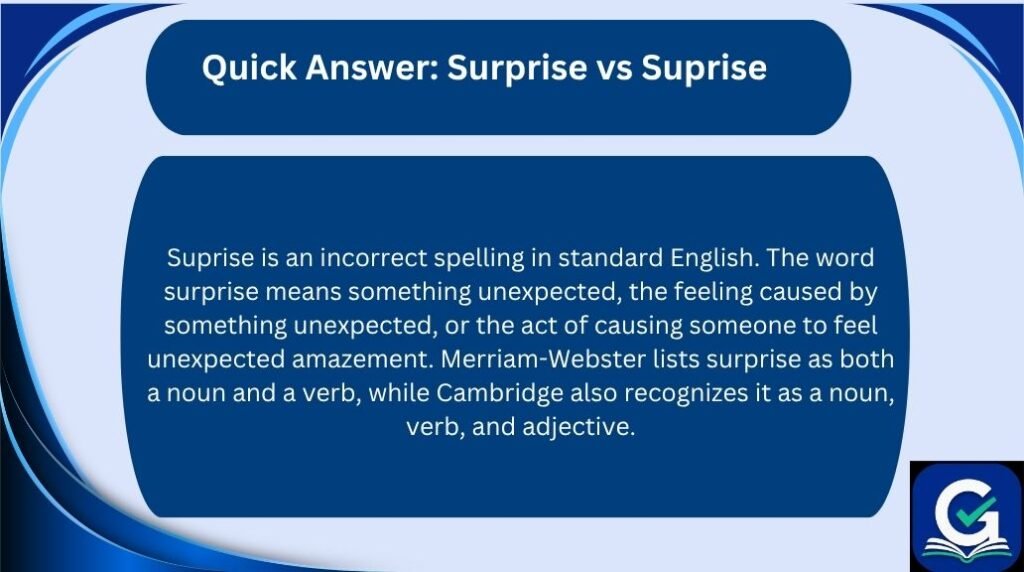
The correct spelling is surprise. ✅
Suprise is an incorrect spelling in standard English. The word surprise means something unexpected, the feeling caused by something unexpected, or the act of causing someone to feel unexpected amazement. Merriam-Webster lists surprise as both a noun and a verb, while Cambridge also recognizes it as a noun, verb, and adjective.
- ✅ Correct: surprise
- ❌ Incorrect: suprise
- Example: The birthday party was a complete surprise.
If you are choosing between surprise vs suprise, always use surprise in standard English.
Understanding the Basics of Surprise vs Suprise
The difference between these two forms is not a difference in meaning. Instead, it is a difference between the standard spelling and a misspelling.
The correct word contains two r letters:
s-u-r-p-r-i-s-e
The incorrect form leaves out the second r:
s-u-p-r-i-s-e
That missing letter is the entire problem.
Comparison Table
| Form | Type | Meaning | Example | Correct/Incorrect |
|---|---|---|---|---|
| surprise | Noun | Something unexpected or a feeling caused by something unexpected | The gift was a surprise. | ✅ Correct |
| surprise | Verb | To cause someone to feel surprised | The news will surprise her. | ✅ Correct |
| surprise | Adjective | Unexpected or intended to be unexpected | He made a surprise visit. | ✅ Correct |
| suprise | Misspelling | No standard English meaning | The gift was a suprise. | ❌ Incorrect |
The important point is that suprise is not an alternative spelling of surprise in standard modern English.
Merriam-Webster does list surprize as a less common variant, but that is different from suprise. The standard form you should use in ordinary US English is surprise.
What Does “Surprise” Mean?
The word surprise has several closely related uses.
At its simplest, a surprise is something you did not expect.
For example:
The birthday party was a surprise.
You did not know the party was being planned. Therefore, the party was unexpected.
Cambridge Dictionary defines surprise as an unexpected event and also as the feeling caused when something unexpected happens. It also identifies surprise as a verb meaning to make someone feel surprised.
Surprise as a Noun
As a noun, surprise can refer to either an unexpected event or the emotional reaction to it.
Example 1:
The party was a surprise.
Here, surprise refers to the unexpected event.
Example 2:
She looked at me in surprise.
Here, surprise refers to her feeling or reaction.
Example 3:
To my surprise, he accepted the offer.
Here, surprise describes the speaker’s reaction to an unexpected result.
Sentence Breakdown
Consider:
To my surprise, the meeting ended early.
- To my surprise = an expression showing an unexpected reaction
- the meeting = subject
- ended = verb
- early = adverb
The spelling must be surprise, not suprise.
Surprise as a Verb
Surprise can also be a verb.
When you surprise someone, you cause that person to experience something unexpected.
For example:
I surprised my sister with a birthday cake.
The speaker did something unexpected, and the sister experienced surprise.
Other examples include:
- The results surprised everyone.
- You surprised me with your answer.
- The children surprised their teacher.
- Her sudden decision surprised her coworkers.
Merriam-Webster defines the verb surprise as, among other things, taking someone unawares or causing wonder or amazement because something is unexpected.
Surprise vs Surprised
Do not confuse surprise with surprised.
- Surprise = the noun or base verb
- Surprised = usually describes someone’s reaction
For example:
The announcement was a surprise.
But:
I was surprised by the announcement.
Both sentences are correct, but they use the word differently.
Surprise as an Adjective
Surprise can also modify another noun.
For example:
We planned a surprise party.
Here, surprise describes the type of party.
Other examples include:
- She received a surprise gift.
- He made a surprise appearance.
- The company announced a surprise change.
- They organized a surprise visit.
Cambridge’s American Dictionary entry identifies surprise as an adjective in uses such as surprise visit.
Why Is “Suprise” Incorrect?
The main reason suprise is incorrect is simple: it does not follow the standard spelling of the English word.
The correct spelling is:
S-U-R-P-R-I-S-E
A common mistake is to write:
S-U-P-R-I-S-E
The second r disappears.
This can happen because English spelling is not always perfectly predictable from pronunciation. When people say surprise, the sounds do not necessarily make every letter easy to identify.
That can lead someone to remember the general sound of the word while forgetting its exact written structure.
The Spelling Pattern
Break the correct word into parts:
sur + prise
This makes the two r letters easier to remember:
surprise
You can mentally emphasize the first part:
SUR + PRISE
Another useful visual trick is:
surPRise
The capitalized PR can remind you that the second r belongs in the word.
A Simple Memory Trick for “Surprise”
If you frequently spell surprise incorrectly, try this memory sentence:
“A real surprise has two Rs.”
The word surprise contains two r letters.
- surprise → two Rs ✅
- suprise → one R ❌
You can also remember:
SUR + PRISE = SURPRISE
The first part ends in r, and the second part begins with pr.
That gives you:
r + pr = rpr
So the middle of the word contains rpr.
Quick Visual Test
Write these side by side:
surprise
suprise
Now look between u and p.
The correct spelling has:
u-r-p
The incorrect spelling has:
u-p
That missing r is the giveaway.
Correct Meanings and Uses of “Surprise”
1. An Unexpected Event
One of the most common meanings of surprise is an unexpected event.
The announcement was a surprise.
The announcement was not expected.
Other examples:
Her visit was a pleasant surprise.
The sudden storm was an unpleasant surprise.
The team received a surprise invitation.
This use is particularly common in everyday English.
2. A Feeling of Amazement
Surprise can also describe the feeling caused by something unexpected.
He stared at the result in surprise.
The person did not expect the result, so he reacted with surprise.
Another example:
She opened the door in surprise.
Here, surprise describes her emotional response.
Merriam-Webster includes the feeling caused by something unexpected or unusual among the noun’s meanings.
3. To Cause Surprise
As a verb:
The news surprised me.
This means the news caused the speaker to feel surprised.
Notice the structure:
Subject + surprise + object
For example:
The movie surprised us.
- The movie = subject
- surprised = verb
- us = object
4. To Encounter Someone Unexpectedly
The verb can also describe finding someone unexpectedly.
I surprised my brother at the office.
Depending on context, this can mean that the speaker appeared unexpectedly and caught the brother off guard.
Cambridge includes this sense of finding or encountering someone when they are not expecting it.
Test Tip: How to Check “Surprise vs Suprise”
When you are unsure, use this three-step test:
Step 1: Look for the two Rs
Ask:
Does the word contain two r’s?
If yes, you have surprise.
Step 2: Check a dictionary
Search for the word in a trusted dictionary such as Merriam-Webster or Cambridge Dictionary.
Step 3: Look at the context
If you mean something unexpected, the standard spelling is:
surprise
For example:
What a surprise!
Never write:
What a suprise! ❌
Case Study: A Workplace Email
Imagine an employee is writing to a manager about an unexpected project result.
Incorrect Version
I was very suprise to see that the client approved the proposal.
The sentence contains the misspelling suprise.
Correct Version
I was very surprised to see that the client approved the proposal.
Notice something important here: in this sentence, the correct form is actually surprised, not surprise, because the writer needs an adjective describing the person’s reaction.
This is a useful grammar lesson.
Another Example
The client’s approval was a surprise.
Here, surprise is correct because it functions as a noun.
So:
- I was surprised. ✅
- It was a surprise. ✅
- It was a suprise. ❌
- I was suprise. ❌
Understanding the grammatical role of the word is just as important as spelling it correctly.
Grammar Rules Behind the Word
The spelling surprise is not a matter of choosing between two equally acceptable modern forms.
In standard English, surprise is the normal spelling.
Merriam-Webster gives surprise as the main dictionary form and notes surprize as a less common variant. It does not identify suprise as an alternative spelling.
Cambridge likewise uses surprise as its headword and gives its noun, verb, and adjective uses.
Therefore, if you are writing:
- a school assignment,
- an email,
- a business report,
- a résumé,
- a blog post,
- an article,
- a formal letter,
you should use surprise.
What About “Surprize”?
This is an interesting edge case.
Merriam-Webster notes surprize as a less common variant.
However, that does not make suprise correct.
The three forms are different:
| Word | Standard US English? |
|---|---|
| surprise | ✅ Yes |
| surprize | ⚠️ Less common variant |
| suprise | ❌ Misspelling |
For ordinary modern writing, surprise is the safest and most widely recognized choice.
Common Mistakes With “Surprise”
Why do people write suprise?
There are several common reasons.
1. Fast Typing
When people type quickly, they may skip a letter.
For example:
I have a suprise for you.
The writer probably knows the correct word but simply omitted the second r.
This is a typing error rather than a misunderstanding of the word’s meaning.
2. Autocorrect Limitations
Autocorrect can sometimes correct obvious errors, but it does not catch every spelling problem.
Depending on the keyboard, app, or software, suprise might remain unchanged.
That is why proofreading still matters.
3. Pronunciation
The pronunciation of surprise can make its spelling tricky.
People may remember the sound without remembering the exact sequence of letters.
English contains many words whose pronunciation does not perfectly reveal their spelling, so memorizing the written form can be helpful.
4. Lack of Familiarity
English learners may encounter the word primarily in conversation before seeing it in writing.
As a result, they may create a spelling based on how the word sounds.
The solution is simple: see the correct spelling repeatedly and practice using it.
Similar Spelling Confusions
The surprise vs suprise mistake is part of a much larger pattern in English. Many errors happen when two forms look or sound similar.
| Common Confusion | Correct Form | Incorrect Form | Main Problem |
|---|---|---|---|
| surprise vs suprise | surprise | suprise | Missing “r” |
| it’s vs its | it’s / its | Depends on meaning | Contraction vs possession |
| your vs you’re | your / you’re | Depends on meaning | Possession vs “you are” |
| their vs there | their / there | Depends on meaning | Possession vs location |
| definitely vs definately | definitely | definately | Incorrect vowel sequence |
| separate vs seperate | separate | seperate | Incorrect vowel |
| receive vs recieve | receive | recieve | “i before e” confusion |
| occurrence vs occurence | occurrence | occurence | Missing “r” |
The best approach is not simply to memorize every possible mistake. Instead, learn the correct form and practice recognizing it in real sentences.
Using “Surprise” in Different Contexts
Everyday Conversation
In casual conversation, surprise is extremely common.
Examples:
I have a surprise for you.
What a surprise!
That was a big surprise.
She surprised me yesterday.
These are natural expressions in everyday American English.
Professional Writing
Professional communication requires accurate spelling.
For example:
The sales results came as a surprise to the entire team.
Or:
We were surprised by the client’s response.
Using suprise in a professional email could make the writer appear careless, even if the mistake is minor.
A single typo does not necessarily damage credibility, but repeated spelling errors can affect how readers perceive the quality of written communication.
Creative Writing
Writers often use surprise to create emotional impact.
For example:
When Maya opened the old wooden box, she discovered a letter that would completely change her life. The contents were an unexpected surprise.
In fiction, surprise can be an important storytelling device. Authors may deliberately hide information so readers experience an unexpected revelation.
Social Media and Texting
Informal platforms are full of spelling shortcuts and typos.
You might see:
Got a suprise waiting for you!
But casual use does not make the spelling correct.
If you want your social media posts, captions, comments, or messages to look polished, use:
Got a surprise waiting for you!
Even short messages benefit from correct spelling. 📱
Why Correct Spelling Matters
You might wonder whether one missing letter really matters.
Sometimes it does.
Clarity
Correct spelling makes your meaning immediately recognizable.
When readers see:
surprise
they understand the intended word instantly.
A misspelling can briefly interrupt reading because the reader has to mentally correct it.
Professionalism
In professional communication, details matter.
A correctly spelled word shows that you took time to review your writing.
This is especially important in:
- job applications,
- business emails,
- reports,
- presentations,
- proposals,
- academic assignments.
Digital Communication
Online writing is often the first impression people have of your communication skills.
A typo such as suprise may seem insignificant, but avoiding repeated errors helps your writing appear more polished and trustworthy.
A Useful Reminder
Good writing is not only about what you say; it is also about making your words easy to trust and understand.
Special Exception: Is “Suprise” Ever Correct?
For ordinary English writing, suprise is not a correct spelling of the word meaning something unexpected.
However, there is an important distinction between a spelling mistake and a proper name.
A business, username, fictional character, product, or other name could theoretically use Suprise as a deliberate name. In that case, it would be treated as a name rather than as the standard English spelling of the word.
That does not change the grammar rule.
If you are writing the ordinary English word, use:
surprise ✅
Merriam-Webster’s entry also notes surprize as a less common variant, which is historically and lexically different from the misspelling suprise.
Surprise vs Suprise in Example Sentences
Here are several examples to make the difference completely clear.
Correct
I bought a surprise gift for my mother.
Incorrect
I bought a suprise gift for my mother.
Correct
The announcement came as a complete surprise.
Incorrect
The announcement came as a complete suprise.
Correct
The results surprised everyone.
Incorrect
The results suprised everyone.
Notice that suprised is also incorrect. The correct past-tense form is:
surprised
Correct
She was surprised by the unexpected call.
Incorrect
She was suprised by the unexpected call.
The letters need to remain in the correct order:
surprise → surprised
Common Forms of “Surprise”
Knowing related forms can make spelling easier.
| Form | Example |
|---|---|
| surprise | The news was a surprise. |
| surprises | Life is full of surprises. |
| surprised | I was surprised by the result. |
| surprising | That was a surprising decision. |
Cambridge lists surprise as the base noun and verb and recognizes related forms such as surprised and surprising.
Pay attention to the spelling family:
surprise → surprises → surprised → surprising
The root surpris- remains visible.
Quick Recap Checklist
Use this checklist whenever you are unsure about surprise vs suprise.
| Question | If Yes → Use |
|---|---|
| Am I referring to something unexpected? | surprise |
| Am I describing an unexpected event? | surprise |
| Am I using the word as a verb? | surprise |
| Am I writing a phrase such as “surprise party”? | surprise |
| Does my spelling contain two Rs? | surprise |
| Did I write “suprise” without the second R? | ❌ Correct it to surprise |
Practice Example 1
Choose the correct spelling:
The birthday party was a complete ______.
Answer: surprise ✅
Practice Example 2
Choose the correct spelling:
I want to ______ my friend with a gift.
Answer: surprise ✅
Practice Example 3
Choose the correct spelling:
She was ______ by the announcement.
Answer: surprised ✅
Remember that grammar determines the form, but the spelling of the root remains important.
A Quick Way to Remember the Difference
If you remember only one thing from this article, remember this:
Surprise has two Rs.
Write it as:
SUR + PRISE = SURPRISE
The incorrect spelling suprise drops one of those Rs.
So whenever you hesitate, pause and ask:
“Did I include both Rs?”
If the answer is yes, you are probably on the right track. 😊
FAQs
1. Is “surprise” or “suprise” correct?
Surprise is correct. Suprise is a misspelling in standard English. Use surprise when referring to something unexpected or the feeling caused by something unexpected.
2. Why do people spell “surprise” as “suprise”?
The mistake usually happens because people type quickly, forget the second r, or spell the word based on its pronunciation. It can also happen because of simple unfamiliarity with the written form.
3. Does “suprise” have a meaning?
In standard English, suprise is not the accepted spelling of surprise. If you intend to refer to something unexpected, use surprise.
4. How do you spell surprise correctly?
The correct spelling is:
S-U-R-P-R-I-S-E
A useful memory trick is: surprise has two Rs.
5. Is “surprize” correct?
Merriam-Webster lists surprize as a less common variant of surprise. However, surprise is the standard spelling you should normally use in modern US English.
6. What is the difference between “surprise” and “surprised”?
Surprise can be a noun or verb, while surprised generally describes a person’s reaction to something unexpected.
For example:
The result was a surprise.
I was surprised by the result.
Both are correct, but they perform different grammatical roles.
Conclusion
When it comes to surprise vs suprise, there is no difficult spelling debate: surprise is the correct standard form, while suprise is a misspelling. The correct word contains two r letters: s-u-r-p-r-i-s-e. It can function as a noun, verb, or adjective depending on the sentence.
You can have a surprise, surprise someone, or describe something as a surprise visit. Trusted dictionaries such as Merriam-Webster and Cambridge recognize surprise as the standard word.
The easiest way to remember the spelling is simple: “A real surprise has two Rs.” If you see suprise in your writing, add the missing r before you publish or send your message.
When in doubt, remember the two Rs—and spell it surprise. ✨

I’m Mason Reed, a grammar researcher at Gramfino, where I explore grammar rules and common English mistakes.
I turn my research into clear explanations and practical examples that readers can easily follow.
[…] situations, and easy memory tricks so you can choose the right word confidently every time. 😊 Surprise vs Suprise | An Hour vs A Hour | Crowler vs […]