Have you ever paused while writing a sentence and wondered whether you should use life vs lives? You are not alone. These two words look closely related, and they are related, but they do not always work in the same grammatical situations. The difference becomes especially important when you are talking about one person, several people, one existence, or multiple individual existences. For example, you might write, “She has a wonderful life,” but “They have wonderful lives.” The spelling changes because the noun changes from singular to plural.
There is also another interesting detail: lives can be the plural of life, but it can also be the third-person singular form of the verb live. Merriam-Webster lists life as a noun whose plural is lives, pronounced /laɪvz/.
In this guide, I’ll explain life vs lives in simple US English, show you when to use each form, point out common mistakes, and give you practical examples you can remember. Sprain vs Strain | Parties vs Partys | Passed Away vs Past Away
Quick Answer: Life vs Lives
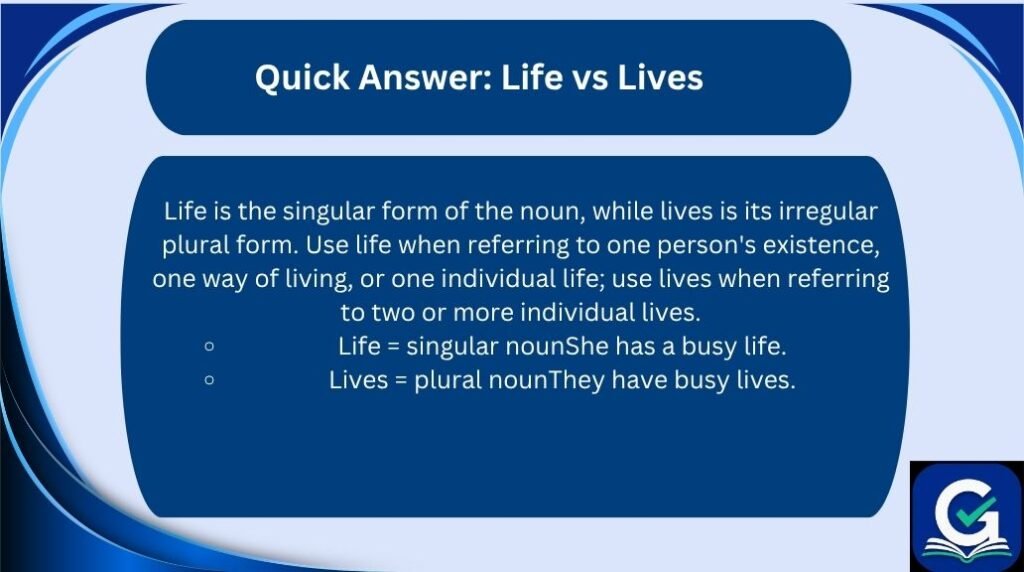
Life is the singular form of the noun, while lives is its irregular plural form. Use life when referring to one person’s existence, one way of living, or one individual life; use lives when referring to two or more individual lives.
- Life = singular noun
- She has a busy life.
- Lives = plural noun
- They have busy lives.
However, lives can also be a verb:
- She lives in Texas.
Here, lives does not mean “multiple lives.” It is the third-person singular present form of live. Merriam-Webster identifies lives as both the plural of life and the third-person singular present tense of live.
Understanding the Basics of Life vs Lives
The easiest way to understand life vs lives is to remember that life is singular and lives is generally plural when it functions as a noun.
Unlike many English nouns, life does not simply become lifes when you make it plural. Instead, it changes to lives.
This is an example of an irregular plural noun.
Comparison Table
| Form | Type | Meaning | Example | Correct/Incorrect |
|---|---|---|---|---|
| life | Singular noun | One existence or way of living | She enjoys her life. | ✅ Correct |
| lives | Plural noun | More than one existence | They value their lives. | ✅ Correct |
| lives | Verb | Third-person singular of live | He lives in Chicago. | ✅ Correct |
| lifes | Plural noun | Incorrect standard plural | They have happy lifes. | ❌ Incorrect |
| life | Singular noun | One existence | Their life is peaceful. | Depends on context |
The key point is that life and lives can have different grammatical jobs.
What Does “Life” Mean?
Life is a singular noun. It can refer to existence, the period between birth and death, a person’s experiences, a way of living, or the useful period of something.
Merriam-Webster gives several meanings for life, including the state of being alive, an individual’s physical and mental experiences, a period from birth to death, and a way or manner of living.
1. Life as One Person’s Existence
When you are talking about one person’s existence, use life.
Example:
She has lived a happy life.
Breakdown:
- She = one person
- has lived = verb phrase
- a happy life = one singular noun phrase
Because the sentence refers to one person’s life, life is correct.
2. Life as a Way of Living
Life can also describe a particular lifestyle or type of existence.
Examples:
- I enjoy city life.
- College life can be challenging.
- He wants a quieter life.
- She loves family life.
In these examples, life does not necessarily mean one person’s complete existence. It can describe a general experience or manner of living.
3. Life as a Period of Existence
You can also use life to describe the period between birth and death.
Examples:
- He spent his life helping others.
- She dedicated her life to teaching.
- Everyone deserves a meaningful life.
Again, the singular form is appropriate when the sentence focuses on one life.
4. Life Can Be Uncountable
There are situations where life is used as an uncountable noun.
For example:
Human life is valuable.
Here, life refers generally to the state or condition of being alive rather than to one particular person’s life.
Other examples include:
- Life is unpredictable.
- There is life on Earth.
- Animal life is important to the ecosystem.
Cambridge likewise identifies uses of life referring generally to living things and the state of being alive, in addition to the countable sense referring to an individual existence.
What Does “Lives” Mean?
Lives has two major grammatical uses.
1. Lives as the Plural of Life
When you are talking about two or more individual lives, use lives.
Examples:
- The accident changed many lives.
- They risked their lives to save the child.
- These stories describe the lives of ordinary people.
- The volunteers helped improve the lives of local families.
Notice the difference:
She changed my life.
One life is being discussed.
She changed our lives.
More than one person’s life is being discussed.
Merriam-Webster explicitly gives lives as the plural of life, including examples involving multiple people.
2. Lives as a Verb
This is where life vs lives can become confusing.
In:
He lives in Boston.
Lives is not a plural noun.
It is a verb.
The base verb is live:
- I live
- You live
- We live
- They live
- He lives
- She lives
- It lives
Merriam-Webster lists lives as the third-person singular present form of live.
Examples
- She lives with her parents.
- My brother lives nearby.
- The cat lives indoors.
- He lives a peaceful life.
In the final example, notice that both words appear:
He lives a peaceful life.
Here:
- lives = verb
- life = singular noun
That distinction is extremely useful when understanding life vs lives.
Life vs Lives: The Most Important Grammar Rule
The basic rule is simple:
Use “life” for one individual life and “lives” for multiple individual lives.
Singular
My life is changing.
There is one speaker and one life.
Plural
Our lives are changing.
There are multiple people and therefore multiple individual lives.
Compare these sentences:
- I want to improve my life.
- We want to improve our lives.
- She changed his life.
- They changed their lives.
The possessive word can help you identify whether the noun should be singular or plural.
Common Pattern
One person → life
Her life is busy.
Several people → lives
Their lives are busy.
Why Is the Plural “Lives” Instead of “Lifes”?
This is one of the most common questions about life vs lives.
English has several irregular plural patterns. For words ending in -fe, the plural sometimes changes to -ves.
For example:
- life → lives
- wife → wives
- knife → knives
However, English spelling is not completely predictable, so you should not assume every word ending in -f or -fe follows this pattern.
For life, the standard plural is definitely lives. Major dictionaries, including Merriam-Webster and Oxford, list the plural as lives.
Therefore:
❌ lifes
✅ lives
Example
Incorrect:
The book tells the story of several lifes.
Correct:
The book tells the story of several lives.
Pronunciation Difference
Pronunciation is another helpful clue.
Life
Life is pronounced approximately:
/laɪf/
The ending sounds like f.
Lives as a noun
The plural lives is pronounced approximately:
/laɪvz/
The ending sounds like vz.
Lives as a verb
The verb lives has the same pronunciation:
/laɪvz/
So:
- life → /laɪf/
- lives → /laɪvz/
This pronunciation difference can help you notice the plural form when speaking.
Correct Meanings and Uses
Life After Possessive Words
Use life when one person has one life.
Examples:
- my life
- your life
- his life
- her life
- its life
Use lives when several people each have a life.
Examples:
- our lives
- your lives
- their lives
Compare
I want to make my life better.
One person’s life.
We want to make our lives better.
Multiple people’s lives.
This is one of the easiest ways to understand life vs lives.
Life After “A” or “One”
Because a and one indicate singularity, use life.
Correct:
She has a wonderful life.
Correct:
He lived one extraordinary life.
Incorrect:
She has a wonderful lives.
The plural form cannot normally follow the singular article a.
Lives After “Many,” “Several,” and “Their”
Plural words usually require lives when referring to individual existences.
Examples:
- many lives
- several lives
- their lives
- our lives
- countless lives
For example:
The charity has improved many lives.
Here, many tells us that more than one life is involved.
Test Tip: The “One or More?” Test
When you are unsure about life vs lives, ask:
Am I talking about one individual life or more than one?
If the answer is one, choose life.
If the answer is more than one, choose lives.
Try It
The decision changed her _____.
One person’s existence?
Yes.
✅ life
The decision changed their _____.
More than one person’s existence?
Yes.
✅ lives
This quick test works in many everyday situations.
Life vs Lives in Real-Life Communication
Imagine a manager writing an email after a difficult workplace incident.
Incorrect
The safety changes will protect our lifes.
The plural noun is spelled incorrectly.
Correct
The safety changes will protect our lives.
Here, the manager is referring to the lives of multiple employees.
Another example:
This experience changed my life.
One person’s experience changed one person’s life.
But:
This experience changed our lives.
The experience affected multiple people.
This tiny spelling difference can completely change the grammatical number of the noun.
Case Study: A Workplace Email
Imagine a company has completed a major safety project.
An employee writes:
The new procedures will make our lifes safer.
The intended meaning is clear, but lifes is not the standard plural of life.
The corrected version is:
The new procedures will make our lives safer.
Why?
- Our refers to multiple people.
- The sentence discusses those people’s individual existences.
- Therefore, the plural noun lives is required.
Now consider:
The new procedure will make his life safer.
This refers to one person, so life is correct.
Practical Lesson
Before submitting an email, report, or workplace document, check whether the noun refers to one individual or multiple individuals.
Grammar Rules Behind Life vs Lives
The main grammatical issue is number.
English nouns can be:
- singular
- plural
Life is singular.
Lives is the irregular plural.
The spelling changes rather than simply adding -s.
According to Merriam-Webster, life has the plural form lives. Oxford also lists lives as the plural form of life.
Singular Example
A person’s life can change quickly.
Plural Example
People’s lives can change quickly.
Notice another useful pattern:
person’s life = one person’s individual existence
people’s lives = multiple people’s individual existences
A Second Grammar Issue: “Lives” as a Verb
Do not assume every occurrence of lives is a plural noun.
Consider:
Maria lives in Seattle.
Here, lives is the verb.
The subject is Maria, which is singular.
The base form is:
live
With a third-person singular subject in the present tense, it becomes:
lives
Merriam-Webster gives lives as the third-person singular present form of live.
Compare
Maria lives in Seattle.
Lives = verb.
Maria has two lives in the story.
Lives = plural noun.
Context determines the grammatical function.
Common Mistakes With Life vs Lives
Many mistakes involving these words are not caused by complicated grammar. They often happen because people type quickly or rely heavily on autocorrect.
1. Writing “Lifes”
❌ They risked their lifes.
✅ They risked their lives.
The standard plural is lives, not lifes.
2. Using “Lives” for One Person
❌ He wants to improve his lives.
✅ He wants to improve his life.
One person’s individual existence is being discussed.
3. Confusing the Noun and Verb
Consider:
She lives a happy life.
There are two related words, but they have different jobs:
- lives = verb
- life = noun
Replacing one with the other can make a sentence grammatically incorrect.
Why Do These Mistakes Happen?
Fast Typing
When people type quickly, they may automatically add -s and create lifes. Because many English plurals simply add -s, this error is understandable.
Autocorrect
Autocorrect can sometimes suggest an unexpected word, particularly when a sentence is typed rapidly.
Lack of Knowledge
Some writers simply have not learned that life has an irregular plural.
The solution is simple: remember life → lives.
Similar Grammar Confusions
Learning life vs lives is easier when you understand other commonly confused English forms.
| Confusion | Correct Form | Main Difference | Example |
|---|---|---|---|
| life / lives | life / lives | Singular vs. plural | my life / our lives |
| it’s / its | it’s / its | Contraction vs. possessive | It’s cold / its color |
| your / you’re | your / you’re | Possessive vs. contraction | your book / you’re ready |
| they’re / their / there | three different forms | Verb contraction, possession, place | They’re here with their bags. |
| who’s / whose | contraction vs. possessive | Who is vs. possession | Who’s calling? Whose phone is this? |
| then / than | time/order vs. comparison | Then we left / taller than me | |
| affect / effect | usually verb vs. noun | It affected me / the effect was strong |
The broader lesson is that English often contains words that look or sound similar but perform different grammatical functions.
Life vs Lives in Everyday Conversation
In casual speech, these words appear constantly.
Talking About Yourself
- Life is good.
- My life is busy.
- I want a better life.
- I love my life.
Talking About Several People
- Our lives are very different.
- Their lives changed after college.
- The event touched many lives.
- Social media affects our lives.
These sentences are simple, but choosing the correct form keeps your meaning precise.
Professional Writing
In professional communication, accuracy matters.
You may encounter these words in:
- reports
- emails
- presentations
- business articles
- employee communications
- safety documents
- academic papers
Compare:
❌ The program improved the lifes of many workers.
✅ The program improved the lives of many workers.
The second version is grammatically correct and more professional.
Another Example
The policy is designed to protect employees’ lives.
Because employees refers to multiple people, lives is correct.
Creative Writing
Writers often use life and lives to express emotional or philosophical ideas.
Examples:
Life moved forward despite everything.
Their lives were forever connected.
One decision changed her life.
A single moment changed countless lives.
In creative writing, the distinction can be especially powerful because singular and plural forms can emphasize an individual experience versus a shared experience.
Social Media and Texting
On social media, people often type quickly, so mistakes such as lifes can appear.
For example:
❌ So grateful for the people who make our lifes better.
✅ So grateful for the people who make our lives better.
Even in informal writing, lives remains the standard plural.
If you want your social media captions to look polished, remember this simple spelling rule:
Life becomes lives, not lifes.
Why Life vs Lives Matters
At first glance, the difference between life and lives may seem tiny. But small grammatical details can make writing clearer.
1. Clarity in Communication
Compare:
This changed my life.
with:
This changed our lives.
The first sentence focuses on one person’s experience. The second focuses on multiple people.
That difference matters.
2. Professionalism
Correct spelling and grammar create a stronger impression in:
- resumes
- emails
- business documents
- academic writing
- websites
- professional posts
A small spelling error such as lifes can make otherwise polished writing look careless.
3. Digital Communication
People read enormous amounts of online content every day. Clear writing helps readers understand your message quickly.
Correct grammar reduces distractions and makes your writing easier to trust.
4. Meaning Matters
A useful reminder is:
Small spelling changes can carry big grammatical meanings.
When you choose life or lives, you are also telling readers whether you mean one individual existence or multiple individual existences.
Special Exceptions and Edge Cases
There is no standard English situation where lifes is used as the ordinary plural of life. The normal plural is lives.
However, Lives can appear in another grammatical role because it is also the verb form of live.
For example:
She lives in Denver.
Here, lives is a verb.
There can also be specialized names, titles, usernames, product names, or brand names that intentionally use unusual spellings. Such proper names do not change the standard grammar rule.
So, in ordinary English writing:
- life = singular noun
- lives = plural noun
- lives = third-person singular verb
- lifes = not the standard plural of life
Life vs Lives: Quick Recap Checklist
Use this checklist whenever you are unsure.
| Question | If Yes → Use |
|---|---|
| Am I talking about one individual existence? | life |
| Am I talking about multiple individual existences? | lives |
| Does the word follow “a” or “one”? | life |
| Does it follow “many” or “several”? | lives |
| Does it follow “my,” referring to one person’s existence? | life |
| Does it follow “our” or “their,” referring to multiple people’s existences? | lives |
| Is the word the present-tense verb for he/she/it? | lives |
| Am I tempted to write “lifes” as the plural? | Use lives instead |
Practice Example 1
I want to make my _____ better.
Answer: life
Why? One person’s life is being discussed.
Practice Example 2
We want to make our _____ better.
Answer: lives
Why? Multiple people have multiple individual lives.
Practice Example 3
She _____ in Los Angeles.
Answer: lives
Why? Here, lives is the third-person singular verb form of live.
Life vs Lives: More Examples
Singular “Life”
- Life can be unpredictable.
- She enjoys her life.
- He dedicated his life to science.
- I want to live a meaningful life.
- Everyone deserves a good life.
Plural “Lives”
- Their lives changed dramatically.
- The program saved many lives.
- Our lives are connected.
- The story follows three different lives.
- Technology has changed our lives.
“Lives” as a Verb
- He lives in New York.
- She lives with her sister.
- The bird lives in the forest.
- My cousin lives nearby.
- The character lives alone.
FAQs
1. Is “lives” the plural of “life”?
Yes. Lives is the standard plural form of life. For example, one life becomes two lives. Merriam-Webster and Oxford both list lives as the plural form.
2. Is “lifes” grammatically correct?
No. Lifes is not the standard plural form of life. The correct plural is lives.
Correct:
Many lives were affected.
Incorrect:
Many lifes were affected.
3. What is the difference between “life” and “lives”?
Life is the singular noun, while lives is its plural form. Lives can also be the third-person singular present-tense form of the verb live.
4. Is “lives” always a plural noun?
No. Lives can be either a plural noun or a verb.
Plural noun:
Many lives were saved.
Verb:
She lives in Miami.
Context tells you which grammatical role lives has.
5. Which is correct: “our life” or “our lives”?
Usually, our lives is correct when you mean the individual lives of multiple people.
Example:
Our lives have changed.
However, our life can be correct when a group is treated as having one shared or collective way of living.
For example:
Our life together has been wonderful.
Here, our life together describes the shared life of a couple or group.
6. How do you remember the spelling of “lives”?
Use this simple memory trick:
One life → two lives.
Do not add -s directly to life. Instead, the spelling changes:
life → lives
Conclusion
Understanding life vs lives is easier once you remember one basic rule: life is the singular noun, while lives is the irregular plural. Use life when referring to one individual existence or one person’s way of living, and use lives when referring to multiple individual existences.
For example, “She changed my life” refers to one life, while “She changed our lives” refers to several lives. Also remember that lives can function as a verb, as in “He lives in Chicago.” Standard dictionaries confirm that life has the plural lives, not lifes.
So, whenever you hesitate, ask yourself: Am I talking about one life, several lives, or the verb “lives”? Once you answer that question, the correct form becomes much easier to choose.

I’m Amelia Parker, an English language writer at Gramfino, focused on making difficult language topics easier to understand.
I write about grammar, vocabulary, word usage, and everyday English to help readers communicate clearly.
[…] practical examples and memory tricks so you never have to second-guess this spelling again. 🧠✨ Life vs Lives | Sprain vs Strain | Parties vs […]
[…] accurately in conversation, writing, menus, reviews, or social media. 🍺 Genius vs Genious | Life vs Lives | Sprain vs […]