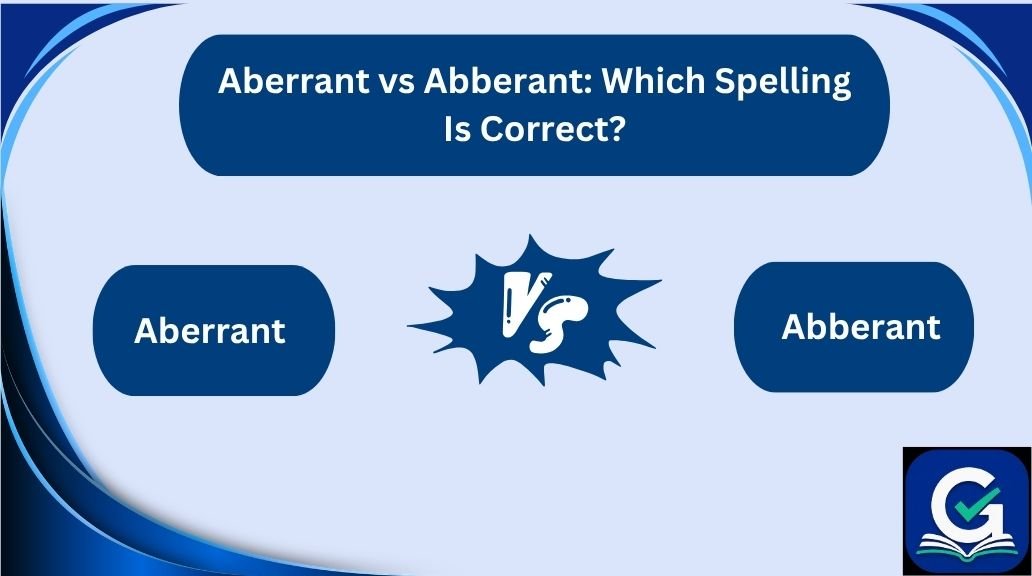
Have you ever typed a word that looks perfectly familiar, only to wonder whether one extra letter belongs there? Aberrant vs abberant is one of those spelling questions that can cause confusion because both forms look believable at first glance. The problem usually comes from the pronunciation of the word and from the way English often doubles consonants in other words. However, there is a clear answer: aberrant is the correct spelling, while abberant is a misspelling.
The word aberrant is commonly used when something differs from what is normal, expected, usual, or accepted. You may encounter it in academic writing, science, medicine, workplace communication, journalism, and everyday discussions about unusual behavior or results. Merriam-Webster defines aberrant as something that is out of the ordinary or departs from an accepted standard.
If you are unsure which spelling to use, this guide will make the distinction easy to remember. Let’s examine aberrant vs abberant, their meanings, examples, grammar rules, common mistakes, and practical usage. Across vs Accros | Smoky vs Smokey | Doughnut vs Donut
Quick Answer: Aberrant vs Abberant
Aberrant is the correct spelling. Abberant is an incorrect spelling and should not be used in standard English.
Aberrant is an adjective that describes something unusual, abnormal, irregular, or different from what is normally expected. For example: “The scientist noticed an aberrant result in the experiment.” Merriam-Webster recognizes aberrant as a standard English word.
Quick rule:
✅ aberrant = correct
❌ abberant = incorrect
Understanding the Basics of Aberrant vs Abberant
The difference between these two forms is primarily a matter of spelling. They may look nearly identical, but only one belongs in standard English.
| Form | Type | Meaning | Example | Correct/Incorrect |
|---|---|---|---|---|
| aberrant | Adjective | Unusual, abnormal, or outside the expected pattern | The test produced an aberrant result. | ✅ Correct |
| abberant | Intended as an adjective | No standard meaning in this spelling | The report contained an abberant result. | ❌ Incorrect |
The correct word contains one b followed by two r’s:
a-b-e-r-r-a-n-t
A common mistake is to change the spelling into:
a-b-b-e-r-a-n-t
That form, abberant, is not the standard spelling of the word.
Why Does “Aberrant” Look Unusual?
English spelling can be difficult because pronunciation does not always tell us exactly how a word should be written. Aberrant contains the sequence -err-, which can make writers hesitate.
The word is historically connected to the idea of wandering or going astray. Modern dictionaries define it in terms of deviation from what is normal, usual, or accepted.
A useful visual reminder is:
ab + err + ant = aberrant
Think of the middle as ERR, which can remind you of something going wrong or departing from the expected pattern.
What Does Aberrant Mean?
Aberrant is an adjective meaning unusual, abnormal, irregular, or different from what is normally expected.
Merriam-Webster gives aberrant senses related to being out of the ordinary and departing from an accepted standard of normality.
Here are several examples:
- The researcher discovered an aberrant pattern in the data.
- The doctor investigated the aberrant result.
- The animal displayed aberrant behavior.
- The unusually high temperature was considered aberrant.
- The company investigated an aberrant transaction.
In each example, the word describes something that does not fit the usual pattern.
Aberrant as an Adjective
Most commonly, aberrant works as an adjective before a noun.
For example:
The laboratory detected an aberrant cell.
Here:
- aberrant = adjective
- cell = noun
The adjective tells us that the cell differs from what would normally be expected.
You can also use aberrant after a linking verb:
The behavior was aberrant.
Here, aberrant describes the subject, behavior.
Aberrant Meaning in Simple English
If the word aberrant seems complicated, replace it mentally with one of these simpler words depending on context:
- unusual
- abnormal
- irregular
- atypical
- unexpected
- unconventional
- different
- outside the norm
For example:
The student’s answer was aberrant.
A simpler version might be:
The student’s answer was unusual.
The exact replacement depends on context, but the central idea remains the same: something has moved away from what is considered normal or expected.
Merriam-Webster’s thesaurus includes words such as unusual, abnormal, atypical, and anomalous among related terms.
Common Uses of Aberrant
The word aberrant appears in several areas of writing. It is particularly useful when you want to describe something that differs from a recognized pattern.
Aberrant Behavior
One common phrase is aberrant behavior.
Example:
The manager became concerned about the employee’s aberrant behavior.
Here, the word suggests that the behavior is unusual or outside the expected pattern.
Aberrant Results
The word is also common when discussing research, tests, and measurements.
The scientist repeated the experiment after observing an aberrant result.
The result was different enough from the expected pattern to require additional attention.
Aberrant Cells
In scientific and medical contexts, aberrant can describe cells or biological characteristics that differ from normal patterns.
The researchers examined the tissue for aberrant cells.
The specific meaning depends on the scientific context, but the general concept is deviation from an expected state.
Aberrant Patterns
The word can also describe data, trends, or patterns.
The analyst noticed an aberrant pattern in the monthly figures.
The pattern did not behave as expected.
Aberrant vs Abberant in a Sentence
Seeing the words in sentences makes the difference easier to remember.
Correct Examples
The researcher identified an aberrant pattern in the data.
His reaction was considered aberrant by the rest of the team.
The machine produced an aberrant reading during the test.
The unusual result appeared to be an aberrant occurrence.
The report discusses several examples of aberrant behavior.
Incorrect Examples
The researcher identified an abberant pattern in the data.
His reaction was considered abberant.
The machine produced an abberant reading.
In these examples, abberant should be replaced with aberrant.
Why Is Aberrant the Correct Spelling?
The correct spelling is established in standard English dictionaries. Merriam-Webster has an entry for aberrant, and its thesaurus identifies it as an adjective meaning unusual or departing from an accepted standard.
The spelling is:
A B E R R A N T
Notice the important part:
ERR
There is not an additional b after the first a.
Therefore:
- aberrant → A-B-E-R-R-A-N-T ✅
- abberant → A-B-B-E-R-A-N-T ❌
The incorrect version probably feels natural because English contains many words with doubled consonants. However, spelling patterns from other words should not be automatically transferred to aberrant.
The Role of “Err” in Aberrant
One useful memory trick comes from the middle of the word.
Aberrant contains:
ERR
The sequence appears as:
ab + err + ant
This can serve as a spelling clue.
The word err itself means to make a mistake or be incorrect. Although aberrant has its own history and meaning, the visual connection can help you remember the spelling.
Think:
ab + ERR + ant = aberrant
This is not a grammar rule that creates the spelling. It is simply a practical memory aid.
Is Abberant Ever Correct?
In standard English usage, abberant is not the correct spelling of the adjective you are looking for.
If you intend to describe something unusual, abnormal, or outside the normal pattern, use:
aberrant
Do not use:
abberant
A spelling checker may sometimes identify abberant as an error, but you should not rely entirely on automatic correction. Learning the correct spelling is especially important in formal documents, academic papers, professional reports, and published content.
Grammar Rules for Aberrant
The grammar itself is straightforward because aberrant is normally used as an adjective.
Rule 1: Use Aberrant to Modify a Noun
You can place aberrant directly before a noun.
The doctor noticed an aberrant symptom.
The study found an aberrant pattern.
The team investigated an aberrant result.
In these sentences, aberrant describes the noun that follows it.
Rule 2: Use Aberrant After a Linking Verb
You can also use it after verbs such as be, seem, or appear.
The result was aberrant.
The behavior seemed aberrant.
The pattern appeared aberrant.
Rule 3: Do Not Add an Extra B
The spelling remains:
aberrant
Do not write:
abberant
The doubled consonant occurs with r, not b.
Aberrant as a Noun
Although aberrant is most familiar as an adjective, dictionaries also recognize a noun use.
Merriam-Webster’s thesaurus lists aberrant as a noun with a meaning related to a person or thing that deviates from the norm.
For example:
The researcher studied several aberrants within the population.
This noun use is less common in ordinary conversation than the adjective.
For most everyday and professional writing, you will probably encounter aberrant in expressions such as:
- aberrant behavior
- aberrant results
- aberrant cells
- aberrant patterns
- aberrant activity
Aberrant vs Aberration
Another useful distinction is between aberrant and aberration.
Aberrant
Aberrant is generally an adjective.
The behavior was aberrant.
It describes something unusual or outside the expected norm.
Aberration
Aberration is a noun.
The behavior was an aberration.
It refers to an instance or condition of deviation from what is normal or expected.
Merriam-Webster defines aberration as the fact or an instance of deviating from a normal state or standard, among its meanings.
Compare:
The unusual result was aberrant.
The unusual result was an aberration.
Both can communicate a similar idea, but they have different grammatical roles.
Aberrant vs Abberant: A Workplace Case Study
Imagine a data analyst reviewing a company’s monthly sales report.
Most months show sales between $90,000 and $110,000. One month suddenly shows sales of $250,000.
The analyst sends this message:
“The June figure appears aberrant compared with the surrounding monthly results. I recommend reviewing the underlying transactions before we finalize the report.”
This is appropriate professional usage.
The analyst could also write:
“The June result appears to be an aberration.”
Both aberrant and aberration can work, but they serve different grammatical purposes.
Now imagine the analyst writes:
“The June figure appears abberant.”
The meaning may still be understandable, but the spelling is incorrect. In a professional report, that error could make the writer appear less careful.
This illustrates why spelling accuracy matters even when readers can understand what you intended.
Aberrant in Everyday Conversation
You can use aberrant in everyday English, but it has a relatively formal tone.
For example:
His behavior was unusual.
sounds more conversational than:
His behavior was aberrant.
The second sentence is perfectly valid, but it sounds more formal or analytical.
If you are talking casually with friends, words such as weird, strange, unusual, or odd may sound more natural.
If you are writing an article, report, research paper, or professional document, aberrant may be a more precise choice when the context calls for it.
Aberrant in Professional Writing
Professional writing often requires precise vocabulary.
Consider these examples:
The audit revealed an aberrant transaction.
The software detected an aberrant pattern.
The laboratory reported an aberrant result.
The committee investigated the employee’s aberrant conduct.
The word can make the writing more specific because it communicates that something differs from an expected standard or pattern.
However, don’t use aberrant simply to make writing sound sophisticated. If unusual communicates the idea more clearly, it may be the better choice.
Good writing is not about choosing the most complicated word. It is about choosing the most accurate word.
Aberrant in Academic and Scientific Writing
The term is especially useful in academic and scientific contexts because researchers frequently compare observations with expected patterns.
For example:
The experiment produced an aberrant response.
Researchers identified an aberrant growth pattern.
The model generated an aberrant prediction.
The researchers investigated several aberrant observations.
In these contexts, aberrant often has a technical or analytical meaning rather than simply meaning “strange.”
It can indicate that an observation differs from an established baseline, expected behavior, or normal pattern.
Aberrant in Creative Writing
Creative writers can also use aberrant, especially when they want a formal, serious, or analytical tone.
For example:
The detective noticed an aberrant detail that everyone else had ignored.
Or:
Something aberrant had entered the quiet rhythm of the town.
The word can create a sense that something is outside the established order.
However, writers should consider their audience. If the tone is casual or aimed at young readers, unusual or strange may be easier to understand.
Aberrant in Social Media and Texting
On social media, people often favor short and familiar words.
You might see:
“That was such a weird reaction.”
rather than:
“That was an aberrant reaction.”
Still, aberrant can appear in social posts when someone is discussing science, politics, statistics, technology, psychology, or another analytical subject.
The important point is that the spelling does not change depending on the platform.
Whether you write an academic paper or a short post, the correct spelling remains:
aberrant
Common Mistakes With Aberrant
Why do people write abberant?
Several factors can contribute to the error.
1. Fast Typing
When typing quickly, people may add an extra letter without noticing.
Because aberrant contains a double r, it is easy to accidentally move the doubled consonant or create an extra b.
2. Pronunciation
Pronunciation does not always reveal the exact spelling.
When a word is heard rather than seen, writers may have difficulty determining which consonants should be doubled.
3. Pattern Confusion
English contains many words with doubled consonants.
This can lead writers to assume that aberrant should contain bb.
It does not.
4. Autocorrect
Autocorrect can sometimes reinforce a spelling mistake, particularly when a misspelled form is not automatically corrected.
5. Lack of Familiarity
Because aberrant is more formal than everyday words such as unusual or strange, some people encounter it less often.
The less frequently you see a word, the easier it is to forget its exact spelling.
Similar Spelling Confusions
The aberrant vs abberant problem belongs to a larger group of common English spelling and grammar confusions.
| Confusion | Correct Form | Incorrect Form | Main Issue |
|---|---|---|---|
| aberrant vs abberant | aberrant | abberant | Spelling |
| it’s vs its | it’s / its | — | Contraction vs possession |
| your vs you’re | your / you’re | — | Possessive vs contraction |
| their vs they’re | their / they’re | — | Possessive vs contraction |
| affect vs effect | affect / effect | — | Different grammatical roles |
| then vs than | then / than | — | Time vs comparison |
| separate vs seperate | separate | seperate | Spelling |
| definitely vs definately | definitely | definately | Spelling |
| receive vs recieve | receive | recieve | Spelling |
These errors are common because English spelling does not always follow simple patterns.
The best solution is not merely to memorize isolated corrections. It is to learn the word in context and notice its spelling whenever you encounter it.
Test Tip: How to Remember Aberrant
Here is a simple test.
When you want to write the word, pause and ask:
“Does the word contain ERR?”
If yes, write:
ab + err + ant
That gives you:
aberrant
Another memory trick is:
Aberrant has two R’s, not two B’s.
So remember:
RR = aberrant
BB = wrong
This quick visual check can prevent the most common spelling mistake.
Why Aberrant vs Abberant Matters
At first, a single misplaced letter may seem unimportant. After all, most readers can probably understand what you mean.
However, accurate spelling matters for several reasons.
Clarity
Correct spelling makes your meaning easier to process.
Readers should not have to stop and wonder whether a word is intentional, technical, or simply misspelled.
Professionalism
Spelling errors can affect how readers judge professional writing.
A typo in an informal text may not matter much. The same typo in a report, résumé, research paper, or business proposal can create a different impression.
Searchability
Correct spelling also matters in digital communication.
Search engines, databases, workplace systems, and digital archives depend heavily on written language. A misspelled word may make information harder to find or classify.
Credibility
Accurate writing helps establish trust.
As a simple reminder:
“Clear writing begins with accurate words.”
When readers see careful spelling, they can focus on your ideas instead of your errors.
A Note on Word Forms Related to Aberrant
Several related words can help you understand the vocabulary family.
Aberration
A noun referring to a deviation from what is normal or expected.
The unexpected result was an aberration.
Merriam-Webster documents several senses of aberration, including deviation from a normal state and certain technical meanings.
Aberrantly
An adverb derived from aberrant.
The system was behaving aberrantly.
Aberrancy
A noun referring to the state or quality of being aberrant. Merriam-Webster defines aberrancy as the quality or state of being aberrant or a related instance of deviation.
These forms all connect to the same general concept of deviation or departure from a normal pattern.
Special Exception: Is “Abberant” a Different Word?
For standard English writing, abberant should not be treated as an alternative spelling of aberrant.
If you see abberant somewhere, it is most likely a spelling error for aberrant.
There can always be unusual uses of strings of letters in proper names, usernames, product names, fictional works, or other nonstandard contexts. However, such an isolated use does not make abberant a standard English spelling of the adjective.
For normal writing, use:
aberrant
Quick Recap Checklist
Use this checklist whenever you are unsure.
| Question | If Yes → Use |
|---|---|
| Do you mean unusual or abnormal? | aberrant |
| Are you describing something outside the normal pattern? | aberrant |
| Are you describing unusual behavior? | aberrant |
| Are you describing an unexpected result? | aberrant |
| Are you tempted to spell it with “bb”? | Stop and use aberrant |
| Are you writing the standard English adjective? | aberrant |
Practice Example 1
Choose the correct spelling:
The scientist noticed an ______ pattern in the data.
Answer:
aberrant
Practice Example 2
Choose the correct spelling:
The patient’s test showed an ______ result.
Answer:
aberrant
Practice Example 3
Choose the correct spelling:
The manager investigated the employee’s ______ behavior.
Answer:
aberrant
If you consistently remember ERR, the spelling becomes much easier.
Aberrant vs Abberant: Easy Memory Trick
Here is the shortest way to remember the answer:
Think “ERR”
The correct spelling contains:
AB + ERR + ANT
So:
ABERRANT ✅
Not:
ABBERANT ❌
You can also connect aberrant with its related noun aberration. Both begin with aber-, not abber-.
That shared beginning can help reinforce the correct spelling.
When Should You Use Aberrant?
Use aberrant when the context involves a meaningful departure from a normal, expected, accepted, or established pattern.
Good examples include:
- aberrant behavior
- aberrant activity
- aberrant cells
- aberrant data
- aberrant findings
- aberrant growth
- aberrant patterns
- aberrant results
- aberrant responses
- aberrant readings
You do not need to use the word every time something is slightly different.
For example, if your friend orders vanilla ice cream instead of chocolate, calling the choice aberrant would sound unnecessarily formal.
But if a scientific experiment produces a result dramatically different from its expected pattern, aberrant may be an appropriate word.
The best vocabulary choice always depends on context.
FAQs About Aberrant vs Abberant
1. Is “aberrant” or “abberant” correct?
Aberrant is correct. Abberant is a misspelling when you intend to use the standard English word meaning unusual, abnormal, or outside the expected norm. Merriam-Webster recognizes aberrant as the standard form.
2. What does aberrant mean?
Aberrant means unusual, abnormal, atypical, or different from what is normally expected. It can describe behavior, results, patterns, biological features, or other things that depart from a recognized standard.
3. How do you spell aberrant?
The correct spelling is:
A-B-E-R-R-A-N-T
A helpful way to remember it is ab + err + ant.
4. Is abberant a word?
Abberant is not the standard spelling of the adjective aberrant. In normal English writing, use aberrant instead.
5. What is the difference between aberrant and aberration?
Aberrant is primarily an adjective describing something that deviates from what is normal or expected. Aberration is a noun referring to an instance or condition of deviation.
For example:
The behavior was aberrant.
The behavior was an aberration.
6. What is an easy way to remember aberrant?
Remember that aberrant contains “ERR.”
Think:
AB + ERR + ANT = ABERRANT
The correct word has two r’s, not two b’s.
Conclusion
The spelling question aberrant vs abberant has a simple answer: aberrant is correct, while abberant is incorrect in standard English. The correct word is an adjective that describes something unusual, abnormal, atypical, or different from what is normally expected. It can be used in everyday explanations, professional writing, academic research, scientific discussions, and many other contexts.
The easiest way to remember the spelling is to focus on the middle: ERR. Think of the word as ab + err + ant, giving you aberrant. Avoid adding an extra b, even though English spelling patterns can sometimes make that mistake feel natural.
When accuracy matters, choose the established spelling every time:
Aberrant = correct.
Abberant = incorrect.
Remember the double R, and you will never need to second-guess this spelling again.

I’m Ethan Carter, a grammar writer at Gramfino, where I explain English grammar in a simple and practical way.
I enjoy helping readers understand sentence structure, grammar rules, and common writing mistakes.