Have you ever typed a sentence and suddenly stopped because you were unsure whether to write “all of a sudden” or “all of the sudden”? If so, you are not alone. The question of all of a sudden vs all of the sudden is a common English usage confusion because both expressions sound almost identical in everyday conversation.
When people speak quickly, the short word “a” can be difficult to hear, which may make the less-standard version seem correct.
The standard expression in American English is “all of a sudden.” It means that something happens unexpectedly, abruptly, or without warning. The alternative “all of the sudden” is heard in informal speech and some regional varieties, but it is generally not preferred in standard edited English.
Understanding all of a sudden vs all of the sudden is useful for students, professionals, bloggers, content writers, and anyone who wants to improve their English accuracy. In this article, we will explain the difference in simple language, examine the grammar behind the expression, explore common mistakes, and provide practical examples. Wiener vs Weiner | Aide vs Aid | High School vs Highschool
Quick Answer: All of a Sudden vs All of the Sudden
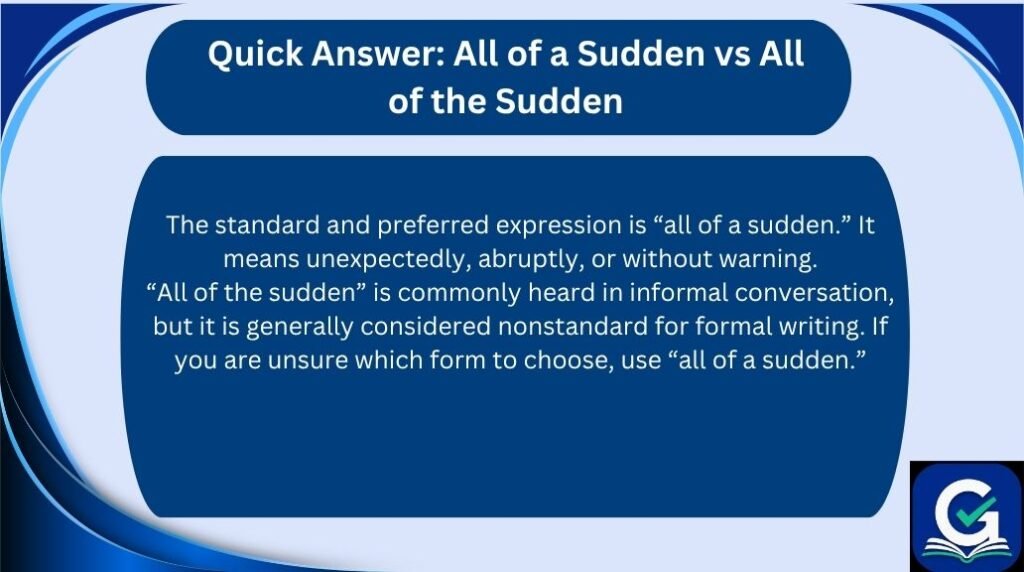
The standard and preferred expression is “all of a sudden.” It means unexpectedly, abruptly, or without warning.
“All of the sudden” is commonly heard in informal conversation, but it is generally considered nonstandard for formal writing. If you are unsure which form to choose, use “all of a sudden.”
Example:
All of a sudden, the lights went out.
This means the lights went out unexpectedly.
Understanding the Basics of All of a Sudden vs All of the Sudden
The central difference between these two expressions is the article used before the word “sudden.”
The standard form is:
All of a sudden
The less-standard variant is:
All of the sudden
The two expressions are usually intended to communicate the same idea, but they do not have the same status in standard written English.
Comparison Table
| Form | Type | Meaning | Example | Correct/Incorrect |
|---|---|---|---|---|
| All of a sudden | Idiomatic adverbial phrase | Unexpectedly or abruptly | All of a sudden, it started raining. | ✅ Standard |
| All of the sudden | Informal/nonstandard variant | Intended to mean unexpectedly | All of the sudden, he left. | ⚠️ Avoid in formal writing |
When discussing all of a sudden vs all of the sudden, remember that the first expression is the safest choice for standard American English.
What Does “All of a Sudden” Mean?
All of a sudden describes an event that occurs unexpectedly or very quickly.
For example:
All of a sudden, the dog started barking.
The sentence tells us that the barking began without warning.
Another example is:
I was walking home when, all of a sudden, it began to rain.
The rain did not gradually develop from the perspective of the speaker. It seemed to begin unexpectedly.
What Does “All of the Sudden” Mean?
In informal speech, all of the sudden is generally intended to mean the same thing as all of a sudden.
For example:
All of the sudden, the computer stopped working.
Most English speakers will understand this sentence immediately. However, because all of the sudden is not the preferred standard form, it should normally be replaced with:
All of a sudden, the computer stopped working.
Why Is “All of a Sudden” the Preferred Form?
The expression all of a sudden is an established idiom. An idiom is a group of words whose meaning is understood as a fixed expression rather than by changing each individual word.
English contains many expressions that need to be learned as complete phrases.
For example:
- by the way
- in a hurry
- at once
- on purpose
- all of a sudden
You generally cannot change individual words in a fixed expression simply because another version sounds familiar.
This is one reason the all of a sudden vs all of the sudden question can be confusing. Speakers may naturally substitute “the” for “a,” but the established standard expression uses “a.”
Correct Meanings and Uses
1. Unexpected Events
The most common use of all of a sudden is to describe something that happens unexpectedly.
All of a sudden, the door opened.
The phrase tells us that the door opened without warning.
Another example:
All of a sudden, everyone started laughing.
The laughter began unexpectedly.
2. Sudden Changes
The expression can also describe an abrupt change in a situation.
All of a sudden, the weather became cold.
The weather changed quickly.
Another example:
She was confident at first, but all of a sudden, she became nervous.
The phrase emphasizes the sudden change in her emotional state.
3. Unexpected Thoughts
All of a sudden can describe a thought, memory, or realization that appears unexpectedly.
All of a sudden, I remembered where I had put my wallet.
The speaker did not deliberately search for the memory at that exact moment. The memory came unexpectedly.
Another example:
All of a sudden, he realized that he had made a mistake.
The realization happened abruptly.
4. Sudden Physical Events
The expression works well with physical events such as sounds, movement, weather, and changes in surroundings.
Examples include:
All of a sudden, the alarm started ringing.
All of a sudden, a bird flew across the road.
The wind became stronger all of a sudden.
All of a sudden, the lights went out.
These examples demonstrate why all of a sudden vs all of the sudden is primarily a usage question rather than a difference in intended meaning.
Sentence Structure and Grammar
The phrase all of a sudden usually functions as an adverbial expression. It provides information about how or when something happens.
Consider this sentence:
All of a sudden, the phone rang.
The phrase all of a sudden modifies the event “the phone rang.” It tells the reader that the ringing happened unexpectedly.
The expression can appear at the beginning of a sentence:
All of a sudden, the children became quiet.
It can also appear near the end:
The children became quiet all of a sudden.
Both structures are acceptable.
With a Comma
When all of a sudden begins a sentence as an introductory expression, a comma is often used:
All of a sudden, the car stopped.
When it appears at the end, no comma is normally needed:
The car stopped all of a sudden.
This small punctuation rule can make your writing cleaner and easier to read.
Test Tip for Choosing the Correct Form
If you are confused about all of a sudden vs all of the sudden, replace the expression with “unexpectedly.”
For example:
All of a sudden, the baby started crying.
Try:
Unexpectedly, the baby started crying.
The basic meaning remains the same.
This is a useful test because all of a sudden is commonly used to express unexpected action.
Easy Memory Trick
Remember this pattern:
a sudden event → all of a sudden
For example:
- a sudden change
- a sudden noise
- a sudden movement
- all of a sudden
The word “a” is part of the standard expression.
Case Study: A Professional Email
Imagine that an employee is explaining why a report was submitted late.
Less-Preferred Version
All of the sudden, my computer stopped working, so I couldn’t finish the report on time.
The meaning is clear, but the expression is not the best choice for formal professional writing.
Standard Version
All of a sudden, my computer stopped working, so I couldn’t finish the report on time.
This version uses the standard idiom.
Breaking Down the Example
All of a sudden → explains that the event was unexpected.
My computer stopped working → identifies the problem.
So I couldn’t finish the report on time → explains the consequence.
This example shows how choosing the standard form can make professional writing more polished without making the sentence complicated.
Grammar Rules Explained
The safest rule for all of a sudden vs all of the sudden is simple:
Use “all of a sudden” in standard English.
Merriam-Webster lists “all of a sudden” as an idiomatic expression meaning suddenly or unexpectedly. Other major English dictionaries also recognize this established form.
The important grammatical point is that “a” belongs to the conventional expression.
Why Does “A” Appear Here?
The exact historical development of idiomatic expressions can be complicated, but modern writers do not need to reconstruct that history every time they use the phrase.
Instead, treat all of a sudden as a fixed expression.
Just as you memorize:
in spite of
rather than changing it to another preposition, you should memorize:
all of a sudden
rather than replacing “a” with “the.”
Is “The” Grammatically Impossible?
The phrase “all of the sudden” is not meaningless. It is used by real speakers, especially in informal or regional varieties of English.
However, standard edited English generally favors “all of a sudden.”
That distinction is important. A form can be common in speech without being the preferred form for formal writing.
Common Mistakes With All of a Sudden vs All of the Sudden
Several factors can cause this mistake.
Fast Typing
People often type what they hear. Since “a” is usually unstressed in natural speech, it can sound very weak.
Someone may hear:
all of a sudden
and mentally process it as:
all of the sudden
Fast typing makes the problem even more likely.
Autocorrect
Autocorrect and predictive text can also influence writing habits. If someone frequently uses phrases beginning with “all of the,” their keyboard may suggest familiar combinations.
This does not mean autocorrect is responsible for every mistake, but it can reinforce an incorrect habit.
Lack of Knowledge
Some people simply have never been taught that all of a sudden is the standard form.
English has many expressions that are learned through exposure rather than formal grammar lessons. If you have heard the nonstandard variant repeatedly, it can feel completely natural.
Speech Influencing Writing
Another common reason is the difference between spoken and written English.
Informal speech often contains regional forms, shortened constructions, and variations that do not always appear in formal edited writing.
That is why understanding the context is important when discussing all of a sudden vs all of the sudden.
Similar Grammar Confusions
The confusion is similar to other English word pairs and expressions that are frequently mixed up.
| Common Confusion | Correct Usage | Common Problem |
|---|---|---|
| its / it’s | its = possession; it’s = it is | Apostrophe confusion |
| your / you’re | your = possession; you’re = you are | Similar pronunciation |
| their / they’re | their = possession; they’re = they are | Similar pronunciation |
| then / than | then = time; than = comparison | Similar sound |
| affect / effect | Meaning depends on grammatical role | Similar spelling and meaning |
| could have / could of | could have | Speech-based spelling |
| all of a sudden / all of the sudden | all of a sudden | Informal substitution |
These mistakes show why listening alone is not always enough to learn written English.
Usage in Different Contexts
Everyday Conversation
In casual conversation, you may hear both expressions.
Standard:
All of a sudden, he started running.
Informal variant:
All of the sudden, he started running.
The second sentence is understandable, but all of a sudden remains the safer standard form.
Professional Writing
Professional communication should generally use:
All of a sudden, the server stopped responding.
This is appropriate for emails, reports, workplace messages, and other formal communication.
If you want an even more concise style, you can often use “suddenly.”
Suddenly, the server stopped responding.
Academic Writing
Academic writing usually benefits from precise and economical language.
Instead of:
All of a sudden, the results changed.
you could write:
The results suddenly changed.
However, when the idiom fits your writing style, all of a sudden is grammatically acceptable.
Creative Writing
Creative writing allows more stylistic flexibility.
A narrator might write:
All of a sudden, the forest became completely silent.
A character’s dialogue might intentionally use:
“All of the sudden, I heard something behind me!”
If the writer wants to reproduce informal speech, the second version can serve a stylistic purpose.
Social Media and Texting
Social media and texting are usually informal, so users may write either version.
Still, if you want polished English, choose:
All of a sudden, everything changed.
Using the standard form is a simple way to maintain strong writing habits even in casual communication.
All of a Sudden vs Suddenly
One of the easiest ways to understand the expression is to compare it with “suddenly.”
Consider these sentences:
All of a sudden, the lights went out.
Suddenly, the lights went out.
Both sentences communicate that the lights went out unexpectedly.
The difference is mostly stylistic.
Suddenly is a single adverb and is more concise.
All of a sudden is a longer idiomatic expression and often sounds more conversational.
Which One Should You Choose?
Use suddenly when you want concise writing.
Use all of a sudden when you want a natural, conversational expression.
Neither choice is inherently wrong.
All of a Sudden vs Abruptly
The word “abruptly” can also communicate a sudden change.
Compare:
All of a sudden, the meeting ended.
The meeting ended abruptly.
The first sentence sounds more conversational.
The second sentence is more concise and slightly more formal.
The best choice depends on the tone of your writing.
Why This Grammar Difference Matters
At first glance, the difference between all of a sudden vs all of the sudden may seem too small to matter. However, small usage choices can affect the overall quality of writing.
1. Clarity
Standard expressions make your writing easier to understand and recognize.
When readers see:
All of a sudden…
they immediately recognize the familiar idiom.
2. Professionalism
Correct standard usage is especially important in professional environments.
Emails, reports, applications, articles, and business documents represent the writer’s attention to detail.
3. Writing Accuracy
Learning small distinctions builds stronger overall grammar skills.
Once you understand why all of a sudden is preferred, you become more aware of fixed expressions and idioms in English.
4. Digital Communication
Modern communication is heavily text-based. People write emails, comments, captions, messages, reports, and online content every day.
Good grammar helps your message appear clear and intentional.
A Short Reminder
When something happens unexpectedly, “all of a sudden” is the standard choice.
That one sentence can help you remember the rule.
Special Exception: Informal and Regional Speech
There is no special exception that makes “all of the sudden” the preferred standard form.
However, the expression can occur in informal or regional speech.
For example, a writer may intentionally use it in dialogue:
“All of the sudden, everybody started shouting!”
A novelist might choose this wording because it reflects the way a particular character speaks.
This is different from using the expression unintentionally in formal writing.
Standard Writing vs Character Voice
Standard narration:
All of a sudden, the hallway became quiet.
Informal character dialogue:
“All of the sudden, the hallway went quiet!”
The second version can be a deliberate stylistic choice.
Therefore, when discussing all of a sudden vs all of the sudden, context matters. Standard writing favors the first form, while creative dialogue can reproduce natural speech.
How to Use All of a Sudden Correctly
Here are several sentence patterns you can remember.
Pattern 1: Beginning of a Sentence
All of a sudden, + subject + verb.
Example:
All of a sudden, the children started laughing.
Pattern 2: Middle of a Sentence
Subject + verb + all of a sudden.
Example:
The children started laughing all of a sudden.
Pattern 3: Unexpected Change
All of a sudden, + situation changed.
Example:
All of a sudden, the weather became colder.
Pattern 4: Unexpected Realization
All of a sudden, + person + realized/remembered.
Example:
All of a sudden, I remembered the answer.
These patterns make the expression easy to use naturally.
Common Sentence Errors and Corrections
Incorrect for Standard Writing
All of the sudden, my phone rang.
Correct
All of a sudden, my phone rang.
Incorrect for Standard Writing
She became nervous all of the sudden.
Correct
She became nervous all of a sudden.
Incorrect for Standard Writing
All of the sudden, the power went out.
Correct
All of a sudden, the power went out.
Incorrect for Standard Writing
He stopped talking all of the sudden.
Correct
He stopped talking all of a sudden.
The key is consistent: when you mean unexpectedly, use the established expression all of a sudden.
Quick Recap Checklist
| Question | If Yes → Use |
|---|---|
| Do you mean unexpectedly? | All of a sudden |
| Are you writing formal English? | All of a sudden |
| Are you writing an essay? | All of a sudden |
| Are you preparing a professional email? | All of a sudden |
| Are you writing an article or report? | All of a sudden |
| Are you intentionally copying informal speech? | All of the sudden may be used in dialogue |
| Do you want the standard American English form? | All of a sudden |
Practice Examples
1. Choose the correct form:
___, the dog ran toward the gate.
Answer: All of a sudden
All of a sudden, the dog ran toward the gate.
2. Choose the correct form:
The lights went off ___.
Answer: all of a sudden
The lights went off all of a sudden.
3. Choose the standard form:
___, she remembered the appointment.
Answer: All of a sudden
All of a sudden, she remembered the appointment.
Quick Rule to Remember
If you remember only one thing from this discussion of all of a sudden vs all of the sudden, remember this:
✅ All of a sudden = standard expression
⚠️ All of the sudden = informal/nonstandard variant
The word “a” belongs to the established idiom.
When writing for school, work, websites, professional communication, or any situation where standard English matters, choose all of a sudden.
FAQs
1. Is “all of a sudden” or “all of the sudden” correct?
“All of a sudden” is the standard and preferred expression in English. “All of the sudden” is common in informal speech but should generally be avoided in formal writing.
2. What does “all of a sudden” mean?
All of a sudden means unexpectedly, abruptly, or without warning. For example, “All of a sudden, the lights went out” means the lights went out unexpectedly.
3. Why do people say “all of the sudden”?
People may use “all of the sudden” because of regional speech patterns, fast pronunciation, exposure to informal language, or simple unfamiliarity with the standard expression.
4. Can “all of the sudden” be used in dialogue?
Yes. A writer may use “all of the sudden” intentionally to represent informal or regional speech in dialogue. However, “all of a sudden” is the preferred form in standard edited writing.
5. Can I replace “all of a sudden” with “suddenly”?
Yes. “Suddenly” is a concise alternative to “all of a sudden.” Both can describe an event that occurs unexpectedly.
Conclusion
The all of a sudden vs all of the sudden confusion is easy to solve once you know the standard rule. “All of a sudden” is the established expression used to mean unexpectedly, abruptly, or without warning. It is the form you should normally choose in standard American English, especially in professional, academic, and carefully edited writing.
“All of the sudden” is commonly heard in informal conversation and some regional varieties, so it is understandable when you encounter it. However, it is generally not the preferred form for standard written English. It can also appear intentionally in creative dialogue when a writer wants to reproduce a character’s natural speech.
The simplest way to remember the difference is to memorize the complete phrase: all of a sudden. Whenever you mean “unexpectedly,” reach for that form.
When an event happens without warning, remember the standard phrase: all of a sudden.

I’m Amelia Parker, an English language writer at Gramfino, focused on making difficult language topics easier to understand.
I write about grammar, vocabulary, word usage, and everyday English to help readers communicate clearly.
[…] sending a text, knowing when to use midday will help you avoid an unnecessary spelling mistake. All of a Sudden vs All of the Sudden | Wiener vs Weiner | Aide vs […]
[…] Once you understand the rule, choosing the correct form becomes quick and easy. Midday vs Mid-Day | All of a Sudden vs All of the Sudden | Wiener vs […]