Have you ever wondered whether tying vs tieing is the correct spelling when you want to describe the action of fastening something? 🤔 This is a common English spelling confusion because the verb tie does not form its -ing version by simply adding -ing to the end. At first glance, tieing may seem logical, but standard modern English uses tying instead.
The confusion usually happens because many English verbs can form their present participle by adding -ing without changing the base spelling. However, verbs ending in -ie follow a different pattern. In the case of tie, the final -ie changes to y before -ing is added. Therefore, the correct form is tying, not tieing.
This small spelling rule is useful in everyday writing. You may be tying your shoes, tying a package, tying your hair, tying a knot, or even tying two ideas together. Once you understand the rule, choosing the correct form becomes quick and easy. Midday vs Mid-Day | All of a Sudden vs All of the Sudden | Wiener vs Weiner
Quick Answer: Tying vs Tieing
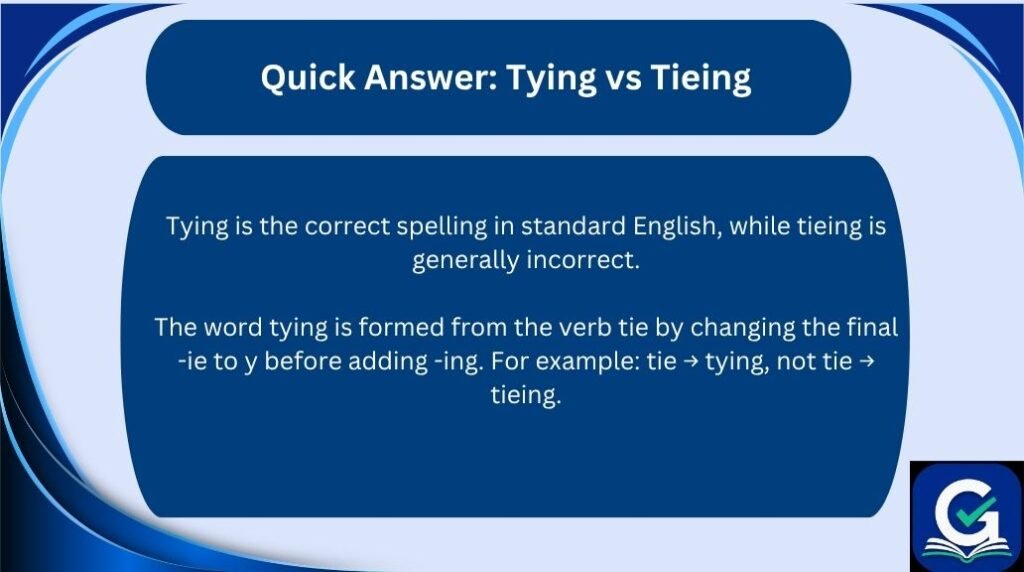
Tying is the correct spelling in standard English, while tieing is generally incorrect.
The word tying is formed from the verb tie by changing the final -ie to y before adding -ing. For example: tie → tying, not tie → tieing.
Understanding the Basics: Tying vs Tieing
The main difference between tying and tieing is spelling and standard usage. Both forms are intended to represent the action of tie, but only tying is the normal standard form used in modern American English.
The base verb is tie. When -ing is added, the spelling changes:
tie → tying
The final -ie becomes y, and then -ing is added.
Comparison Table
| Form | Type | Meaning | Example | Correct/Incorrect |
|---|---|---|---|---|
| tying | Present participle / gerund | The act of fastening, connecting, or securing something | She is tying her shoes. | ✅ Correct |
| tieing | Nonstandard spelling | Intended to mean the same action as tying | She is tieing her shoes. | ❌ Incorrect in standard English |
| tie | Base verb | To fasten, connect, or secure | Please tie the rope. | ✅ Correct |
| tied | Past tense / past participle | Fastened or connected | He tied the package. | ✅ Correct |
The important point is simple: when you use the -ing form of tie, write tying.
What Does “Tying” Mean?
Tying is the -ing form of the verb tie. It can function as a present participle or a gerund depending on how it appears in a sentence.
The basic meaning of tie is to fasten, secure, connect, or attach something using a knot, string, rope, cord, or another method.
For example:
- She is tying her shoelaces.
- He is tying the package with string.
- They are tying the boat to the dock.
- I am tying my hair back.
- The children are tying ribbons onto the gifts.
In each sentence, tying describes an ongoing action.
Tying as a Present Participle
A present participle is often used with a form of be to create a progressive verb tense.
Consider:
Maria is tying her shoes.
Here, is is the helping verb, while tying shows the action currently taking place.
The structure is:
Subject + be + tying + object
Another example:
The worker is tying the cables together.
The word tying tells us that the action is happening now or around the current time.
Tying as a Gerund
The same form can also function as a noun.
For example:
Tying a complicated knot requires practice.
Here, tying is the subject of the sentence. It names an activity rather than simply describing what someone is doing.
Another example is:
I enjoy tying decorative ribbons.
In this sentence, tying acts as the object of the verb enjoy.
So, although the grammatical functions can differ, the spelling remains the same:
tying
Why Is “Tieing” Incorrect?
The spelling tieing looks reasonable because English learners often learn a simple rule:
Add -ing to a verb to form its present participle.
That rule works for many verbs:
- walk → walking
- jump → jumping
- read → reading
- cook → cooking
However, English spelling contains special patterns that require a change in the base word.
The verb tie ends in -ie. When -ing is added, the ie changes to y:
tie + ing → tying
This spelling pattern also appears in other verbs ending in -ie.
For example:
- die → dying
- lie → lying
- vie → vying
- tie → tying
Writing tieing ignores this standard spelling change.
The Easy Pattern to Remember
If a verb ends in -ie, its -ing form commonly changes -ie to y.
Examples:
- tie → tying
- lie → lying
- die → dying
- vie → vying
This gives you a useful memory trick:
IE + ING → YING
Therefore:
TIE + ING → TYING
The Spelling Rule Behind “Tying”
The spelling change is not random. It helps preserve a natural and established spelling pattern in English.
When the final letters of a verb are -ie, the ie is changed to y before -ing is added.
Compare these examples:
| Base Verb | Incorrect Form | Correct -ing Form |
|---|---|---|
| tie | tieing | tying |
| lie | lieing | lying |
| die | dieing | dying |
| vie | vieing | vying |
This is why tying looks different from what you might initially expect.
The spelling is conventional and follows an established English pattern.
Correct Meanings and Uses of “Tying”
The word tying can be used in several everyday contexts. Understanding these meanings makes it easier to recognize the correct spelling.
Tying Shoes
One of the most common uses is fastening shoelaces.
The child is tying his shoes.
Here, tying describes the physical action of creating or tightening the knot.
You could also say:
I learned tying my shoes when I was young.
Although the sentence may be more naturally phrased as “I learned how to tie my shoes,” the spelling of tying remains unchanged whenever the word is used.
Tying a Knot
Another common meaning involves creating a knot.
She is tying a knot in the rope.
Breakdown:
- She = subject
- is = helping verb
- tying = present participle
- a knot = object
The word tying tells us what action she is performing.
Tying Something Together
Tying can also mean connecting things.
The gardener is tying the plants to a support.
The action does not necessarily involve making a traditional knot. It can simply mean securing something with string, wire, tape, or another material.
Tying Hair
The word is also common when talking about hair.
She is tying her hair into a ponytail.
Here, tying means securing the hair so it stays in a particular position.
Tying Ideas Together
Tying can have a figurative meaning as well.
The writer is tying the two arguments together.
In this case, no physical knot is involved. The word means connecting two ideas or concepts.
Test Tip: How to Check “Tying vs Tieing”
When you are unsure whether to write tying or tieing, use this quick test:
Step 1: Find the base verb
Ask yourself:
What is the original verb?
If the answer is tie, continue to Step 2.
Step 2: Add -ing mentally
Instead of writing tieing, remember the -ie → y spelling change.
tie → tying
Step 3: Compare It With Similar Verbs
Think about:
- lie → lying
- die → dying
- vie → vying
If those words look familiar, tying should become easier to remember.
Quick Memory Trick
Think:
Tie has an “ie,” but tying has a “y.”
That one sentence can help prevent the most common spelling mistake.
Case Study: A Workplace Email
Imagine an employee is writing a workplace email about preparing an event.
A draft might say:
“I am tieing the name tags to the gift bags this afternoon.”
The writer’s meaning is perfectly clear, but the spelling is incorrect in standard English.
The corrected version is:
“I am tying the name tags to the gift bags this afternoon.”
The corrected spelling makes the sentence appropriate for professional communication.
Why the Difference Matters
A single spelling mistake will not usually prevent readers from understanding the message. However, repeated spelling errors can make professional writing appear less polished.
This is especially relevant in:
- Emails
- Reports
- Resumes
- School assignments
- Business documents
- Customer communication
- Online articles
Using tying correctly helps keep your writing accurate and professional.
Grammar Rules Explanation
The correct form is tying because standard English spelling changes a final -ie to y before adding -ing in verbs such as tie, lie, and die.
This is different from verbs that simply retain their final letters when -ing is added.
For example:
- play → playing
- enjoy → enjoying
- work → working
- tie → tying
- lie → lying
- die → dying
Standard American English dictionaries and established grammar references recognize tying as the standard spelling.
The form tieing is not the normal spelling for the present participle or gerund of tie.
Why Does the “IE” Become “Y”?
English spelling conventions have developed over time to make certain combinations easier to read and recognize.
The sequence -ie + -ing is avoided in these common verbs. Instead, the spelling changes to -ying.
Thus:
tie + ing = tying
not:
tie + ing = tieing
The same pattern explains:
lie + ing = lying
and
die + ing = dying
Tying in Different Verb Tenses
Knowing how tie changes across tenses can reinforce the correct spelling.
| Tense | Form | Example |
|---|---|---|
| Base form | tie | I tie my shoes. |
| Third-person singular | ties | She ties her shoes. |
| Present participle | tying | She is tying her shoes. |
| Past tense | tied | She tied her shoes. |
| Past participle | tied | She has tied her shoes. |
Notice that only the -ing form creates the spelling pattern tying.
The other forms follow different patterns:
- tie
- ties
- tying
- tied
This makes tying especially easy to misspell if you try to build it mechanically from the base word.
Common Mistakes With “Tying vs Tieing”
The biggest mistake is simply writing tieing instead of tying.
But why does this happen?
Fast Typing
When people type quickly, they often spell words based on how they look or sound.
Because tie is clearly visible in the word, a writer may automatically type:
tie + ing = tieing
This is understandable, but it does not follow the standard spelling convention.
Autocorrect
Autocorrect can sometimes create confusion. Depending on the software, language settings, or dictionary being used, an unusual spelling may not always be flagged immediately.
Writers should therefore understand the rule instead of relying completely on automated correction.
Lack of Knowledge
Some people simply have never learned the -ie → y pattern.
This is particularly common among learners who assume every verb forms its -ing version by adding the letters i-n-g without changing anything else.
Visual Habit
Because tie is spelled with ie, the form tieing can look logical at first glance.
However, familiar-looking does not always mean standard.
Similar Grammar and Spelling Confusions
English contains many word pairs that create confusion because the forms look or sound similar.
| Confusing Pair | Correct Usage | Common Mistake |
|---|---|---|
| its / it’s | its = possession; it’s = it is | Mixing the two |
| your / you’re | your = possession; you’re = you are | Using one for the other |
| their / they’re | their = possession; they’re = they are | Confusing the forms |
| there / their / they’re | Different grammatical functions | Treating them as interchangeable |
| than / then | than = comparison; then = time/order | Switching them |
| affect / effect | Usually affect = influence; effect = result | Using them incorrectly |
| lie / lay | Different verb patterns | Treating them as identical |
| tieing / tying | tying is standard | Writing tieing |
These examples show why English spelling and grammar cannot always be handled by simply following what looks logical.
Usage in Different Contexts
Everyday Conversation
Tying is completely normal in everyday communication.
Examples:
- “I’m tying my shoes.”
- “She’s tying her hair back.”
- “Can you help me with tying this knot?”
- “He is tying the boxes together.”
Because these sentences describe ordinary actions, the word appears frequently in casual English.
Professional Writing
In professional writing, tying should be used whenever the action of tie is being described.
Examples:
The technician is tying the cables securely.
The employee is tying the documents together for shipment.
We are tying the final details together before the presentation.
Using tieing in these situations would be considered a spelling error in standard professional English.
Creative Writing
Writers may use tying in descriptive or figurative ways.
For example:
She stood by the window, tying the ribbon around the old box.
Or:
The final chapter was tying together several details introduced earlier in the story.
Creative writing can use tying both literally and metaphorically.
Social Media and Texting
Casual online writing is often less formal, but tying remains the standard spelling.
For example:
“Just tying my shoes and heading out! 👟”
or:
“I’m tying everything together before the trip.”
Even in short messages, using the standard spelling makes the sentence look polished.
Tying in Literal and Figurative Expressions
One reason the word tying is useful is that it can describe both physical and abstract connections.
Literal Use
A literal use refers to physically fastening something.
He is tying the rope to the post.
The rope is physically being secured.
Figurative Use
A figurative use refers to connecting ideas, events, or concepts.
The conclusion is tying the main ideas together.
There is no physical knot. Instead, the writer is connecting concepts logically.
Other examples include:
- tying loose ends together
- tying one event to another
- tying a story together
- tying a decision to a specific goal
In every case, the spelling remains tying.
Why “Tying vs Tieing” Matters
At first, the difference may seem like a tiny spelling detail. After all, most readers can understand what someone means when they write tieing.
However, correct spelling matters for several reasons.
Clarity in Communication
Standard spelling helps readers process information quickly.
When words follow familiar conventions, readers do not have to pause and wonder whether a spelling is intentional.
Professionalism
Correct spelling contributes to polished communication.
A report, email, article, or application containing many unusual spellings can distract from the main message.
Writing Accuracy
Understanding small spelling rules improves overall writing accuracy.
Once you learn that:
tie → tying
you can apply the same pattern to:
- lie → lying
- die → dying
- vie → vying
Digital Communication
People communicate constantly through digital platforms. Emails, messages, social posts, online forms, and documents all depend on written language.
Correct spelling helps your message appear deliberate and reliable.
A Simple Reminder
“Clear writing starts with choosing the standard form.”
The goal is not to make every sentence complicated. It is to make simple communication accurate and easy to understand.
Special Exception: Is “Tieing” Ever Seen?
You may occasionally encounter tieing in older material, historical documents, unusual databases, or nonstandard writing.
Seeing the form does not make it the preferred spelling in modern standard American English.
It is also possible to encounter unusual spellings in proper names, specialized titles, or other contexts where a word is intentionally written in a particular way. A specific name or title should be preserved when it is officially established.
However, when you are writing an ordinary modern sentence about the action of tie, use:
tying
For standard grammar and spelling purposes, there is no need to use tieing.
Tying vs Tieing in American English
In modern American English, tying is the expected standard form.
For example:
The student is tying a ribbon around the box.
I am tying my shoes before the race.
She is tying the curtains back.
They are tying the boat to the dock.
The form tieing should generally be corrected to tying.
This applies whether the word is used in casual writing, academic writing, workplace communication, or professional content.
Common Questions Writers Ask
Why Isn’t “Tieing” Correct?
Because verbs ending in -ie commonly change the ie to y before -ing is added. Therefore, tie becomes tying, not tieing.
Is “Tying” a Verb?
Yes. Tying is the present participle of the verb tie. It can also function as a gerund when it acts as a noun.
Is “Tieing” Ever Correct?
In ordinary modern standard English, tieing is not the preferred form. Tying is the standard spelling.
Is It “Tying” or “Tieing the Knot”?
The correct expression is:
tying the knot
For example:
They are tying the knot this summer.
The phrase traditionally means getting married.
Why Does “Dying” Have a Y?
The same spelling pattern applies. The verb die becomes dying, just as tie becomes tying.
Is “Tying” the Same as “Tied”?
No. Tying describes an ongoing action or can name the activity, while tied is the past tense or past participle.
For example:
She is tying the ribbon.
She tied the ribbon yesterday.
Quick Recap Checklist
Use this checklist whenever you are unsure about tying vs tieing.
| Question | If Yes → Use |
|---|---|
| Are you describing the action of fastening something? | tying |
| Are you using the -ing form of the verb tie? | tying |
| Does the base verb end in -ie? | Change ie → y before -ing |
| Are you writing “tie + ing” mechanically? | Stop and use tying |
| Are you writing standard modern American English? | tying |
Practice Examples
Example 1:
Jake is ___ his shoelaces.
Correct answer: tying
Example 2:
She spent ten minutes ___ the ribbon around the package.
Correct answer: tying
Example 3:
They are ___ the boat securely to the dock.
Correct answer: tying
A useful formula to remember is:
tie → tying
FAQs About Tying vs Tieing
1. Is “tying” or “tieing” correct?
Tying is correct in standard modern English. Tieing is generally considered an incorrect or nonstandard spelling of the -ing form of tie.
2. What is the correct spelling of “tie” with -ing?
The correct spelling is tying. The final -ie in tie changes to y before -ing is added.
3. Why does “tie” become “tying”?
English spelling conventions change the final -ie to y before the -ing suffix in this type of verb. Therefore, tie + ing becomes tying.
4. Is “tieing” a spelling mistake?
In normal modern standard English, yes. If you mean the action of tie, the standard spelling is tying.
5. Are “tying” and “tied” interchangeable?
No. Tying refers to an ongoing action or activity, while tied is the past tense or past participle.
For example:
She is tying the rope.
She tied the rope yesterday.
6. What other words follow the same spelling pattern?
Several verbs ending in -ie show a similar change before -ing:
- tie → tying
- lie → lying
- die → dying
- vie → vying
Remembering these examples can make the pattern easier to recognize.
More Examples of Correct “Tying” Usage
Seeing the word in different sentences can help make the correct spelling automatic.
Physical Actions
- He is tying his shoes.
- She is tying a knot.
- We are tying the boxes together.
- The sailor is tying the rope.
- I am tying my hair back.
Work and Projects
- The team is tying the final details together.
- She is tying the documents into one bundle.
- The technician is tying the cables securely.
- We are tying the final steps to the original plan.
Figurative Uses
- The final paragraph is tying the argument together.
- The ending is tying several storylines together.
- The evidence is tying the two events together.
- The conclusion is tying the main points together.
Notice that every sentence uses tying, never tieing.
How to Remember the Correct Spelling
If you frequently confuse these two forms, use a short memory strategy.
Remember “IE Changes to Y”
When you see a verb ending in -ie, think:
IE → Y + ING
Then apply it:
TIE → TY + ING → TYING
You can reinforce the pattern with three familiar examples:
LIE → LYING
DIE → DYING
TIE → TYING
Once these become familiar, tieing will start to look unusual.
Use the “Three Y Words” Trick
Remember:
lying, dying, tying
All three end with -ying.
That gives you a simple mental group to recall whenever you are unsure.
Tying vs Tieing: A Final Comparison
The distinction can be reduced to one important rule.
Tying is the standard spelling.
Tieing is not the standard modern spelling for the -ing form of tie.
The change happens because the final -ie becomes y before -ing:
tie → tying
The same principle appears in:
lie → lying
die → dying
vie → vying
Therefore, if you are writing an email, school assignment, article, social media post, report, or everyday message, choose tying.
Conclusion
The confusion between tying vs tieing is understandable because adding -ing to tie does not produce the form you might expect. However, the correct spelling is easy to remember once you learn the pattern.
In standard modern American English, tying is the correct -ing form of the verb tie, while tieing is generally considered incorrect or nonstandard.
The key rule is simple: when a verb such as tie ends in -ie, the ie changes to y before -ing is added. That gives us tie → tying, just as lie → lying and die → dying.
Whether you are talking about tying your shoes, tying a package, tying a knot, or tying ideas together, use the same spelling every time.
When in doubt, remember: IE changes to Y before ING — tie becomes tying.

I’m Ethan Carter, a grammar writer at Gramfino, where I explain English grammar in a simple and practical way.
I enjoy helping readers understand sentence structure, grammar rules, and common writing mistakes.
[…] to speak more accurately, understanding these verbs can make your English clearer and more natural. Tying vs Tieing | Midday vs Mid-Day | All of a Sudden vs All of the […]