Have you ever written a sentence and suddenly wondered whether the right word is aide vs aid? You are not alone. These two words sound exactly the same when spoken, and they differ by only one letter. That small spelling difference, however, can change the meaning of your sentence.
The confusion becomes especially common when you are writing about assistance, support, employees, teachers, medical workers, or helpful tools. For example, you might write about a teacher’s aide, financial aid, or a hearing aid. Although all three expressions involve the idea of helping, they do not use the same word.
Understanding aide vs aid is easier once you remember one basic distinction: aide usually refers to a person who assists someone, while aid usually refers to help, assistance, support, or something that provides help. Merriam-Webster defines aide as a person who acts as an assistant, while aid can function as both a noun and a verb.
In this guide, I will explain the difference between aide vs aid, show you when to use each word, and provide practical examples so you can choose the correct spelling confidently. High School vs Highschool | Trek vs Treck | Truly vs Truely
Quick Answer: Aide vs Aid
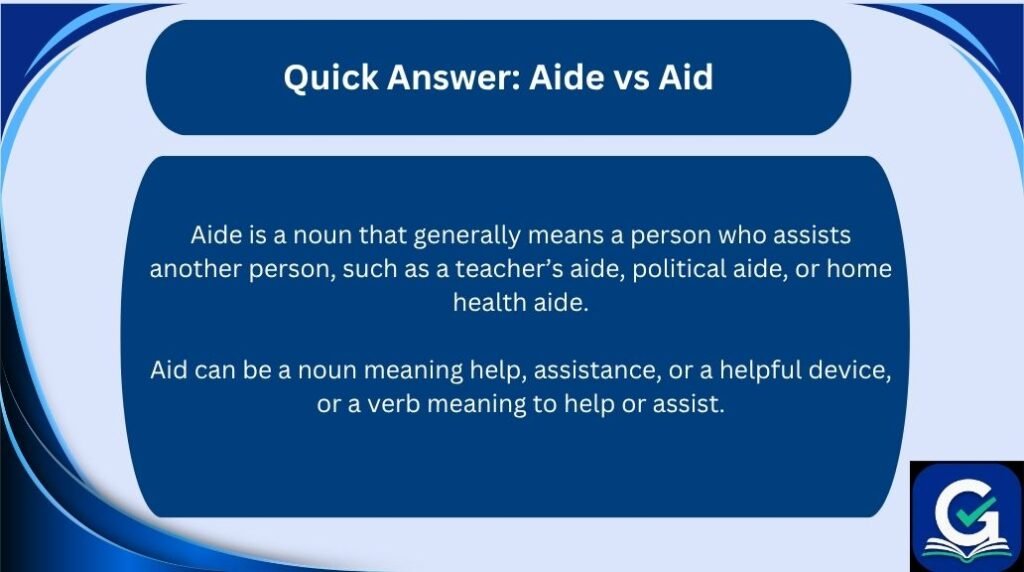
Aide is a noun that generally means a person who assists another person, such as a teacher’s aide, political aide, or home health aide.
Aid can be a noun meaning help, assistance, or a helpful device, or a verb meaning to help or assist.
Easy rule:
👉 Aide = a person who helps.
👉 Aid = help, assistance, or something that helps.
For example:
- The senator’s aide organized the meeting.
- The organization provided financial aid.
- The chart was a useful aid to understanding the topic.
- The nurse aided the injured patient.
Understanding the Basics of Aide vs Aid
The words aide and aid are homophones. This means they have the same pronunciation but different spellings and meanings. Because they sound identical, you cannot always identify the correct word by listening to a sentence.
The key is to look at the role the word plays in the sentence.
Aide is primarily used as a noun for a person who provides assistance. Merriam-Webster defines it as “a person who acts as an assistant.”
Aid, on the other hand, has several uses. As a noun, it can mean help, assistance, relief, or a device that helps someone. As a verb, it means to help or assist.
Aide vs Aid Comparison Table
| Form | Type | Meaning | Example | Correct/Incorrect |
|---|---|---|---|---|
| aide | Noun | A person who assists | The senator hired an aide. | ✅ Correct |
| aid | Noun | Help or assistance | The family received financial aid. | ✅ Correct |
| aid | Noun | A helpful device | She uses a hearing aid. | ✅ Correct |
| aid | Verb | To help or assist | The guide aided the travelers. | ✅ Correct |
| aide | Verb | Not normally used as a verb | He aide the students. | ❌ Incorrect |
| visual aide | Phrase | Intended to mean a helpful visual tool | The chart is a visual aid. | ❌ Incorrect |
| visual aid | Phrase | A visual tool that provides help | The chart is a visual aid. | ✅ Correct |
The most important point is that aide normally identifies a person, while aid has a much wider range of meanings.
What Does Aide Mean?
Aide is a noun meaning a person who helps or assists another person, usually as part of a job or official role.
For example:
- The governor’s aide answered the phone.
- The teacher asked her aide to distribute the worksheets.
- A home health aide visited the patient every morning.
- The executive’s aide arranged the schedule.
In each sentence, aide refers to a person.
Aide in Professional Roles
You will often see aide in job titles or descriptions.
Common examples include:
- teacher’s aide
- nurse’s aide
- home health aide
- congressional aide
- presidential aide
- political aide
- administrative aide
- legislative aide
- classroom aide
These expressions describe people whose job involves assisting someone else.
Merriam-Webster also lists examples such as congressional aides and home health aides, confirming this person-centered use.
Aide in a Sentence
Consider this sentence:
The principal’s aide prepared the documents.
Here, aide is a noun because it identifies a person. The phrase principal’s aide tells us that this person assists the principal.
A useful question to ask is:
“Am I talking about a person whose role is to assist someone?”
If the answer is yes, aide is usually the appropriate choice.
What Does Aid Mean?
Aid is more flexible than aide. It can function as both a noun and a verb.
As a noun, aid means help, assistance, support, relief, or something that provides assistance.
As a verb, aid means to help or assist.
Merriam-Webster gives both noun and verb definitions for aid, including help, assistance, useful means of assistance, and the act of helping.
Aid as a Noun
When aid is a noun, it often refers to help or assistance.
Examples include:
- financial aid
- emergency aid
- humanitarian aid
- medical aid
- military aid
- disaster aid
- legal aid
- government aid
- first aid
For example:
The students applied for financial aid.
Here, aid means financial assistance.
Another example is:
The rescue team provided medical aid.
Here, aid means medical assistance.
Aid as a Helpful Object
Aid can also describe something that helps a person perform a task or understand something.
Examples include:
- hearing aid
- visual aid
- teaching aid
- learning aid
- memory aid
- mobility aid
For example:
The teacher used a visual aid during the presentation.
The visual aid is an object or tool that helps students understand the material. Merriam-Webster specifically defines a teaching aid as an object or device used to improve classroom instruction.
Aid as a Verb
Aid can also be used as a verb.
Examples:
- The volunteers aided the victims.
- The medication aided his recovery.
- The guide aided us during the journey.
- Her notes aided her understanding of the subject.
In these examples, aid means help.
A simple substitution test works well:
The volunteers aided the victims.
Replace aided with helped:
The volunteers helped the victims.
The sentence still makes sense, so aid is being used correctly as a verb.
Aide vs Aid: The Main Difference
The simplest way to understand aide vs aid is to focus on person versus assistance.
Use Aide for a Person
The doctor’s aide called the patient.
The aide is a person.
Use Aid for Help
The doctor provided aid to the patient.
The aid is assistance.
Use Aid for a Helpful Object
The doctor used a hearing aid.
The aid is a device.
Use Aid as a Verb
The nurse aided the patient.
Here, aided means helped.
This distinction is also supported by major dictionary references. Merriam-Webster identifies aide as an assistant, while aid can mean assistance, a helpful device, or the act of helping.
Correct Meanings and Uses of Aide
Aide Means Assistant
The most common modern use of aide is to describe an assistant.
The manager’s aide scheduled the appointments.
The person who scheduled the appointments is the manager’s assistant.
Aide in Education
In schools, you may encounter:
The teacher’s aide helped the children with their assignments.
A teacher’s aide is a person who assists a teacher with classroom duties.
Do not write:
The teacher’s aid helped the children.
Although aid can technically refer to assistance, the conventional expression for the person is teacher’s aide.
Aide in Government
Government and political writing frequently uses aide.
The senator’s aide released a statement.
The aide is a person working for the senator.
Other examples include:
- presidential aide
- congressional aide
- political aide
- legislative aide
Aide in Healthcare
Healthcare also uses aide for certain assisting roles.
She works as a home health aide.
The person provides assistance to patients or clients.
Correct Meanings and Uses of Aid
Aid Means Help
The charity provided aid to families affected by the disaster.
Here, aid means help or assistance.
Aid Means Financial Support
She received financial aid for college.
Financial aid refers to money or other financial assistance that helps someone pay for education.
Aid Means Relief
Emergency aid arrived after the storm.
The aid may include food, water, medicine, supplies, or other assistance.
Aid Means a Device
He uses a hearing aid.
A hearing aid is a device that helps with hearing.
Notice that hearing aide would not normally be correct when referring to the device.
Aid Means Help as a Verb
The new software aided the research team.
Here, aided means helped.
Test Tip: How to Choose Between Aide vs Aid
When you are unsure about aide vs aid, ask yourself one question:
Is the word referring to a person?
- Yes → Use aide.
- No → Use aid.
For example:
The mayor’s ___ attended the meeting.
The blank refers to a person.
✅ The mayor’s aide attended the meeting.
Now consider:
The charity provided ___ to the community.
The blank refers to help.
✅ The charity provided aid to the community.
Another example:
She purchased a hearing ___.
The blank refers to a device.
✅ hearing aid
This quick test will solve most aide vs aid questions.
Aide vs Aid in Real-Life Situations
Understanding these words becomes easier when you see them in everyday situations.
At School
Imagine a teacher preparing for a busy school day.
Ms. Carter asked her aide to help organize the classroom.
The aide is a person.
Now consider:
The teacher used a visual aid during the lesson.
The visual aid is a tool.
Both words appear in the same environment, but their meanings are different.
At a Hospital
Consider:
The nurse’s aide helped move the patient.
The aide is a person.
Now:
The patient received medical aid.
The aid is assistance.
In Politics
The senator’s aide prepared the briefing materials.
The aide is a person.
But:
The country received economic aid.
The aid is financial or material assistance.
These examples show why context matters when choosing between the two words.
Case Study: Aide vs Aid in a Workplace Email
Imagine a manager writing this email:
Please ask my aide to send the updated schedule.
This sentence tells the reader to contact a specific assistant.
Now imagine the manager writes:
Please provide financial aid to the affected employees.
Here, aid means financial assistance.
A workplace mistake could create confusion if the words are switched:
Please ask my aid to send the schedule.
Although a reader may understand the intended meaning from context, aid is not the standard choice for a person’s job role in this sentence.
A more polished version is:
Please ask my aide to send the updated schedule.
This distinction is particularly important in professional communication, where precise word choice helps prevent misunderstandings.
Grammar Rules for Aide vs Aid
The grammar rule is straightforward.
Aide Is a Noun
Aide functions as a noun and refers to an assistant.
Examples:
- The aide arrived early.
- Her aide answered the phone.
- The teacher thanked her aide.
You generally cannot use aide as a standard verb meaning “to help.”
Incorrect:
The volunteer aide the family.
Correct:
The volunteer aided the family.
Aid Can Be a Noun
Examples:
- The victims needed aid.
- Financial aid was available.
- The organization provided aid.
Aid Can Be a Verb
Examples:
- Volunteers aided the victims.
- The new method aided researchers.
- His advice aided the team.
Merriam-Webster confirms these noun and verb functions for aid.
Why Are They So Easy to Confuse?
The words share the same pronunciation and are historically related to the idea of helping. Their spellings are also nearly identical.
That makes aide vs aid a classic homophone problem.
The spelling aide developed as a specialized form for an assistant, while aid retained its broader meanings connected with help and assistance.
Common Mistakes With Aide vs Aid
Mistakes usually happen because the two words sound identical.
Mistake 1: Using Aide for a Helpful Object
Incorrect:
I bought a hearing aide.
Correct:
I bought a hearing aid.
A hearing aid is a device.
Mistake 2: Using Aid for an Assistant
Incorrect:
The teacher’s aid helped prepare the lesson.
Correct:
The teacher’s aide helped prepare the lesson.
When referring to the person assisting the teacher, aide is the standard spelling.
Mistake 3: Using Aide as a Verb
Incorrect:
The treatment aide the patient.
Correct:
The treatment aided the patient.
Aid is the verb.
Why Do These Mistakes Happen?
Fast Typing
When people type quickly, they may choose the first spelling that comes to mind.
Autocorrect
Spell-checking software may not recognize a contextual mistake because both aid and aide are legitimate English words.
Lack of Knowledge
Some writers know that both words mean something related to helping but do not know when to use each spelling.
The solution is to focus on meaning rather than sound.
Similar Grammar Confusions
Aide vs aid is one of many English word pairs that sound alike or look similar.
| Confusing Words | Correct Use | Example |
|---|---|---|
| its / it’s | Possession / it is | The dog wagged its tail. |
| your / you’re | Possession / you are | You’re holding your book. |
| their / there / they’re | Possession / place / they are | They’re over there with their bags. |
| to / too / two | Direction / also / number | I want to go, too. |
| then / than | Time / comparison | She is taller than me. |
| affect / effect | Usually verb / usually noun | The weather affected the result. |
| principal / principle | School leader / rule or belief | The principal explained the principle. |
| aide / aid | Assistant / help or assistance | The aide provided aid. |
The best way to handle these pairs is to learn their individual functions and meanings, not just their spelling.
Aide vs Aid in Different Contexts
Everyday Conversation
In casual conversation, both words are common.
I need some aid with this project.
More naturally, many speakers would simply say:
I need some help with this project.
For a person:
My aide will call you later.
The second sentence clearly identifies an assistant.
Professional Writing
Professional writing requires careful word choice.
Examples:
The director’s aide prepared the report.
The organization received government aid.
The training program provided an important aid to new employees.
Using the wrong spelling can make formal writing look careless.
Creative Writing
Authors may use both words depending on the situation.
The wounded traveler cried for aid.
Here, aid means help.
The king’s aide entered the chamber.
Here, aide means assistant.
Creative writing often relies heavily on context, so choosing the precise word helps readers visualize the scene.
Social Media and Texting
Informal communication often contains spelling errors because people type quickly.
You might see:
Need financial aide for college.
The intended phrase is:
Need financial aid for college.
Because both words are real English words, automatic spell-checking may not always catch the mistake.
Common Expressions With Aid
Learning common phrases can make aid vs aide easier to remember.
Financial Aid
Many students apply for financial aid.
First Aid
She completed a first-aid course.
Medical Aid
The injured person needed immediate medical aid.
Foreign Aid
The country received foreign aid after the disaster.
Humanitarian Aid
Volunteers delivered humanitarian aid.
Hearing Aid
He uses a hearing aid.
Visual Aid
The presentation included several visual aids.
Teaching Aid
The instructor used a teaching aid to explain the concept.
All these expressions use aid, not aide, because they refer to assistance or something that provides assistance.
Common Expressions With Aide
Teacher’s Aide
The teacher’s aide helped students during the activity.
Nurse’s Aide
The nurse’s aide assisted with routine tasks.
Home Health Aide
A home health aide visited the patient.
Political Aide
The political aide prepared the campaign schedule.
Congressional Aide
A congressional aide answered questions from reporters.
Presidential Aide
The presidential aide delivered the message.
These expressions use aide because they identify a person who performs an assisting role.
Why Aide vs Aid Matters
It may seem like a tiny spelling difference, but correct word choice can improve your writing in several ways.
Clarity in Communication
Correct spelling tells readers exactly what you mean.
Compare:
The teacher’s aid arrived early.
with:
The teacher’s aide arrived early.
The second version clearly identifies a person.
Professionalism
Correct grammar and spelling make professional documents more credible.
Whether you are writing an email, résumé, report, article, or business proposal, using aide and aid correctly shows attention to detail.
Accuracy in Digital Communication
Digital writing moves quickly. Emails, text messages, social posts, and workplace chats are often written without much editing.
Because aide and aid sound the same, the error can easily slip through.
A Simple Reminder
“Aide is an assistant; aid is assistance.”
This short distinction captures the central rule.
Special Exceptions and Edge Cases
There is an important nuance: aid can sometimes refer to a person who assists, although aide is generally preferred for the person-centered sense.
Merriam-Webster notes a chiefly U.S. use of aid meaning aide, as in “teacher’s aid.”
However, in modern standard usage, especially when referring to a person’s role, aide is often the clearer and more recognizable choice.
For example:
teacher’s aide
is widely understood as a person assisting a teacher.
Meanwhile:
teaching aid
refers to an object, material, or device used to support teaching. Merriam-Webster defines a teaching aid as an object or device that helps classroom instruction.
This creates an especially useful distinction:
- teacher’s aide = a person
- teaching aid = a tool or resource
Aide-de-Camp
Another specialized use is aide-de-camp, a military or official assistant to a senior officer or dignitary.
The word aide originated in part from the phrase aide-de-camp, which helps explain its specialized connection with assistants.
Aide vs Aid: Sentence Breakdown
Let’s examine several examples.
Example 1
The senator’s aide called the reporter.
- The senator’s = possessive phrase
- aide = noun
- called = verb
- the reporter = object
The word aide identifies a person.
Example 2
The charity provided aid after the earthquake.
- The charity = subject
- provided = verb
- aid = noun
- after the earthquake = time/context phrase
Here, aid means assistance.
Example 3
The new software aided the researchers.
- The new software = subject
- aided = verb
- the researchers = object
Here, aided means helped.
Example 4
The students used a visual aid.
- The students = subject
- used = verb
- a visual aid = object
Here, aid refers to a helpful tool.
Quick Recap Checklist
Use this table whenever you are unsure about aide vs aid.
| Question | If Yes → Use |
|---|---|
| Does the word refer to an assistant or worker? | aide |
| Does it mean help or assistance? | aid |
| Does it refer to a helpful device? | aid |
| Can you replace it with “help” as a verb? | aid |
| Is it a teacher’s assistant? | aide |
| Is it financial support? | aid |
| Is it a hearing device? | aid |
| Is it a political assistant? | aide |
Practice Example 1
The governor’s ___ prepared the speech.
Answer: aide
The blank refers to a person.
Practice Example 2
The organization provided emergency ___.
Answer: aid
The blank refers to assistance.
Practice Example 3
The diagram was a useful ___ to understanding the process.
Answer: aid
The diagram is a helpful tool.
Aide vs Aid: Easy Memory Tricks
If you regularly confuse these words, try one of these memory tricks.
Trick 1: Aide Has “E” for Employee
Think:
AidE = EmployeE
An aide is generally a person who works as an assistant.
Trick 2: Aid Means Help
Remember the short phrase:
Aid = Assistance
Both words begin with A, and both describe help-related ideas.
Trick 3: Person or Help?
Ask:
Person? → aide.
Help or tool? → aid.
This is probably the easiest method.
FAQs
1. What is the difference between aide and aid?
Aide is usually a noun referring to a person who assists someone. Aid can be a noun meaning help, assistance, or a helpful device, and it can also be a verb meaning to help.
2. Is it teacher’s aide or teacher’s aid?
Teacher’s aide is the standard choice when referring to a person who assists a teacher. For example, “The teacher’s aide helped prepare the classroom.”
3. Is it financial aid or financial aide?
The correct expression is financial aid. It means financial assistance, such as money or support for education.
4. Is it hearing aid or hearing aide?
The standard expression is hearing aid. A hearing aid is a device that helps a person hear. Aide refers primarily to a person.
5. Can aid be used as a verb?
Yes. Aid can be a verb meaning “to help” or “to assist.” For example, “The new technology aided the researchers.”
6. Is aide always a person?
In standard modern usage, aide generally refers to a person who acts as an assistant. It is especially common in job titles and official roles such as teacher’s aide, political aide, and home health aide.
Conclusion
The difference between aide vs aid is simple once you focus on what the word represents. Aide is generally a person who assists someone, while aid refers to help, assistance, a helpful device, or the act of helping. Aid can also function as a verb, while aide is normally used as a noun.
Remember these examples:
- teacher’s aide → a person
- financial aid → assistance
- hearing aid → a device
- medical aid → help
- political aide → a person
- aided the team → helped the team
The words sound identical, so listening alone will not tell you which spelling is correct. Instead, look at the meaning and grammatical role of the word.
When in doubt, ask yourself: Am I talking about a person who helps, or the help itself? If it is the person, choose aide. If it is help, assistance, a helpful tool, or the verb “to help,” choose aid.
Aide is the assistant; aid is the assistance. Remember that distinction, and you will rarely confuse these two words again.

I’m Mason Reed, a grammar researcher at Gramfino, where I explore grammar rules and common English mistakes.
I turn my research into clear explanations and practical examples that readers can easily follow.
[…] uses, common mistakes, and practical examples so you can choose the right spelling confidently. Aide vs Aid | High School vs Highschool | Trek vs […]
[…] behind the expression, explore common mistakes, and provide practical examples. Wiener vs Weiner | Aide vs Aid | High School vs […]