Few English grammar questions cause as much confusion as lay vs lie. These two small words look and sound simple, but their meanings and grammatical roles are different. The confusion becomes even greater because the past tense of lie is lay, while the past tense of lay is laid. That overlap can make an otherwise simple sentence surprisingly difficult.
For example, should you say, “I need to lie down,” or “I need to lay down”? The answer depends on whether you are placing something somewhere or reclining yourself. Once you understand that basic distinction, the rest of the rule becomes much easier.
In this guide, we will explain lay vs lie in simple terms, compare their forms, examine real-world examples, discuss common mistakes, and provide practical tests you can use when writing.
If you are writing an email, posting online, creating a story, or simply trying to speak more accurately, understanding these verbs can make your English clearer and more natural. Tying vs Tieing | Midday vs Mid-Day | All of a Sudden vs All of the Sudden
Quick Answer: Lay vs Lie
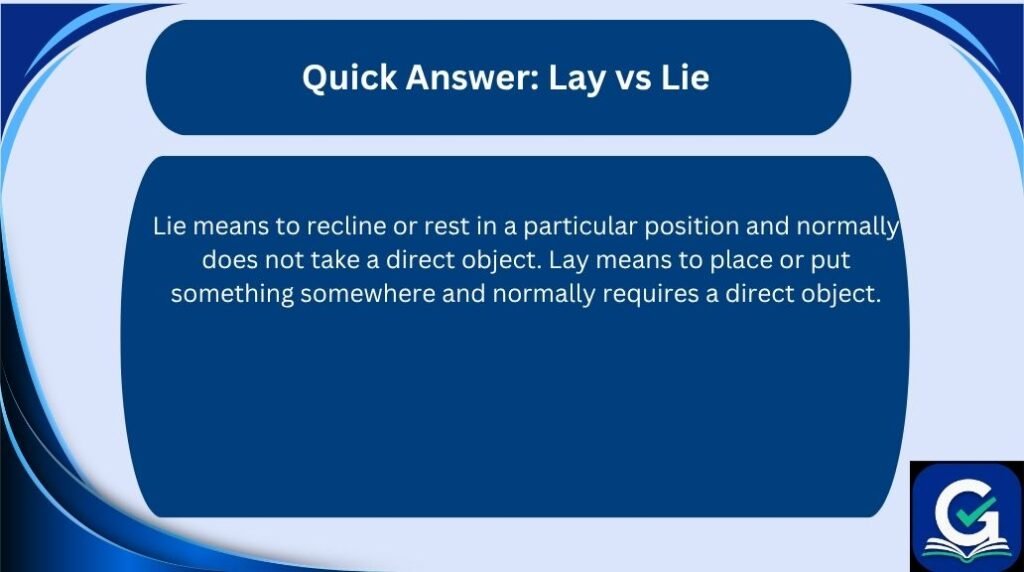
Lie means to recline or rest in a particular position and normally does not take a direct object. Lay means to place or put something somewhere and normally requires a direct object.
- Lie: I need to lie down.
- Lay: Please lay the book on the table.
The confusing part is that lay is also the past tense of lie: “Yesterday, I lay on the couch for an hour.”
Understanding the Basics: Lay vs Lie
The easiest way to understand the difference is to ask one question:
Are you placing something somewhere, or are you resting/reclining?
If you are placing something, use lay.
If you are reclining or resting yourself, use lie.
Comparison Table
| Form | Type | Meaning | Example | Correct/Incorrect |
|---|---|---|---|---|
| Lie | Present verb | To recline or rest | I lie on the sofa after work. | ✅ Correct |
| Lay | Present verb | To put or place something | I lay the keys on the desk. | ✅ Correct |
| Lay | Past tense of lie | Reclined or rested | Yesterday, I lay on the sofa. | ✅ Correct |
| Laid | Past tense of lay | Put or placed something | She laid the keys on the desk. | ✅ Correct |
| Lying | Present participle of lie | Reclining or resting | He is lying on the bed. | ✅ Correct |
| Laying | Present participle of lay | Putting or placing something | She is laying the blanket on the bed. | ✅ Correct |
The key is to remember that lay normally needs an object, while lie normally does not when it means “recline.”
Correct Meanings and Uses
What Does “Lie” Mean?
When lie means to recline, rest, or be positioned horizontally, it is an intransitive verb. That means it does not normally take a direct object.
For example:
I want to lie down.
The person is performing the action of reclining. There is no object being placed somewhere.
Another example is:
The dog likes to lie beside the fireplace.
The dog is resting. Nothing is being placed by the dog.
What Does “Lay” Mean?
Lay means to put, place, or set something in a particular location. Because something is being placed, the verb normally takes a direct object.
For example:
Please lay the blanket on the chair.
The object is the blanket. Someone is putting the blanket in a specific place.
Another example:
She laid her phone beside her laptop.
The phone is the object being placed.
The Simple Object Test
When you are unsure about lay vs lie, look for an object.
Ask:
“Am I putting something somewhere?”
If the answer is yes, lay is probably the correct present-tense choice.
- Lay the papers on the desk.
- Lay the baby in the crib.
- Lay your jacket on the chair.
If you are describing yourself or another person resting:
- I need to lie down.
- She wants to lie on the couch.
- The cat likes to lie in the sun.
The Forms of Lie
One major reason lay vs lie is confusing is that lie has an unusual set of verb forms.
When lie means “to recline,” its forms are:
- Present: lie
- Past: lay
- Past participle: lain
- Present participle: lying
Examples:
I lie down every afternoon.
Yesterday, I lay down after lunch.
I have lain here for an hour.
She is lying on the couch.
Notice the important change:
lie → lay → lain → lying
That is different from the verb lay.
The Forms of Lay
When lay means “to put or place,” its forms are:
- Present: lay
- Past: laid
- Past participle: laid
- Present participle: laying
Examples:
I lay the book on the desk every morning.
Yesterday, I laid the book on the desk.
She has laid the documents on the table.
He is laying the plates on the dining table.
The pattern is:
lay → laid → laid → laying
This distinction is one of the most useful things to memorize.
Why “I Lay Down” Can Be Correct
Here is where many learners become confused.
You might hear:
Yesterday, I lay down for an hour.
That sentence is correct.
Why?
Because lay is the past tense of lie.
Present:
I lie down every afternoon.
Past:
Yesterday, I lay down.
Present perfect:
I have lain down several times today.
So the word lay does not always mean “put something somewhere.” Its meaning depends on the grammatical context.
Why “I Laid Down” Can Be Different
Consider:
I laid the book down.
This is correct because the book is being placed somewhere.
But:
I laid down for an hour.
In standard American English, this is generally considered incorrect when you mean that you reclined.
The correct sentence is:
I lay down for an hour.
However, laid down can be correct when an object follows it:
I laid the baby down.
Here, the baby is the object being placed in a resting position.
This is a crucial distinction.
A Useful Memory Trick
Try this simple rule:
Lie = Recline
Think:
“I lie down.”
You are not putting an object somewhere. You are resting.
Lay = Place
Think:
“I lay the book down.”
You are putting an object somewhere.
A short memory formula is:
Lie = yourself. Lay = something else.
This is not a complete grammatical rule for every possible use of the words, but it is an excellent shortcut for their common meanings.
Case Study: A Workplace Example
Imagine an employee sends this message:
“I’m feeling tired, so I’m going to lay down for a few minutes.”
The intended meaning is clear, but in standard usage, lie down is the appropriate present-tense form:
“I’m feeling tired, so I’m going to lie down for a few minutes.”
Now imagine the employee is discussing an object:
“I’m going to lay the files on your desk.”
This is correct because the files are being placed on the desk.
The difference is easy to see:
- lie down = the person reclines
- lay the files down = the person places the files
This small distinction can make workplace writing look more polished and grammatically precise.
Grammar Rules Explained
Standard English grammar distinguishes lie and lay based largely on whether the verb is transitive or intransitive.
Lie as an Intransitive Verb
A verb is intransitive when it does not take a direct object.
In:
The child lies on the bed.
The child is the subject, and there is no direct object receiving the action.
Lay as a Transitive Verb
A transitive verb takes a direct object.
In:
The child lays the toy on the bed.
The toy is the direct object.
The distinction is consistent with standard dictionary treatment, including guidance found in Merriam-Webster, which identifies lie in this sense as meaning to recline and lay as meaning to put or place something.
The difficulty comes from the fact that the past tense of lie is lay.
Therefore:
Today, I lie on the sofa.
becomes:
Yesterday, I lay on the sofa.
That unusual verb pattern is the main source of confusion.
Common Mistakes With Lay vs Lie
People make mistakes with these verbs for several understandable reasons.
Fast Typing
When people type quickly, they often choose the word that sounds natural rather than stopping to consider the grammar.
For example:
I need to lay down.
This phrase is extremely common in casual communication, but standard grammar calls for:
I need to lie down.
Autocorrect
Autocorrect can also create confusion. A typing system may suggest a familiar word without understanding the grammatical relationship between the subject, verb, and object.
Lack of Knowledge
Some writers simply never learned the difference. Because lay is the past tense of lie, the rules can feel inconsistent.
Hearing the Wrong Form Repeatedly
People often absorb grammar from everyday speech. If they regularly hear “I’m going to lay down,” they may naturally assume it is correct.
Similar Grammar Confusions
| Confusing Forms | Correct Difference | Example |
|---|---|---|
| It’s / Its | It’s = it is; its = possession | It’s cold. / The dog wagged its tail. |
| Your / You’re | Your = possession; you’re = you are | Your coat is here. / You’re early. |
| They’re / Their / There | They’re = they are; their = possession; there = place | They’re ready. / Their car is there. |
| Then / Than | Then = time/order; than = comparison | Eat first, then leave. / Taller than me. |
| Affect / Effect | Affect is usually a verb; effect is usually a noun | Stress can affect sleep. / The effect was noticeable. |
| Lay / Lie | Lay = place; lie = recline | Lay the book down. / Lie down. |
Like these other pairs, lay vs lie becomes easier when you focus on the grammatical job each word performs.
Usage in Different Contexts
Everyday Conversation
In everyday speech, you will hear both forms used in ways that do not always follow formal grammar.
For standard usage, remember:
I need to lie down.
The dog is lying on the floor.
I lay down yesterday.
I laid the blanket on the floor.
These forms are appropriate in careful conversation and writing.
Professional Writing
Professional communication benefits from precise grammar.
Instead of:
“I am going to lay down because I don’t feel well.”
Use:
“I am going to lie down because I don’t feel well.”
For placing something:
“I will lay the documents on your desk.”
Correct verb selection helps make professional writing appear careful and polished.
Creative Writing
Creative writers have more flexibility because dialogue may intentionally reflect natural speech.
A character might say:
“I’m just gonna lay down for a minute.”
If the character’s voice is casual, the writer may intentionally reproduce that speech pattern. However, narrative prose can still use standard grammar:
She went upstairs to lie down.
The choice depends on whether the writer is representing dialogue or writing formal narration.
Social Media and Texting
Social media and texting are informal, so grammatical mistakes are common and often ignored.
You may see:
“I’m gonna lay down lol.”
But if your goal is grammatically standard English, write:
“I’m going to lie down.”
Informality does not change the underlying grammar rule.
Lie vs Lay in Questions
Questions can make the distinction easier to spot.
When You Mean Recline
Should I lie down?
Did you lie down after work?
Have you lain down yet?
When You Mean Place Something
Should I lay the papers here?
Did you lay the keys on the counter?
Have you laid the clothes out?
Look for the object.
“the papers,” “the keys,” and “the clothes” are objects being placed. That calls for lay or one of its forms.
Lie vs Lay With “Down”
The word down does not automatically determine which verb you should use.
Both can appear with “down”:
I need to lie down.
I lay the book down.
The difference remains the same.
Lie down means recline.
Lay something down means place something down.
Compare:
She lay down after dinner.
Here, lay is the past tense of lie.
But:
She laid the book down after dinner.
Here, laid is the past tense of lay.
Lie vs Lay With “In” and “On”
These words frequently appear with prepositions such as in, on, and beside.
Examples of lie:
The baby is lying in the crib.
The cat lies on the rug.
I lay on the grass yesterday.
Examples of lay:
Lay the blanket on the grass.
She laid the baby in the crib.
He laid the papers on the table.
Again, the object makes the difference.
The Confusing Word “Lying”
Another common issue is lying.
When lie means recline, its -ing form is:
lying
For example:
He is lying on the couch.
It is spelled lying, not lieing.
The word laying comes from the verb lay:
She is laying the plates on the table.
A useful comparison is:
- lying = reclining
- laying = placing something
Examples:
The dog is lying on the carpet.
The owner is laying a blanket on the carpet.
What About “Lain”?
Lain is the past participle of lie.
It is often less familiar because it appears more frequently in formal or literary writing than in everyday conversation.
Examples:
She has lain awake all night.
The old boat has lain abandoned for years.
You generally use lain with helping verbs such as has, have, or had.
Compare:
Yesterday, I lay in bed.
I have lain in bed all morning.
The first uses the simple past. The second uses the past participle.
What About “Laid”?
Laid is the past tense and past participle of lay.
Examples:
She laid the book on the table.
He has laid the foundation for the project.
They had laid the clothes out before dinner.
Because laid is always associated with the verb lay, it normally involves something being placed or arranged.
Why It Matters
Correct use of lay vs lie matters because small grammar choices can affect clarity.
Clarity in Communication
When verbs are used correctly, readers can understand your meaning without stopping to interpret the sentence.
Professionalism
In business emails, reports, applications, and other formal writing, correct grammar contributes to a polished presentation.
Digital Communication
Social media and texting are informal, but digital writing is still communication. Clear grammar helps your message remain understandable, especially when context is limited.
Writing Accuracy
Knowing the difference gives you more control over your writing. Instead of relying on what “sounds right,” you can identify the grammatical role of the verb.
“Clear writing begins with clear choices.”
That principle applies to small grammar distinctions as much as major writing decisions.
Special Exception and Edge Cases
There is another verb spelled lie that means to tell an untruth.
For example:
He lied about his age.
This is a completely different verb from lie meaning “to recline.”
Its forms are:
- lie
- lied
- lied
- lying
Examples:
I never lie.
She lied yesterday.
He has lied before.
This should not be confused with the reclining verb:
- lie
- lay
- lain
- lying
So lying can belong to either verb depending on context:
She is lying on the bed.
= reclining
He is lying about what happened.
= not telling the truth
Context tells you which meaning is intended.
Quick Recap Checklist
Use this checklist whenever you are unsure.
| Question | If Yes → Use |
|---|---|
| Am I reclining or resting? | Lie |
| Am I putting something somewhere? | Lay |
| Am I talking about the past tense of reclining? | Lay |
| Am I using the past tense of placing? | Laid |
| Do I need the past participle of reclining? | Lain |
| Is someone currently reclining? | Lying |
| Is someone currently placing something? | Laying |
Practice Example 1
I need to ___ down for a while.
Answer: lie
I need to lie down for a while.
Practice Example 2
She ___ the phone on the table yesterday.
Answer: laid
She laid the phone on the table yesterday.
Practice Example 3
Yesterday, I ___ down after lunch.
Answer: lay
Yesterday, I lay down after lunch.
A Simple Four-Step Test
When the rule still feels confusing, use this process.
Step 1: Identify the Action
Ask whether the sentence describes resting or placing.
Step 2: Look for an Object
If something is receiving the action, lay is likely involved.
For example:
Lay the book on the desk.
Step 3: Check the Time
If you mean “recline” and the sentence is in the past, use lay:
Yesterday, I lay down.
If you mean “place” and the sentence is in the past, use laid:
Yesterday, I laid the book down.
Step 4: Check the Verb Form
Remember:
Lie → lay → lain → lying
Lay → laid → laid → laying
Once these two patterns become familiar, most sentences become much easier to solve.
FAQs
It can be correct when lay has an object, such as “Lay the blanket down.” When you mean that you are reclining yourself, standard English uses lie down.
Is “I lay down” correct?
Yes. I lay down is correct when you are talking about the past tense of lie.
For example:
Yesterday, I lay down for a nap.
What is the difference between “lay” and “lie”?
Lay means to put or place something, while lie means to recline or rest. The main complication is that lay is also the past tense of lie.
Is it “I laid down” or “I lay down”?
If you mean that you reclined, use I lay down for the past tense.
Yesterday, I lay down for an hour.
If you placed an object, use laid:
I laid the book down.
Is “lying” related to “lie”?
Yes. Lying is the present participle of lie when it means reclining.
The dog is lying on the floor.
However, lying can also mean telling an untruth:
He is lying to his parents.
The meaning depends on context.
Is “laying” correct?
Yes. Laying is the present participle of lay, meaning putting or placing something.
She is laying the dishes on the table.
It is different from lying, which describes reclining.
Conclusion
The difference between lay vs lie becomes much easier once you separate their basic meanings. Lie means to recline or rest, while lay means to put or place something.
The biggest complication is that lay is also the past tense of lie. Therefore, you can correctly say, “I lie down every night,” but “I lay down last night.”
For the placing verb, the forms are simpler: lay, laid, laid, laying. For the reclining verb, remember: lie, lay, lain, lying.
When you are unsure, look for an object. If you are placing something, choose the appropriate form of lay. If you are reclining, choose the appropriate form of lie.
Remember the core rule: lie to rest, lay to place—and let the context guide the form.

I’m Jordan Hayes, a proofreading and editing writer at Gramfino, focused on clear and accurate English.
I enjoy finding common writing mistakes and sharing simple ways to make sentences stronger and easier to read.