Have you ever written a sentence and suddenly wondered whether you should use there vs their vs theyre? You are not alone. These three forms are among the most frequently confused words in English because they sound almost identical in everyday speech. However, their meanings and grammatical jobs are completely different. There can refer to a place or introduce something that exists.
Their shows possession or a connection to a person or group. They’re is the shortened form of they are. Once you understand these three basic functions, choosing the correct word becomes much easier. I know that English spelling can sometimes feel frustrating, especially when several words sound the same. The good news is that you do not need to memorize complicated grammar rules. You simply need to ask what the word means in your sentence.
This guide explains there vs their vs theyre with simple definitions, examples, comparison tables, practical tests, common mistakes, and easy memory tricks. Ditto vs Diddo | Humorous vs Humerous | Totaling vs Totalling
Quick Answer: There vs Their vs Theyre
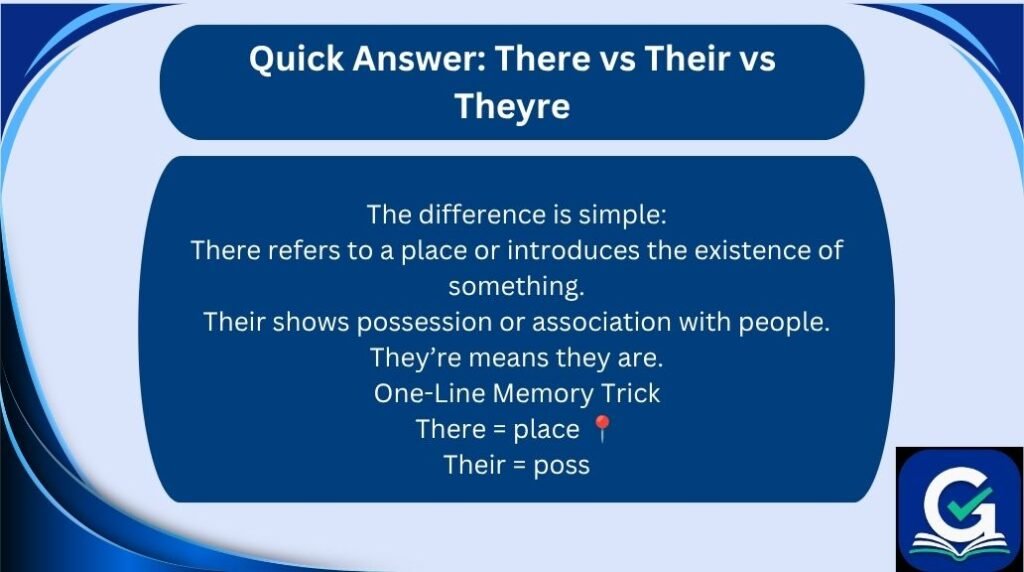
The difference is simple:
- There refers to a place or introduces the existence of something.
- Their shows possession or association with people.
- They’re means they are.
One-Line Memory Trick
There = place 📍
Their = possession 🔑
They’re = they are 👥
For example:
There is a car outside.
Their car is outside.
They’re waiting outside.
Each sentence uses a different word because each word performs a different grammatical function.
Understanding the Three Forms
The biggest problem with these words is pronunciation. In many accents, there, their, and they’re sound the same or nearly the same. When you hear them, you usually cannot tell which spelling the speaker means.
Writing is different.
When you write, you must choose the form that matches the meaning.
Comparison Table
| Form | Grammatical Role | Meaning | Example | Correct? |
|---|---|---|---|---|
| There | Adverb / introductory word | A place or existence | The keys are over there. | ✅ |
| Their | Possessive determiner | Belonging to them | Their keys are missing. | ✅ |
| They’re | Contraction | They are | They’re looking for the keys. | ✅ |
| There | — | Possession | There keys are missing. | ❌ |
| Their | — | Location | The keys are their. | ❌ |
| They’re | — | Possession | They’re keys are missing. | ❌ |
The easiest way to understand there vs their vs theyre is to ignore how the words sound and focus on what the sentence is trying to say.
What Does “There” Mean?
There has more than one common use, but the two most important are location and existence.
1. “There” Can Refer to a Place
When there refers to a location, it tells the reader or listener where something is happening or where something can be found.
Examples:
- Your jacket is over there.
- Please sit there.
- I left my phone there.
- We went there yesterday.
- The store is right there.
Consider this sentence:
My backpack is over there.
The word there identifies the location of the backpack.
You could replace there with in that place:
My backpack is in that place.
The wording changes, but the basic meaning remains.
More Examples
Look over there!
The children are playing there.
I saw your brother there.
We should meet there tomorrow.
In all these examples, there relates to a place.
2. “There” Can Introduce Existence
There is another important use of there that does not necessarily refer to a physical location.
Look at these sentences:
There is a problem.
There are several solutions.
There was a loud noise.
There will be a meeting tomorrow.
Here, there introduces the existence or presence of something.
For example:
There are three books on the table.
The sentence tells us that three books exist or are present on the table.
It does not mean that there itself is the location.
This distinction is important because many learners assume that there must always mean a place. It does not.
“There Is” vs. “There Are”
A common grammar point is choosing between there is and there are.
Use there is with a singular noun:
There is one student in the classroom.
Use there are with a plural noun:
There are five students in the classroom.
Compare:
- There is a problem.
- There are several problems.
- There was an accident.
- There were two accidents.
The word there remains the same. The verb changes according to the noun that follows.
What Does “Their” Mean?
Their is a possessive determiner. It normally appears before a noun and tells us that something belongs to, relates to, or is associated with them.
Examples include:
- their house
- their car
- their children
- their teacher
- their opinions
- their decision
- their company
Consider:
Their house is near the school.
The word their connects the house with the people being discussed.
Another Example
The students submitted their assignments.
The assignments are associated with the students.
Therefore, their is correct.
“Their” Does Not Always Mean Physical Ownership
Possession in grammar can be broader than simply owning an object.
For example:
The team celebrated their victory.
A victory is not an object that the team physically owns. However, it is associated with the team.
Similarly:
The employees shared their opinions.
The opinions belong to the employees in the sense that they are the employees’ own views.
Therefore, their can indicate a relationship, association, or connection—not only literal ownership.
“Their” Before a Noun
A useful clue is that their is generally followed by a noun or noun phrase.
Examples:
their house
their new car
their favorite restaurant
their final decision
their children
If you see a noun that needs a possessive word referring to them, their may be the correct choice.
For example:
They forgot their tickets.
Ask:
Whose tickets?
Their tickets.
Therefore, their is correct.
What Does “They’re” Mean?
They’re is a contraction of they are.
This is the easiest rule in the entire there vs their vs theyre discussion.
Whenever you see they’re, expand it:
they’re = they are
For example:
They’re ready.
becomes:
They are ready.
The sentence still works, so they’re is correct.
Examples of “They’re”
Here are several examples:
- They’re coming soon.
- They’re very busy.
- They’re waiting outside.
- They’re my neighbors.
- They’re working today.
- They’re excited about the trip.
- I think they’re correct.
Try expanding each one.
They’re coming.
→ They are coming.
They’re busy.
→ They are busy.
They’re working.
→ They are working.
The meaning stays intact.
The Apostrophe in “They’re”
The apostrophe is not decorative. It shows that they’re is a shortened form.
They are → they’re
The apostrophe represents the omitted part of the original expression.
That is why these forms are different:
❌ Theyre coming.
❌ Their coming.
✅ They’re coming.
If you are writing formally, always include the apostrophe in they’re.
The Best Test for Choosing the Correct Word
If you forget the rule, do not guess.
Use a replacement test.
Test 1: Replace It With “They Are”
If the sentence still makes sense, use they’re.
Example:
They’re planning a vacation.
Replace it:
They are planning a vacation.
It works.
Therefore:
✅ They’re planning a vacation.
Test 2: Ask “Does It Belong to Them?”
If the answer is yes, use their.
Example:
Their dog is sleeping.
Ask:
Whose dog?
The dog belongs to or is associated with them.
Therefore:
✅ Their dog is sleeping.
Test 3: Ask “Is It a Place or an Existence Construction?”
If yes, use there.
Example:
The dog is over there.
The word identifies a location.
Therefore:
✅ The dog is over there.
Another example:
There is a dog outside.
Here, there introduces the existence of the dog.
Therefore:
✅ There is a dog outside.
A Simple Way to See All Three Together
One of the best ways to learn there vs their vs theyre is to put all three words into one sentence.
Consider:
They’re taking their bags over there.
Now break it down:
They’re
They’re = they are
They are taking their bags over there.
Their
Their shows possession or association.
Their bags
There
There refers to a location.
over there
This sentence contains all three forms, and every one is correct.
Real-Life Case Study: A Workplace Message
Imagine that an employee sends this message to a coworker:
They’re meeting us over there at 2 p.m. Their manager will arrive later.
At first glance, the three forms may look confusing. But each one has a specific job.
“They’re meeting us”
Expand they’re:
They are meeting us.
Correct.
“Over there”
This refers to the meeting location.
Correct.
“Their manager”
The manager is associated with the people being discussed.
Correct.
So the complete sentence is grammatically correct:
They’re meeting us over there at 2 p.m. Their manager will arrive later.
This kind of example shows why learning the meaning of each word is more useful than memorizing spelling alone.
Another Everyday Example
Imagine you are talking about a family visiting your neighborhood.
You might say:
They’re bringing their children, and they’ll meet us over there.
The sentence contains:
- They’re = they are
- their = associated with them
- there = location
The same three words can appear naturally in everyday communication.
Grammar Rules You Should Know
The rules behind there vs their vs theyre are straightforward.
Rule 1: “There” Can Function as a Place Word
When there points to a location, it functions as an adverb.
Example:
The restaurant is there.
It answers the question:
Where is the restaurant?
Answer:
There.
Rule 2: “There” Can Introduce an Existential Construction
Example:
There is a problem with the printer.
Here, there introduces the existence of a problem.
Another example:
There are several people waiting.
Again, there introduces something that exists or is present.
Rule 3: “Their” Is Possessive
Their indicates possession, association, or relationship.
Example:
Their office is on the second floor.
The office is connected with them.
Rule 4: “They’re” Means “They Are”
This rule is absolute in standard English.
They’re = they are
Example:
They’re late.
Expanded:
They are late.
If the expanded sentence does not make sense, you should not use they’re.
What Major Dictionaries Say
Standard English dictionaries distinguish these forms because they have different meanings and grammatical functions.
Merriam-Webster lists there with uses involving location and existence, while their is used as a possessive form related to they. They’re is the contraction of they are.
This distinction reflects standard English usage rather than a matter of personal writing style.
The important lesson is that these words are not interchangeable simply because they sound similar.
Common Mistakes With There, Their, and They’re
Many mistakes happen because writers hear the word correctly but choose the wrong spelling.
Mistake 1: Using “Their” for “They’re”
Incorrect:
❌ Their going to the movies.
Why is it wrong?
The intended meaning is:
They are going to the movies.
Therefore, the correct form is:
✅ They’re going to the movies.
Mistake 2: Using “There” for Possession
Incorrect:
❌ There house is beautiful.
The sentence asks for a possessive determiner.
Whose house?
Their house.
Correct:
✅ Their house is beautiful.
Mistake 3: Using “They’re” for Possession
Incorrect:
❌ They’re car is parked outside.
You cannot expand this to:
They are car is parked outside.
That does not work.
The intended meaning is possession.
Correct:
✅ Their car is parked outside.
Mistake 4: Using “Their” for a Location
Incorrect:
❌ The children are playing their.
If you mean a location, use there.
Correct:
✅ The children are playing there.
Why These Mistakes Happen
Understanding the cause can help you prevent the error.
Fast Typing
When people type quickly, they may choose a word based on sound rather than meaning.
This is especially common in text messages and informal online conversations.
Autocorrect
Predictive keyboards sometimes select the wrong homophone. The result may look correct at a glance because the word is spelled correctly—but it is the wrong word.
Lack of Familiarity
Some writers have never been clearly taught the difference between these forms.
Fortunately, the solution is simple: learn the function of each word.
Pronunciation
Because the words sound alike or almost alike, listening alone is not enough.
You must use context.
Similar English Word Confusions
The problem with there vs their vs theyre is part of a larger pattern in English.
| Confusing Words | Meaning | Example |
|---|---|---|
| your / you’re | your = possession; you’re = you are | Your phone is here. / You’re early. |
| its / it’s | its = possession; it’s = it is | The dog wagged its tail. / It’s cold. |
| whose / who’s | whose = possession; who’s = who is/who has | Whose book is this? |
| to / too / two | direction/infinitive; also; number | Go to school. / Me too. / Two people came. |
| then / than | sequence/time; comparison | Eat first, then leave. / She is taller than me. |
| accept / except | receive/agreement; excluding | I accept the invitation. / Everyone came except Sam. |
These examples demonstrate an important principle:
Words that sound similar can still have completely different meanings.
Using These Words in Everyday Conversation
In spoken English, listeners usually understand the intended meaning from context.
For example:
“They’re over there.”
The listener does not need to know the spelling to understand the message.
But writing is different.
You must choose between:
- there
- their
- they’re
That is why these words cause more problems in written English than in conversation.
Using Them in Professional Writing
Professional writing requires extra attention to word choice.
Consider an email:
They’re available for the meeting at 10 a.m.
This is correct because they’re means they are.
Now consider:
Their available for the meeting at 10 a.m.
This is incorrect.
Similarly:
Their report is ready.
is correct because their shows association or possession.
In business emails, reports, applications, resumes, and workplace documents, these small distinctions can make your writing appear more polished and reliable.
Using Them in Academic Writing
Students frequently encounter these words in essays, assignments, research papers, and discussion posts.
For example:
The researchers presented their findings.
Correct.
But:
The researchers presented there findings.
Incorrect.
Why?
The findings are associated with the researchers, so their is required.
Another example:
They’re discussing the results.
Correct because:
They are discussing the results.
Academic writing benefits from careful proofreading because even small grammar mistakes can distract readers from your main argument.
Using Them in Creative Writing
Writers may use all three forms in a single passage.
For example:
They’re standing over there beside their old house.
This sentence sounds natural because every word has a distinct role.
Creative writers should be especially careful with dialogue. Characters may speak informally, but narration and descriptions generally require standard spelling unless a deliberate stylistic choice is being made.
Using Them in Text Messages and Social Media
Informal digital communication often contains mistakes because people type quickly.
You might see:
Their going to post it later.
The intended meaning is probably:
They’re going to post it later.
Although the mistake may not prevent readers from understanding the message, correct usage makes your writing cleaner.
This matters particularly when a casual post is later shared, quoted, or seen by a larger audience.
Why Correct Usage Matters
Learning there vs their vs theyre may seem like a small grammar lesson, but accurate word choice has practical benefits.
1. It Improves Clarity
Correct spelling tells readers exactly what you mean.
Compare:
Their going there.
with:
They’re going there.
The second sentence is immediately clear.
2. It Shows Attention to Detail
In professional and academic settings, careful writing demonstrates that you have reviewed your work.
A single mistake is understandable. Repeated mistakes, however, can make writing look careless.
3. It Makes Digital Communication More Accurate
Emails, texts, comments, and social media posts move quickly.
Because people often write without proofreading, homophones can easily be mixed up.
A quick three-second check can prevent the problem.
A Useful Reminder
Good grammar is not about sounding complicated; it is about making your meaning clear.
That principle applies to simple words just as much as advanced vocabulary.
Singular “They” and the Word “Their”
One useful modern grammar point is that their can be used with singular they.
For example:
Every student should bring their notebook.
Here, student is singular, but their is used as a gender-neutral possessive determiner.
Another example:
Someone left their umbrella in the office.
The identity of the person is unknown or unspecified.
This is standard and widely accepted usage in contemporary English.
The important point is that their still expresses possession or association.
A Five-Second Decision Method
When you are editing your writing, use this method.
Step 1: Look at the word.
Is it there, their, or they’re?
Step 2: Identify the meaning.
Ask:
Does it mean “they are”?
If yes → they’re
Does it show possession or association?
If yes → their
Does it indicate a place or introduce existence?
If yes → there
Step 3: Read the entire sentence.
Sometimes the surrounding words make the answer obvious.
Quick Recap Checklist
| Question | If Yes → Use |
|---|---|
| Can you replace the word with they are? | They’re |
| Does the word show something belongs to or is associated with them? | Their |
| Does the word refer to a location? | There |
| Does the word introduce something that exists? | There |
| Is the word followed by a noun describing something connected to them? | Their |
| Does the sentence need the contraction of “they are”? | They’re |
Practice Examples
Try filling in the blanks before checking the answers.
Example 1
_____ going to bring _____ books over _____.
Answer:
They’re going to bring their books over there.
Explanation:
- They’re = they are
- their = possession/association
- there = location
Example 2
_____ are two restaurants over _____.
Answer:
There are two restaurants over there.
Both uses of there are correct.
The first introduces existence.
The second refers to location.
Example 3
I think _____ going to visit _____ grandparents over _____.
Answer:
I think they’re going to visit their grandparents over there.
Again:
- they’re = they are
- their = associated with them
- there = location
Common Sentences to Memorize
If you want to build confidence quickly, remember these examples:
They’re ready.
Their house is ready.
The house is over there.
There is a problem.
There are several options.
They’re bringing their children over there.
These examples cover the most common uses.
The Most Important Rule
If you remember only one thing from this article, remember this:
There = place or existence
Their = possession or association
They’re = they are
You do not need to rely on pronunciation.
You do not need to memorize complicated terminology.
Simply identify the intended meaning.
If you mean:
they are
write:
they’re
If you mean:
belongs to them / associated with them
write:
their
If you mean:
a place / something that exists
write:
there
FAQs
1. What is the difference between there, their, and they’re?
There refers to a place or can introduce something that exists. Their shows possession or association with people. They’re is the contraction of they are.
2. How do I know when to use “they’re”?
Use they’re when you can replace it with they are without changing the meaning.
Example:
They’re ready.
→ They are ready.
Because the replacement works, they’re is correct.
3. When should I use “their” instead of “there”?
Use their when you are showing possession or association.
Example:
Their car is outside.
Use there when you are referring to a place or introducing existence.
Example:
The car is over there.
4. Can all three words be used in one sentence?
Yes. For example:
They’re taking their bags over there.
They’re means they are, their shows possession, and there identifies a location.
5. Why do there, their, and they’re cause so many mistakes?
They sound the same or very similar in many accents, so pronunciation does not provide enough information to distinguish them. Fast typing, autocorrect, and unfamiliarity with their grammatical functions can also cause errors.
Conclusion
The difference between there vs their vs theyre is much simpler than it first appears. There is used for a place and in constructions that introduce the existence of something. Their is a possessive determiner that shows something belongs to or is associated with people. They’re is the contraction of they are.
When you are unsure, use the three-part test: place or existence = there, possession or association = their, and they are = they’re. This quick method works in everyday conversations, school assignments, professional emails, creative writing, and social media posts.
The most important thing is to focus on meaning rather than sound. Once you recognize what each word is doing in a sentence, the correct spelling becomes much easier to choose.
So, the next time these three words seem confusing, pause for a moment and ask what you actually mean. There is a place, their shows possession, and they’re means they are. Remember that simple rule, and this common grammar problem becomes easy. ✨

I’m Ethan Carter, a grammar writer at Gramfino, where I explain English grammar in a simple and practical way.
I enjoy helping readers understand sentence structure, grammar rules, and common writing mistakes.

[…] understand how leaped vs leapt works, you can confidently choose the form that fits your sentence. There vs Their vs Theyre | Ditto vs Diddo | Humorous vs […]