Have you ever written a word that sounded right but suddenly looked wrong on the screen? The spelling confusion around humorous vs humerous is a perfect example. These two forms look almost identical, so it is easy to wonder whether both are acceptable or whether one is simply a spelling mistake. If you are writing an email, school assignment, blog post, business document, or social media caption, choosing the correct form matters.
The good news is that the rule is easy once you understand where the word comes from. Humorous is the correct standard English spelling when you mean funny, amusing, or related to humor. Humerous is generally an incorrect spelling when it is intended to have that meaning. The extra “o” in humorous is important because the word is connected to the noun humor.
In this guide, we will look at the meaning, spelling, grammar, examples, common mistakes, and practical uses of humorous vs humerous so you can confidently choose the right word every time. 😊 Totaling vs Totalling | Experience vs Experiance | Lent vs Lended
Quick Answer: Humorous vs Humerous
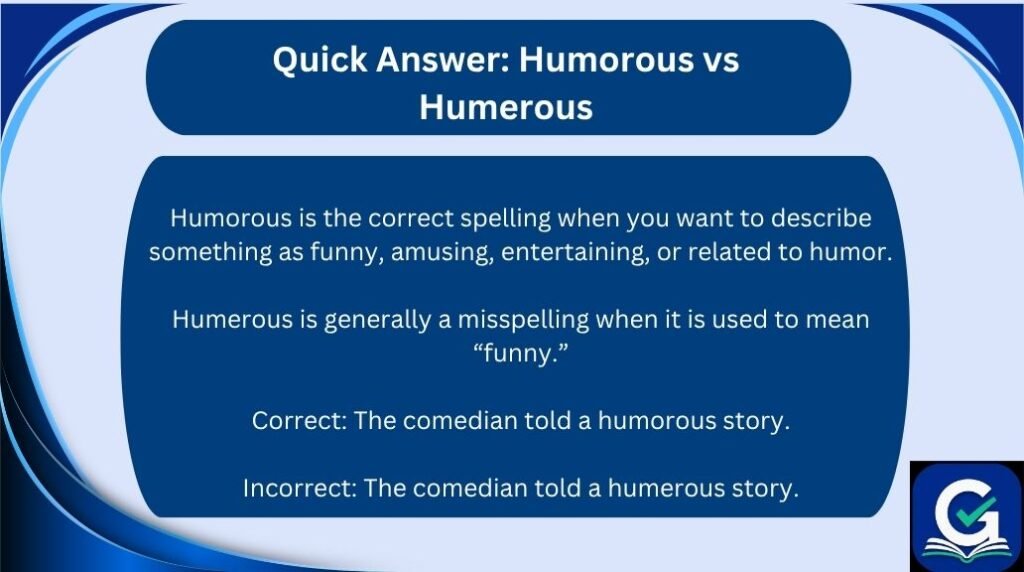
Humorous is the correct spelling when you want to describe something as funny, amusing, entertaining, or related to humor.
Humerous is generally a misspelling when it is used to mean “funny.”
Correct: The comedian told a humorous story.
Incorrect: The comedian told a humerous story.
The easiest way to remember the correct spelling is:
humor → humorous
If you can remember the word humor, you can remember where the extra “o” belongs.
Understanding the Difference
The basic difference between humorous vs humerous is very simple: one is the standard spelling, while the other is generally an error.
The correct word is humorous. It is an adjective that describes someone or something that is funny, amusing, witty, or connected with humor.
For example:
The movie has a humorous ending.
The adjective humorous describes the ending and tells us that the ending is amusing.
The spelling humerous is often created because people write the word according to how they hear it. English pronunciation can make the vowels in humorous less obvious, especially in quick speech.
Comparison Table
| Form | Type | Meaning | Example | Correct/Incorrect |
|---|---|---|---|---|
| humorous | Adjective | Funny, amusing, or related to humor | She wrote a humorous story. | ✅ Correct |
| humerous | Intended adjective | Usually intended to mean funny | She wrote a humerous story. | ❌ Incorrect |
| humor | Noun | Quality or expression of being funny | His humor is clever. | ✅ Correct |
| humorously | Adverb | In a funny or amusing way | She answered humorously. | ✅ Correct |
So, whenever you mean funny or amusing, choose humorous.
What Does “Humorous” Mean?
Humorous is an adjective. It describes something that causes amusement or contains humor.
According to standard English usage, the word can describe a person, story, situation, comment, style, tone, or other thing that is funny or amusing.
Consider these examples:
She is a humorous writer.
The word humorous describes the writer’s style or ability to create amusing content.
He made a humorous comment.
Here, humorous describes the comment.
The presentation had a humorous tone.
In this sentence, humorous describes the overall tone of the presentation.
Common Things You Can Describe as Humorous
You can use humorous with many nouns, including:
- Story
- Movie
- Book
- Speech
- Comment
- Character
- Personality
- Advertisement
- Presentation
- Article
- Conversation
- Situation
- Response
- Tone
- Writing style
For example:
The author has a humorous writing style.
Her humorous personality made everyone laugh.
The advertisement uses a humorous approach.
These examples show how flexible the word can be.
Why Is “Humerous” Incorrect?
The confusion in humorous vs humerous often comes from spelling the word based on pronunciation.
The correct word is connected to the noun:
humor
When the adjective is formed, we get:
humor + ous = humorous
The spelling does not become humerous.
This is similar to many English words where pronunciation does not give you every detail of the spelling. If you always spell words exactly as they sound, you may accidentally create errors.
For example, a person may hear humorous and think the word contains “humer,” but its written form preserves the connection with humor.
Remember the Word Family
Think of these related words:
- humor
- humorous
- humorously
- humorist
- humorless
Seeing the repeated humor pattern can make the correct spelling easier to remember.
Humorous Is an Adjective
Understanding the grammatical role of humorous can also help you use it correctly.
An adjective modifies or describes a noun.
For example:
She wrote a humorous article.
Here:
- She = subject
- wrote = verb
- a = article
- humorous = adjective
- article = noun
The word humorous tells us what kind of article she wrote.
You can also place the adjective after a linking verb:
The article was humorous.
Here, humorous describes the subject, article.
Other examples include:
His response was humorous.
The conversation became humorous.
Her explanation seemed humorous.
In each sentence, humorous functions as an adjective.
Humorous vs Funny
One reason people may hesitate about humorous vs humerous is that they are more familiar with the word funny.
Funny and humorous are closely related, but they are not always identical.
For example:
That comedian is funny.
This normally means that the comedian makes people laugh.
You can also say:
That comedian is humorous.
This has a similar meaning, although it may sound slightly more descriptive or formal.
However, funny has additional meanings.
For example:
There is a funny smell in the room.
Here, funny can mean strange or unusual rather than amusing.
Humorous is more specifically associated with humor and amusement.
Therefore, if you are describing the comedic quality of something, humorous is a useful and precise choice.
Correct Meanings and Uses
Describing a Person
You can use humorous to describe someone’s personality or communication style.
My uncle is very humorous.
This means that he often makes amusing comments or has a funny personality.
Another example:
She is known for her humorous observations.
Here, the adjective describes the observations she makes.
Describing a Story
A story can be humorous if it makes readers laugh or contains amusing situations.
The author included a humorous story about childhood.
The adjective modifies story.
Describing a Tone
Writers often use humorous to describe tone.
The article takes a humorous approach to a serious subject.
This means the article discusses a serious topic using humor.
Describing a Comment
You can also describe an individual remark as humorous.
His humorous comment made the meeting more relaxed.
The comment contains an amusing element.
Describing Creative Work
Movies, books, advertisements, plays, and television programs can all be described as humorous.
The show is a humorous look at modern family life.
This tells readers that the show uses comedy or amusement as part of its style.
A Simple Test Tip
If you are unsure about humorous vs humerous, use the humor test.
Ask yourself:
Can I connect this word to “humor”?
If yes, write:
humorous
For example:
The writer has a ______ style.
If you mean that the style is funny or amusing, the answer is:
The writer has a humorous style.
Another useful test is to replace the word with funny or amusing.
If the replacement makes sense, you probably need humorous.
Easy Formula
Funny → humor → humorous
That simple chain can help you remember the spelling.
A Real-Life Workplace Example
Imagine that an employee sends a message to a coworker after a company presentation.
The employee writes:
Your presentation was very humerous and kept everyone interested.
The intended meaning is clear, but the spelling is incorrect.
A polished version would be:
Your presentation was very humorous and kept everyone interested.
The corrected sentence uses humorous, the standard spelling.
Why the Correction Matters
A single spelling error is not usually a major communication problem. However, professional writing should be as accurate as possible.
This is especially true when writing:
- Client emails
- Business proposals
- Reports
- Resumes
- Cover letters
- Presentations
- Marketing materials
- Company websites
Knowing the difference between humorous vs humerous helps prevent a small spelling mistake from distracting the reader.
Grammar Rules Behind the Correct Spelling
The standard adjective is humorous.
It is derived from humor, a noun associated with amusement, comedy, or a person’s ability to appreciate and express what is funny.
The spelling relationship is:
humor → humorous
Standard dictionaries, including Merriam-Webster, recognize humorous as the adjective meaning funny or amusing.
The spelling humerous does not represent a standard alternative spelling of humorous in ordinary English.
This distinction is important because some spelling variations are legitimate differences between American and British English. Humerous, however, is not simply the British version of humorous.
American English vs British English
There is a genuine spelling difference between American and British English involving the noun humor.
American English
humor
British English
humour
However, the adjective is still:
humorous
This means American writers should use:
The article is humorous.
British writers also commonly use:
The article is humorous.
Therefore, humerous is not a British spelling.
This is an important point when considering humorous vs humerous. The extra “o” should not be removed just because the word may sound different when spoken.
Common Reasons People Write “Humerous”
Why does humerous appear so often?
There are several possible reasons.
1. Fast Typing
When typing quickly, people sometimes leave out letters.
Because humorous contains multiple vowels, the second “o” can easily be skipped.
2. Pronunciation
The pronunciation of humorous can make the spelling difficult to predict.
When people hear a word rather than see it written, they may create a spelling based on sound.
3. Autocorrect
Autocorrect is useful, but it does not catch every error. Some incorrect spellings may remain unnoticed.
4. Lack of Knowledge
Someone who has never learned the written form of the word may naturally guess its spelling.
5. Online Exposure
People sometimes encounter misspelled words repeatedly on websites, social media, forums, or informal messages. Repetition can make an incorrect form look familiar.
Familiarity, however, does not necessarily mean correctness.
Similar English Spelling Confusions
The humorous vs humerous problem is similar to many other common English confusions.
| Confusing Forms | Correct Choice | Difference |
|---|---|---|
| humorous / humerous | humorous | Correct spelling vs misspelling |
| your / you’re | Depends on meaning | Possession vs “you are” |
| its / it’s | Depends on meaning | Possessive vs “it is” |
| their / there / they’re | Depends on meaning | Different grammatical functions |
| affect / effect | Depends on context | Different grammatical and semantic roles |
| than / then | Depends on meaning | Comparison vs sequence/time |
| accept / except | Depends on meaning | Receive/agree vs exclude |
| definitely / definately | definitely | Common spelling error |
| separate / seperate | separate | Common vowel error |
| receive / recieve | receive | Common letter-order error |
These examples show why it is useful to learn the correct written form instead of relying entirely on pronunciation.
Using “Humorous” in Everyday Conversation
In casual conversation, people often choose simpler words such as funny, hilarious, or amusing.
For example:
That was a funny story.
You could also say:
That was a humorous story.
Both sentences are understandable, but the second one sounds slightly more descriptive.
Here are some natural examples:
She has a humorous personality.
He gave a humorous response.
That was a surprisingly humorous conversation.
The movie had several humorous scenes.
The spelling remains humorous regardless of how casual the conversation is.
Humorous in Professional Writing
Professional writing requires clarity and accuracy.
You might use humorous when discussing marketing, advertising, presentations, customer communication, or workplace culture.
For example:
The company uses humorous advertisements to connect with younger customers.
Or:
The speaker used a humorous example to explain a complicated idea.
The word is appropriate when humor is genuinely relevant to the subject.
However, professional writers should consider their audience. Humor can be effective, but it may not be suitable for every message or situation.
Humorous in Creative Writing
Creative writers often use humorous to describe tone and style.
For example:
The novel combines suspense with a humorous tone.
Or:
The main character has a humorous way of responding to difficult situations.
The adjective can help readers understand the emotional style of a story.
A humorous tone may make serious topics feel lighter, create contrast, or make characters more memorable.
Humorous in Social Media and Texting
Social media is informal, but spelling still matters.
You might write:
This is such a humorous post. 😂
Or:
Her humorous caption made everyone laugh.
On informal platforms, people may intentionally shorten words or ignore conventional punctuation. That does not make humerous the correct spelling.
If you are using standard English, write:
humorous
Why Correct Spelling Matters
At first glance, the difference between humorous vs humerous may seem tiny. After all, readers can usually understand what the writer means.
However, correct spelling has several benefits.
1. It Improves Clarity
Correct spelling helps readers move through your writing without unnecessary distractions.
2. It Builds Professionalism
Accurate writing gives the impression that you pay attention to details.
3. It Supports Credibility
When an article contains many spelling errors, readers may question the reliability of the information.
4. It Helps Digital Communication
Online content is read by people, search systems, AI tools, and other technologies. Standard spelling makes the intended meaning easier to identify.
5. It Makes Writing More Polished
Even small corrections can make a sentence look more professional.
As a useful reminder:
“Small spelling choices can make a big difference in clear writing.”
Is There a Special Exception?
There is no standard English exception that makes humerous an acceptable alternative spelling for humorous when you mean funny or amusing.
There is, however, a different word that can sometimes cause visual confusion: humerus.
Humerus is the name of the bone in the upper arm.
For example:
The X-ray showed a fracture in the humerus.
This word has nothing to do with comedy or amusement.
Compare the meanings:
humorous = funny or amusing
humerus = a bone in the upper arm
humerous = generally an incorrect spelling when intended to mean funny
Keeping these words separate can prevent additional confusion.
Humorous vs Humerous: Common Sentence Corrections
Let’s look at several practical examples.
Example 1
❌ The teacher told a humerous story.
✅ The teacher told a humorous story.
Why? The story is described as funny or amusing.
Example 2
❌ Her humerous personality made everyone comfortable.
✅ Her humorous personality made everyone comfortable.
Why? The adjective describes a funny or amusing personality.
Example 3
❌ The advertisement uses a humerous approach.
✅ The advertisement uses a humorous approach.
Why? The campaign uses humor.
Example 4
❌ His answer was surprisingly humerous.
✅ His answer was surprisingly humorous.
Why? The answer was amusing.
Example 5
❌ We enjoyed the humerous movie.
✅ We enjoyed the humorous movie.
Why? The movie contained comedy or amusing content.
How to Remember the Correct Spelling
The easiest memory trick for humorous vs humerous is to remember the root word.
Step 1: Start With “Humor”
HUMOR
Step 2: Add “-ous”
HUMOR + OUS
Step 3: Get the Correct Word
HUMOROUS
You can remember the phrase:
Humor makes something humorous.
This connection keeps the second “o” in the correct position.
Another Quick Trick
If you see humerous, ask:
Where did the word come from?
The answer is humor, so the spelling should preserve that connection:
humor → humorous
Quick Recap Checklist
Use this checklist when you are unsure about humorous vs humerous.
| Question | If Yes → Use |
|---|---|
| Do you mean funny? | humorous |
| Do you mean amusing? | humorous |
| Are you describing something related to humor? | humorous |
| Are you writing standard US English? | humorous |
| Did you write “humerous” to mean funny? | Change it to humorous |
| Are you referring to the upper-arm bone? | humerus |
Practice Questions
1. The comedian gave a ______ performance.
Answer: humorous
2. She has a very ______ personality.
Answer: humorous
3. Which spelling is correct when you mean funny: humorous or humerous?
Answer: humorous
FAQs
1. Is “humorous” or “humerous” correct?
Humorous is the correct standard spelling when you mean funny, amusing, or related to humor. Humerous is generally a misspelling in this context.
2. What does “humorous” mean?
Humorous is an adjective meaning funny, amusing, entertaining, or characterized by humor. For example, “She wrote a humorous story” means that the story is amusing.
3. Why do people spell “humorous” as “humerous”?
The error can result from pronunciation, fast typing, unfamiliarity with the word, autocorrect, or repeated exposure to the incorrect spelling.
4. Is “humerous” the British spelling?
No. British English commonly spells the noun as humour, but the adjective is still humorous. Humerous is not the standard British spelling.
5. How can I remember the spelling of “humorous”?
Connect it to the word humor. Think of the pattern humor + ous = humorous. The extra “o” becomes easier to remember when you see the word family.
6. Is “humorous” the same as “funny”?
They are closely related. Humorous means funny or amusing, while funny can also mean strange or unusual depending on context. Therefore, humorous is more specifically connected with humor.
Conclusion
The answer to humorous vs humerous is straightforward: humorous is the correct standard spelling when you mean funny, amusing, or related to humor. Humerous is generally an incorrect spelling and should not be used as an alternative form. The best way to remember the difference is to connect the adjective to its root word: humor → humorous. This spelling works in everyday conversation, professional writing, academic work, creative writing, and digital communication. Although American English uses humor and British English commonly uses humour, the adjective remains humorous. If you ever hesitate, remember the simple rule: something connected with humor is humorous. Keep that extra “o,” and you will never have to second-guess the humorous vs humerous spelling again. ✍️

I’m Amelia Parker, an English language writer at Gramfino, focused on making difficult language topics easier to understand.
I write about grammar, vocabulary, word usage, and everyday English to help readers communicate clearly.

[…] By the end, you will know exactly when to use ditto and why diddo should generally be avoided. Humorous vs Humerous | Totaling vs Totalling | Experience vs […]
[…] comparison tables, practical tests, common mistakes, and easy memory tricks. Ditto vs Diddo | Humorous vs Humerous | Totaling vs […]