Have you ever typed a word that looked right, only to stop and wonder whether you spelled it correctly? The confusion surrounding ditto vs diddo is a good example. Both forms may look believable at first glance, especially because English has many words with repeated letters and similar sounds. However, only one of these spellings is recognized as a standard English word.
If you have seen someone write “diddo” and wondered whether it was simply another spelling of “ditto,” you are not alone. This small spelling difference can create uncertainty in emails, school assignments, social media posts, and everyday conversations.
In this guide, I will explain the difference between ditto vs diddo, show you how to use the correct word, and explain why the incorrect spelling is so common. We will also look at real-life examples, grammar rules, common mistakes, and practical memory tricks. By the end, you will know exactly when to use ditto and why diddo should generally be avoided. Humorous vs Humerous | Totaling vs Totalling | Experience vs Experiance
Quick Answer: Ditto vs Diddo
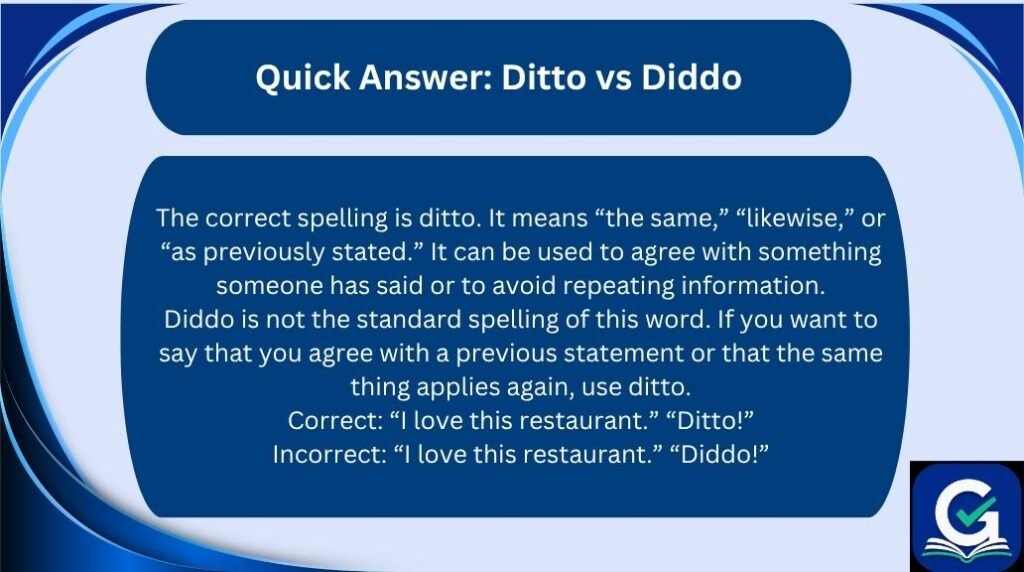
The correct spelling is ditto. It means “the same,” “likewise,” or “as previously stated.” It can be used to agree with something someone has said or to avoid repeating information.
Diddo is not the standard spelling of this word. If you want to say that you agree with a previous statement or that the same thing applies again, use ditto.
Correct: “I love this restaurant.” “Ditto!”
Incorrect: “I love this restaurant.” “Diddo!”
Merriam-Webster lists ditto as an adverb, noun, verb, and adjective, with meanings connected to repetition, agreement, or similarity.
Understanding the Basics of Ditto vs Diddo
The easiest way to understand ditto vs diddo is to remember that ditto is the established English word, while diddo is generally a misspelling.
The word ditto has been part of English for centuries. Merriam-Webster traces it to Italian ditto/detto, ultimately related to Latin dicere, meaning “to say.”
Here is the basic comparison:
| Form | Type | Meaning | Example | Correct/Incorrect |
|---|---|---|---|---|
| ditto | Adverb, noun, verb, adjective | The same; likewise; repeat or copy | “I agree with your point.” “Ditto.” | ✅ Correct |
| diddo | Nonstandard spelling | Usually intended to mean “ditto” | “I agree. Diddo.” | ❌ Incorrect in standard English |
What Does “Ditto” Mean?
Ditto generally means “the same” or “likewise.” It can also refer to something that has already been mentioned.
For example:
“I think the new policy is confusing.”
“Ditto.”
The second speaker means:
“I think the same thing.”
Cambridge Dictionary defines ditto as a word used to agree with something just said or to avoid repeating something already mentioned.
What About “Diddo”?
Diddo is usually a spelling error caused by writing the word the way it may sound.
The pronunciation of ditto can make the final vowel sound less obvious to some speakers. When people type quickly, they may also accidentally substitute d for t.
For standard English writing, however, ditto is the form you should use.
Correct Meanings and Uses of “Ditto”
Understanding the different uses of ditto makes it much easier to remember its spelling.
1. Ditto Means “The Same”
The most common conversational use of ditto is to mean “the same thing.”
Example:
“I am exhausted after that meeting.”
“Ditto.”
Here, the second speaker means:
“I am exhausted too.”
The word saves the speaker from repeating the entire sentence.
2. Ditto Means “Likewise”
Ditto can also mean likewise or similarly.
Example:
Sarah enjoyed the movie, and her brother did ditto.
A more natural modern construction would be:
Sarah enjoyed the movie, and her brother did too.
However, ditto can appear naturally in expressions such as:
The food was excellent, and ditto for the service.
The meaning is that the service was also excellent.
3. Ditto Can Show Agreement
In conversation, ditto can function as a short response.
Example:
“I really need a vacation.”
“Ditto!”
This is casual and conversational. It communicates strong agreement without repeating the original statement.
4. Ditto Can Avoid Repetition
Historically, ditto was also used to avoid writing the same information repeatedly.
For example:
| Item | Color |
|---|---|
| Shirt | Blue |
| Pants | Ditto |
| Jacket | Black |
Here, ditto means that the pants have the same color as the item immediately above them.
Cambridge notes that a ditto mark can be used in lists to mean “the same” and avoid rewriting a word or phrase.
5. Ditto Can Be Used as a Verb
This use is less common in everyday conversation, but ditto can function as a verb.
Merriam-Webster lists dittoed, dittoing, and dittos as forms of the verb. The verb can mean to repeat, imitate, echo, or copy something.
Example:
I completely ditto your recommendation.
This means:
I completely echo or support your recommendation.
Another example is:
The second team dittoed the strategy used by the first team.
In this sentence, dittoed means copied or repeated.
How to Use “Ditto” in a Sentence
The most natural way to use ditto depends on the context.
Casual Conversation
“I love pizza.”
“Ditto!”
Meaning:
“I love pizza too.”
Agreement
“That was the best concert I’ve attended this year.”
“Ditto.”
Meaning:
“I agree. I feel the same way.”
Written Comparison
The first model is affordable; ditto the second model.
Meaning:
The second model is also affordable.
Repeated Information
Monday: Office closed
Tuesday: Ditto
Here, ditto means the same information applies to Tuesday.
Test Tip: How to Know Whether “Ditto” Is Correct
Here is a simple test.
Ask yourself:
“Am I trying to say ‘the same,’ ‘likewise,’ or mas before’?”
If the answer is yes, ditto is probably the word you need.
For example:
“I agree with everything you said.”
“Ditto.”
You can mentally replace ditto with same here or me too.
If the replacement makes sense, ditto is likely appropriate.
Memory Trick
Remember:
DITTO = DO IT THE SAME
The letters are different, but the idea can help you remember the correct spelling.
Another quick trick is:
Ditto has a T, not a D in the middle.
So when deciding between ditto vs diddo, remember the standard form contains tt:
D-I-T-T-O
A Real-Life Case Study
Imagine you work in an office and your manager sends this email:
“The client meeting has been moved to Thursday at 10 a.m. Please update your calendars.”
A coworker replies:
“Done. Thanks!”
You could respond casually:
“Ditto. Thanks for the update!”
Here, ditto means:
“I have done the same thing.”
Now imagine a team conversation:
Manager:
“We need to improve communication between departments.”
Employee 1:
“I completely agree.”
Employee 2:
“Ditto.”
The second employee does not need to repeat the entire statement. Ditto communicates agreement efficiently.
What Would Be Wrong?
Writing:
“Diddo.”
would be a spelling mistake if you intend the standard English word ditto.
This illustrates why understanding ditto vs diddo matters even in ordinary workplace communication.
Grammar Rules: Why “Ditto” Is Correct
The key point is that ditto is an established English word with several recognized grammatical functions.
Merriam-Webster identifies ditto as an adverb meaning “as before” or “in the same manner.” It also lists noun, verb, and adjective uses.
Cambridge Dictionary likewise recognizes ditto as an adverb and noun. Its definitions include using the word to agree with something previously said or to avoid repeating information.
There is no equivalent standard spelling rule that turns ditto into diddo.
Why Does “Diddo” Look Plausible?
English spelling can be unpredictable.
Consider words such as:
- middle
- little
- fiddle
- bottle
- riddle
Because English contains many words with dd, some writers may naturally assume that ditto could also be spelled diddo.
However, spelling is not determined simply by how a word feels or sounds.
The established spelling is:
ditto
Not:
diddo
The History Behind the Word “Ditto”
The history of ditto is surprisingly interesting.
Merriam-Webster explains that the English word came from Italian ditto, related to detto, meaning something like “said” or “aforesaid.” The word ultimately traces back to the Latin verb dicere, meaning “to say.”
English adopted the word because it was useful for referring back to something already mentioned.
Its use developed over time. Merriam-Webster records noun usage from around the late 17th century, while adverb and verb uses appeared later.
This long history helps explain why ditto is firmly established in standard English.
Common Mistakes With Ditto vs Diddo
Why do people write diddo?
There are several likely reasons.
1. Fast Typing
When typing quickly, people often hit a nearby or expected letter without noticing.
A writer may know the word but accidentally type:
diddo
instead of:
ditto
This is especially common in informal messages where people do not proofread every sentence.
2. Pronunciation
The spoken form of ditto may cause spelling uncertainty.
Someone who has heard the word but rarely seen it written may try to spell it based on memory.
This is a common source of English spelling errors.
3. Autocorrect
Autocorrect does not always identify a typo correctly.
If a device recognizes an unusual word or accepts a nonstandard form, the writer may assume the spelling is correct.
4. Lack of Familiarity
Some people encounter ditto mainly in conversation or social media.
If they have never seen the word in a dictionary or formal writing, they may not know its standard spelling.
5. Pattern Confusion
English has many words containing double consonants. This can make diddo look visually believable even though ditto is the correct spelling.
Similar Spelling Confusions
The ditto vs diddo problem belongs to a much larger group of common English spelling and usage mistakes.
| Common Confusion | Correct Form | Meaning |
|---|---|---|
| it’s vs its | Both, depending on context | “It’s” = it is; “its” = possession |
| your vs you’re | Both, depending on context | “Your” = possession; “you’re” = you are |
| they’re vs their vs there | All three | Different grammatical functions |
| affect vs effect | Both | Different meanings and uses |
| then vs than | Both | Different meanings |
| definitely vs definately | definitely | Correct spelling |
| separate vs seperate | separate | Correct spelling |
| receive vs recieve | receive | Correct spelling |
| ditto vs diddo | ditto | Correct spelling |
The important lesson is that English spelling must be learned from established usage, not simply from pronunciation.
Using “Ditto” in Different Contexts
The word is flexible, but its tone changes depending on where you use it.
Everyday Conversation
Ditto works very well in casual speech.
Example:
“I am ready to go home.”
“Ditto.”
This sounds natural and concise.
You might also hear:
“I love this song.”
“Ditto!”
It is friendly and informal.
Professional Writing
Ditto can be appropriate in some workplace situations, especially when the tone is conversational.
For example:
“The marketing team supports the proposal; ditto the sales team.”
However, in formal reports, clarity may be better served by writing:
“The sales team also supports the proposal.”
The more formal alternative removes any possible ambiguity.
Creative Writing
Writers can use ditto to create a particular voice.
For example:
“He hated crowded restaurants. Ditto his sister.”
This gives the writing a compact, conversational rhythm.
Because creative writing allows more flexibility, ditto can be an effective stylistic choice.
Social Media and Texting
Ditto is especially useful online because it is short.
Examples:
“Best movie of the year!”
“Ditto!”
Or:
“I need coffee.”
“Ditto ☕”
In casual digital communication, the word can feel playful and natural.
Ditto vs Diddo in Formal Writing
If you are writing a school essay, business report, professional email, or academic paper, spelling accuracy matters.
Using ditto correctly demonstrates that you understand the established word.
Using diddo may make the reader stop and wonder whether it is:
- a typo,
- a name,
- a brand,
- or an unfamiliar technical term.
That interruption can reduce clarity.
For formal writing, always choose the recognized spelling:
ditto
If there is any chance the reader may not understand it, replace it with a clearer phrase such as:
- likewise
- similarly
- the same
- also
- as previously stated
Why Spelling Accuracy Matters
At first, a single letter may seem unimportant. But spelling contributes to how readers understand and evaluate written communication.
Clarity in Communication
Correct spelling helps readers process information quickly.
When they see:
“Ditto.”
they immediately recognize the intended word.
When they see:
“Diddo.”
they may hesitate.
Professionalism
Small spelling mistakes can affect how professional your writing appears.
This matters especially in:
- resumes
- cover letters
- business emails
- reports
- academic assignments
- client communication
Digital Communication
Online writing moves quickly. People often type messages without checking them.
That makes small mistakes easy to overlook.
However, a spelling error can remain visible to many readers once a message is posted publicly.
A Useful Reminder
Clear writing makes your message easier to trust.
Correct spelling is only one part of good writing, but it is an important part.
Special Exception: Could “Diddo” Ever Be Correct?
There is an important distinction between a word and a name or title.
If you encounter Diddo as a person’s name, username, company name, fictional character, product name, or other proper name, its spelling may be intentional.
In that situation, Diddo does not necessarily represent a misspelling of ditto. It may simply be a separate name or label.
The rule in this article concerns the ordinary English word meaning “the same,” “likewise,” or “as before.”
For that meaning, use:
ditto
So if someone deliberately names a product “Diddo,” that does not change the standard spelling of the English word.
When Should You Use “Ditto”?
Use ditto when you want to:
- agree with a previous statement,
- indicate that the same thing applies,
- avoid unnecessary repetition,
- refer back to information already mentioned,
- create a concise conversational response.
Examples
“I think we should leave early.”
“Ditto.”
“The first proposal was rejected; ditto the second.”
“She loves hiking, and ditto her brother.”
“I completely ditto your opinion.”
Remember that some constructions are more natural than others. In formal writing, words such as likewise, similarly, and also may be clearer.
When Should You Avoid “Ditto”?
Although ditto is correct, it is not always the best word.
Avoid it when:
- the audience may not know what it refers to,
- the previous statement is unclear,
- the writing is highly formal,
- repetition would actually improve clarity.
For example, instead of:
“The committee approved the first proposal. Ditto the second.”
you might write:
“The committee also approved the second proposal.”
The second sentence is more direct.
Good writing is not simply about choosing a correct word. It is about choosing the clearest word for the situation.
Quick Recap Checklist
Use this checklist whenever you are unsure about ditto vs diddo:
| Question | If Yes → Use |
|---|---|
| Do you mean “the same”? | ditto |
| Do you mean “likewise”? | ditto |
| Are you agreeing with a previous statement? | ditto |
| Are you avoiding repetition? | ditto |
| Are you writing the standard English word? | ditto |
| Are you using “diddo” to mean “the same”? | ❌ Change it to ditto |
Practice Example 1
Incorrect:
“I agree with your suggestion. Diddo.”
Correct:
“I agree with your suggestion. Ditto.”
Practice Example 2
Incorrect:
“The first report was accurate; diddo the second.”
Correct:
“The first report was accurate; ditto the second.”
Practice Example 3
Incorrect:
“I am tired after the long trip.”
“Diddo!”
Correct:
“I am tired after the long trip.”
“Ditto!”
A Simple Way to Remember the Correct Spelling
If you frequently confuse these two forms, use this sentence:
“Ditto means the same, and it has two T’s.”
Think of the double T as a visual reminder.
D I T T O ✅
D I D D O ❌
You can also remember that the word is connected historically to the idea of something already said or mentioned, but its modern spelling is still ditto. Merriam-Webster confirms the word’s Italian and Latin origins and its long-standing use in English.
FAQs
1. Is “ditto” or “diddo” correct?
Ditto is correct when you mean “the same,” “likewise,” or “as previously mentioned.” Diddo is generally a misspelling of ditto and should not be used as the standard English word.
2. What does “ditto” mean?
Ditto means the same, likewise, or as before. It can be used to agree with something someone has said or to avoid repeating information. Both Merriam-Webster and Cambridge Dictionary recognize these uses.
3. Can “ditto” be used in a sentence?
Yes. For example:
“I love this book.”
“Ditto.”
Here, ditto means “I love it too” or “I feel the same way.”
4. Is “diddo” a real English word?
Diddo is not the standard spelling of the English word meaning “the same.” If you intend that meaning, use ditto. A separate name, brand, username, or title could still intentionally use the spelling “Diddo.”
5. Is “ditto” formal or informal?
Ditto can be used in both written and spoken English, but it often has a casual or conversational feel when used to express agreement. In very formal writing, likewise, similarly, or also may be clearer.
6. What is the easiest way to remember “ditto”?
Remember:
Ditto = the same = two T’s.
The correct spelling is D-I-T-T-O.
Conclusion
When it comes to ditto vs diddo, the rule is simple: ditto is the correct standard English spelling. It means “the same,” “likewise,” or “as before,” and it can be used to express agreement, avoid repetition, or indicate that something previously mentioned applies again.
Diddo, when used as an attempt to spell this ordinary English word, is a misspelling. Although it may look reasonable because of English spelling patterns and fast typing habits, it is not the standard form you should choose in normal writing.
Merriam-Webster and Cambridge Dictionary both recognize ditto and document its meanings and grammatical uses.
So, whenever you find yourself wondering which spelling to use, remember the simple rule:
If you mean “the same,” choose DITTO.
One small spelling choice can make your writing clearer, cleaner, and more professional.

I’m Clara Bennett, a vocabulary and language specialist at Gramfino, where I write about word meanings and proper usage.
I love helping readers choose the right words and build stronger English vocabulary with confidence.

[…] definitions, examples, comparison tables, practical tests, common mistakes, and easy memory tricks. Ditto vs Diddo | Humorous vs Humerous | Totaling vs […]
[…] works, you can confidently choose the form that fits your sentence. There vs Their vs Theyre | Ditto vs Diddo | Humorous vs […]