Have you ever typed a word that sounds perfectly familiar but suddenly looks strange on the screen? Wiener vs weiner is one of those spelling questions that can make even careful writers stop and think. The two forms look almost identical, and they are often pronounced the same in English. The only difference is the order of two letters, but that small difference can matter.
The word wiener is most commonly used for a frankfurter, hot dog, or similar sausage. It can also appear in expressions such as “wiener dog” and in certain proper names. Weiner, meanwhile, is especially familiar as a surname, although weiner is also found as a less common spelling variant of the food-related word.
So, which spelling should you choose? In standard American English, wiener is the preferred spelling when you mean the sausage. If you are referring to someone whose surname is Weiner, however, you should preserve that person’s exact spelling.
Understanding the difference between wiener vs weiner is simple once you focus on meaning and context. This guide explains both forms, their origins, correct uses, common mistakes, and practical examples so you can choose the right spelling confidently. Aide vs Aid | High School vs Highschool | Trek vs Treck
Quick Answer: Wiener vs Weiner
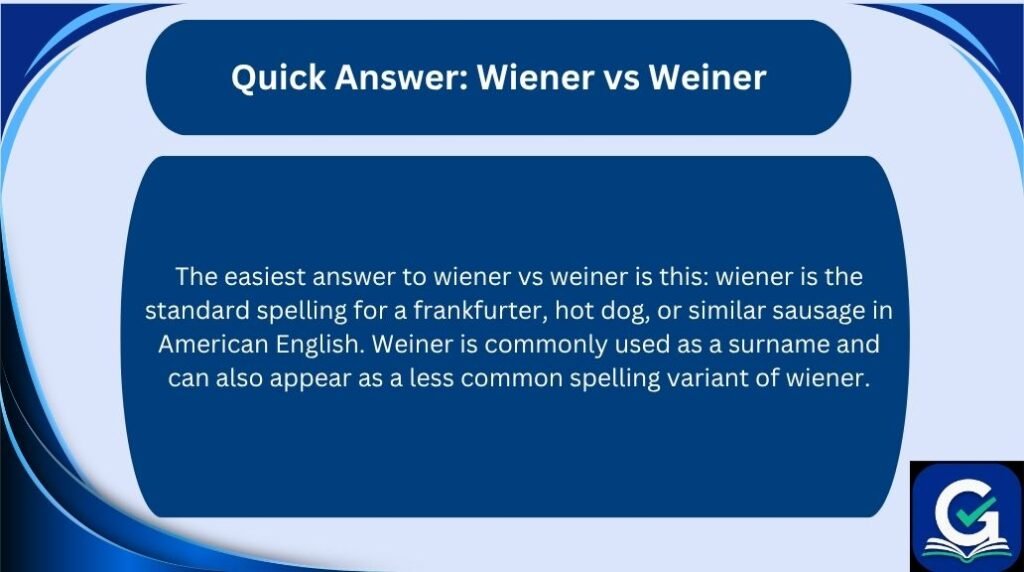
The easiest answer to wiener vs weiner is this: wiener is the standard spelling for a frankfurter, hot dog, or similar sausage in American English. Weiner is commonly used as a surname and can also appear as a less common spelling variant of wiener.
For standard writing about food, choose wiener:
We grilled several wieners for the picnic.
If you are referring to someone’s surname, use the spelling that belongs to that person:
Mr. Weiner joined the meeting.
Therefore, the safest rule is:
Food → wiener
Surname → use the person’s actual spelling
This distinction resolves most wiener vs weiner questions immediately.
Understanding Wiener vs Weiner
The core difference between wiener vs weiner involves spelling, meaning, and context.
Wiener is the established English spelling for a type of sausage. It comes from German Wiener, which is associated with Vienna, or Wien in German. English uses the word primarily in connection with frankfurters and similar sausages.
Weiner is widely recognized as a surname. It can also be found as a variant spelling of wiener, but it is not the preferred standard spelling when you are simply referring to the food.
Wiener vs Weiner Comparison Table
| Form | Type | Meaning | Example | Correct/Incorrect |
|---|---|---|---|---|
| wiener | Common noun | A frankfurter or sausage | I ordered a wiener. | ✅ Correct |
| wieners | Plural noun | More than one wiener | We grilled six wieners. | ✅ Correct |
| Wiener | Proper noun | A surname or proper name | Mr. Wiener called today. | ✅ Correct |
| Weiner | Proper noun | A surname | Ms. Weiner arrived early. | ✅ Correct |
| weiner | Variant spelling | Less common spelling of wiener | He ordered a weiner. | ⚠️ Less common |
| Weiner | Common noun for food | Nonstandard choice in most contexts | I bought a Weiner. | ❌ Usually incorrect |
The most important point is that Wiener and Weiner are not automatically interchangeable. Their correct use depends on what the writer intends to communicate.
Wiener vs Weiner: What Does Wiener Mean?
The word wiener has several meanings, but its most familiar standard meaning is a type of sausage.
Wiener as a Food
A wiener is a frankfurter or similar sausage. In American English, it is often associated with hot dogs.
Examples include:
- I put a wiener on the grill.
- The children wanted wieners for lunch.
- She ordered a chili wiener.
- We bought buns and wieners for the barbecue.
In each example, wiener is a common noun referring to food.
Wiener in Food Expressions
The word also appears in several food-related expressions:
- wiener roast
- cocktail wiener
- chili wiener
- wiener bun
- grilled wiener
For example:
Our neighborhood is hosting a wiener roast this weekend.
Here, wiener is the correct standard spelling.
Wiener as an Informal Word
Wiener can also have informal or slang meanings in English. It may refer humorously to a person who is foolish or annoying, and it can also have a childish slang meaning for the penis.
Because these meanings are informal, writers should consider the audience and context before using the word.
Wiener vs Weiner: What Does Weiner Mean?
In the wiener vs weiner comparison, Weiner is especially important as a surname.
A surname is a family name, so its spelling must be preserved.
Examples:
Sarah Weiner sent the email.
Professor Weiner gave a presentation.
The Weiner family moved to Boston.
In these sentences, Weiner is correct because it is being used as a proper name.
Weiner as a Variant
The lowercase form weiner can also be encountered as a variant spelling of wiener. However, this does not make the two forms equally preferred in every situation.
If you are writing standard American English and mean a frankfurter, wiener is the safest and most conventional choice.
That distinction is especially useful when proofreading articles, school assignments, menus, and professional documents.
Wiener vs Weiner and Their Origins
Looking at the history of wiener vs weiner makes the spelling difference easier to remember.
The food word wiener comes from German. The German word Wien is the name for Vienna. A Wiener is therefore something associated with Vienna.
The full German food expression Wiener Wurst refers to a Viennese-style sausage. English eventually adopted wiener as a shortened form.
This historical connection explains the ie spelling:
Wien → Wiener
By contrast, Weiner developed as a surname with its own naming history. Surnames can arise from occupations, locations, nicknames, and other historical sources. Different families may therefore have different but visually similar surnames.
This is one reason you should not assume that Weiner is simply a “wrong” version of every occurrence of Wiener.
Wiener vs Weiner in American English
American English generally uses wiener for the sausage.
For example:
We had hot dogs and wieners at the cookout.
In casual American speech, people may simply say hot dog, so wiener is not always the most common word in everyday conversation. However, it remains a recognized English noun.
The spelling weiner may appear in informal writing because it sounds the same or because people are familiar with Weiner as a surname.
When accuracy matters, standard usage is preferable:
The restaurant serves grilled wieners.
rather than:
The restaurant serves grilled weiners.
The first sentence follows the conventional spelling.
Wiener vs Weiner in Sentences
Looking at complete sentences can make the distinction easier to understand.
Examples With Wiener
- The vendor sold grilled wieners.
- We bought several wieners for the barbecue.
- He placed the wiener inside a toasted bun.
- The menu includes chili wieners.
- They organized a wiener roast for the neighborhood.
In all these examples, the word refers to food.
Examples With Weiner
- Mr. Weiner scheduled the meeting.
- Dr. Weiner published a new paper.
- The Weiner family attended the event.
- I received an email from Ms. Weiner.
- Professor Weiner spoke to the students.
In these sentences, Weiner is a surname.
The examples demonstrate why context is more useful than pronunciation when dealing with wiener vs weiner.
Wiener vs Weiner: Common Grammar Rules
Although this issue is primarily about spelling and word usage rather than grammar, several grammar principles can help.
Rule 1: Use Wiener for the Sausage
When referring to a frankfurter or similar sausage, wiener is the standard spelling.
We grilled three wieners.
Rule 2: Preserve Surname Spellings
If someone’s surname is Weiner, keep it as Weiner.
The report was prepared by Daniel Weiner.
Do not change the surname because wiener is a food word.
Rule 3: Capitalize Proper Names
A surname is capitalized:
Weiner
A common noun is normally lowercase:
wiener
Compare:
We ordered a wiener.
with:
Mr. Weiner arrived.
Rule 4: Follow the Intended Meaning
Do not choose a spelling simply because it sounds right. Determine what the word represents first.
This rule is especially valuable when proofreading wiener vs weiner in digital content.
Wiener vs Weiner: How to Test the Correct Usage
A quick substitution test can help.
Ask yourself:
Can I replace the word with “frankfurter” or “sausage”?
If yes, use wiener.
For example:
We grilled a ___.
Replace it:
We grilled a sausage.
The intended word is:
We grilled a wiener.
Now ask:
Is the word someone’s family name?
If yes, preserve the person’s spelling.
For example:
I spoke with Mr. ___.
If his surname is Weiner:
I spoke with Mr. Weiner.
Test Tip
Whenever you are uncertain about wiener vs weiner, first identify the meaning. Meaning first, spelling second is the easiest way to avoid the mistake.
Wiener vs Weiner: A Real-Life Case Study
Imagine a company is planning a summer picnic.
An employee sends this message:
We’re providing burgers, wieners, salads, and drinks for everyone.
The spelling wieners is correct because the employee is referring to sausages.
Now imagine that another employee is responsible for organizing the event:
Jessica Weiner will coordinate the food order.
Here, Weiner is correct because it is Jessica’s surname.
A final message might combine both:
Jessica Weiner ordered 100 wieners for the company picnic.
This sentence provides an excellent example of wiener vs weiner because both spellings appear correctly in the same sentence.
Weiner identifies the person.
wieners identifies the food.
Wiener vs Weiner in Professional Writing
Professional writing requires consistency and accuracy.
If you are creating a restaurant menu, article, product description, or workplace communication, use wiener when referring to the food.
For example:
Our lunch menu includes grilled wieners with onions and mustard.
A spelling mistake such as weiners may look careless, especially when the word appears repeatedly.
However, proper names are different.
If an employee’s surname is Weiner, professional documents must preserve that exact spelling:
Please contact Michael Weiner for additional information.
Changing the name to Wiener would introduce an error.
Therefore, professional writers should pay close attention to context when checking wiener vs weiner.
Wiener vs Weiner in Everyday Conversation
In everyday conversation, people often use hot dog instead of wiener.
For example:
I had a hot dog for lunch.
The word wiener is still perfectly understandable:
I had a wiener for lunch.
Because pronunciation does not clearly reveal the spelling, someone may not know whether the written form should contain ie or ei.
That is why reading the word regularly is helpful. Seeing wiener in dictionaries, menus, and articles reinforces the standard spelling.
In casual texting, a person might write weiner without realizing it. The meaning will often be obvious, but that does not make it the preferred spelling for formal writing.
Wiener vs Weiner in Creative Writing
Creative writing gives authors more flexibility.
A writer might intentionally use an unusual spelling to represent a character’s mistake, joke, accent, or informal communication style.
For example:
“Don’t forget the weiners!” Jake shouted from the backyard.
If the unusual spelling is intentional characterization, the author may retain it.
However, outside intentional dialogue or stylistic choices, wiener remains the safer standard spelling for the food.
Creative freedom does not mean that every spelling is equally appropriate in ordinary narration.
Wiener vs Weiner on Social Media
Social media is full of informal spelling.
Users frequently type quickly, omit punctuation, shorten words, or make accidental spelling errors. As a result, both wiener and weiner can appear online.
You may also see jokes involving the two spellings because wiener has both food-related and slang meanings.
For casual posts, a minor spelling mistake may not matter much. But if you are representing a business, publishing educational content, or building a professional profile, standard spelling is still important.
For food-related content, use:
Try our grilled wieners with homemade mustard.
rather than:
Try our grilled weiners with homemade mustard.
Why Wiener vs Weiner Matters
A one-letter difference may seem insignificant, but accurate spelling improves communication.
Clarity
Readers should be able to understand your intended meaning without stopping to interpret the word.
Professionalism
Correct spelling makes business writing, educational content, and published material look more polished.
Accuracy
A person’s name is part of their identity in written communication. Changing Weiner to Wiener can create an incorrect name.
Digital Communication
Online writing is often scanned quickly. Clear spelling helps readers, search systems, and digital tools understand your content more easily.
A useful principle is:
Small spelling details can create big differences in meaning.
That principle applies far beyond wiener vs weiner.
Wiener vs Weiner and Similar Spelling Confusions
The confusion between wiener vs weiner is similar to many other English word pairs.
| Confusing Words | Correct Difference |
|---|---|
| your / you’re | Your shows possession; you’re means “you are.” |
| its / it’s | Its shows possession; it’s means “it is” or “it has.” |
| their / there / they’re | Each has a different grammatical function. |
| than / then | Than is used for comparisons; then often refers to time or sequence. |
| affect / effect | Usually, affect is a verb and effect is a noun, although exceptions exist. |
| accept / except | Accept means receive or agree; except means excluding. |
| principal / principle | Principal can mean a person or main item; principle means a rule or belief. |
| wiener / weiner | Wiener is the standard food spelling; Weiner is commonly a surname. |
These pairs show why writers should consider meaning instead of relying only on pronunciation.
Wiener vs Weiner: Why Do People Make the Mistake?
Several factors contribute to the confusion.
Fast Typing
People often type words according to how they sound. Because wiener and weiner can sound identical, the wrong letter order can easily slip through.
Autocorrect
Digital keyboards may not always identify every unusual spelling as an error. A writer may therefore send a message without noticing the difference.
Lack of Familiarity
Someone who has mostly heard the word spoken may never have had a reason to remember its written form.
Familiarity With Surnames
Because Weiner is an established surname, writers may already recognize that spelling. This can influence how they spell the food-related word.
Pronunciation
Pronunciation provides little help because the two spellings can represent the same or very similar pronunciation.
The best solution is simple: learn the conventional spelling and check the context.
Wiener vs Weiner: Special Exceptions
There are several situations where context overrides the general rule.
Personal Names
If a person is named Weiner, that spelling is correct.
If a person is named Wiener, that spelling is correct.
Names should not be changed to fit a general spelling rule.
Historical Names
Historical figures may have established names containing either spelling. Always reproduce the documented name.
Creative or Deliberate Variants
A writer may intentionally use weiner as a variant spelling in dialogue, humor, branding, or another specific context.
The important thing is to distinguish deliberate usage from an accidental spelling error.
Brand Names
A company, product, restaurant, or organization may use an unusual spelling as part of its official branding. If you are writing about such a brand, follow its official spelling rather than automatically applying the general food rule.
Wiener vs Weiner: Singular and Plural Forms
Understanding number can also help.
The singular food noun is:
wiener
The plural is:
wieners
Examples:
- I ate one wiener.
- We ordered two wieners.
- The restaurant sells grilled wieners.
The spelling does not change when you make the word plural; you simply add -s.
For surnames, the same basic principle applies to ordinary pluralization, but writers should be careful with family names and possessives.
For example:
The Weiners hosted a dinner.
Here, Weiners refers to a family with the surname Weiner.
This demonstrates another reason why context matters in wiener vs weiner.
Wiener vs Weiner: Quick Recap Checklist
Use this checklist when you need to decide between the two forms.
| Question | If Yes → Use |
|---|---|
| Are you referring to a frankfurter? | wiener |
| Are you referring to a sausage? | wiener |
| Are you talking about a hot dog using this informal term? | wiener |
| Are you writing about a person named Weiner? | Weiner |
| Are you writing about a person named Wiener? | Wiener |
| Is the unusual spelling part of an official brand? | Use the brand’s official spelling |
| Is the spelling intentionally used in creative dialogue? | Preserve the intended form |
Practice Example 1
Sentence: We bought five ___ for the barbecue.
Answer: wieners
We bought five wieners for the barbecue.
Practice Example 2
Sentence: Mr. ___ will contact you tomorrow.
If his surname is Weiner:
Mr. Weiner will contact you tomorrow.
Practice Example 3
Sentence: The restaurant specializes in grilled ___.
Answer: wieners
The restaurant specializes in grilled wieners.
Wiener vs Weiner: Easy Memory Trick
One of the easiest ways to remember the standard spelling is to connect wiener with Vienna.
In German:
Wien = Vienna
Therefore:
Wien → Wiener
When you see wiener on a menu, think of its Vienna-related origin.
For Weiner, think of a person’s surname instead.
A simple mental rule is:
Wiener = food
Weiner = name, when that is the established surname
This is not an absolute rule for every historical or variant use, but it works very well for ordinary American English writing.
Wiener vs Weiner: Final Decision Guide
If you are writing an article, email, school assignment, menu, or social media post and you encounter this spelling question, follow these steps:
- Identify the meaning.
- If it means a sausage, choose wiener.
- If it is a person’s surname, copy the person’s actual spelling.
- If it is a brand or proper name, follow the official spelling.
- If you encounter weiner as a food spelling, check whether it is intentional or simply a variant/error.
- For standard American English, prefer wiener for the food.
This approach is more reliable than trying to determine the answer from pronunciation alone.
FAQs
1. Is wiener or weiner the correct spelling?
Wiener is the standard spelling for a frankfurter or similar sausage in American English. Weiner is commonly used as a surname and is also found as a less common variant spelling.
2. Is “weiner” always wrong?
No. Weiner can be a perfectly correct surname. The lowercase spelling weiner can also appear as a variant of wiener. However, wiener is the preferred standard spelling when referring to the food.
3. Why is the sausage spelled wiener?
The word comes from German Wiener, which is connected with Wien, the German name for Vienna. The English food term developed from this German connection.
4. Is Wiener a person’s last name?
Yes. Wiener can be a surname. If someone’s surname is Wiener, that spelling should be preserved exactly.
5. Is Weiner a real last name?
Yes. Weiner is an established surname. If a person’s family name is Weiner, writing it as Wiener would be incorrect.
6. How can I remember the difference between wiener and weiner?
For the food, remember Wien → Wiener, because Wien is the German name for Vienna. For a person’s surname, use whatever spelling belongs to that person.
Conclusion
The wiener vs weiner question becomes much easier when you focus on meaning rather than pronunciation. In standard American English, wiener is the preferred spelling for a frankfurter, hot dog, or similar sausage. The spelling is connected historically to the German word Wiener, associated with Vienna.
Weiner is commonly encountered as a surname, and it should always be preserved when it is someone’s established family name. Although weiner can appear as a less common variant spelling of the food term, wiener remains the safer choice for standard writing.
Remember the simple distinction: use “wiener” for the food, and use “Weiner” when that is the person’s actual name. Context is the key to choosing correctly.
When spelling feels uncertain, do not rely on sound alone. Ask what the word means, check how it is being used, and then choose the appropriate form. One small spelling difference can make your writing much clearer.

I’m Amelia Parker, an English language writer at Gramfino, focused on making difficult language topics easier to understand.
I write about grammar, vocabulary, word usage, and everyday English to help readers communicate clearly.
[…] examine the grammar behind the expression, explore common mistakes, and provide practical examples. Wiener vs Weiner | Aide vs Aid | High School vs […]