Have you ever typed a sentence such as “Team A verses Team B” and then paused to wonder whether “verses” is actually correct? You are not alone. Versus vs. verses is a common English confusion because the two words look and sound remarkably similar.
In speech, the difference can be especially difficult to notice, but in writing, choosing the wrong word can change the meaning of a sentence completely.
The good news is that the rule is simple once you connect each word with its meaning.
Versus means “against,” “in contrast with,” or “as an alternative to.” It commonly appears when two people, teams, ideas, choices, or things are being compared or placed in opposition. Verses, on the other hand, is normally the plural of verse, referring to lines or sections of poetry, songs, or scripture.
So, if you are writing about a basketball game, you probably need versus. If you are talking about several parts of a song, poem, or religious text, you probably need verses.
Let’s make the difference easy to remember. 👇 Informal vs. Unformal | Optimize vs Optimise | Practices vs Practises
Quick Answer: Versus vs. Verses
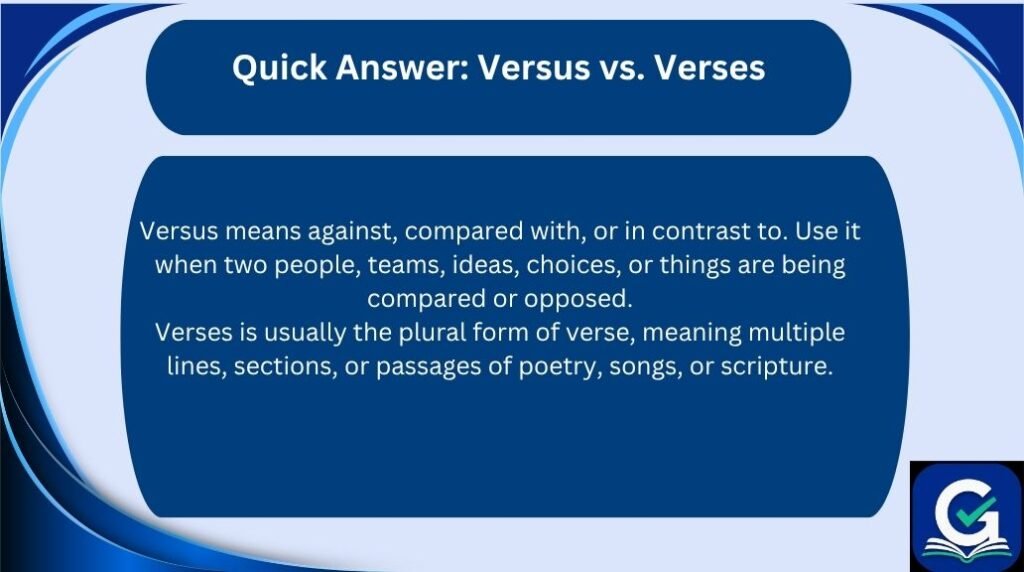
Versus means against, compared with, or in contrast to. Use it when two people, teams, ideas, choices, or things are being compared or opposed.
Verses is usually the plural form of verse, meaning multiple lines, sections, or passages of poetry, songs, or scripture.
Easy memory trick:
- versus = against ⚔️
- verses = parts of a poem, song, or scripture 📖🎵
For example:
- Correct: The Lakers are playing versus the Celtics.
- Correct: She memorized three verses of the song.
- Incorrect: The Lakers are playing verses the Celtics.
Understanding the Basics of Versus vs. Verses
The biggest difference between versus and verses is their grammatical function and meaning.
What Does “Versus” Mean?
Versus is a preposition meaning “against” or “in contrast to.” It can describe a direct contest, a comparison, or a choice between alternatives. Merriam-Webster defines it as meaning “against” and also “in contrast to or as the alternative of.”
Examples include:
- Team A versus Team B
- Traditional marketing versus digital marketing
- Renting versus buying
- Quality versus quantity
- Plaintiff versus defendant
In each case, versus establishes a relationship between two sides or alternatives.
What Does “Verses” Mean?
Verses is most commonly the plural form of the noun verse.
A verse can mean a line of poetry, a section of a song, a stanza, or one of the short divisions of a chapter of scripture. Therefore, verses refers to more than one such unit.
Examples include:
- The poem contains several verses.
- She sang the first two verses.
- The book contains many biblical verses.
- He wrote three verses for the song.
Versus vs. Verses Comparison Table
| Form | Type | Meaning | Example | Correct/Incorrect |
|---|---|---|---|---|
| versus | Preposition | Against; in contrast with; compared with | The Tigers played versus the Bears. | ✅ Correct |
| verses | Plural noun | More than one verse | She memorized several verses. | ✅ Correct |
| verses | Informal verb | Competes against or opposes | He is versing another player. | ⚠️ Informal |
| versus | Preposition | Against or as an alternative | Coffee versus tea | ✅ Correct |
| verses in place of versus | Wrong word choice | Does not mean “against” in standard usage | The Tigers played verses the Bears. | ❌ Incorrect |
The crucial point is this: versus and verses are different words, even though they sound alike. Merriam-Webster describes them as homophones—words that are pronounced alike but differ in meaning, derivation, or spelling.
Correct Meanings and Uses of “Versus”
1. Versus Means “Against”
This is the most familiar use of versus.
Use it when one person or team competes against another.
Example:
The Eagles will play versus the Giants on Sunday.
Here is the sentence breakdown:
- The Eagles = one team
- versus = against
- the Giants = opposing team
You could replace versus with against:
The Eagles will play against the Giants on Sunday.
That replacement works because versus and against have similar meanings in this context.
2. Versus Shows a Comparison
Versus is not limited to sports.
It can also introduce a comparison between two things.
For example:
Online learning versus classroom learning remains an important educational debate.
The sentence compares two approaches:
- online learning
- classroom learning
Another example:
Quality versus quantity is a common business dilemma.
The writer is not necessarily saying that quality and quantity are physically fighting. Instead, the sentence presents them as competing priorities.
3. Versus Shows Alternative Choices
You can also use versus when considering one option against another.
For example:
Should you buy versus rent a home?
A more natural construction might be:
Should you buy a home versus rent one?
Here, versus introduces the alternative being considered.
Other examples include:
- Driving versus taking the train
- Saving versus spending
- Working remotely versus working in an office
- Cooking at home versus eating out
In these examples, versus can often be understood as “compared with” or “rather than.”
Correct Meanings and Uses of “Verses”
1. Verses as Parts of a Song
One of the most common uses of verses is to describe multiple sections of a song.
For example:
The singer performed the first two verses before the chorus.
Here, verses is the plural of verse.
A typical song may contain:
- a verse
- another verse
- a chorus
- perhaps a bridge
- additional verses
Therefore:
I like the second verse.
means one section.
But:
I like the second and third verses.
means more than one section.
2. Verses in Poetry
Verses can also refer to multiple lines or units of poetic writing.
For example:
The poet divided the work into four verses.
Here, verses has nothing to do with competition or opposition.
3. Verses in Scripture
The word verse is also used for short divisions of chapters in religious texts, including the Bible and other scriptures. Merriam-Webster specifically includes this meaning in its definition of verse.
For example:
She read several verses from the Bible.
This is clearly verses, not versus, because the sentence refers to passages of scripture.
Test Tip: Replace the Word
Here is a simple test for versus vs. verses:
Can you replace the word with “against” or “compared with”?
- If yes → use versus.
- If no, and you mean multiple parts of a poem, song, or scripture → use verses.
Try these:
The Yankees ___ the Red Sox.
Replace the blank with against:
The Yankees against the Red Sox.
The meaning works, so versus is correct.
Now try:
She sang three ___ of the song.
Can you replace the blank with against?
No.
Therefore, verses is correct.
A Real-Life Case Study: Versus vs. Verses in the Workplace
Imagine that a marketing manager sends this email:
“For tomorrow’s meeting, we’ll discuss traditional advertising verses social media advertising.”
At first glance, the sentence might seem fine. The writer probably means that the team will compare two marketing approaches.
However, verses is the wrong word.
The corrected sentence is:
“For tomorrow’s meeting, we’ll discuss traditional advertising versus social media advertising.”
Why?
Because the manager is comparing two alternatives:
- traditional advertising
- social media advertising
The intended meaning is essentially:
traditional advertising compared with social media advertising
Therefore, versus is the correct choice.
Another Workplace Example
Imagine a colleague writes:
“Please prepare a report on remote work verses office work.”
Again, the intended meaning is comparison.
The correct sentence is:
“Please prepare a report on remote work versus office work.”
This small spelling difference matters because professional writing depends on precision. A reader may understand the intended meaning, but the incorrect word can still make the writing appear careless.
Grammar Rules: Why “Versus” Is Correct in Comparisons
The grammar rule becomes easier when you understand what each word does.
“Versus” Is a Preposition
Merriam-Webster classifies versus as a preposition. Its core meanings include “against” and “in contrast to or as the alternative of.”
That is why you can write:
The defendant versus the plaintiff
or:
Summer versus winter
or:
Private school versus public school
The word connects two sides, opponents, or alternatives.
“Verses” Is Usually a Plural Noun
Verses is the plural form of verse.
A verse can be:
- a line of metrical writing
- poetry
- a poem
- a stanza
- a section of a song
- a short division of scripture
So:
The singer forgot the verses.
means the singer forgot several song sections.
It does not mean:
The singer forgot the opponents.
Why the Confusion Happens
The confusion is understandable because versus and verses have very similar pronunciations.
In ordinary conversation, listeners often rely on context rather than spelling. When the words are written, however, the distinction becomes visible.
Merriam-Webster specifically notes that the two words sound alike but have different meanings and should not be substituted for one another in writing.
Versus Abbreviations: “vs.”, “vs,” and “v.”
You will often see versus abbreviated.
Common forms include:
- vs.
- vs
- v.
Merriam-Webster notes that vs, vs., and v. can be used as abbreviations of versus.
For example:
Lakers vs. Celtics
or:
Smith v. Jones
The exact abbreviation style can depend on the context and style guide.
An Important Point About “vs.”
Don’t confuse vs. with verses.
The abbreviation vs. represents versus.
For example:
Team A vs. Team B
means:
Team A versus Team B.
Merriam-Webster’s dictionary also lists vs. as an abbreviation associated with versus.
Common Mistakes With Versus and Verses
Mistake 1: Writing “Verses” for a Competition
❌ The Cowboys play verses the Eagles.
✅ The Cowboys play versus the Eagles.
The mistake happens because the writer is spelling the word according to how it sounds.
Mistake 2: Writing “Versus” When Talking About Songs
❌ She sang three versus.
✅ She sang three verses.
The intended meaning is multiple sections of a song, so verses is correct.
Mistake 3: Confusing Comparison With Poetry
❌ The article compares traditional media verses digital media.
✅ The article compares traditional media versus digital media.
The sentence describes a comparison, not poetry.
Why Do These Mistakes Happen?
There are several common reasons:
Fast typing:
When people type quickly, they may write the first spelling that comes to mind.
Autocorrect:
Spell-checking software may not recognize a context-based word-choice error. Both versus and verses are legitimate English words, so software may not flag the wrong one.
Lack of knowledge:
Some writers simply have never learned the distinction.
Similar pronunciation:
Because the words are homophones, hearing them does not always reveal which spelling is intended.
This is an important lesson in proofreading: A word can be spelled correctly and still be the wrong word.
Similar Grammar Confusions
The versus vs. verses problem belongs to a larger group of English word-choice mistakes.
| Confusing Words | Correct Difference | Example |
|---|---|---|
| versus / verses | against / multiple verses | Cars versus trains; three song verses |
| it’s / its | it is / possessive form | It’s cold; the dog wagged its tail |
| your / you’re | possessive / you are | Your phone; you’re late |
| there / their / they’re | place / possession / they are | Put it there; their car; they’re ready |
| to / too / two | direction/infinitive / additionally / number | Go to school; me too; two books |
| then / than | time/sequence / comparison | First this, then that; taller than me |
| affect / effect | usually verb / usually noun | Stress can affect sleep; the effect was noticeable |
| your / yore | possessive / past time | Your idea; days of yore |
The lesson is simple: context determines which correctly spelled word belongs in a sentence.
Versus vs. Verses in Different Contexts
The right choice becomes especially easy when you look at different types of writing.
Everyday Conversation
In casual conversation, people often say versus when discussing competition or comparison.
Examples:
Who’s playing versus the home team?
I’m trying to decide between coffee versus tea.
It’s experience versus education.
For song sections:
I only remember the first two verses.
Because people hear rather than see the spelling during conversation, the distinction becomes more important when the same ideas are written down.
Professional Writing
Professional writing requires careful word choice.
Use versus when discussing:
- business strategies
- competing products
- legal cases
- research comparisons
- alternative solutions
- competing priorities
Examples:
The report examines in-house hiring versus outsourcing.
The court considered the case of Smith versus Jones.
Avoid writing verses when you mean versus.
Creative Writing
Both words can appear in creative writing, but they serve completely different purposes.
For example:
The story explored courage versus fear.
Here, versus creates a thematic contrast.
Meanwhile:
The poet arranged the verses into three distinct sections.
Here, verses refers to poetic structure.
Social Media and Texting
Social media users frequently shorten versus to vs.
Examples:
Who wins: Team A vs. Team B? 🏆
Homemade pizza vs. takeout 🍕—which do you prefer?
In informal writing, abbreviations are common. Still, verses should not be used simply because it sounds like versus.
Versus in Legal and Formal Contexts
One particularly important use of versus appears in legal cases.
You may see names written in a format such as:
Smith v. Jones
Here, v. is an abbreviation for versus. Merriam-Webster also identifies v. as a legal abbreviation for versus.
The word is also common in formal comparisons:
The study examined medication A versus medication B.
The report compared federal policy versus state policy.
In these settings, precise word choice is especially important because the writing may be read by professionals, researchers, lawyers, or decision-makers.
Special Exception: The Informal Verb “Verse”
There is an interesting edge case worth knowing.
Although verses is normally the plural of verse, Merriam-Webster also records an informal verb verse, meaning to compete against or oppose someone.
For example:
He is versing another player.
This usage developed from versus and is found in informal speech and writing.
However, it should not be used as a reason to replace versus with verses in standard comparison sentences.
For example:
❌ The two teams will verses each other.
The standard choice is:
✅ The two teams will versus each other.
Even better:
✅ The two teams will play against each other.
The informal verb verse is a separate usage and does not change the standard distinction between versus and verses. Merriam-Webster notes that this verb is informal and dates its first known use to the 20th century.
Why the Difference Matters
At first, versus vs. verses may seem like a tiny spelling issue. But word choice affects communication.
1. Clarity
Correct word choice helps readers understand exactly what you mean.
Compare:
The report discusses taxes verses spending.
with:
The report discusses taxes versus spending.
The second sentence immediately communicates a comparison.
2. Professionalism
Errors involving commonly confused words can make otherwise strong writing appear less polished.
A business proposal, résumé, academic assignment, report, or formal email should use the correct word.
3. Digital Communication
Online communication moves quickly. Emails, social media posts, text messages, blogs, and websites are often written under time pressure.
That makes homophone mistakes particularly common.
A quick proofreading check can prevent them.
4. Writing Accuracy
Good writing is not simply about avoiding misspellings. It is also about choosing the word that expresses the intended meaning.
As a useful rule:
Correct spelling is not enough; correct meaning matters too.
Quick Recap Checklist
Use this checklist whenever you are unsure about versus vs. verses.
| Question | If Yes → Use |
|---|---|
| Does the word mean “against”? | versus |
| Are you comparing two things? | versus |
| Are you presenting two alternatives? | versus |
| Are two teams competing? | versus |
| Are you talking about multiple parts of a song? | verses |
| Are you talking about multiple sections of a poem? | verses |
| Are you referring to multiple passages of scripture? | verses |
| Can you replace the word with “against”? | versus |
| Does the word mean more than one “verse”? | verses |
Practice Examples
1. The championship game is Team A ___ Team B.
Answer: versus
The championship game is Team A versus Team B.
2. The singer performed three ___.
Answer: verses
The singer performed three verses.
3. The article examines traditional advertising ___ digital advertising.
Answer: versus
The article examines traditional advertising versus digital advertising.
One-Second Memory Trick
Think:
VS = competition or comparison.
VERSES = more than one verse.
That’s the whole rule in a nutshell. 🧠
FAQs About Versus vs. Verses
1. What is the difference between “versus” and “verses”?
Versus means against, in contrast with, or compared with. Verses is usually the plural of verse, meaning multiple sections or lines of a poem, song, or scripture.
2. Is it “Team A versus Team B” or “Team A verses Team B”?
The standard form is “Team A versus Team B.”
You can also abbreviate versus as vs., depending on the writing style:
Team A vs. Team B
Verses is incorrect when you mean “against.”
3. Is “verses” ever correct?
Yes. Verses is correct when it is the plural of verse.
For example:
She memorized several verses of the poem.
It can also occur in the informal verb usage versing, meaning competing against someone, but that is distinct from the standard preposition versus.
4. Is “versus” abbreviated as “vs.”?
Yes. Versus is commonly abbreviated as vs., vs, or v., depending on context and style.
For example:
The Giants vs. the Eagles
5. Are “versus” and “verses” pronounced the same?
They are commonly treated as homophones, meaning they have the same or very similar pronunciation while differing in spelling and meaning. This similarity is a major reason writers confuse them.
6. How can I remember whether to use “versus” or “verses”?
Use this simple memory device:
Versus = against.
Verses = multiple verses.
If you are comparing two things, choose versus. If you are talking about multiple sections of a song, poem, or scripture, choose verses.
Conclusion
The difference between versus vs. verses is straightforward once you focus on meaning rather than pronunciation.
Versus is a preposition meaning against, in contrast with, or as an alternative to. Use it for competitions, comparisons, contrasts, and opposing sides. Verses is generally the plural of verse, so use it when discussing multiple sections or lines of poetry, songs, or scripture.
Remember the easiest test: If you can replace the word with “against,” use “versus.” If you mean more than one verse, use verses.
So write:
Team A versus Team B.
But:
The singer performed three verses.
The two words may sound alike, but their jobs are completely different. Once you connect versus with comparison and verses with multiple sections of a verse, this common grammar confusion becomes easy to avoid.
When in doubt, check the meaning—not just the sound.

I’m Jordan Hayes, a proofreading and editing writer at Gramfino, focused on clear and accurate English.
I enjoy finding common writing mistakes and sharing simple ways to make sentences stronger and easier to read.
[…] common mistakes, and give you practical examples that make the correct form easy to remember. 😊 Versus vs. Verses | Informal vs. Unformal | Optimize vs […]
[…] you can use in everyday, academic, professional, and online writing. 👶 Suing vs. Sueing | Versus vs. Verses | Informal vs. […]
[…] This guide explains the difference between wracking vs. racking, shows when to use each form, and gives you simple tests to remember the correct spelling. 🧠 Babies vs Babys | Suing vs. Sueing | Versus vs. Verses […]