Have you ever typed “sueing” and suddenly wondered whether it should actually be “suing”? You are not alone. The spelling question “suing vs. sueing” is surprisingly common because the word sue does not look like many other verbs when it takes the -ing ending.
At first, sueing seems logical. You might think that you simply take sue and add -ing. However, standard English spelling uses a different pattern here. The final e in sue is dropped before -ing is added, giving us suing.
This distinction is especially important because suing appears in news stories, legal discussions, business emails, workplace conversations, academic writing, and everyday speech. A small spelling mistake can make an otherwise professional sentence look less polished.
So, in the suing vs. sueing debate, which form should you use?
The answer is straightforward: suing is correct, and sueing is incorrect in standard English.
In this guide, we will explain the difference, show you how to use suing correctly, explain the spelling rule, examine common mistakes, and give you practical examples that make the correct form easy to remember. 😊 Versus vs. Verses | Informal vs. Unformal | Optimize vs Optimise
Quick Answer: Suing vs. Sueing
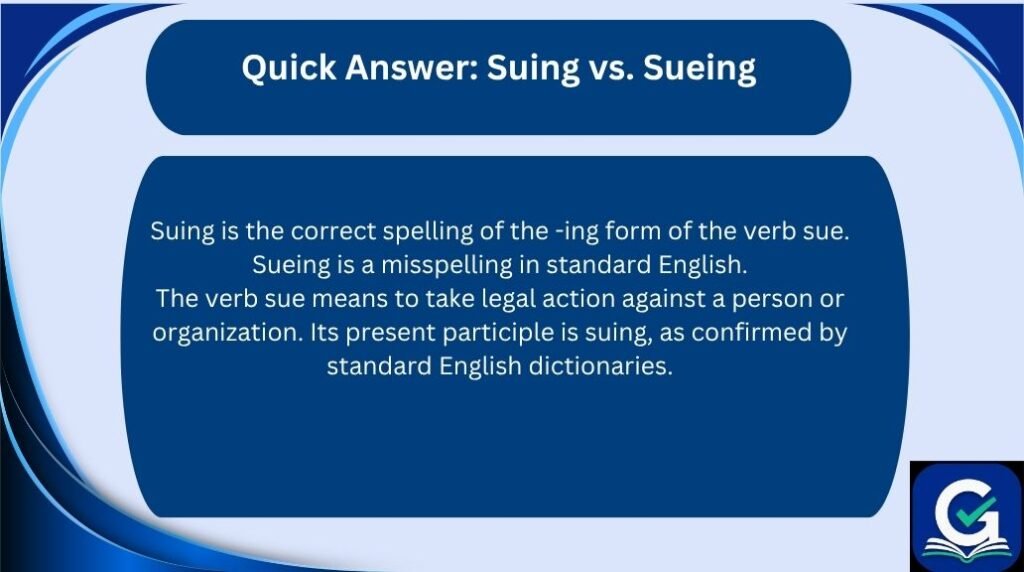
Suing is the correct spelling of the -ing form of the verb sue. Sueing is a misspelling in standard English.
The verb sue means to take legal action against a person or organization. Its present participle is suing, as confirmed by standard English dictionaries.
The simple rule:
sue → suing
Not:
sue → sueing
If you are deciding between suing vs. sueing, always choose suing when you mean “taking legal action.”
Understanding the Basics of Suing vs. Sueing
The easiest way to understand suing vs. sueing is to look at the base verb first.
The base verb is:
sue
When you use the verb in an -ing form, it becomes:
suing
The final e is removed.
This is part of a common English spelling pattern involving verbs that end in a silent e.
For example:
- make → making
- bake → baking
- take → taking
- use → using
- write → writing
- move → moving
- sue → suing
Therefore, the correct transformation is:
sue + ing = suing
The form sueing keeps the final e, which is why it is considered incorrect in standard English.
Suing vs. Sueing Comparison Table
| Form | Type | Meaning | Example | Correct/Incorrect |
|---|---|---|---|---|
| sue | Base verb | To take legal action | “They plan to sue the company.” | ✅ Correct |
| suing | Present participle / -ing form | Taking legal action | “They are suing the company.” | ✅ Correct |
| sued | Past tense / past participle | Took legal action | “They sued the company.” | ✅ Correct |
| sues | Third-person singular | Takes legal action | “She sues companies for damages.” | ✅ Correct |
| sueing | Incorrect -ing form | Intended to mean “taking legal action” | “They are sueing the company.” | ❌ Incorrect |
This table gives you the basic answer to the suing vs. sueing question: suing is the standard spelling.
What Does “Suing” Mean?
To understand suing vs. sueing, you also need to understand what suing actually means.
Suing is the present participle of sue. The verb sue means to take legal action against someone or an organization, often by making a legal claim. Cambridge Dictionary lists suing as the present participle of sue.
For example:
“The customer is suing the company.”
This means the customer is taking legal action against the company.
The sentence can be broken down like this:
- The customer = subject
- is = helping verb
- suing = present participle
- the company = object
The word suing tells us what action the customer is currently taking.
Another example is:
“Several employees are suing their former employer.”
Here, are suing is a present progressive verb phrase.
The meaning is that the employees are currently involved in legal action against their former employer.
Why Is “Suing” Correct Instead of “Sueing”?
The central issue in suing vs. sueing is the final e.
Many English verbs end with a silent e. When these verbs are changed into their -ing forms, the final e is commonly removed.
For example:
hope → hoping
drive → driving
write → writing
use → using
Following the same pattern:
sue → suing
The spelling sueing incorrectly retains the final e.
The spelling transformation
Think about it in three steps:
Step 1: Start with the base verb.
sue
Step 2: Add -ing.
You might initially think:
sue + ing
Step 3: Remove the final silent e.
suing
That gives us the standard form.
This is the key spelling rule behind the suing vs. sueing confusion.
Is “Sueing” Ever Correct?
In ordinary standard English, sueing is not the correct spelling of the -ing form of sue.
You may occasionally see sueing online because of:
- typing mistakes,
- spelling mistakes,
- autocorrect problems,
- OCR errors,
- transcription errors,
- user-generated content,
- or an intentionally unusual name.
However, seeing a spelling online does not automatically make it standard English.
If your sentence means “taking legal action,” the correct spelling is:
suing
For example:
❌ “The customer is sueing the retailer.”
✅ “The customer is suing the retailer.”
The second sentence follows standard English spelling.
Suing vs. Sueing in a Sentence
A useful way to understand suing vs. sueing is to compare correct and incorrect sentences.
Incorrect
“The company is sueing its former partner.”
The problem is the spelling sueing.
Correct
“The company is suing its former partner.”
The word suing is the present participle of sue.
Another example
❌ “They are sueing the manufacturer for damages.”
✅ “They are suing the manufacturer for damages.”
Another example
❌ “She considered sueing her landlord.”
✅ “She considered suing her landlord.”
Notice that the correct spelling remains suing even when it follows a different grammatical structure.
Suing vs. Sue: What Is the Difference?
The suing vs. sueing question can sometimes become confused with another question: sue vs. suing.
These are different issues.
“Sue” is the base form
Use sue when the grammar calls for the base verb.
Examples:
“They plan to sue the company.”
“She wants to sue her former employer.”
“They may sue for damages.”
“He threatened to sue.”
In these examples, sue is the correct form.
“Suing” is the -ing form
Use suing when the sentence requires the -ing form.
Examples:
“They are suing the company.”
“She is suing her former employer.”
“The group is considering suing the manufacturer.”
The important point is:
sue = base verb
suing = -ing form
So, when discussing suing vs. sueing, do not accidentally replace suing with sue when the sentence requires an -ing form.
Grammar Rules Behind Suing vs. Sueing
The spelling of suing is connected to how English forms present participles.
A present participle is an -ing form of a verb. It can be used with forms of be to create continuous verb constructions. Cambridge Dictionary explains that present participles end in -ing and can be used with another verb to express continuous action.
For example:
“She is working.”
“They are running.”
“He is writing.”
Similarly:
“She is suing.”
The grammatical structure is:
subject + be + present participle
Therefore:
She + is + suing.
The spelling suing is not optional. It is the standard present participle of sue.
Why the final “e” disappears
The spelling pattern is not unique to sue.
Compare:
| Base Verb | -ing Form |
|---|---|
| make | making |
| bake | baking |
| take | taking |
| drive | driving |
| write | writing |
| use | using |
| move | moving |
| sue | suing |
This comparison makes the answer to suing vs. sueing easier to remember.
Correct Meanings and Uses of “Suing”
The word suing can appear in several grammatical situations.
1. Present Progressive
The most familiar use is with a form of be.
“The customer is suing the company.”
This indicates that the legal action is currently in progress.
Another example:
“The investors are suing the corporation.”
Here, are suing is the present progressive construction.
2. After Certain Verbs
Some verbs are followed naturally by an -ing form.
For example:
“They considered suing the contractor.”
Here, suing follows considered.
Another example:
“She avoided suing her former business partner.”
Again, suing is grammatically appropriate.
3. After a Preposition
An -ing form can also appear after a preposition.
For example:
“The company was criticized for suing its former supplier.”
The word suing follows the preposition for.
4. In Legal and News Writing
Because sue is a legal verb, suing often appears in journalism and formal writing.
Examples include:
“The family is suing the manufacturer.”
“Several consumers are suing the company.”
“The former employee is suing the employer.”
These sentences all use suing correctly.
Test Tip: How to Check “Suing vs. Sueing”
If you are unsure about suing vs. sueing, use this simple test.
Test 1: Find the base verb
Ask yourself:
“What is the original verb?”
The answer is:
sue
Now ask:
“What is the standard -ing form?”
The answer is:
suing
Test 2: Compare it with “using”
Think about:
use → using
You would not write useing.
Likewise:
sue → suing
You should not write sueing.
Test 3: Check a dictionary
If you still have doubts, consult a reputable English dictionary. Cambridge Dictionary lists suing as the present participle of sue.
Easy memory trick
Remember:
“When Sue starts suing, the e goes missing.” 😊
It is simple, memorable, and helps you remember the spelling.
Case Study: Suing vs. Sueing in a Workplace Email
Imagine that an employee needs to inform a manager about a legal dispute.
The employee writes:
“The supplier is sueing us because of the payment dispute.”
The manager understands the sentence, but the spelling is incorrect.
The corrected version is:
“The supplier is suing us because of the payment dispute.”
What changed?
Only one letter changed:
sueing → suing
However, that small correction improves the professionalism of the email.
A polished workplace message might say:
“The supplier is suing us over the payment dispute. I have forwarded the relevant documents for review.”
Here, suing is spelled correctly and fits naturally into a professional sentence.
Practical lesson
When writing an important email, do not rely only on whether a word “looks right.” Apply the spelling rule.
If the verb is sue, its standard -ing form is:
suing
Suing vs. Sueing in Everyday Conversation
The word suing is common enough to appear in ordinary conversation.
For example:
“Are they really suing the company?”
“He said he was thinking about suing.”
“They are suing over the contract.”
People may pronounce the word correctly without realizing how it is spelled. That is one reason the suing vs. sueing confusion can occur.
When speaking, the distinction is invisible.
When writing, however, the difference becomes obvious.
That means someone can use suing correctly in speech while accidentally typing sueing.
The best solution is simply to memorize the written form:
suing
Suing vs. Sueing in Professional Writing
Professional writing requires a higher level of spelling accuracy because readers often associate careful writing with attention to detail.
Consider these two sentences:
❌ “The client is sueing the contractor.”
✅ “The client is suing the contractor.”
The second version looks more polished.
This matters in:
- business emails,
- reports,
- legal correspondence,
- workplace messages,
- academic assignments,
- news articles,
- professional websites,
- and formal documents.
The suing vs. sueing distinction is especially relevant when the subject of your writing is legal action. Legal topics can already contain complex terminology, so basic spelling errors can distract the reader.
Suing vs. Sueing in Creative Writing
Creative writing follows the same standard spelling unless an author intentionally changes spelling to represent a character’s speech or create a particular effect.
For example:
“If they keep ignoring us, we’re suing.”
The word suing is correctly spelled.
A novelist might deliberately write a misspelled word in dialogue to show that a character is making a mistake. That would be a stylistic choice, not evidence that sueing is standard spelling.
Therefore, the normal rule remains:
suing = correct
sueing = incorrect
Suing vs. Sueing in Social Media and Texting
Social media and texting are full of abbreviations, typos, and informal language.
You might see:
“They’re sueing the company 😳”
The intended meaning is obvious, but the spelling is still incorrect.
A polished version would be:
“They’re suing the company. 😳”
Even in casual communication, correct spelling makes your message easier to read.
If you are creating a social media post for a business, publication, professional profile, or brand, using suing is particularly important.
Common Suing vs. Sueing Mistakes
The most common mistake is simply adding -ing to sue without removing the final e.
Mistake 1: Adding “-ing” directly
❌ sue + ing = sueing
The writer treats the word as though no spelling change is needed.
Mistake 2: Relying on pronunciation
Because sue and suing have similar sounds, the spelling may not be obvious.
Mistake 3: Typing too quickly
Fast typing often leads to mistakes that the writer does not notice.
Mistake 4: Autocorrect
Spell-checking software can catch many mistakes, but writers should still understand the underlying spelling rule.
Mistake 5: Not reading the final draft
A person may type sueing once and overlook it during editing.
Why Do People Confuse Suing and Sueing?
The suing vs. sueing confusion happens for several understandable reasons.
Fast typing
When people type quickly, they often focus on meaning rather than individual letters. Since sueing looks like a direct combination of sue and -ing, it can slip through.
Autocorrect
Digital tools are helpful, but autocorrect does not replace proofreading. Different applications may have different dictionaries or language settings.
Lack of knowledge
Some writers have never learned the silent-e spelling pattern. If they have rarely encountered the written word suing, they may naturally guess sueing.
Visual intuition
The word sue ends with e, so adding ing appears visually straightforward. English spelling, however, is not always a simple matter of attaching suffixes.
Similar Spelling Confusions
The suing vs. sueing problem is one example of a much larger group of common English mistakes.
| Common Confusion | Correct Forms | What Causes the Confusion? |
|---|---|---|
| suing / sueing | suing | Final silent “e” |
| use / using | using | Final silent “e” |
| make / making | making | Final silent “e” |
| write / writing | writing | Final silent “e” |
| its / it’s | its / it’s | Possessive vs. contraction |
| your / you’re | your / you’re | Possessive vs. contraction |
| their / they’re | their / they’re | Possessive vs. contraction |
| affect / effect | affect / effect | Different meanings and functions |
| then / than | then / than | Time/order vs. comparison |
| definitely / definately | definitely | Common spelling error |
| separate / seperate | separate | Vowel-order confusion |
The lesson is simple: English spelling often follows patterns, but those patterns need to be learned rather than guessed.
Why Suing vs. Sueing Matters
You might wonder whether one missing letter really matters.
In casual writing, a reader will probably understand sueing. But correctness still matters for several reasons.
Clarity
Correct spelling lets readers process your message without distractions.
Professionalism
A correctly spelled word looks more polished in workplace and formal writing.
Credibility
When you write about serious subjects such as lawsuits, contracts, or legal disputes, accurate language can strengthen the overall impression of your writing.
Digital communication
Emails, websites, social media posts, and online articles are often scanned quickly. Readers appreciate writing that is easy to understand.
SEO and search visibility
If you are writing an article about suing vs. sueing, using the standard spelling suing helps search engines and readers understand the subject clearly. At the same time, mentioning the common misspelling sueing is useful because it directly addresses the question people are asking.
The goal is not to repeat the keyword unnaturally. The goal is to keep the article clearly focused on the spelling question throughout.
Suing vs. Sueing: A Quick Grammar Comparison
| Word | Grammar Role | Example |
|---|---|---|
| sue | Base verb | “They want to sue.” |
| sues | Third-person singular | “She sues the company.” |
| sued | Past tense | “They sued last year.” |
| suing | Present participle / -ing form | “They are suing now.” |
| sueing | Misspelling | ❌ “They are sueing now.” |
This makes the suing vs. sueing answer especially easy:
If you need the -ing form of sue, write suing.
Suing vs. Sueing: More Correct Examples
Here are additional examples to reinforce the rule.
Example 1
“The family is suing the manufacturer.”
Correct: suing
Example 2
“The workers are suing their former employer.”
Correct: suing
Example 3
“She is considering suing the company.”
Correct: suing
Example 4
“The customer threatened to sue.”
Correct: sue
Example 5
“The customer sued the company last year.”
Correct: sued
Example 6
“They are sueing the company.”
Incorrect: sueing
The last example is the mistake this article is designed to prevent.
How to Remember Suing vs. Sueing Permanently
If you frequently forget the correct spelling, use a short three-word pattern:
Sue. Sued. Suing.
Say it as a sequence:
sue → sued → suing
The spelling of the three forms becomes easier to recognize when you learn them together.
You can also compare sue with use:
use → using
sue → suing
If you already know that useing is incorrect, you can use that knowledge to remember that sueing is also incorrect.
Another memory sentence
“Sue loses the e when suing.”
That is probably the shortest way to remember the rule.
When to Use “Sue,” “Sued,” and “Suing”
Understanding the entire verb family can eliminate many related mistakes.
Use “sue”
Use sue for the base form.
“They plan to sue.”
Use “sues”
Use sues with a singular third-person subject in the simple present.
“She sues the company.”
Use “sued”
Use sued for the past tense and past participle.
“They sued the company last year.”
Cambridge identifies sued as the past simple and past participle of sue.
Use “suing”
Use suing for the -ing form.
“They are suing the company.”
Therefore:
sue → sues → sued → suing
And never:
sueing
A Note About Legal Meaning
The word sue has a specific legal meaning. It generally refers to taking legal action against another person or organization. Cambridge’s American English dictionary gives the same core meaning and lists suing as the present participle.
However, saying that someone is suing does not necessarily explain every detail of the legal proceeding.
For example:
“The customer is suing the company.”
This tells us that legal action is being taken, but it does not tell us exactly what claim has been filed, what damages are being requested, or what stage the case has reached.
For ordinary English writing, suing is an accurate general term. Specific legal terminology should be used when the exact legal situation needs to be described.
Quick Recap Checklist for Suing vs. Sueing
Use this checklist whenever you are unsure about suing vs. sueing.
| Question | If Yes → Use |
|---|---|
| Do you mean “taking legal action”? | sue / suing |
| Do you need the -ing form? | suing |
| Is the action happening now? | suing |
| Does the sentence use “is,” “are,” “was,” or “were” before the action? | Usually suing |
| Are you using the base verb after “to”? | sue |
| Are you describing completed legal action? | sued |
| Are you about to write “sueing”? | Change it to suing |
Practice 1
“The customer is ___ the retailer.”
Answer: suing
Practice 2
“They plan to ___ the manufacturer.”
Answer: sue
Practice 3
“The company ___ its former partner last year.”
Answer: sued
Practice 4
“She is considering ___ the contractor.”
Answer: suing
FAQs
Is “suing” or “sueing” correct?
Suing is correct. Sueing is a misspelling in standard English. The standard present participle of sue is suing.
Why is “suing” spelled without the “e”?
The final e in sue is dropped when the -ing form is formed. This gives us sue → suing rather than sue → sueing.
What does “suing” mean?
Suing means taking legal action against a person or organization. For example, “The customer is suing the company” means the customer is taking legal action against the company.
Is “sueing” ever acceptable?
Not as the standard -ing form of sue. If you mean “taking legal action,” use suing. A nonstandard spelling might appear in a typo, username, transcription, or other special context, but that does not make it standard English.
What is the difference between “sue” and “suing”?
Sue is the base verb, while suing is its -ing form.
Examples:
“They plan to sue.”
“They are suing.”
Is “suing” a verb?
Yes. Suing is the present participle of sue and can be used in continuous verb constructions such as “is suing” or “are suing.” Cambridge Dictionary identifies suing as the present participle of sue.
How do you spell the past tense of “sue”?
The past tense is sued.
“They sued the company last year.”
Cambridge lists sued as both the past simple and past participle of sue.
Is “suing” pronounced differently from “sue”?
The pronunciation is closely related. The spelling change can therefore be easy to miss when you hear the word rather than see it written. This is one reason the suing vs. sueing spelling question occurs so frequently.
Conclusion
The answer to suing vs. sueing is clear: suing is the correct spelling.
The verb sue means to take legal action against a person or organization. When you need its -ing form, the final e is removed:
sue → suing
The spelling sueing is incorrect in standard English.
Use sue when you need the base verb:
“They plan to sue.”
Use sued when describing completed legal action:
“They sued the company last year.”
Use suing when you need the -ing form:
“They are suing the company.”
If you remember only one thing from this guide, remember this:
Sue loses the “e” when it starts suing. 😊
So, whenever you face the suing vs. sueing dilemma, do not overthink it. Choose suing.
One simple spelling rule can turn a common mistake into a confident, correct sentence.

I’m Amelia Parker, an English language writer at Gramfino, focused on making difficult language topics easier to understand.
I write about grammar, vocabulary, word usage, and everyday English to help readers communicate clearly.
[…] see practical examples you can use in everyday, academic, professional, and online writing. 👶 Suing vs. Sueing | Versus vs. Verses | Informal vs. […]