Have you ever wondered whether informal vs unformal is the correct way to describe something that is not formal? This is a common English grammar confusion because both words may seem logical at first glance.
However, in standard American English, informal is the correct and commonly used word for something casual, relaxed, or not formal.
In this guide, we’ll explain the difference between informal vs unformal, show you which form is correct, and provide clear examples to help you use the right word confidently. Optimize vs Optimise | Practices vs Practises | Hoarder vs Horder
Quick Answer: Informal vs. Unformal
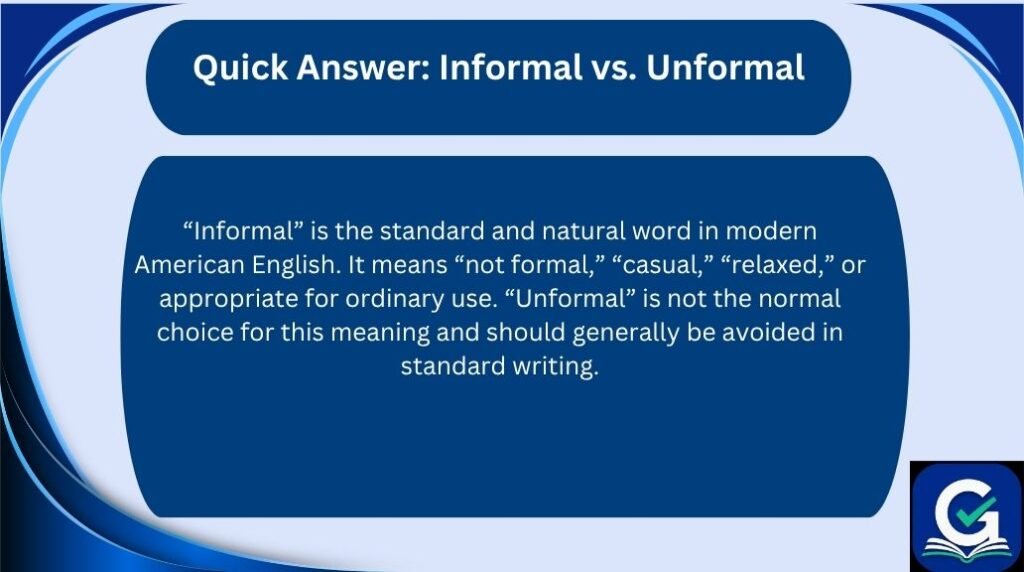
“Informal” is the standard and natural word in modern American English. It means “not formal,” “casual,” “relaxed,” or appropriate for ordinary use. “Unformal” is not the normal choice for this meaning and should generally be avoided in standard writing.
For example:
- Correct: “The meeting will be informal.”
- Usually incorrect/nonstandard: “The meeting will be unformal.”
If you need a noun, use informality; if you need an adverb, use informally. Merriam-Webster lists both forms alongside informal.
Understanding the Basics: Informal vs. Unformal
The easiest way to understand the difference is to recognize that English vocabulary is based on established usage, not simply on mathematical prefix rules.
Although un- can create opposites in words such as unhappy, unfair, and unusual, that does not mean every adjective beginning with a particular word can form its opposite with un-.
The conventional adjective is informal.
Comparison Table
| Form | Type | Meaning | Example | Correct/Incorrect |
|---|---|---|---|---|
| informal | Adjective | Not formal; casual; relaxed | “She wore informal clothes.” | ✅ Correct |
| informally | Adverb | In an informal way | “They spoke informally.” | ✅ Correct |
| informality | Noun | The quality of being informal | “The informality of the event made everyone comfortable.” | ✅ Correct |
| unformal | Adjective | Intended as “not formal,” but not the standard modern choice | “It was an unformal meeting.” | ❌ Avoid in standard English |
| unformalize | Verb | To make something less formal; rare/nonstandard compared with informalize | — | ⚠️ Avoid unless a specialized source requires it |
Merriam-Webster specifically defines informal and provides established related forms such as informality and informally.
The Core Rule
When you want to say that something is not formal, choose:
formal → informal
Not:
formal → unformal
That simple substitution will solve most informal vs. unformal questions.
What Does “Informal” Mean?
Informal is an adjective with several closely related uses.
Merriam-Webster gives two central meanings: something can lack formality or ceremony, or it can be characteristic of ordinary, casual, or familiar use.
1. Informal Means Casual or Relaxed
You can use informal when an event, situation, or interaction is relaxed rather than highly structured.
Example:
“We had an informal meeting over lunch.”
Here is the sentence breakdown:
- We = subject
- had = verb
- an informal meeting = object
- over lunch = phrase describing when or where the meeting occurred
The adjective informal describes the noun meeting.
It suggests that the meeting was relaxed and did not follow a highly formal structure.
2. Informal Can Describe Language
Informal is also frequently used to describe words, expressions, speech, and writing.
For example:
“The article uses an informal tone.”
The phrase informal tone means a conversational, relaxed tone rather than a highly formal or academic one.
Another example:
“That expression is common in informal speech.”
Here, informal describes the kind of speech in which the expression is appropriate.
Merriam-Webster’s examples include phrases such as “informal language,” “informal meeting,” and “informal manner,” demonstrating how broadly the adjective is used.
3. Informal Can Describe Clothing
The word is not limited to communication.
For example:
“The invitation says the dress code is informal.”
This means guests do not need highly formal clothing.
You might also see:
“He wore informal clothes to the gathering.”
In this context, informal means casual or everyday rather than dressy.
4. Informal Can Describe Relationships or Settings
Consider:
“They developed an informal relationship with their neighbors.”
The adjective suggests that the relationship is relaxed or familiar rather than highly official or ceremonious.
Similarly:
“The interview took place in an informal setting.”
The environment was probably relaxed rather than rigid or highly ceremonial.
Why “Unformal” Sounds Like It Should Work
The confusion makes sense.
English speakers know that un- often means “not.”
Consider:
- happy → unhappy
- clear → unclear
- fair → unfair
- certain → uncertain
- comfortable → uncomfortable
So it is natural to reason:
formal → unformal
But English vocabulary does not always work by freely attaching prefixes.
Some opposites are conventionalized with in-, while others use un-, non-, or an entirely different word.
For formal, the established adjective meaning “not formal” is informal.
This is an important lesson in vocabulary: a word can look logically possible without being the conventional word used by fluent speakers.
That is why unformal can feel understandable while still sounding unusual or incorrect in ordinary standard English.
Is “Unformal” a Real Word?
This question requires a little nuance.
It is better to say that “unformal” is not the standard modern word you should use when you mean “informal.” That is more accurate than claiming that no historical or specialized use of the form could ever exist.
English contains many rare, archaic, regional, technical, or historically attested formations that are not part of normal contemporary American usage.
For everyday writing, however, the choice is straightforward:
Use “informal.”
If your goal is a professional email, essay, website, report, application, or general-purpose article, informal is the safe and standard form.
Merriam-Webster’s current dictionary entry establishes informal, while its related entries include informality, informally, and informalize.
Informal vs. Unformal in Real Sentences
Seeing the difference in context makes the rule easier to remember.
Example 1: Meeting
Preferred:
“Tomorrow’s meeting will be informal.”
Not recommended:
“Tomorrow’s meeting will be unformal.”
Why?
The adjective informal modifies meeting and tells readers that the meeting will be relaxed rather than highly formal.
Example 2: Email
Preferred:
“I used a more informal tone in the email.”
Not recommended:
“I used a more unformal tone in the email.”
The first sentence sounds natural to an American English reader.
Example 3: Conversation
Preferred:
“Our conversation was informal and friendly.”
The word informal communicates that the conversation was relaxed.
Example 4: Writing
Preferred:
“This paragraph sounds too informal for an academic paper.”
Here, informal means that the language may be too conversational for the intended context.
Example 5: Event
Preferred:
“The company held an informal reception after the conference.”
Again, the adjective describes an event without a highly formal atmosphere.
A Simple Test Tip
When you are unsure about informal vs. unformal, use this test:
Test Tip
Ask yourself:
Would I naturally say “casual,” “relaxed,” or “not formal” here?
If the answer is yes, informal is almost certainly the word you want.
For example:
“It was a ___ discussion.”
Try the alternatives:
- It was a casual discussion. ✅
- It was a relaxed discussion. ✅
- It was an informal discussion. ✅
- It was an unformal discussion. ❌ Awkward/nonstandard
This substitution test is especially useful when editing quickly.
Informal vs. Formal: Understanding the Real Contrast
One reason the informal vs. unformal question persists is that people may actually be looking for the distinction between formal and informal.
These words form the standard contrast:
| Formal | Informal |
|---|---|
| Formal language | Informal language |
| Formal meeting | Informal meeting |
| Formal clothing | Informal clothing |
| Formal invitation | Informal invitation |
| Formal tone | Informal tone |
| Formal conversation | Informal conversation |
| Formal setting | Informal setting |
The key idea is not that informal means “bad” or “incorrect.”
Informal language can be completely correct English.
The difference is usually one of context and style, not simply correctness.
For example:
“Hey, can you send me the file?”
This could be perfectly appropriate in a casual workplace message to a colleague.
In a highly formal letter, however, you might choose:
“Could you please send me the file at your earliest convenience?”
Both sentences can communicate the same basic request. The difference is their level of formality.
Correct Meanings and Uses of “Informal”
Informal Communication
Informal communication is relaxed communication.
It may include:
- casual conversations
- friendly emails
- text messages
- workplace chats
- conversations with familiar people
- everyday speech
For example:
“Let’s talk about it over coffee.”
This is informal because the wording is natural and conversational.
Informal Writing
Informal writing can still be well written.
It may use:
- contractions
- conversational vocabulary
- direct questions
- personal expressions
- shorter sentences
For example:
“I’m glad you could make it. Let’s get started.”
That is informal but grammatically correct.
By contrast, an academic paper may require a more formal style.
Informal Meetings
An informal meeting may have fewer ceremonial or procedural elements than a formal meeting.
For example:
“Let’s have an informal meeting to discuss the new project.”
The sentence does not suggest that the meeting is unstructured or meaningless. It simply indicates a more relaxed format.
Informal Language Does Not Mean Incorrect Language
This distinction matters.
Informal and incorrect are not synonyms.
A sentence can be:
- informal and grammatically correct
- formal and grammatically correct
- informal and grammatically incorrect
- formal and grammatically incorrect
For example:
“I’m going to call you later.”
This is informal, but it is grammatically correct.
The contraction I’m is normal English.
Case Study: A Workplace Email
Imagine that an employee wants to invite coworkers to a discussion.
Version A
“Hi everyone,
Let’s have an informal meeting Friday afternoon to discuss the new schedule. Please bring any questions or suggestions.
Thanks!”
This works well for many workplace situations.
The word informal signals that the meeting will be relaxed.
Version B
“Hi everyone,
Let’s have an unformal meeting Friday afternoon to discuss the new schedule.”
The intended meaning is understandable, but unformal is not the standard choice.
A reader may notice the unusual word and wonder whether it is a typo.
The Practical Lesson
Professional writing rewards familiar, established vocabulary.
Even when a nonstandard word can be understood, using the conventional form reduces distraction.
In this case:
formal → informal
is the established pair.
Grammar Rules: Why “Informal” Is Correct
The most important point is that dictionary usage establishes informal as the normal adjective meaning “not formal.”
Merriam-Webster defines informal as “marked by the absence of formality or ceremony” and also describes it as appropriate to ordinary, casual, or familiar use.
The dictionary also identifies related forms:
- informal — adjective
- informally — adverb
- informality — noun
- informalize — verb
That established word family gives writers several natural choices.
Formal → Informal
The relationship can be understood like this:
formal
↓
informal = not formal / casual / relaxed
Then:
informal → informally
informal → informality
informal → informalize
This is why simply creating unformal from the prefix un- is unnecessary.
What About “Nonformal”?
There is another legitimate word worth knowing: nonformal.
Merriam-Webster defines nonformal as “not formal” and gives informal as a synonym.
However, nonformal and informal are not always interchangeable in every specialized field.
In general everyday American English, informal is the most natural choice when describing casual language, meetings, clothes, conversations, or settings.
Common Mistakes With Informal and Unformal
Why do people make this mistake?
Several factors can contribute.
1. Fast Typing
When people type quickly, they may construct a word rather than recall the established form.
Someone remembers:
formal = one thing
and automatically creates:
unformal = opposite
The brain recognizes the meaning, even though the conventional English word is informal.
2. Autocorrect
Autocorrect can reinforce assumptions.
If a device does not flag a word immediately, users may assume it is standard English. Conversely, an autocorrect suggestion can sometimes create confusion.
3. Lack of Vocabulary Knowledge
English contains thousands of words whose forms cannot be predicted perfectly.
Knowing that un- can mean “not” does not mean that un- can be attached freely to every adjective.
Vocabulary is learned through actual usage as well as through grammar rules.
4. Logical Word Formation
This is probably the biggest reason.
Unformal looks logical.
But natural English depends on convention.
The same issue appears with many other words. A formation may be understandable but still sound unnatural because native usage has established a different form.
Similar Grammar Confusions
The informal vs. unformal problem belongs to a larger group of common English mistakes.
| Confusion | Correct Form | Meaning/Reason |
|---|---|---|
| it’s / its | it’s / its | It’s = it is; its = possessive |
| your / you’re | your / you’re | Your = possessive; you’re = you are |
| their / they’re / there | their / they’re / there | Possession, contraction, and location |
| affect / effect | affect / effect | Usually verb vs. noun, with important exceptions |
| then / than | then / than | Time/sequence vs. comparison |
| loose / lose | loose / lose | Not tight vs. fail to keep |
| advice / advise | advice / advise | Noun vs. verb |
| everyday / every day | everyday / every day | Adjective vs. frequency phrase |
| informal / unformal | informal | Standard adjective for “not formal” |
These mistakes share an important lesson:
English cannot always be solved by looking at how a word appears to be constructed.
Context, conventional usage, and dictionary evidence matter.
Usage in Different Contexts
The correct word can become easier to remember when you see how it works in different situations.
Everyday Conversation
In everyday conversation, informal is very common.
Examples:
“It’s an informal get-together.”
“We had an informal chat.”
“The atmosphere was informal.”
These sentences describe relaxed social situations.
You may also use simpler alternatives such as:
- casual
- relaxed
- friendly
- conversational
Professional Writing
Professional writing requires attention to tone.
Informal is perfectly acceptable when it accurately describes the intended style.
For example:
“The team held an informal discussion before the presentation.”
Or:
“Please keep the tone professional but informal.”
However, do not assume that an informal workplace email can ignore grammar and clarity.
Informal does not mean careless.
Creative Writing
Creative writers have more stylistic freedom.
A character might speak informally:
“Come on, let’s get out of here.”
That dialogue sounds natural because it reflects ordinary speech.
An author may also deliberately use unusual vocabulary for characterization, historical flavor, humor, or artistic effect.
That does not change the standard recommendation for general writing: use informal rather than unformal.
Social Media and Texting
Social media is naturally more informal.
You may encounter:
- abbreviations
- slang
- contractions
- emojis
- incomplete sentences
- conversational expressions
For example:
“Hey! Just wanted to share this 😊”
That is informal communication.
However, if you are writing a professional LinkedIn post, business announcement, or public statement, you may want a more polished form of informal English rather than highly casual slang.
Why It Matters
Choosing informal instead of unformal may seem like a tiny detail. In many conversations, readers will understand what you mean either way.
But accuracy matters for several reasons.
Clarity in Communication
Established words are easier for readers to process.
When you write:
“an informal conversation”
the reader immediately recognizes the intended meaning.
An unusual form such as unformal may cause a moment of hesitation.
Professionalism
In business, academic, and public writing, unusual word choices can distract from your message.
A simple correction can make the sentence look more polished:
❌ “We will have an unformal discussion.”
✅ “We will have an informal discussion.”
Accuracy in Digital Communication
Digital communication is fast.
Emails, messages, social posts, websites, and online documents can reach large audiences quickly. Small vocabulary errors can therefore be repeated and shared.
Using the standard form helps your writing remain clear and credible.
A Useful Principle
“Choose the established word, not merely the word that seems logically possible.”
That principle applies far beyond informal.
Special Exception: Rare or Specialized Forms
There is an important distinction between standard modern usage and the possibility that a form may appear somewhere in historical, specialized, or unusual language.
English has many uncommon formations that exist outside everyday American English.
For example, Merriam-Webster recognizes unformalized, meaning something that has not been put into a definite shape or arrangement, with one listed sense marked archaic.
Notice the difference:
- informal = not formal; casual
- unformalized = not given a definite form or arrangement
These are not interchangeable.
Likewise, nonformal is an established word and can mean “not formal” or “informal,” particularly in specialized contexts.
So the best rule is not:
“Every word beginning with unformal- is impossible.”
Instead, use this practical rule:
For ordinary modern American English, use “informal” when you mean “not formal” or “casual.”
Informal vs. Unformal: Quick Recap Checklist
Use this checklist whenever you are unsure.
| Question | If Yes → Use |
|---|---|
| Do you mean “casual”? | informal |
| Do you mean “relaxed”? | informal |
| Do you mean “not formal”? | informal |
| Are you describing casual language? | informal |
| Are you describing a relaxed meeting? | informal |
| Are you writing a professional email? | informal if that is the intended meaning |
| Are you describing the quality of being informal? | informality |
| Do you need the adverb meaning “in an informal way”? | informally |
| Are you considering “unformal” simply because un- means “not”? | Choose informal instead |
Practice Examples
1. “The manager invited everyone to an ___ discussion.”
Answer: informal
“The manager invited everyone to an informal discussion.”
2. “Her writing style is friendly and ___.”
Answer: informal
“Her writing style is friendly and informal.”
3. “They spoke ___ during the lunch break.”
Answer: informally
“They spoke informally during the lunch break.”
FAQs
Is “informal” correct English?
Yes. Informal is the standard English adjective meaning “not formal,” “casual,” or “relaxed.” Merriam-Webster explicitly defines it in these senses.
Is “unformal” grammatically correct?
Unformal is not the standard modern choice when you mean “not formal.” In ordinary American English, use informal instead.
What is the difference between informal and unformal?
The practical difference is that informal is the established standard word, while unformal is not the normal modern form for this meaning. Informal can describe casual language, relaxed meetings, everyday clothing, familiar interactions, and similar situations.
Can I use “informal” in professional writing?
Yes. Informal is completely appropriate in professional writing when you need to describe something as casual or less formal. For example: “The team held an informal discussion after the presentation.”
Is “nonformal” correct?
Yes. Nonformal is an established word meaning “not formal” or “informal.” However, it is less likely to be the natural choice in many everyday situations. Merriam-Webster lists informal as a synonym.
What is the noun form of informal?
The noun is informality. It means the quality or state of being informal. For example: “The informality of the event made guests feel comfortable.”
Final Conclusion
The informal vs. unformal question has a simple answer: use “informal” in standard modern American English when you mean “not formal,” “casual,” or “relaxed.”
Although unformal may appear logical because the prefix un- often creates opposites, English does not form every opposite mechanically. Established usage determines which word sounds natural and standard. In this case, formal → informal is the conventional pair.
Remember the related forms, too: informally is the adverb, informality is the noun, and informalize is an established verb meaning to make something informal.
So when you are writing an email, essay, article, message, or report, do not let the seemingly logical un- prefix trick you.
When you mean “not formal,” make the standard choice: use “informal.” ✍️
For reference, Merriam-Webster’s “informal” dictionary entry provides the established definition and usage information.

I’m Ethan Carter, a grammar writer at Gramfino, where I explain English grammar in a simple and practical way.
I enjoy helping readers understand sentence structure, grammar rules, and common writing mistakes.
[…] make the difference easy to remember. 👇 Informal vs. Unformal | Optimize vs Optimise | Practices vs […]