Have you ever typed a sentence, stopped, and wondered whether time-frame vs timeframe is the correct spelling? You are not alone. This is one of those English usage questions that can make even confident writers hesitate because you may see the term written with a hyphen, as two words, or as one word.
The good news is that the answer is simpler than it first appears. In modern American English, time frame is the most established and commonly preferred form, while timeframe is also recognized as a valid, less common variant.
The hyphenated time-frame is much less preferred in standard US English. Merriam-Webster lists time frame as the main form and timeframe as a less common variant.
In this guide, I’ll explain the difference, show you how to use each form naturally, and give you practical examples so you can choose confidently every time. 😊 Possible vs Posible | Homie vs Homey | Sentence vs Sentance
Quick Answer: Time-Frame vs Timeframe
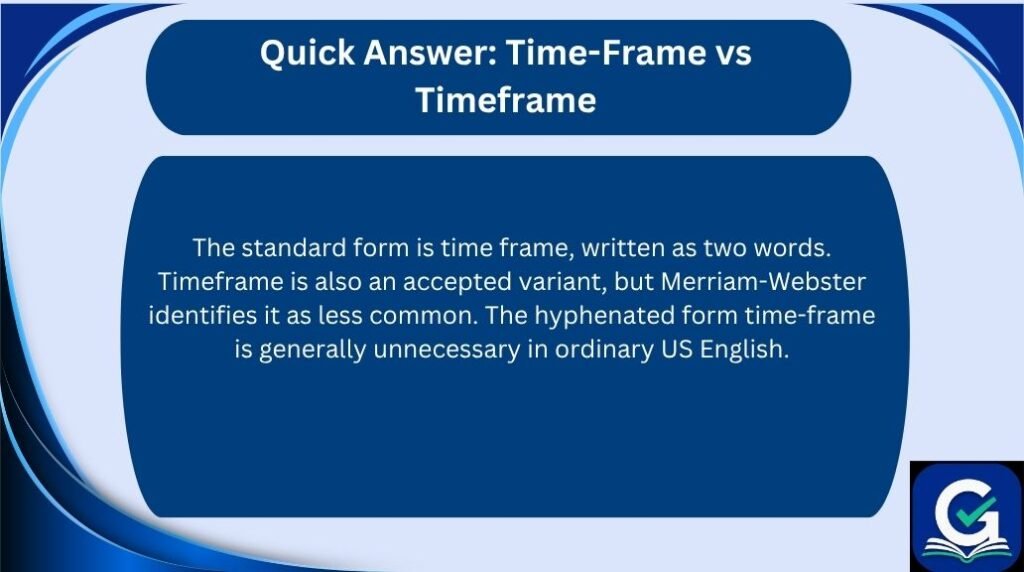
The standard form is time frame, written as two words. Timeframe is also an accepted variant, but Merriam-Webster identifies it as less common. The hyphenated form time-frame is generally unnecessary in ordinary US English.
Example:
- Preferred: What is the time frame for completing the project?
- Also acceptable: What is the timeframe for completing the project?
- Usually avoid: What is the time-frame for completing the project?
So, if you want the safest choice for formal American English, use time frame.
Understanding the Basics of Time-Frame vs Timeframe
At first glance, time frame, timeframe, and time-frame may look like three different words. In reality, they are different spellings of the same basic noun.
The expression refers to a period of time during which something happens, is expected to happen, or should be completed.
For example:
We need to finish the project within a two-week time frame.
Here, time frame refers to the two-week period available for completing the project.
Merriam-Webster defines time frame as a period of time, especially in relation to an action or project, and lists timeframe as a less common variant. It also notes that compounds can gradually change from open forms to closed forms over time.
Comparison Table
| Form | Type | Meaning | Example | Correct/Incorrect |
|---|---|---|---|---|
| time frame | Open compound noun | A period of time | We have a short time frame. | ✅ Preferred |
| timeframe | Closed compound noun | A period of time | The timeframe is flexible. | ✅ Accepted |
| time-frame | Hyphenated compound | A period of time | The time-frame is flexible. | ⚠️ Usually unnecessary |
| time frame | Noun phrase | A designated period | What is the time frame? | ✅ Preferred |
| timeframe | Noun | A designated period | What is the timeframe? | ✅ Acceptable |
The key point is that time frame and timeframe have the same basic meaning. The main difference is spelling preference and style.
What Does “Time Frame” Mean?
A time frame is a particular period during which an activity, event, process, or project takes place or is expected to take place.
It can describe a period of:
- Hours
- Days
- Weeks
- Months
- Years
- Decades
For example:
The company expects to complete the renovation within a six-month time frame.
Breaking Down the Sentence
- The company = subject
- expects = verb
- to complete the renovation = action
- within = preposition showing the limits of the period
- a six-month time frame = the period available
The phrase clearly communicates that the renovation should be completed during a six-month period.
More Examples
The application must be submitted within the specified time frame.
We are working under a tight time frame.
The doctor gave me a reasonable time frame for recovery.
The project has a longer time frame than we originally expected.
In each sentence, time frame refers to a period or window of time.
Is “Timeframe” a Correct Word?
Yes. Timeframe is a recognized English spelling.
However, there is an important distinction between saying that a form is accepted and saying that it is the preferred form.
Merriam-Webster lists time frame as the main entry and timeframe as a less common variant. Its usage note specifically says that the two-word form is currently much more common.
Merriam-Webster’s own “one word or two?” guidance likewise presents time frame first and gives timeframe as a less common alternative.
So this sentence is acceptable:
What is the expected timeframe for delivery?
But this version is the more traditional choice:
What is the expected time frame for delivery?
Both communicate the same idea.
Why Is “Time-Frame” Usually Avoided?
The hyphenated form time-frame is not usually necessary when the expression is being used as a noun.
For example:
We need to establish a time frame.
There is no need to insert a hyphen between time and frame.
Hyphens are often used to connect words when they work together as a compound modifier before a noun. But not every compound noun needs a hyphen.
Compare:
- a high-quality product → hyphenated compound modifier
- a six-month project → hyphenated compound modifier
- a time frame → normally open compound
- the project time frame → normally open compound
This is why time frame is the safest spelling in standard American writing.
When Should You Use “Time Frame”?
Use time frame when you are writing formal, academic, professional, or general-purpose English and want the most established form.
1. For Projects
The construction project has a two-year time frame.
Here, time frame identifies how long the project is expected to take.
2. For Deadlines
Please submit your application within the specified time frame.
The phrase identifies the period during which submission is allowed.
3. For Business Plans
The company expects to reach profitability within a three-year time frame.
This communicates an expected period for achieving a goal.
4. For Research
The study examined changes over a ten-year time frame.
Here, the expression identifies the period covered by the research.
5. For Everyday Situations
What is the time frame for delivery?
This is a very natural question when asking when something is expected to arrive.
When Can You Use “Timeframe”?
You can use timeframe when your preferred style guide, publication, company, or audience accepts the closed compound.
For example:
The expected timeframe for completion is six weeks.
That sentence is grammatically understandable and dictionary-supported.
It is especially common in:
- Business communication
- Digital content
- Workplace emails
- Project management
- Technology writing
- Informal professional communication
Still, if you are unsure what a particular editor or style guide prefers, time frame is the safer default.
Time Frame vs. Timeline
One common source of confusion is the difference between time frame and timeline.
Although the words are related, they are not always interchangeable.
Time Frame
A time frame describes a period.
The project has a six-month time frame.
The focus is on duration.
Timeline
A timeline generally describes a sequence of events, dates, or stages.
The project timeline includes five major phases.
The focus is on when specific things happen and in what order.
Simple Way to Remember
Think of it this way:
Time frame = How long?
Timeline = When and in what order?
For example:
We have a three-month time frame.
This tells you the duration.
The timeline shows that testing begins in May.
This tells you when a particular stage occurs.
Merriam-Webster also recognizes timeline as a term that can refer to a period of time, especially in relation to a project or event, but its other common meaning involves a chronological sequence.
Test Tip: Use This Simple Trick
If you are unsure about time frame vs timeframe, try replacing the expression with period of time.
For example:
We need to complete the work within the time frame.
Replace it:
We need to complete the work within the period of time.
The meaning still works.
That confirms that you are dealing with the noun meaning of time frame.
Another Test
Ask yourself:
“Am I talking about a period during which something happens?”
If the answer is yes, time frame or timeframe can work.
If you are writing formal US English and have no style requirement saying otherwise, choose time frame.
Case Study: A Workplace Email
Imagine that Sarah works as a project coordinator. Her manager asks when a website redesign will be completed.
Sarah writes:
Hi James,
The development team expects to complete the website redesign within a six-week time frame. Testing should begin during the final week.
Best,
Sarah
This is clear and professional.
Now imagine Sarah writes:
The development team expects to complete the website redesign within a six-week timeframe.
This is also understandable and accepted.
However, if her organization follows a style guide that prefers the traditional open compound, the first version would be the better choice.
What About the Hyphen?
Sarah should generally avoid:
within a six-week time-frame
The phrase six-week is hyphenated because it functions as a compound modifier before time frame. But time frame itself does not need a hyphen.
Notice the structure:
six-week + time frame
That distinction is important.
Grammar Rules Behind Time Frame vs Timeframe
The issue here is primarily one of compound-word spelling, not a difference in grammatical meaning.
English contains many compound expressions that can exist as:
- Open compounds
- Hyphenated compounds
- Closed compounds
Open Compound
Two words are written separately.
time frame
Hyphenated Compound
The words are connected with a hyphen.
time-frame
Closed Compound
The words are combined into one word.
timeframe
English compound words can change over time. A phrase that begins as two words may eventually become a single word as usage becomes more established.
Merriam-Webster specifically explains that compounds can move from open to closed forms and notes that its evidence suggests time frame may be moving in that direction. However, the open form remains considerably more common at present.
That is why it would be inaccurate to say that timeframe is simply wrong.
It is better to say:
Time frame is the preferred and more common form, while timeframe is an accepted less-common variant.
What Does Cambridge Dictionary Say?
Cambridge Dictionary also recognizes time frame as the main form and lists timeframe and time-frame as alternative forms. It defines the expression as a period within which an activity is intended to happen.
This reinforces an important point: English spelling conventions are not always as absolute as writers expect.
A spelling can be less preferred without being grammatically incorrect.
For practical US English writing, however, choosing time frame gives you the most straightforward option.
Common Mistakes With Time Frame
Writers commonly make mistakes because compound-word spelling in English can be unpredictable.
Mistake 1: Assuming “Timeframe” Is Always Wrong
Some writers see time frame in dictionaries and assume timeframe must be incorrect.
That is not accurate.
Merriam-Webster recognizes timeframe as a less common variant.
Mistake 2: Always Adding a Hyphen
Another mistake is writing:
time-frame
because the writer assumes compound expressions must be hyphenated.
They do not.
The standard form is:
time frame
Mistake 3: Switching Forms Randomly
A document might contain:
The time frame is six months.
and later:
The project timeframe is flexible.
This is not necessarily a grammar error, but inconsistent spelling can make your writing look less polished.
Choose one preferred form and use it consistently.
Mistake 4: Confusing It With “Timeline”
A time frame describes a period. A timeline usually organizes events or stages chronologically.
Why Do These Mistakes Happen?
There are several practical reasons.
Fast Typing
When people type quickly, they often combine familiar phrases.
For example:
timeframe
may be typed automatically because the writer has seen the closed form frequently.
Autocorrect
Modern writing tools may recognize multiple spellings. If your software accepts both, it may not alert you to a style preference.
Lack of Knowledge
Many writers simply never learned that time frame is the more established spelling.
They may assume that whichever version looks familiar must be correct.
Digital Communication
Online writing constantly exposes people to different spelling conventions. A writer may see timeframe in one article and time frame in another.
Over time, both begin to look equally natural.
Similar Grammar and Spelling Confusions
The time frame vs timeframe question belongs to a larger group of common English uncertainties.
| Confusion | Correct/Preferred Forms | Main Issue |
|---|---|---|
| it’s vs its | it’s / its | Contraction vs possessive |
| your vs you’re | your / you’re | Possessive vs contraction |
| their vs they’re | their / they’re | Possessive vs contraction |
| everyday vs every day | everyday / every day | Adjective vs time expression |
| altogether vs all together | altogether / all together | Different meanings |
| setup vs set up | setup / set up | Noun vs verb |
| login vs log in | login / log in | Noun/adjective vs verb |
| time frame vs timeframe | time frame / timeframe | Open vs closed compound |
These examples demonstrate why English spelling cannot always be solved by simply asking whether two words “look right.”
Context and standard usage matter.
Usage in Different Contexts
Everyday Conversation
In casual conversation, both forms are likely to be understood.
For example:
What is the time frame for the repair?
Or:
What is the timeframe for the repair?
Most listeners will not notice a difference because the words sound identical when spoken.
The spelling becomes important when you write the phrase.
Professional Writing
For business emails, reports, proposals, and official documents, time frame is a strong default.
Examples:
Please provide a realistic time frame for completion.
The client requested a shorter time frame.
We are working within a limited time frame.
These sentences are clear, polished, and appropriate for professional communication.
Academic Writing
Academic writing generally benefits from consistency and conventional usage.
For example:
The research covered a five-year time frame.
This is a safe choice for papers, reports, and scholarly discussions.
If your university, journal, or publisher has a house style, follow that style first.
Creative Writing
Creative writers have more flexibility.
You might write:
Within that narrow time frame, everything changed.
The open form often looks natural and unobtrusive.
If you deliberately use timeframe, however, the meaning remains clear.
Social Media and Texting
Social media users commonly write quickly and may use timeframe because it is shorter.
For example:
What’s the timeframe for the event?
This is perfectly understandable.
Still, informal digital communication does not necessarily determine the preferred spelling for formal writing.
Why This Spelling Difference Matters
At first, the difference between time frame and timeframe may seem tiny. After all, the meaning does not really change.
But spelling choices matter because good writing is about more than simply being understood.
1. Clarity
Consistent spelling helps readers process information smoothly.
2. Professionalism
In a business report, consistent language choices can make the document appear more carefully edited.
3. Writing Accuracy
Knowing the standard form gives you confidence when writing emails, articles, reports, and academic work.
4. Digital Communication
Online content is read quickly. Small inconsistencies can distract readers, particularly when they appear repeatedly.
5. Reader Trust
A polished document gives readers confidence that the writer has paid attention to detail.
Clear writing makes the message easier to trust.
The goal is not to make every sentence complicated. The goal is to make every sentence easy to understand.
Time Frame in Compound Expressions
One area that deserves special attention is the use of numbers before time frame.
Consider:
a three-month time frame
The phrase three-month is hyphenated because it functions as a compound adjective modifying time frame.
But time frame itself remains two words.
Compare:
The project has a three-month time frame.
Here:
- three-month = compound adjective
- time frame = noun phrase
Now compare:
The project will take three months.
No hyphen is necessary because three months is not functioning as a compound adjective before a noun.
More Examples
a two-week time frame
a five-year time frame
a 30-day time frame
a six-month time frame
This distinction helps prevent accidental over-hyphenation.
Is “Time-Frame” Ever Possible?
You may encounter time-frame in some dictionaries, publications, or varieties of English.
Cambridge, for example, lists time-frame as an alternative form.
That does not mean you should automatically use it in American English.
If your goal is clear, conventional US English, use:
time frame
rather than:
time-frame
The hyphenated version is not the best default for ordinary writing.
Special Exception: Style Guides and House Styles
The most important exception is a publication or organization that has its own style guide.
Some organizations may prefer:
time frame
Others may permit or prefer:
timeframe
In professional writing, consistency with the required house style should take priority.
For example, if a company consistently writes timeframe throughout its documentation, changing every instance to time frame may create inconsistency with the organization’s established style.
The Associated Press also emphasizes that style decisions often depend on specific editorial guidance and that its style system contains detailed rules for hyphens and compound constructions. Its current print edition is the 58th edition, covering 2026–2028.
So the practical rule is:
Follow your required style guide first. Otherwise, choose the more established “time frame.”
Time Frame vs Timeframe in SEO Content
If you are writing blog posts, website content, or SEO articles, you may wonder whether one spelling is better for search engines.
The answer is simple: write naturally and accurately rather than forcing one spelling repeatedly.
Search engines can understand related forms and context. Your priority should be:
- Natural language
- Correct grammar
- Helpful information
- Clear sentence structure
- Consistent spelling
- Strong search intent alignment
For example, an article can naturally include:
What is the time frame for delivery?
and later discuss:
The expected timeframe depends on the service.
There is no reason to insert the same spelling unnaturally just to increase keyword frequency.
Good SEO writing should serve the reader first.
Quick Recap Checklist
Use this table whenever you are unsure about time frame vs timeframe.
| Question | If Yes → Use |
|---|---|
| Are you writing standard US English? | time frame |
| Are you following a style guide that prefers two words? | time frame |
| Does your company’s style guide specifically use one word? | timeframe |
| Are you using the phrase as an ordinary noun? | time frame |
| Are you wondering whether “timeframe” is a real word? | Yes, it is an accepted variant |
| Are you thinking about using “time-frame” automatically? | Usually don’t |
| Do you need the safest formal choice? | time frame |
Practice Example 1
Choose the best form:
What is the expected ______ for delivery?
Answer: time frame
What is the expected time frame for delivery?
Practice Example 2
The company has a two-year ______ for expansion.
Answer: time frame
The company has a two-year time frame for expansion.
Practice Example 3
The expected ______ is approximately three weeks.
Both can work:
The expected time frame is approximately three weeks.
The expected timeframe is approximately three weeks.
For formal US English, time frame remains the safer choice.
Time Frame vs Timeframe: A Simple Memory Rule
If you want one rule that is easy to remember, use this:
When in doubt, write “time frame” as two words.
You do not need to memorize complicated grammar rules.
Just remember:
Preferred: time frame
Accepted variant: timeframe
Usually unnecessary: time-frame
This three-part rule will handle most situations you encounter.
Frequently Asked Questions
1. Is “time frame” one word or two?
Time frame is normally written as two words in standard American English. Merriam-Webster lists it as the main form and identifies timeframe as a less common variant.
2. Is “timeframe” grammatically correct?
Yes. Timeframe is an accepted variant with the same basic meaning as time frame. It is less common than the two-word form according to Merriam-Webster.
3. Is “time-frame” correct?
You may encounter time-frame, and some dictionaries recognize it as an alternative spelling. However, the hyphenated form is generally not the preferred choice in standard US English. Time frame is the safest default.
4. Which is better for formal writing: “time frame” or “timeframe”?
Time frame is generally the better choice for formal writing when you are not following a specific house style. It is the more common and established form in Merriam-Webster’s treatment.
5. Does “time frame” mean the same thing as “timeline”?
Not exactly. A time frame usually describes a period or duration, while a timeline commonly describes a sequence of dates, stages, or events. The two terms can overlap in some contexts, but they are not always interchangeable.
6. Should I use “time frame” consistently throughout an article?
Yes. Consistency is important. If you choose time frame, continue using that spelling unless there is a specific reason to follow a different style. If your publication or organization prefers timeframe, use that form consistently instead.
Conclusion
The confusion between time-frame vs timeframe is understandable because English contains many compound words whose spellings evolve over time. The important point is that time frame and timeframe have the same basic meaning: a period during which something happens or is expected to happen. Merriam-Webster lists time frame as the main and more common form while recognizing timeframe as a less common variant.
For standard US English, especially in formal, academic, and professional writing, time frame is the safest choice. The hyphenated time-frame is generally unnecessary unless a particular style guide calls for it.
So, when you hesitate, remember the simple rule: use “time frame” as two words unless your style guide tells you otherwise. Once you understand that, this spelling question becomes much easier.
When in doubt, keep your time frame clear—and your writing clearer. ✨

I’m Clara Bennett, a vocabulary and language specialist at Gramfino, where I write about word meanings and proper usage.
I love helping readers choose the right words and build stronger English vocabulary with confidence.

[…] to use each form, and provide simple examples so you can choose the right spelling with confidence. Time-Frame vs Timeframe | Possible vs Posible | Homie vs […]
[…] you can use in everyday, academic, professional, and digital writing. 🚗✈️ Through vs Thru | Time-Frame vs Timeframe | Possible vs […]