Have you ever typed a sentence like “I’m in route to the office” and then wondered whether something looked wrong? You are not alone. The confusion between en route vs in route is common because both expressions contain the familiar word “route,” and they can sound somewhat similar when spoken quickly.
However, standard English does not treat them as interchangeable. If you want to say that someone or something is on the way to a destination, the correct expression is en route.
The phrase comes from French and has been used in English to describe movement toward or from a place. In route is generally not the standard expression for this meaning.
In this guide, I’ll explain the difference in simple US English, show you how to use en route correctly, explain why in route causes confusion, and give you practical examples you can use in everyday, academic, professional, and digital writing. 🚗✈️ Through vs Thru | Time-Frame vs Timeframe | Possible vs Posible
Quick Answer: En Route vs In Route
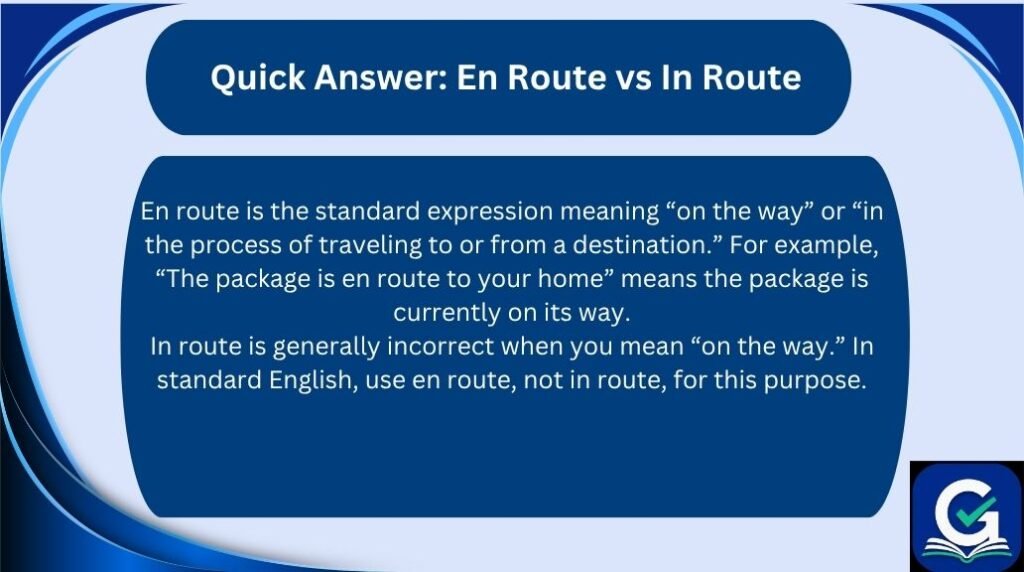
En route is the standard expression meaning “on the way” or “in the process of traveling to or from a destination.” For example, “The package is en route to your home” means the package is currently on its way.
In route is generally incorrect when you mean “on the way.” In standard English, use en route, not in route, for this purpose.
Correct: The driver is en route to the warehouse.
Incorrect: The driver is in route to the warehouse.
Understanding the Basics of En Route vs In Route
The easiest way to understand en route vs in route is to focus on the meaning you want to communicate.
En route is an established English expression meaning on the way, along the way, or during a journey toward a destination. It can describe people, vehicles, packages, aircraft, ideas, projects, or even abstract progress toward a goal.
For example:
- The ambulance is en route to the hospital.
- Your order is en route.
- We stopped for coffee en route to the airport.
- She discovered an interesting bookstore en route.
- The company is en route to becoming a market leader.
By contrast, in route is not normally used as a replacement for en route. When writers use “in route” to mean “on the way,” they are usually making a word-choice error.
Cambridge Dictionary defines en route as “on the way to or from somewhere” and provides examples such as “The ambulance is en route to the hospital.”
Comparison Table
| Form | Type | Meaning | Example | Correct/Incorrect |
|---|---|---|---|---|
| en route | Fixed expression/adverbial phrase | On the way to or from somewhere | The train is en route to Boston. | ✅ Correct |
| en route to | Fixed expression + preposition | On the way to a destination | We stopped en route to Chicago. | ✅ Correct |
| en route from | Fixed expression + preposition | On the way from a place | She called me en route from work. | ✅ Correct |
| in route | Nonstandard substitute for “en route” | Intended to mean “on the way” | The bus is in route to the station. | ❌ Generally incorrect |
| in the route | Prepositional phrase | Inside or within a particular route/context | The stop is in the route we planned. | ⚠️ Context-dependent |
| route | Noun | A path or direction between places | This is the fastest route. | ✅ Correct |
The key point is simple:
When you mean “on the way,” choose “en route.”
What Does En Route Mean?
En route means on the way to or from a particular place.
The expression can describe physical travel:
- The plane is en route to New York.
- The delivery truck is en route to the customer.
- We met another group en route.
- The hikers stopped en route to the summit.
It can also describe progress toward an abstract goal:
- The company is en route to profitability.
- The project is en route to completion.
- The team is en route to winning the championship.
This broader use is important because en route does not always involve literal roads or vehicles.
Cambridge also gives examples of en route being used for progress toward an objective, such as being “en route to achieving that goal.”
Breaking Down an Example
Consider this sentence:
The package is en route to the customer.
- The package = subject
- is = linking/auxiliary verb
- en route = indicates that the package is traveling
- to the customer = identifies the destination
The meaning is:
The package is currently on its way to the customer.
Another example:
We stopped for lunch en route to Dallas.
Here, en route to Dallas means while traveling toward Dallas.
Why Is En Route Correct?
The answer lies partly in the history of the expression.
En route is a phrase borrowed from French. In French, en route conveys the idea of being on the way or setting out on a journey. English adopted the expression and retained its established form.
That is why English speakers do not normally replace en with in.
English contains many borrowed expressions whose wording does not always follow the pattern a learner might expect.
For example:
- en route
- à la carte
- per se
- vice versa
- status quo
The fact that in often relates to location in English does not mean it can replace en in every expression.
This is an important lesson in vocabulary: fixed expressions must often be learned as complete units rather than reconstructed word by word.
What Does In Route Mean?
This is where the confusion begins.
People sometimes write in route because they naturally associate in with location.
For example, English commonly uses:
- in the car
- in the building
- in the city
- in transit
- in the area
A writer may therefore assume that “in route” should mean “on the route.”
However, if the intended meaning is “on the way,” standard English calls for en route.
For example:
❌ The ambulance is in route to the hospital.
✅ The ambulance is en route to the hospital.
The second sentence is the natural standard form.
Important Distinction
There is a difference between:
en route
and a phrase that happens to contain the words in and route separately.
For example:
The restaurant is in the route we planned.
This may be understandable in a special context, although a more natural sentence might be:
The restaurant is on the route we planned.
Here, “in” is not replacing “en” in the fixed expression en route.
So the problem is not that the words in and route can never appear next to each other under any circumstances. The problem is using in route as a substitute for en route.
Correct Uses of En Route
En Route to a Destination
One of the most common structures is:
en route to + destination
Examples:
- I’m en route to the office.
- The flight is en route to Los Angeles.
- The courier is en route to your address.
- We stopped for gas en route to the beach.
- She called me en route to the conference.
This construction clearly tells the reader where someone or something is heading.
En Route From a Place
You can also use:
en route from + place
Examples:
- I called her en route from the airport.
- He stopped at a café en route from work.
- The shipment was damaged en route from the factory.
- We received an update en route from Denver.
The expression can therefore describe travel away from a particular location.
En Route Without a Destination
Sometimes the destination is obvious from context.
Examples:
- We encountered heavy traffic en route.
- Several passengers became sick en route.
- The driver stopped twice en route.
- I picked up coffee en route.
In these cases, the reader understands that the person or object is traveling somewhere.
En Route as an Adverb
En route is commonly used as an adverbial expression.
It tells us something about the circumstances of an action.
Consider:
We stopped for lunch en route.
The phrase en route explains when or during what part of the journey the action happened.
Another example:
The plane experienced turbulence en route to Chicago.
Here, en route to Chicago modifies the situation involving the plane.
Cambridge classifies en route as an adverb and also recognizes an adjective use in American English.
En Route as an Adjective
You may also see en route used before a noun in certain contexts.
For example:
En route aircraft received updated weather information.
Here, en route describes aircraft that are traveling.
You may also encounter:
- en route delays
- en route services
- en route information
- en route passengers
This usage is especially common in transportation, aviation, logistics, and technical writing.
Cambridge lists an adjective use of en route in US English, including examples involving aircraft and weather-related delays.
How to Pronounce En Route
Pronunciation can contribute to the confusion.
In US English, en route is commonly pronounced approximately like:
ahn ROOT
Some speakers use a pronunciation closer to the French form.
The important point is that pronunciation does not change the spelling.
You should still write:
en route
not:
in route
Cambridge lists US pronunciations including /ɑn ˈrut/ and /ɑ̃ː ˈruːt/.
Is En Route One Word or Two Words?
For standard general English, the safest form is:
en route
It is normally written as two words.
For example:
✅ The package is en route.
Not:
❌ The package is enroute.
However, you may occasionally encounter enroute as a variant in specialized or regional usage. Cambridge notes “enroute” in some dictionary contexts, including an adjective entry in US English.
For ordinary US English writing, especially when you want the clearest and most widely recognized form, en route is the better choice.
En Route vs On the Way
A useful trick is to replace en route with on the way.
If “on the way” makes sense, en route will often work.
For example:
I’m on the way to work.
You can write:
I’m en route to work.
Another example:
The ambulance is on the way to the hospital.
You can write:
The ambulance is en route to the hospital.
The two expressions have essentially the same basic meaning, although en route can sound slightly more formal or polished.
Compare the Tone
Casual:
I’m on my way to the office.
Neutral:
I’m on the way to the office.
More formal/polished:
I’m en route to the office.
This makes en route particularly useful in professional communication.
Test Tip: The “On the Way” Test
Here is an easy way to remember the correct choice.
Step 1: Replace the phrase with “on the way.”
Ask:
Does the sentence mean someone or something is traveling toward or from a destination?
If yes, use:
en route
For example:
❌ The driver is in route to the warehouse.
Replace it:
“The driver is on the way to the warehouse.”
That makes sense.
Therefore:
✅ The driver is en route to the warehouse.
Memory Trick
Think:
EN ROUTE = ON THE WAY
If you can replace the phrase with on the way, choose en route.
Case Study: A Workplace Email
Imagine a manager is waiting for an important shipment.
An employee sends this email:
The replacement equipment is in route to our office and should arrive this afternoon.
The message is understandable, but in route is not the standard expression for “on the way.”
A polished version would be:
The replacement equipment is en route to our office and should arrive this afternoon.
This version is clearer and more professional.
Why the Difference Matters
The employee may have typed in route because the phrase sounds logical. They may have mentally translated “on the route” into “in route.”
However, professional writing benefits from using established expressions accurately.
A better workplace message might say:
The replacement equipment is en route to our office and is expected to arrive this afternoon.
That sentence sounds natural, concise, and professional.
Grammar Rules for En Route vs In Route
The central grammar rule is straightforward:
Use “en route” when you mean “on the way” or “during a journey.”
Standard dictionaries define en route in this sense. Cambridge Dictionary specifically defines it as being “on the way to or from somewhere.”
Rule 1: Use En Route for Travel
Correct:
The train is en route to New York.
Incorrect:
The train is in route to New York.
Rule 2: Use En Route for a Journey
Correct:
We stopped en route to the hotel.
Incorrect:
We stopped in route to the hotel.
Rule 3: Use En Route for Progress Toward a Goal
Correct:
The business is en route to profitability.
This is not necessarily physical travel. The phrase can describe progress toward an outcome.
Rule 4: Do Not Treat “En” as a Replaceable Preposition
A common mistake is assuming that en should become in because English frequently uses “in” for location.
But en route is an established expression.
You cannot simply change one component because another word seems more familiar.
Common Mistakes With En Route
The most common mistake is simple:
❌ in route
instead of:
✅ en route
But there are other related errors worth knowing.
Mistake 1: Writing “Enroute”
Example:
❌ The package is enroute.
Preferred:
✅ The package is en route.
For standard US English, especially formal writing, keeping the expression as two words is the safest choice.
Mistake 2: Writing “In Route To”
Example:
❌ She is in route to the airport.
Correct:
✅ She is en route to the airport.
Mistake 3: Confusing En Route With On Route
Some writers also produce:
❌ We stopped on route to the city.
In standard usage, write:
✅ We stopped en route to the city.
However, on the route is perfectly normal when you are literally discussing a particular route.
For example:
The gas station is on the route to the airport.
That is different from:
We stopped en route to the airport.
Why Do People Write In Route?
There are several reasons.
Fast Typing
People often type quickly and rely on what sounds familiar.
If someone knows the meaning but has never studied the expression carefully, they may automatically write in route.
Autocorrect
Autocorrect can sometimes reinforce an incorrect form, particularly when a user repeatedly types a nonstandard phrase.
Lack of Knowledge
Many people learn expressions by hearing them rather than seeing them in writing.
Because en route can sound like a single spoken unit, someone may not know its standard spelling.
Influence From Similar Expressions
English contains many expressions using in:
- in transit
- in motion
- in progress
- in the car
- in the process
This may encourage people to construct in route even though en route is the established phrase.
Similar Grammar Confusions
The en route vs in route issue is part of a much larger pattern in English: two forms may sound similar or feel logical, but only one is standard in a particular context.
| Common Confusion | Correct Form | Why |
|---|---|---|
| it’s / its | Depends on meaning | “It’s” = it is; “its” = possessive |
| your / you’re | Depends on meaning | “Your” = possessive; “you’re” = you are |
| their / there / they’re | Depends on meaning | Possession, location, or “they are” |
| affect / effect | Depends on grammatical role | Usually verb vs. noun distinction |
| then / than | Depends on meaning | Time/result vs. comparison |
| to / too / two | Depends on meaning | Direction/infinitive, excessive/also, number |
| could of / could have | could have | “Could of” is a nonstandard spelling of the spoken contraction |
| in route / en route | en route | “En route” means on the way |
These examples show why English cannot always be solved by choosing the word that “sounds right.”
Usage in Different Contexts
Everyday Conversation
In casual conversation, en route is perfectly acceptable, although on the way may sound more relaxed.
For example:
Casual:
I’m on my way home.
More polished:
I’m en route home.
More naturally, you might say:
I’m en route to my home.
or:
I’m en route home.
The first option is clearer for learners.
Professional Writing
En route works especially well in professional communication.
Examples:
- Your order is en route.
- The technician is en route to the site.
- The shipment is currently en route.
- The documents are en route to headquarters.
- The team is en route to the client’s office.
It is concise and communicates movement clearly.
Logistics and Shipping
The phrase is especially common in shipping and delivery.
Examples:
- Your package is en route.
- The shipment is en route to the distribution center.
- The replacement parts are en route.
- The driver is en route to the delivery address.
This is one reason you may frequently see en route in tracking updates.
Aviation
The expression is also common in aviation.
Examples:
- The aircraft is en route to Chicago.
- Weather conditions may affect en route operations.
- The pilot received an updated en route weather report.
Cambridge specifically gives examples involving aircraft and en route delays.
Creative Writing
Authors can use en route to describe physical or metaphorical journeys.
For example:
She discovered an old photograph en route to the village.
Or:
He learned several difficult lessons en route to becoming a successful entrepreneur.
The phrase can make writing more concise without changing the basic meaning.
Social Media and Texting
You can absolutely use en route in texts and social posts.
For example:
En route to the concert! 🎵
Or:
Finally en route home! 🚗
However, casual alternatives such as on my way may feel more natural:
On my way! 🚙
The choice depends on tone.
En Route vs In Route in Digital Communication
Digital communication has made short expressions more important than ever.
People write:
- delivery updates
- GPS messages
- workplace chats
- text messages
- social media captions
- customer-service notifications
Because these messages are often short, small wording errors can stand out.
Compare:
❌ Your order is in route.
with:
✅ Your order is en route.
The second version looks polished and professional.
This is especially important for businesses. A customer may judge the quality of a company partly by the clarity of its emails, notifications, and website copy.
Why En Route vs In Route Matters
At first glance, this may seem like a tiny grammar issue. After all, most readers can understand what “in route” is supposed to mean.
But accurate word choice matters for several reasons.
Clarity
Correct expressions make your meaning immediately recognizable.
En route is a familiar established phrase.
Professionalism
In business communication, standard wording can make a message sound more polished.
Compare:
The technician is in route.
with:
The technician is en route.
The second sentence sounds more natural and professional.
Writing Accuracy
Using established expressions correctly demonstrates attention to language.
That matters in:
- resumes
- emails
- reports
- academic writing
- business communication
- customer-service messages
Digital Communication
Short messages leave little room for ambiguity.
When your message contains only five or six words, each one matters.
Your package is en route.
is concise, accurate, and easy to understand.
A Simple Principle
Correct word choice makes simple messages stronger.
You do not need complicated vocabulary to write professionally. You need the right vocabulary.
Is There a Difference Between En Route and On the Route?
Yes.
En route means on the way.
On the route means located along or connected with a particular route.
Compare:
The bus is en route to Boston.
This means the bus is traveling toward Boston.
The restaurant is on the route to Boston.
This means the restaurant is located along the route someone is taking to Boston.
These meanings are related but not identical.
More Examples
En route:
We stopped for gas en route to Denver.
Meaning: We were traveling toward Denver when we stopped.
On the route:
There is a gas station on the route to Denver.
Meaning: A gas station is located along that particular route.
This distinction is useful because it explains why in route may feel tempting. English already has the phrase on the route, but that does not make in route the correct equivalent of en route.
Special Exception: Can “In Route” Ever Appear?
There is an important nuance.
The sequence in route can theoretically appear when in and route are functioning independently in a larger construction or specialized wording. It may also appear in names, labels, technical contexts, or nonstandard writing.
But this does not make it a standard replacement for en route.
If your intended meaning is:
“on the way”
use:
en route
For general US English, professional writing, educational writing, and SEO content, there is no reason to choose in route when en route expresses your intended meaning.
Similarly, if you are describing a specific road or path, you can use on the route:
The hotel is on the route to the airport.
That is a completely different construction.
Quick Recap Checklist
Use this checklist whenever you are unsure.
| Question | If Yes → Use |
|---|---|
| Do you mean “on the way”? | en route |
| Is someone traveling toward a destination? | en route to |
| Is someone traveling from a location? | en route from |
| Are you describing something that happens during a journey? | en route |
| Are you talking about a particular path or road? | on the route |
| Are you using “in route” to mean “on the way”? | ❌ Change it to en route |
Practice Examples
1. The ambulance is ___ to the hospital.
Correct answer: en route
The ambulance is en route to the hospital.
2. We stopped for coffee ___ to the airport.
Correct answer: en route
We stopped for coffee en route to the airport.
3. The hotel is ___ the route to the beach.
Correct answer: on
The hotel is on the route to the beach.
Notice that the third sentence is different. It refers to the location of the hotel along a particular route, not the hotel traveling somewhere.
FAQs
Is “en route” correct English?
Yes. En route is standard English and means “on the way to or from somewhere.” It is commonly used for travel and can also describe progress toward a goal.
Is “in route” grammatically correct?
In route is generally not correct when you mean “on the way.” In that situation, use en route.
Should I write “en route” or “enroute”?
For standard US English, en route is the safest and most widely recognized form. It is normally written as two words. Some dictionary contexts recognize enroute as a variant, but that does not make it preferable for ordinary writing.
Can I say “en route to”?
Yes. En route to is one of the most common constructions.
Examples:
- The plane is en route to Miami.
- I’m en route to work.
- The package is en route to the customer.
Can I say “en route from”?
Yes. Use en route from when you want to identify where someone or something is traveling from.
Example:
She called me en route from the airport.
Is “en route” formal?
It can sound somewhat more polished or formal than on the way, but it is common in everyday English as well. The best choice depends on your audience and tone.
Conclusion
When comparing en route vs in route, the rule is much simpler than it may first appear: use “en route” when you mean “on the way.” The expression can describe someone traveling to a destination, someone traveling from a location, something happening during a journey, or even progress toward an abstract goal. In route is generally not the standard phrase for this meaning.
Remember the easiest test: if you can replace the expression with “on the way,” choose en route. You can also use en route to for a destination and en route from for a starting point. If you are talking about a particular road or path, however, on the route may be the better expression.
So the next time you write about a package, plane, driver, colleague, or traveler who is heading somewhere, keep the rule in mind:
On the way = en route.
Once you remember that simple connection, the en route vs in route confusion becomes easy to avoid. 🚗✈️

I’m Jordan Hayes, a proofreading and editing writer at Gramfino, focused on clear and accurate English.
I enjoy finding common writing mistakes and sharing simple ways to make sentences stronger and easier to read.
[…] the difference clearly, show you practical examples, and give you an easy way to remember the rule. En Route vs In Route | Through vs Thru | Time-Frame vs […]
[…] conventions. Merriam-Webster lists both forms as standard variants. Combating vs Combatting | En Route vs In Route | Through vs […]