Have you ever paused while writing because you could not decide between through vs thru? You are not alone. These two forms sound exactly the same, and both can appear in everyday American English, but they are not equally appropriate in every situation.
Through is the standard spelling used in formal, academic, professional, and general writing, while thru is an informal variant that commonly appears in casual communication, signs, branding, and expressions such as drive-thru.
The confusion often comes from seeing thru so frequently that it can seem interchangeable with through everywhere. In reality, context matters. If you are writing an email, school assignment, business document, or article, through is usually the safer and more professional choice.
In this guide, I’ll explain the difference between through vs thru, show you when to use each form, and provide simple examples so you can choose the right spelling with confidence. Time-Frame vs Timeframe | Possible vs Posible | Homie vs Homey
Quick Answer: Through vs Thru
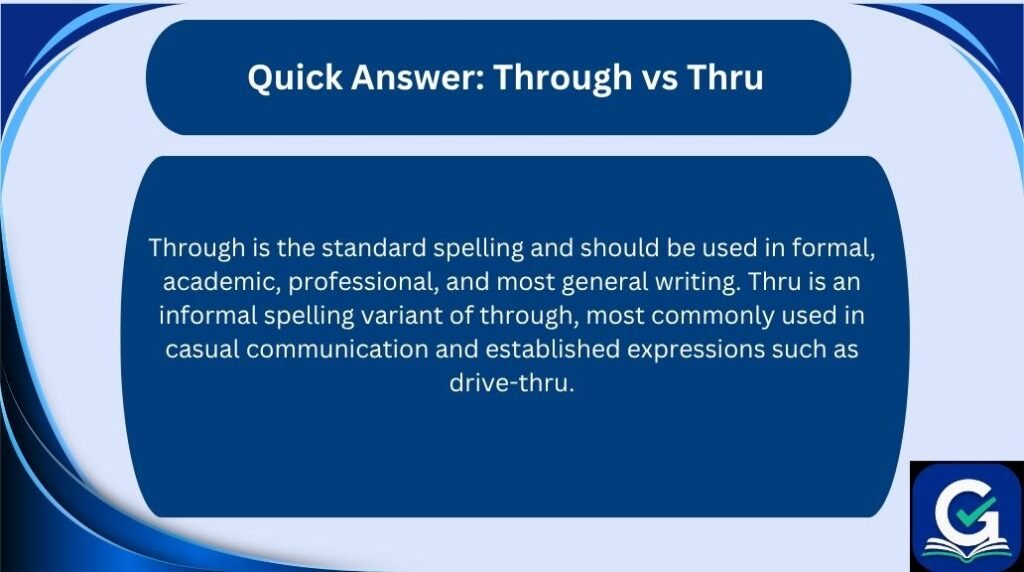
Through is the standard spelling and should be used in formal, academic, professional, and most general writing. Thru is an informal spelling variant of through, most commonly used in casual communication and established expressions such as drive-thru.
For example:
- Correct for standard writing: I walked through the park.
- Informal: I went through the drive-thru.
- Professional: Please read through the report.
- Casual texting: I’ll be there thru Friday.
The safest rule is simple: When in doubt, use “through.”
Understanding the Basics of Through vs Thru
The confusion exists because the two spellings have the same pronunciation and can refer to the same general concept. The difference is primarily one of standard spelling and context, not pronunciation.
Comparison Table
| Form | Type | Meaning | Example | Correct/Incorrect |
|---|---|---|---|---|
| through | Standard word | From one side to another, during a period, by means of, until, and more | We walked through the tunnel. | ✅ Correct |
| thru | Informal variant | Informal spelling of through | We stopped at the drive-thru. | ✅ Correct in specific informal contexts |
| thru | Formal academic spelling | Standard replacement for through in formal prose | We walked thru the museum. | ❌ Not recommended |
| through | Professional spelling | Standard spelling in formal and general communication | I read through the report. | ✅ Correct |
The key point is that thru is not simply a spelling mistake. It has a documented history and is recognized as an informal variant. Merriam-Webster notes that thru has a long history as a spelling variant, even though through became the standard spelling.
So, calling every use of thru “wrong” would be too simplistic. The better distinction is standard versus informal usage.
What Does “Through” Mean?
Through is a versatile English word. It can function as a preposition, adverb, or adjective, and its meaning changes depending on the sentence.
Merriam-Webster lists several major uses, including movement from one side to another, movement within an area, passage during a period, means or agency, and completion.
1. Movement From One Side to Another
Use through when something moves from one side or point to another.
Example:
The train traveled through the tunnel.
Here, through the tunnel tells us where the train traveled. It entered the tunnel and continued through it.
More examples:
- We walked through the forest.
- Light came through the window.
- The children ran through the doorway.
- The river flows through the city.
2. Movement Within an Area
Through can also describe movement within or across an area.
We walked through the mall for an hour.
The sentence does not necessarily mean that the people entered at one exact point and exited at another. It can describe movement around different parts of the mall.
Other examples:
- We drove through downtown.
- She wandered through the market.
- The hikers moved through the woods.
3. During an Entire Period
Another common use of through relates to time.
I worked through the weekend.
This means the action continued during the weekend.
You can also say:
- She stayed awake through the night.
- We studied through the summer.
- He worked through the holidays.
Merriam-Webster specifically includes the meaning “during the entire period” and also recognizes through as meaning “to and including,” as in Monday through Friday.
4. By Means Of
Through can describe the method by which something happens.
I learned English through practice.
Here, through practice means “by means of practice.”
Other examples include:
- She succeeded through hard work.
- We solved the problem through careful planning.
- He found the job through a friend.
5. From Beginning to End
Through can also describe completion.
I read the book through.
This means the person read the book from beginning to end.
Another example:
We need to think this problem through.
Here, think through means to consider something carefully and completely.
6. Until or Including a Specific Point
In North American English, through is frequently used to indicate a range that includes the final point.
The office is open Monday through Friday.
This means Monday, Tuesday, Wednesday, Thursday, and Friday.
You might also see:
- Chapters 3 through 7
- January through March
- Monday through Saturday
Oxford also identifies this use of through as standard North American English and notes that it can mean “until, and including.”
What Does “Thru” Mean?
Thru is an informal spelling of through.
It generally carries the same basic meaning as through, but it is much less appropriate in formal writing.
Dictionary.com describes thru as an informal, simplified spelling of through, particularly common in the United States.
For example:
We went thru the tunnel.
The meaning is understandable, but through would be the preferred spelling in standard prose:
We went through the tunnel.
The spelling thru is more likely to appear in:
- Casual texts
- Informal notes
- Advertising
- Signs
- Brand names
- Shortened expressions
- Space-saving contexts
- Certain established compounds
The most familiar example is drive-thru.
When Should You Use “Through”?
Use through whenever you are writing standard English and want the safest, most widely accepted form.
Use “Through” in Professional Emails
For workplace communication, choose through.
Instead of:
I looked thru the document.
Write:
I looked through the document.
The second version is more polished and appropriate for professional communication.
Use “Through” in Academic Writing
Academic papers should normally use through.
For example:
The researchers collected the data through interviews.
Avoid:
The researchers collected the data thru interviews.
The first sentence follows conventional formal writing standards.
Use “Through” in Essays and Reports
If you are writing an essay, report, application, article, or formal letter, through is the best choice.
Examples:
- We examined the issue through several different perspectives.
- The program improved access through community partnerships.
- Students learned through practical experience.
Use “Through” in General Prose
Even when the writing is not especially formal, through remains the default spelling.
For example:
She walked through the door.
This is the natural standard form.
When Is “Thru” Acceptable?
Thru has legitimate uses, but context matters.
Drive-Thru
The most recognizable example is drive-thru.
You may see:
- Drive-thru restaurant
- Drive-thru window
- Drive-thru pharmacy
- Drive-thru service
Merriam-Webster discusses the use of drive-thru and notes that the Associated Press Stylebook has allowed drive-thru as an alternative to drive-through in its style guidance.
So:
We stopped at the drive-thru.
is perfectly normal.
Signs and Space-Saving Language
Shorter spellings can be useful when space is limited.
A sign might use:
DRIVE-THRU OPEN
rather than:
DRIVE-THROUGH OPEN
This is partly practical. Signs need to communicate information quickly and efficiently.
Casual Texting
In informal texting, someone might write:
I’ll be available thru Friday.
The meaning is clear, and the context is casual.
However, if you are writing to a professor, client, employer, or business partner, through is a better choice.
A Simple Rule for Choosing the Right Form
Here is the easiest rule to remember:
Formal or standard writing? Use “through.” Casual, abbreviated, or established usage? “Thru” may be acceptable.
Think of the choice this way:
Through = standard
Thru = informal
This rule will solve most through vs thru questions immediately.
Test Tip: How to Check Your Choice
When you are unsure, ask yourself:
“Would I use this spelling in a formal essay?”
If the answer is yes, choose through.
For example:
We traveled through the mountains.
That looks appropriate in an essay.
Now consider:
We traveled thru the mountains.
It is understandable, but the shortened spelling looks informal.
Another useful test is to replace the word with across, during, by means of, or until and including.
If the sentence makes sense with one of these meanings, through is likely the standard spelling you need.
Through vs Thru in a Real-Life Workplace Example
Imagine that an employee sends this message to a manager:
Hi Sarah, I went thru the sales report and found three errors.
The message is understandable, but the spelling thru makes the email feel more casual.
A more professional version would be:
Hi Sarah, I went through the sales report and found three errors.
The meaning has not changed. Only the spelling and level of formality have changed.
Now imagine a restaurant sign:
DRIVE-THRU OPEN UNTIL 11 PM
Here, thru is natural because it is an established commercial expression and works well in concise signage.
This demonstrates why context matters more than simply labeling one form “right” and the other “wrong.”
Grammar Rules Behind the Difference
The fundamental grammar rule is that through is the standard dictionary spelling, while thru is an informal spelling variant.
Merriam-Webster’s dictionary entry recognizes through as a preposition, adverb, and adjective. Its meanings include movement across or within a space, duration, means, completion, and other related concepts.
Merriam-Webster also explains that thru has a much longer history than many people realize. In fact, historical spellings of the word varied considerably before modern English spelling became standardized. The spelling thru is older than the modern spelling through in the historical record discussed by Merriam-Webster.
This is an interesting reminder that English spelling has never been completely static.
Why Is “Through” the Standard?
English spelling gradually became more standardized through printing, education, dictionaries, and established usage.
Although alternative spellings existed, through became the conventional form used in standard written English.
That is why a modern writer should generally choose:
through
rather than:
thru
unless there is a specific reason to use the informal form.
Common Mistakes With Through and Thru
Many people make this mistake because both forms sound identical.
Mistake 1: Using “Thru” in Formal Writing
Incorrect for standard formal style:
The information was gathered thru interviews.
Better:
The information was gathered through interviews.
Mistake 2: Assuming “Thru” Is Always Wrong
This is also an oversimplification.
For example:
We ordered food at the drive-thru.
The spelling thru is established and widely used in this expression.
Mistake 3: Treating Pronunciation as a Spelling Guide
Because both forms are pronounced the same way, pronunciation cannot tell you which spelling to use.
English has many words whose pronunciation does not clearly reveal their spelling.
That is especially true of through, which has an unusual spelling compared with its pronunciation.
Why Do People Write “Thru”?
There are several reasons.
Fast Typing
When people type quickly, they may shorten words to save time.
For example:
See you thru the week.
In casual communication, abbreviations and shortened forms are common.
Autocorrect and Predictive Text
Modern keyboards may influence how people write. If someone frequently uses informal spelling, predictive text may reinforce that habit.
Lack of Knowledge
Some writers may genuinely believe that thru is the standard spelling.
If you learned English primarily through speech rather than extensive reading, it can be difficult to know which spelling is conventional.
Signs and Advertising
People also see thru frequently in commercial environments.
After repeatedly seeing drive-thru, a person may reasonably assume that thru is equally appropriate everywhere.
That assumption is understandable—but it is not correct for formal writing.
Similar Grammar and Spelling Confusions
The through vs thru issue belongs to a larger group of common English confusions.
| Confusion | Correct Standard Form | Common Informal/Error Form | Key Difference |
|---|---|---|---|
| through vs thru | through | thru | Standard vs informal |
| its vs it’s | its / it’s | — | Possession vs “it is” |
| your vs you’re | your / you’re | — | Possession vs “you are” |
| their vs they’re | their / they’re | — | Possession vs “they are” |
| to vs too | to / too | — | Direction/function vs excess/also |
| then vs than | then / than | — | Time/order vs comparison |
| affect vs effect | affect / effect | — | Usually verb vs noun |
| accept vs except | accept / except | — | Receive vs exclude |
The lesson is simple: English often contains words that sound similar or appear similar but have different standard uses.
Through vs Thru in Different Contexts
Context is one of the most important factors when deciding which form to use.
Everyday Conversation
When speaking, there is no visible difference.
You might say:
I walked through the park.
Nobody hears whether you would spell the word through or thru.
The difference becomes important when the language is written.
Professional Writing
Use through.
Examples:
- We received the documents through email.
- The project was completed through careful planning.
- Please review the information through the attached report.
In professional writing, standard spelling makes your communication look polished.
Creative Writing
Creative writers have more freedom.
A novelist might use thru deliberately to reflect:
- A character’s voice
- A text message
- A sign
- Informal dialogue
- A particular stylistic effect
For example:
“I’ll come thru after work.”
If the character is texting, thru can make the dialogue feel realistic.
So creative writing does not always follow the same rules as academic writing.
Social Media and Texting
Thru is more acceptable in casual digital communication.
You might see:
I’ll be there thru Sunday.
or:
Just go thru the main entrance.
These are easy to understand.
Still, if you want your social media writing to appear polished and professional, through is the safer choice.
Why the Difference Matters
At first glance, choosing through instead of thru may seem like a tiny detail. However, small spelling choices can influence how readers perceive your writing.
Clarity
Standard spelling makes your writing immediately recognizable.
Readers do not have to wonder whether a shortened spelling was intentional.
Professionalism
In a résumé, business email, cover letter, report, or academic paper, standard spelling demonstrates attention to detail.
Compare:
Please follow the instructions thru the final step.
with:
Please follow the instructions through the final step.
The second version feels more polished.
Digital Communication
Digital communication moves quickly, but speed does not always justify informal spelling.
If the audience includes customers, employers, clients, teachers, or colleagues, standard spelling is usually the better choice.
A Simple Principle
Good writing is not only about being understood; it is also about choosing language that fits the situation.
That is exactly why knowing the difference between through vs thru is useful.
A Short History of “Thru”
One fascinating fact is that thru is not a modern invention created by texting.
Merriam-Webster explains that through has had many historical spelling variations. Before English spelling became standardized, the word appeared in numerous forms. The spelling thru actually predates through by more than a century according to Merriam-Webster’s historical discussion.
So why did through become standard?
English spelling gradually became more standardized, particularly after the development and spread of printing. Over time, one spelling became conventional while others became less common.
The history of the word shows that thru is not inherently nonsensical or a modern misspelling. It is a historical variant that now occupies a primarily informal role.
That distinction is important.
Special Exceptions and Established Uses
The biggest practical exception is the compound drive-thru.
You will commonly see:
- drive-thru
- drive-thru window
- drive-thru service
- drive-thru restaurant
These forms are so established that replacing thru with through may sometimes look less natural in a brand or sign.
For example:
The restaurant has a drive-thru.
is completely normal.
You may also encounter thru in business names, product names, signs, or branding. In those cases, preserve the official spelling of the name.
A brand can intentionally choose an unconventional spelling.
That does not mean you should use the same spelling throughout ordinary formal writing.
Can You Use “Thru” in Formal Writing?
Generally, you should avoid it in formal prose.
There are exceptions when you are:
- Quoting an original source
- Reproducing an official name
- Referring to a branded expression
- Discussing the word itself
- Using a specific established compound such as drive-thru
Otherwise, through is the safest standard choice.
For academic, professional, and formal writing, there is rarely any advantage to replacing through with thru.
Is “Thru” a Misspelling?
Not exactly.
Calling thru a simple misspelling would ignore its recognized status as an informal variant. Merriam-Webster explicitly discusses it as a spelling variant of through, while other dictionaries similarly identify it as an informal form.
However, informal does not mean appropriate everywhere.
Think of it like this:
- Through → standard spelling
- Thru → informal variant
Therefore, if a teacher asks you to correct:
We walked thru the park.
the expected answer will normally be:
We walked through the park.
Quick Recap Checklist
Use this checklist whenever you are unsure.
| Question | If Yes → Use |
|---|---|
| Is this an academic paper? | through |
| Is this a professional email? | through |
| Is this a formal report? | through |
| Is this a casual text? | thru may be acceptable |
| Is it an established expression like “drive-thru”? | thru |
| Is it part of an official brand name? | Use the brand’s spelling |
| Are you writing general standard English? | through |
| Are you deliberately reproducing informal speech? | thru may work |
Practice Examples
1. I walked ___ the door.
Answer: through
I walked through the door.
2. We stopped at the ___ after the movie.
Answer: drive-thru
We stopped at the drive-thru after the movie.
3. Please review the document ___ Friday.
Answer: through
Please review the document through Friday.
Easy Memory Trick
If you need one simple memory trick, remember:
“Through” is the spelling you can trust.
When writing an essay, email, report, article, application, or formal message, choose through.
When you see thru, think:
“This is probably informal, abbreviated, branded, or part of an established expression.”
This mental shortcut can help you make the correct choice quickly.
FAQs
1. Is “through” or “thru” correct?
Through is the standard spelling and is correct for formal and general writing. Thru is an informal variant that is acceptable in certain casual or established contexts, such as drive-thru.
2. Is “thru” grammatically correct?
Yes, thru is recognized as an informal spelling variant of through. However, that does not mean it is appropriate in every context. For formal writing, through is the preferred form.
3. Should I use “thru” in a professional email?
Generally, no. Use through in professional emails because it is the standard spelling and creates a more polished impression.
Write:
I reviewed the information through the report.
rather than:
I reviewed the information thru the report.
4. Why do people write “drive-thru” instead of “drive-through”?
Drive-thru is an established informal spelling used widely in American English, particularly in commercial settings. Merriam-Webster specifically discusses the development and acceptance of drive-thru in style usage.
5. Does “thru” mean the same thing as “through”?
Generally, yes. Thru is an informal spelling variant of through, so the intended meaning is usually the same. The major difference is the level of formality and the contexts in which the spelling is appropriate.
6. Which should I use in an essay: “through” or “thru”?
Use through. Essays, academic assignments, reports, and other formal writing should normally use the standard spelling.
Conclusion
The difference between through vs thru is easier to understand once you separate meaning from style. Both forms can represent the same basic word, but through is the standard spelling used in formal, academic, professional, and general writing.
Thru is an informal variant that appears frequently in casual communication, signs, branding, and established expressions such as drive-thru. Merriam-Webster recognizes thru as an informal variant while documenting the many historical spellings that preceded modern English standardization.
If you are unsure which form to choose, there is one dependable rule: use “through” unless you have a specific reason to use “thru.” That single habit will keep your writing clear, polished, and appropriate for almost any audience.
Remember it this way: Through is the standard; thru is the shortcut. Choose the full spelling when professionalism matters. ✍️

I’m Ethan Carter, a grammar writer at Gramfino, where I explain English grammar in a simple and practical way.
I enjoy helping readers understand sentence structure, grammar rules, and common writing mistakes.
[…] practical examples you can use in everyday, academic, professional, and digital writing. 🚗✈️ Through vs Thru | Time-Frame vs Timeframe | Possible vs […]
[…] show you practical examples, and give you an easy way to remember the rule. En Route vs In Route | Through vs Thru | Time-Frame vs […]