Have you ever typed a sentence such as “I have an enquiry about my order” and then wondered whether inquiry would be better? 🤔 You are not alone. The words inquiry vs enquiry cause confusion because they look almost identical, sound the same, and generally carry the same basic meaning. The main difference is not really about meaning; it is largely about regional spelling and style.
In American English, inquiry is the standard spelling. In British English, enquiry is commonly used for a question or request for information, while inquiry is also used, particularly in formal contexts. Both forms can refer to asking for information or to an official investigation. Cambridge Dictionary lists enquiry as a UK form of inquiry, confirming that the two spellings are closely related.
For writers using US English, the safest and most natural choice is inquiry. If you are writing for a British audience, enquiry may be the preferred spelling in everyday situations. Understanding this small distinction can make your emails, articles, academic papers, and professional documents more polished. Madam vs Madame | Echoes vs Echos | Themself vs Theirself
Quick Answer: Inquiry vs Enquiry
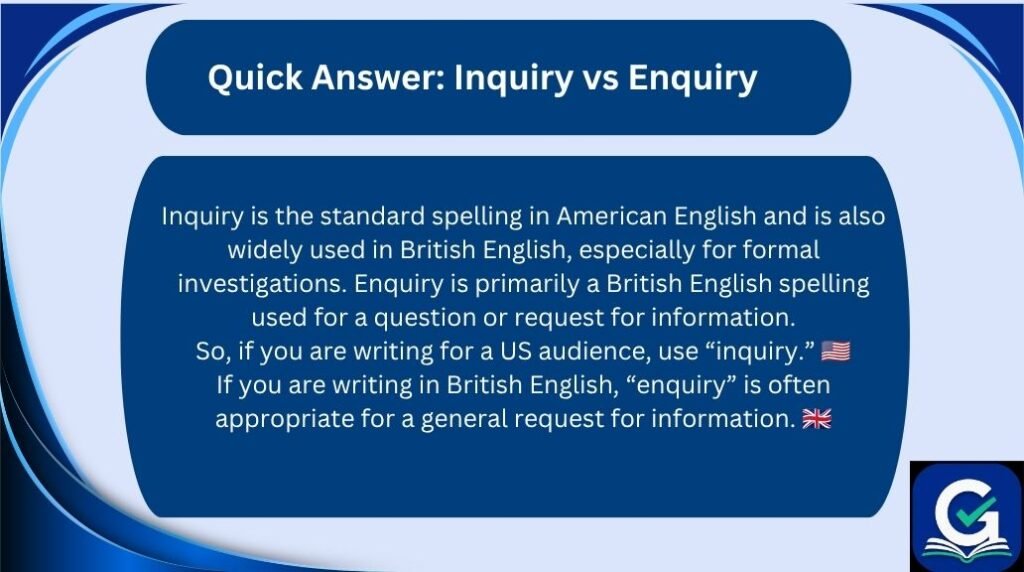
Inquiry is the standard spelling in American English and is also widely used in British English, especially for formal investigations. Enquiry is primarily a British English spelling used for a question or request for information.
So, if you are writing for a US audience, use “inquiry.” 🇺🇸
If you are writing in British English, “enquiry” is often appropriate for a general request for information. 🇬🇧
Examples:
- US English: I have an inquiry about my order.
- British English: I have an enquiry about my order.
- Formal investigation: The government launched an inquiry into the incident.
Understanding the Basics of Inquiry vs Enquiry
The easiest way to understand these words is to think about English varieties rather than completely different definitions.
Both inquiry and enquiry can describe the act of asking for information. They can also relate to an investigation or a formal process of finding facts. Cambridge Dictionary defines inquiry as both the act of asking a question and an official process used to discover facts. It identifies enquiry as the UK form.
Comparison Table
| Form | Type | Meaning | Example | Correct/Incorrect |
|---|---|---|---|---|
| inquiry | American English | A question or request for information | I sent an inquiry about the course. | ✅ Correct |
| enquiry | British English | A question or request for information | I sent an enquiry about the course. | ✅ Correct in British English |
| inquiry | British English | A formal investigation or general questioning | An inquiry was launched into the accident. | ✅ Correct |
| enquiry | American English | British-style spelling of inquiry | I sent an enquiry about the course. | ⚠️ Understandable, but not standard US spelling |
| inquiries | US plural | Multiple questions or requests | We received several inquiries. | ✅ Correct |
| enquiries | UK plural | Multiple questions or requests | We received several enquiries. | ✅ Correct in British English |
The important point is that enquiry is not simply a misspelling of inquiry. It is an established British spelling. Likewise, inquiry is not wrong in British English. The choice depends heavily on region, context, and house style.
What Does “Inquiry” Mean?
Inquiry is a noun meaning a question, request for information, or process of investigating something.
It can be used in several common ways.
1. Inquiry as a Question
An inquiry can simply be a question asked to obtain information.
For example:
I made an inquiry about the hotel’s cancellation policy.
Here, inquiry means a request for information.
The sentence can be broken down like this:
- I = subject
- made = verb
- an inquiry = object
- about the hotel’s cancellation policy = explains what information was requested
Another example:
The company received hundreds of inquiries about the new product.
Here, inquiries means questions or requests for information from customers.
This is extremely common in business English.
2. Inquiry as an Investigation
Inquiry can also describe a formal investigation designed to discover facts.
For example:
The committee launched an inquiry into the accident.
In this sentence, the word does not mean a simple customer question. It refers to a structured investigation.
Cambridge Dictionary specifically identifies this meaning as an official process for discovering facts about something that has happened.
Other examples include:
- The government ordered an inquiry into the allegations.
- A public inquiry examined the causes of the disaster.
- The committee conducted an independent inquiry.
- The inquiry found several serious problems.
This meaning is especially common in legal, political, academic, and governmental writing.
What Does “Enquiry” Mean?
Enquiry generally has the same basic meaning as inquiry, but it is particularly associated with British English.
For example:
I made an enquiry about the available rooms.
This means:
I asked for information about the available rooms.
Cambridge Dictionary labels enquiry as a UK form of inquiry.
British English commonly uses expressions such as:
- customer enquiry
- general enquiry
- telephone enquiry
- email enquiry
- sales enquiry
- further enquiry
- public enquiry
- make an enquiry
For example:
Please contact our office if you have any further enquiries.
That sentence sounds natural in British English.
In American English, however, you would normally write:
Please contact our office if you have any further inquiries.
Both sentences communicate the same basic idea. The spelling changes according to the variety of English being used.
Is Inquiry or Enquiry Correct?
Both are correct, but inquiry is the standard choice for American English.
That distinction is especially important if your target audience is in the United States.
Use “inquiry” when:
- Writing American English
- Writing for a US company
- Creating US-focused website content
- Writing American academic material
- Preparing a US business email
- Referring to a formal investigation
- Writing for a broad international audience where US English is your chosen style
Use “enquiry” when:
- Writing British English
- Writing for a UK audience
- Following a British organization’s house style
- Referring to a general request for information in a British context
The safest rule for US writers is simple:
If you use American English, choose “inquiry.”
Inquiry vs Enquiry in American English
American English strongly favors inquiry.
Consider these examples:
I have an inquiry about my membership.
We received several inquiries from customers.
Please direct all media inquiries to the communications department.
The senator called for an inquiry into the matter.
These sentences use the standard American spelling.
You may still encounter enquiry in an American context because English is full of international influences. A British company operating in the United States might use enquiry in its branding or internal communications. A quotation from a British publication may also preserve British spelling.
However, if you are writing original content in US English, inquiry is the better choice.
Inquiry vs Enquiry in British English
British English is slightly more flexible.
Enquiry is commonly used for ordinary questions or requests for information.
For example:
I sent an enquiry to the university.
The hotel received several enquiries about room availability.
At the same time, inquiry is also used in British English, particularly in formal or official contexts.
For example:
A public inquiry was launched after the incident.
This means British writers may distinguish the forms by context, although usage is not perfectly uniform.
Cambridge’s entries demonstrate this overlap: enquiry is treated as a UK form of inquiry, while inquiry is also used in British English for both questions and official investigations.
Therefore, it is misleading to say:
“Inquiry is American, and enquiry is British.”
That statement is too simplistic.
A better explanation is:
Inquiry is the standard American spelling, while enquiry is a common British spelling, especially for general requests for information.
The Difference Between a General Inquiry and a Formal Investigation
One reason people become confused about these words is that inquiry has more than one meaning.
General inquiry
A general inquiry is simply a request for information.
Example:
I called the airline with an inquiry about my reservation.
You are asking a question.
Formal inquiry
A formal inquiry is an investigation.
Example:
The government established an inquiry into the accident.
A group or authority is trying to discover what happened.
Why context matters
Compare these two sentences:
I made an inquiry about the price.
The court ordered an inquiry into the allegations.
The first involves ordinary information-seeking.
The second involves a formal investigation.
The spelling remains inquiry, but the meaning changes because of the context.
Common Expressions With “Inquiry”
Learning common word combinations can make your writing sound more natural.
Common phrases include:
- make an inquiry
- make inquiries
- receive an inquiry
- respond to an inquiry
- answer an inquiry
- customer inquiry
- media inquiry
- business inquiry
- product inquiry
- inquiry about
- inquiry into
- formal inquiry
- public inquiry
- official inquiry
- independent inquiry
- government inquiry
Examples:
We received an inquiry about the new pricing plan.
Please send your inquiry to our customer service department.
The journalist submitted a media inquiry.
The committee opened an inquiry into the financial records.
Notice the difference between about and into.
Generally:
- inquiry about something → asking for information
- inquiry into something → investigating something
This is not an absolute rule, but it is a useful pattern.
Common Expressions With “Enquiry”
British English commonly uses:
- make an enquiry
- make further enquiries
- customer enquiry
- sales enquiry
- general enquiry
- telephone enquiry
- email enquiry
- product enquiry
- enquiry about
- enquiry into
Examples:
We received a customer enquiry this morning.
Please make further enquiries before making a decision.
I sent an enquiry about the application process.
The newspaper reported an official enquiry into the incident.
The plural form also changes:
inquiry → inquiries
enquiry → enquiries
This is an important spelling difference.
Inquiry vs Enquiry: Singular and Plural Forms
The plural forms are easy to overlook.
American English
- singular: inquiry
- plural: inquiries
Example:
We received five inquiries.
British English
- singular: enquiry
- plural: enquiries
Example:
We received five enquiries.
Notice that the y changes to ies in the plural.
The same spelling pattern appears in many English nouns:
- company → companies
- country → countries
- party → parties
- inquiry → inquiries
- enquiry → enquiries
So writing inquirys or enquirys is incorrect.
Test Tip: How Can You Choose the Right Spelling?
Here is an easy test. 🧠
Ask yourself:
“Which English variety am I writing?”
If the answer is:
American English → inquiry
If the answer is:
British English → enquiry is often used for general questions
If you are referring to a formal investigation:
Inquiry is a safe and widely recognized choice, including in British English.
A simple memory trick
Think:
US = inquiry
The American spelling keeps the i.
For British-style general requests, remember:
UK = enquiry
The British spelling uses e at the beginning.
If you are writing content specifically for American readers, consistently choosing inquiry will prevent most problems.
A Real-Life Workplace Case Study
Imagine that Sarah works for an American technology company.
A customer emails her:
“I would like more information about your enterprise plan.”
Sarah responds:
“Thank you for your inquiry. I’ll be happy to provide more information about our enterprise plan.”
This is appropriate American business English.
Now imagine Sarah works for a British company. Her response might say:
“Thank you for your enquiry. I’ll be happy to provide more information about our enterprise plan.”
Both responses are grammatically correct.
The difference is primarily regional spelling and style.
What if the company has an international audience?
In that situation, the company should establish a consistent editorial style.
If its website uses American English, it should generally use:
customer inquiry
If it uses British English, it may prefer:
customer enquiry
Consistency matters more than switching randomly between the two forms.
Grammar Rules: Why Does the Spelling Change?
The difference between inquiry and enquiry is primarily a matter of spelling conventions rather than a fundamental grammatical distinction.
Both words function as nouns.
For example:
Her inquiry was answered quickly.
Here, inquiry is the subject complement/object-like noun referring to a request for information.
You can also use the plural:
Several inquiries were submitted.
The British form behaves in the same way:
Her enquiry was answered quickly.
Several enquiries were submitted.
Cambridge Dictionary recognizes enquiry as a UK form of inquiry. It also gives inquiry meanings involving both asking for information and official investigation.
Therefore, the question is not:
“Which spelling is grammatically possible?”
Instead, ask:
“Which spelling matches my target variety of English and context?”
That is the more accurate way to approach the issue.
Why Do Inquiry and Enquiry Exist?
English developed differently across regions, and spelling conventions evolved over time.
American English developed its own spelling preferences, while British English retained or developed different conventions in various words.
This is why English has pairs such as:
- color / colour
- center / centre
- organize / organise
- traveler / traveller
- inquiry / enquiry
These differences do not necessarily mean that one spelling is “correct English” and the other is “bad English.”
Instead, they often indicate regional standards.
The same principle applies here.
For a US audience, inquiry is the natural choice.
For a British audience, enquiry can be entirely appropriate.
Common Mistakes With Inquiry vs Enquiry
Why do writers mix these spellings?
There are several common reasons.
1. Fast Typing
When people type quickly, they may use whichever spelling comes to mind first.
For example:
I received an enquiry yesterday.
A US writer may have intended:
I received an inquiry yesterday.
The error is understandable because the words sound the same.
2. Autocorrect
Autocorrect can sometimes preserve a spelling rather than change it, especially when the word is technically valid.
Because enquiry is a legitimate English word, software may not flag it as incorrect.
That means a US writer cannot always depend on spell-checking software to identify a regional spelling mismatch.
3. Lack of Knowledge
Some learners assume that one spelling must be correct and the other must be a typo.
That is not true.
Both forms are established English words.
The key is knowing where and how they are normally used.
4. Mixing English Varieties
A writer may use American English in one paragraph and British English in another.
For example:
We received several inquiries about the program, but our UK office recorded several enquiries.
This can be correct if the distinction is intentional.
However, if the writer is simply inconsistent, it can make the document look poorly edited.
Similar Grammar Confusions
Inquiry vs enquiry belongs to a larger group of spelling and usage questions.
| Confusion | Correct Forms | Main Difference |
|---|---|---|
| its vs it’s | Both | Possession vs “it is” |
| your vs you’re | Both | Possession vs “you are” |
| their vs they’re | Both | Possession vs “they are” |
| affect vs effect | Both | Usually verb vs noun, with exceptions |
| than vs then | Both | Comparison vs time/order |
| advice vs advise | Both | Noun vs verb |
| inquiry vs enquiry | Both | Mainly regional spelling/style |
| practice vs practise | Both | US English uses “practice” for noun and verb; British English distinguishes noun/verb |
The important lesson is that not every confusing pair contains one correct word and one incorrect word.
Sometimes both words are legitimate, but they differ in meaning, grammar, pronunciation, or regional usage.
Inquiry vs Enquiry in Different Contexts
Everyday Conversation
In casual American conversation, inquiry is the standard spelling when the word appears in writing.
For example:
I have an inquiry about the event.
In British English:
I have an enquiry about the event.
However, in everyday speech, people obviously do not hear the spelling. Both words are pronounced essentially the same.
That means the distinction becomes important primarily when writing.
Professional Writing
This is one of the most important areas to get right.
American businesses commonly use phrases such as:
customer inquiry
sales inquiry
media inquiry
product inquiry
general inquiry
For example:
Please direct all media inquiries to the communications team.
For a US company, inquiry should normally be used consistently.
British organizations may use enquiry for similar customer-service contexts.
Academic Writing
Academic writing frequently uses inquiry in the United States.
Examples:
Scientific inquiry requires careful observation.
Academic inquiry often begins with a well-defined question.
The study contributes to ongoing inquiry into language development.
Here, inquiry has a broader intellectual meaning: the systematic process of asking questions, examining evidence, and developing knowledge.
This usage is especially common in phrases such as:
- scientific inquiry
- academic inquiry
- scholarly inquiry
- intellectual inquiry
- philosophical inquiry
Creative Writing
Creative writers have more freedom.
If a character is British, using enquiry in dialogue or correspondence can help maintain authenticity.
For example:
“I sent an enquiry to the hotel yesterday,” James said.
If the story is set in the United States, inquiry would normally be more natural.
Creative writing therefore gives you another reason to understand regional spelling: language can help establish character and setting.
Social Media and Texting
On social media, people often ignore regional spelling differences.
You might see:
“Just made an inquiry about tickets.”
or:
“Just made an enquiry about tickets.”
Both are understandable.
However, if you are creating professional social media content for a US brand, inquiry is the better choice.
For a British brand, enquiry may fit the brand’s established style.
Why the Difference Matters
You might wonder:
“If everyone understands both words, why should I care?”
The answer is consistency and credibility.
1. Clarity in Communication
Using the spelling expected by your audience makes your writing easier to process.
A US reader will naturally expect:
inquiry
A British reader may naturally expect:
enquiry
Neither spelling creates major confusion, but matching the reader’s language conventions improves the overall experience.
2. Professionalism
Small language choices can influence how polished your writing appears.
Imagine a US company website that uses American spelling everywhere but suddenly writes:
“Please send your enquiry to our support department.”
The sentence is understandable, but the British spelling may look inconsistent with the rest of the website.
3. Digital Communication
Websites, emails, product pages, and social media posts often represent a company publicly.
Consistent spelling helps establish a recognizable editorial voice.
4. Search and SEO
For SEO, both terms can appear in searches because people use different regional spelling conventions.
However, if your content is specifically targeted to a US audience, using inquiry naturally throughout the article is appropriate.
Do not force both forms into every paragraph. Search engines understand related terms and spelling variations, so keyword stuffing is unnecessary.
Good writing is not about using every possible variation. It is about using the right word naturally for the reader.
Special Exception: Brand Names and Official Names
There are situations where you should preserve the original spelling, even if it does not match your normal regional style.
For example, an organization may officially use:
Enquiries Department
or:
Customer Enquiries
If that is the organization’s official name, do not automatically change it to:
Customer Inquiries
when referring to the organization by its official title.
The same applies to:
- company names
- department names
- product names
- official documents
- quotations
- titles
- trademarks
- institutional terminology
The rule
Follow the organization’s official spelling when reproducing its name or title.
This is a general editorial principle that applies far beyond inquiry vs enquiry.
Inquiry vs Enquiry in Formal Investigations
There is an interesting distinction worth remembering.
When discussing an official investigation, inquiry is especially common and widely understood in both American and British English.
Examples:
The committee launched an inquiry.
The judge ordered an inquiry.
The government announced an independent inquiry.
The inquiry examined the evidence.
In British contexts, public inquiry is a particularly familiar expression.
This means that even if a British writer commonly uses enquiry for a customer question, they may still use inquiry when referring to an official investigation.
That is one reason the simple rule “British = enquiry” is incomplete.
Common Phrases You Should Know
Here are useful expressions to remember.
American English
- customer inquiry
- media inquiry
- sales inquiry
- product inquiry
- email inquiry
- general inquiry
- formal inquiry
- official inquiry
- public inquiry
- inquiry about
- inquiry into
- make an inquiry
- receive an inquiry
- respond to an inquiry
British English
- customer enquiry
- sales enquiry
- general enquiry
- email enquiry
- telephone enquiry
- enquiry about
- make an enquiry
- further enquiries
- customer enquiries
- public inquiry
- official inquiry
The exact choice can vary by organization and context, especially in British English.
Quick Recap Checklist
Use this checklist whenever you are unsure.
| Question | If Yes → Use |
|---|---|
| Am I writing for a US audience? | inquiry |
| Am I using standard American English? | inquiry |
| Am I writing a US business email? | inquiry |
| Am I referring to an official investigation? | inquiry |
| Am I writing general British English? | enquiry is often appropriate |
| Does a British organization officially use “enquiry”? | Preserve enquiry |
| Am I reproducing an official name or title? | Keep the organization’s spelling |
Practice Example 1
Sentence:
I contacted the company with an ___ about the warranty.
For US English:
I contacted the company with an inquiry about the warranty.
For British English:
I contacted the company with an enquiry about the warranty.
Practice Example 2
Sentence:
The government announced an ___ into the incident.
Best general choice:
The government announced an inquiry into the incident.
Practice Example 3
Sentence:
We received several ___ from customers.
US English:
We received several inquiries from customers.
British English:
We received several enquiries from customers.
Inquiry vs Enquiry: Easy Memory Rule
If you only remember one thing from this article, remember this:
🇺🇸 American English → Inquiry
🇬🇧 British English → Enquiry for many general requests
🔎 Formal investigation → Inquiry is widely used
That three-part rule will solve most everyday questions about these spellings.
Also remember that enquiry is not an incorrect spelling. It is a recognized British form. Cambridge Dictionary explicitly identifies enquiry as a UK form of inquiry.
Likewise, inquiry is not exclusively American. It is also used in British English, particularly in formal contexts.
FAQs
1. Is “inquiry” or “enquiry” correct?
Both are correct. Inquiry is the standard spelling in American English, while enquiry is a common British English spelling for a question or request for information. Both forms are recognized in English dictionaries.
2. Is “enquiry” British or American?
Enquiry is primarily associated with British English. American English normally uses inquiry instead.
For example:
- US: customer inquiry
- UK: customer enquiry
3. Should I use “inquiry” in American English?
Yes. If you are writing standard American English, inquiry is the preferred spelling.
For example:
I have an inquiry about my account.
4. Is “enquiry” a misspelling of “inquiry”?
No. Enquiry is a legitimate English word and a recognized British spelling. It is not simply a typographical error. Cambridge Dictionary lists enquiry as a UK form of inquiry.
5. What is the plural of inquiry?
The plural of inquiry is inquiries.
Example:
We received several inquiries from customers.
The plural of enquiry is enquiries.
Example:
We received several enquiries from customers.
6. Is “inquiry” used for formal investigations?
Yes. Inquiry can refer to an official investigation intended to discover facts.
For example:
The committee launched an inquiry into the incident.
This meaning is recognized by major English dictionaries, including Cambridge Dictionary.
Conclusion
The difference between inquiry vs enquiry is easier to understand once you stop treating them as completely different words. Both can refer to a question, request for information, or process of investigation. The main distinction is regional spelling and usage. In standard American English, inquiry is the preferred spelling, while enquiry is commonly used in British English for general requests for information. British English can also use inquiry, especially for formal investigations.
For US writers, the rule is simple: use inquiry and inquiries. If you are writing for a British audience, follow the style of that audience or organization and use enquiry and enquiries where appropriate.
Most importantly, do not assume that one spelling is universally correct and the other is always wrong. English varies by region, and good writing respects those differences.
When in doubt, match your spelling to your audience—and remember: US English prefers “inquiry.” ✍️

I’m Ethan Carter, a grammar writer at Gramfino, where I explain English grammar in a simple and practical way.
I enjoy helping readers understand sentence structure, grammar rules, and common writing mistakes.
[…] show you how each word works in real sentences, and help you choose the right form with confidence. Inquiry vs Enquiry | Madam vs Madame | Echoes vs […]