Have you ever typed “echos” and then stopped to wonder whether it should actually be “echoes”? 🤔 You are not alone. The words echoes vs echos create confusion because English has many spelling rules that change when a word ends in a vowel plus o. At first glance, “echo” looks like a word that could simply take -s to form its plural, but standard English usually adds -es instead.
The good news is that the difference is easy to understand once you know the basic rule. Echoes is the standard and most widely preferred plural spelling of echo, especially in everyday, academic, professional, and formal writing. However, echos is not simply a random misspelling. Major dictionaries, including Merriam-Webster, recognize echos as an alternative plural form, although echoes is the conventional spelling most writers should choose.
In this guide, I’ll explain echoes vs echos, why both forms appear in dictionaries, when to use each one, common mistakes to avoid, and the easiest way to remember the correct spelling. Themself vs Theirself | Counselor vs Councilor | Shears vs Sheers
Quick Answer: Echoes vs Echos
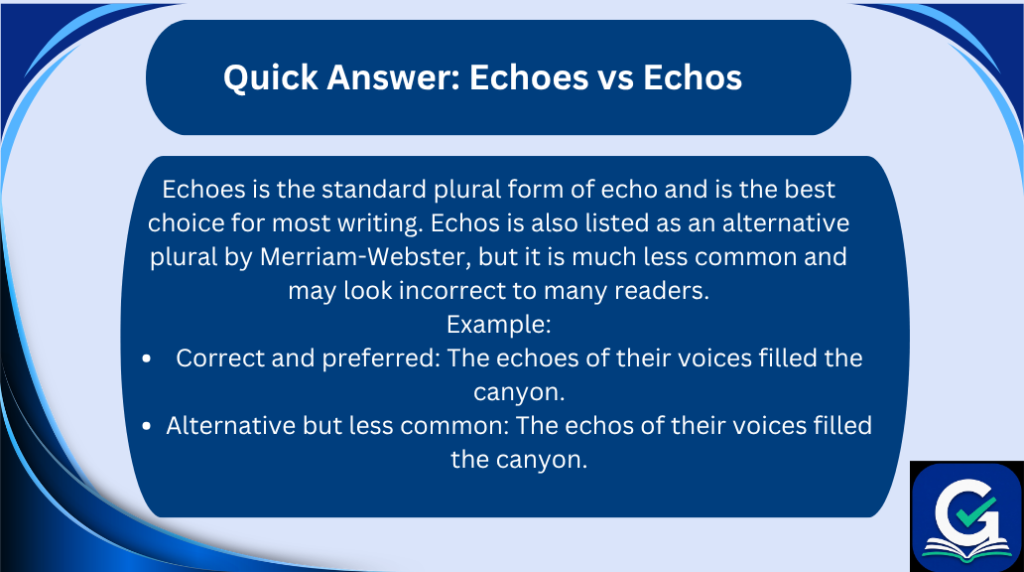
Echoes is the standard plural form of echo and is the best choice for most writing. Echos is also listed as an alternative plural by Merriam-Webster, but it is much less common and may look incorrect to many readers.
Example:
- Correct and preferred: The echoes of their voices filled the canyon.
- Alternative but less common: The echos of their voices filled the canyon.
For school, business, academic, and professional writing, use “echoes.”
Understanding the Basics of Echoes vs Echos
The word echo can function as both a noun and a verb.
As a noun, an echo is a repeated sound caused by the reflection of sound waves. It can also describe a repeated idea, feeling, image, or influence.
As a verb, echo means to repeat a sound, statement, opinion, or idea.
When echo is used as a plural noun, the usual spelling is echoes.
Echoes vs Echos Comparison Table
| Form | Type | Meaning | Example | Correct/Incorrect |
|---|---|---|---|---|
| echo | Singular noun | A repeated sound or similar reflection | I heard an echo in the cave. | Correct |
| echoes | Plural noun | More than one echo | The echoes continued through the tunnel. | Correct and preferred |
| echos | Plural noun | Alternative plural spelling of echo | The echos faded away. | Acceptable but uncommon |
| echoes | Verb | Third-person singular present of echo | Her words echoes through the room. | Incorrect in this sentence |
| echoes | Verb | Third-person singular present of echo | His opinion echoes mine. | Correct |
One important point is that echoes can be either a plural noun or a verb, depending on the sentence.
For example:
The echoes were getting louder.
Here, echoes is a plural noun.
But:
Her argument echoes an earlier criticism.
Here, echoes is a verb.
What Does “Echo” Mean?
Before comparing the plural forms, it helps to understand the base word.
An echo is a sound that is heard again after reflecting from a surface such as a wall, cliff, building, or other object. Cambridge Dictionary gives this as one of the primary meanings of the noun.
For example:
We shouted inside the cave and heard an echo.
The original sound was produced by the people. The sound then reflected from the cave walls and was heard again.
However, echo has meanings beyond physical sound.
It can also describe:
- A repeated idea
- A similar opinion
- A reminder of something
- A trace of an earlier event
- An imitation
- A repeated musical phrase
- A response or reflection of something previously expressed
Merriam-Webster lists several meanings, including repetition of sound, imitation, reflection, response, trace, and result.
Physical Sound
The echo of the drum traveled across the valley.
Here, echo refers to a repeated sound.
Repeated Ideas
The article contains echoes of an earlier debate.
Here, echoes means similarities or reminders of something from the past.
Repeated Opinions
Several employees echoed the manager’s concerns.
Here, echoed means repeated or expressed a similar opinion.
Why Is the Plural “Echoes” Instead of “Echos”?
This is where the spelling confusion begins.
English has several pluralization patterns. Some nouns simply take -s, while others take -es.
For example:
- book → books
- car → cars
- house → houses
- box → boxes
- class → classes
- dish → dishes
The word echo traditionally forms its plural as echoes.
The extra e helps preserve the conventional spelling and pronunciation pattern.
So:
echo + es = echoes
rather than the more straightforward-looking:
echo + s = echos
Although echos exists as a dictionary-recognized variant, echoes remains the standard form most writers will encounter and use. Merriam-Webster specifically lists “echoes” first and “echos” as an alternative plural.
Cambridge Dictionary lists echoes as the plural form.
Is “Echos” Wrong?
Not exactly.
This is an important distinction.
If someone tells you that “echos” can never be a word, that statement is too absolute.
Merriam-Webster lists the plural of echo as “echoes also echos.”
That means echos has dictionary recognition as an alternative plural spelling.
However, there is a difference between:
- technically acceptable
- standard and preferred
- common
- appropriate for formal writing
In everyday modern English, echoes is overwhelmingly the safer choice.
If you are writing:
- A school assignment
- A business email
- An article
- A report
- A research paper
- A professional document
- A formal letter
use echoes.
Example
Preferred:
The echoes of the announcement spread throughout the building.
Less common:
The echos of the announcement spread throughout the building.
The first version will look natural to virtually every English reader.
Correct Uses of “Echoes”
1. Echoes as a Plural Noun
The most common use of echoes is as the plural of echo.
Use it when you are talking about two or more repeated sounds or figurative reflections.
Examples
The echoes of laughter filled the hallway.
Sentence breakdown:
- The = article
- echoes = plural noun
- of laughter = describes what produced the echoes
- filled = verb
- the hallway = location
Another example:
We could hear echoes coming from the mountains.
Here, echoes refers to multiple reflected sounds.
2. Echoes as Figurative Reflections
The word does not always refer to physical sound.
It can describe something that reminds us of another event, idea, period, or experience.
Example
The novel contains echoes of classic American literature.
Here, echoes does not mean actual sounds.
It means the novel contains qualities, ideas, themes, or influences that resemble earlier literature.
Cambridge also gives examples of echoes referring to similarities or reminders of something else.
3. Echoes in Opinions and Arguments
You can use echoes when discussing repeated ideas or opinions.
Example
The report contains echoes of concerns raised by employees last year.
The meaning is that the current report expresses concerns similar to those expressed previously.
Another example:
Her speech contained echoes of her earlier campaign promises.
Again, the word refers to similarity rather than physical sound.
4. Echoes in Creative Writing
Writers often use echoes to create an emotional or atmospheric effect.
Example
Only faint echoes of the old song remained in his memory.
This sentence can suggest both sound and memory.
Another example:
The abandoned theater seemed filled with echoes of another era.
The word creates a sense of history and nostalgia.
“Echoes” as a Verb
One reason echoes can be confusing is that it is not always a plural noun.
It can also be a third-person singular present-tense verb.
The base verb is:
echo
The forms include:
- I echo
- You echo
- We echo
- They echo
- He echoes
- She echoes
- It echoes
Examples
His voice echoes through the hallway.
Her opinion echoes mine.
The music echoes across the valley.
The speech echoes earlier arguments.
In these sentences, echoes means “repeats,” “resounds,” or “reflects.”
Cambridge lists echoes as the present-tense third-person form of the verb echo.
Echo, Echoes, Echoed, and Echoing
Understanding the complete word family can make the spelling much easier.
| Form | Function | Example |
|---|---|---|
| echo | Base noun/verb | I heard an echo. |
| echoes | Plural noun / third-person verb | The echoes were loud. |
| echoed | Past tense / past participle | Her voice echoed through the room. |
| echoing | Present participle | We heard an echoing sound. |
Notice something important:
The spelling changes depending on the grammatical function.
Present
The sound echoes through the tunnel.
Past
The sound echoed through the tunnel.
Continuous
The sound is echoing through the tunnel.
Plural noun
The echoes continued for several seconds.
Merriam-Webster confirms the verb forms echoed and echoing.
Test Tip: How to Choose “Echoes” or “Echos”
Here is a simple test.
Step 1: Ask whether you mean more than one echo.
If yes, choose:
echoes
Example:
We heard several echoes.
Step 2: Ask whether the word is describing what “he,” “she,” or “it” does.
If yes, echoes may also be the correct verb.
Example:
Her voice echoes across the room.
Step 3: If you are writing formally, choose the conventional spelling.
Use:
echoes
This is the safest option.
Easy Memory Trick 🧠
Think:
Echo + ES = Echoes
If you’re unsure, remember that echoes is the familiar standard form.
A Real-Life Case Study: Workplace Writing
Imagine that a marketing manager sends this email to a team:
The customer feedback contains several echoes of concerns we heard last quarter.
This sentence is clear and professional.
Now imagine the manager writes:
The customer feedback contains several echos of concerns we heard last quarter.
Although echos has dictionary recognition as an alternative plural, many readers may interpret it as a spelling mistake.
That’s why word choice is not only about whether a form technically exists.
Good professional writing also considers:
- Familiarity
- Clarity
- Reader expectations
- Consistency
- Formality
In workplace communication, echoes is clearly the better choice.
Grammar Rules Behind “Echoes vs Echos”
The important rule is not simply “words ending in o always take -es.”
English spelling is more complicated than that.
Some words ending in o take -s, while others traditionally take -es.
For example:
- photo → photos
- piano → pianos
- radio → radios
- video → videos
But:
- echo → echoes
- potato → potatoes
- tomato → tomatoes
There are also words that have variation.
That is why it is dangerous to create an absolute rule based only on the final letter.
Instead, treat common nouns as individual vocabulary items when necessary.
For echo, the safest standard plural is:
echoes
Merriam-Webster recognizes both echoes and echos, while Cambridge gives echoes as the plural.
What Major Dictionaries Say
Dictionary evidence is especially useful here because the question is partly about accepted spelling variation.
Merriam-Webster
Merriam-Webster lists echoes as the plural and also recognizes echos as an alternative.
Cambridge Dictionary
Cambridge lists echoes as the plural form of echo.
So the practical conclusion is straightforward:
Use “echoes” as your default plural spelling.
This recommendation is especially strong for formal and edited English.
Common Mistakes With Echoes vs Echos
Why do people write echos?
There are several common reasons.
1. Fast Typing
When people type quickly, they often use the shortest form that seems logical.
Because many nouns simply add -s, someone may naturally type:
echo + s = echos
The spelling feels intuitive even though echoes is the conventional form.
2. Autocorrect
Autocorrect can sometimes create confusion.
A writer may type echoes, notice a correction suggestion, or accidentally remove a letter without realizing it.
Digital writing encourages speed, and speed can increase spelling errors.
3. Lack of Knowledge
Some writers simply have never learned the conventional plural.
If they have only heard the word spoken, they may not know whether it should be:
- echoes
- echos
English pronunciation does not always tell us the spelling.
4. Overgeneralizing Spelling Rules
Someone may learn:
“Just add -s to make a plural.”
That rule works for many English nouns but not all of them.
English contains many irregular and variable spelling patterns.
Similar Grammar Confusions
The echoes vs echos question belongs to a much larger group of common English mistakes.
| Confusion | Correct Form | Common Error | Reason |
|---|---|---|---|
| it’s / its | Depends on meaning | Mixing possession and contraction | Similar appearance |
| your / you’re | Depends on meaning | Confusing possession and contraction | Same pronunciation |
| they’re / their / there | Depends on meaning | Mixing related forms | Same or similar pronunciation |
| who’s / whose | Depends on meaning | Confusing contraction and possession | Similar spelling |
| then / than | Depends on context | Sound confusion | Similar pronunciation |
| echo / echoes | echoes for standard plural | echos | Overgeneralizing plural rules |
| potato / potatoes | potatoes | potatos | Applying simple -s rule |
| tomato / tomatoes | tomatoes | tomatos | Applying simple -s rule |
The lesson is simple:
Do not rely only on what looks logical. Check the established form when a word has an unusual spelling pattern.
Usage in Different Contexts
Everyday Conversation
In casual conversation, the distinction usually does not cause much trouble because people hear the word rather than see it.
You might say:
There were echoes all around us.
Nobody needs to think about the spelling while speaking.
However, when writing a text message or social post, echoes is still the best standard choice.
Professional Writing
Professional writing should favor the familiar spelling.
Use:
The survey results contain echoes of the concerns raised in January.
Avoid using echos unless you have a specific reason to follow a source or style that uses the variant.
Professional readers generally expect conventional spelling.
Academic Writing
Academic writing places a strong emphasis on consistency and accuracy.
For example:
The findings contain echoes of previous research.
This form is clear, standard, and appropriate.
If your instructor, publisher, or style guide has a specific preference, follow that guidance.
Otherwise, echoes is the safest choice.
Creative Writing
Creative writers have more freedom.
For example:
The echoes of childhood followed her into adulthood.
Here, echoes creates a figurative connection between the past and present.
Writers can also use unusual forms intentionally for characterization, historical flavor, or stylistic effect. But intentional creative spelling is different from an accidental spelling mistake.
Social Media and Texting
Social media is more flexible.
You may encounter:
The echos of summer are still with me.
But that does not make echos the preferred spelling.
If you want polished writing, use:
The echoes of summer are still with me.
For professional social media accounts, blogs, websites, and public-facing content, echoes is especially advisable.
Why Correct Spelling Matters
At first, the difference between echoes and echos may seem tiny.
It is only one letter.
But small spelling details can affect how readers perceive your writing.
Clarity
Correct spelling makes your meaning easier to process.
When readers see a familiar form, they understand it instantly.
Professionalism
A polished spelling choice can make an email, article, report, or website appear more carefully edited.
Digital Communication
Online writing is often read quickly.
People scan:
- Emails
- Headlines
- Blog posts
- Social media captions
- Product pages
- Reports
A familiar spelling helps readers move through the text without unnecessary distraction.
Credibility
Spelling is not the only factor that determines credibility, but repeated errors can make readers question the care behind the content.
As a useful principle:
Clear writing earns attention; accurate writing earns trust.
Special Exception: When “Echos” Can Be Used
There is an important exception to the simple “always use echoes” advice.
Echos is a recognized alternative plural form of echo.
Merriam-Webster explicitly lists the noun plural as “echoes also echos.”
This means you should not claim that echos is never a word.
Instead, the more accurate statement is:
“Echoes” is the standard and preferred plural spelling, while “echos” is an accepted but less common variant.
This distinction is useful because English contains many spelling variants that are technically valid but not equally common.
What About Names and Brands?
A company, product, organization, username, fictional title, or other proper name may use Echos as part of its official name.
If Echos appears as a proper name, do not “correct” it to Echoes.
Proper names follow their established spelling.
For ordinary English writing, however, use echoes.
Echoes vs Echos in Example Sentences
Seeing the forms in context makes the distinction easier.
Standard plural
The echoes of the thunder rolled across the valley.
Figurative meaning
The speech contained echoes of an earlier political debate.
Multiple sounds
We heard strange echoes coming from the tunnel.
Third-person verb
Her voice echoes through the empty room.
Past tense
His laughter echoed through the house.
Continuous form
The music was echoing through the hall.
Less common alternative plural
The echos disappeared as the storm moved away.
The final sentence uses a dictionary-recognized variant, but echoes would normally be the better choice.
How to Remember the Correct Spelling
If spelling rules are difficult to memorize, use a simple phrase:
“One echo, two echoes.”
That gives you:
- One echo
- Two echoes
- Many echoes
You can also remember:
Echo needs “ES” when it becomes plural.
So:
echo → echoes
This is much easier than trying to memorize a long list of spelling rules.
Quick Recap Checklist
Use this checklist whenever you hesitate between echoes and echos.
| Question | If Yes → Use |
|---|---|
| Are you talking about more than one echo? | echoes |
| Are you writing formally? | echoes |
| Are you writing for school or work? | echoes |
| Are you writing an article or report? | echoes |
| Are you using the standard plural form? | echoes |
| Are you intentionally following a source that uses the variant? | echos may be appropriate |
| Is “Echos” part of an official proper name? | Preserve the official spelling |
Practice Example 1
Fill in the blank:
The ______ of their voices could be heard across the canyon.
Answer: echoes
Practice Example 2
Her argument ______ the concerns raised by the committee.
Answer: echoes
Here, echoes is a verb, not a plural noun.
Practice Example 3
The ______ slowly faded into silence.
Answer: echoes
FAQs
1. Is “echoes” or “echos” correct?
Echoes is the standard and preferred plural spelling of echo. Merriam-Webster also recognizes echos as an alternative plural, but echoes is the safer choice for most writing.
2. Why does echo become echoes?
The conventional plural spelling of echo is formed with -es, giving echoes. English plural spelling is not completely predictable, so individual words sometimes need to be learned in their established forms.
3. Is “echos” a spelling mistake?
Not necessarily. Merriam-Webster lists echos as an alternative plural form. However, it is much less common than echoes, so many readers may perceive it as an error.
4. What is the plural of echo?
The standard plural is echoes. Cambridge Dictionary lists echoes as the plural of echo, while Merriam-Webster lists echoes and the alternative echos.
5. Is “echoes” also a verb?
Yes. Echoes can be the third-person singular present form of the verb echo.
For example:
The sound echoes through the hallway.
Here, echoes is a verb.
6. Should I use “echos” in formal writing?
Generally, no. Although echos is recognized as an alternative plural, echoes is more familiar and conventional. For formal, academic, professional, and public-facing writing, echoes is the better choice.
conclusion
The confusion between echoes vs echos is understandable because English does not always follow perfectly predictable spelling rules. When you turn echo into its standard plural form, the spelling is echoes. This is the form you should normally use in school assignments, professional documents, articles, emails, academic writing, and everyday polished English.
At the same time, it is important to recognize that echos is not completely invalid. Merriam-Webster records it as an alternative plural, while Cambridge lists echoes as the plural form.
The easiest rule to remember is:
One echo → two echoes.
When in doubt, choose echoes. It is familiar, standard, clear, and appropriate for virtually every ordinary writing situation.
So the next time you type the word, do not let that extra e make you hesitate. Just remember: echoes is the spelling that makes your writing ring true. 🔊

I’m Jordan Hayes, a proofreading and editing writer at Gramfino, focused on clear and accurate English.
I enjoy finding common writing mistakes and sharing simple ways to make sentences stronger and easier to read.

[…] trying to improve your grammar, knowing which form fits the situation makes a difference. 😊 Echoes vs Echos | Themself vs Theirself | Counselor vs […]