High School vs Highschool: Which Spelling Is Correct
Have you ever wondered whether high school vs highschool is the correct spelling? 🤔 This is a common confusion because both forms look and sound almost the same. When people say the phrase aloud, there is no visible space between the two words, so it is easy to assume that highschool might be acceptable.
However, standard US English follows a clear rule: high school is written as two separate words when referring to secondary education or the school itself. The closed form highschool is generally not considered standard English.
This small spelling difference matters in school assignments, resumes, applications, emails, websites, and other formal writing. Understanding high school vs highschool can help you avoid an easy mistake and make your writing more accurate.
In this guide, we will explain the difference, show correct examples, examine the grammar behind the spelling, and provide simple tips for remembering which form to use. Trek vs Treck | Truly vs Truely | Elses vs Elses
Quick Answer: High School vs Highschool
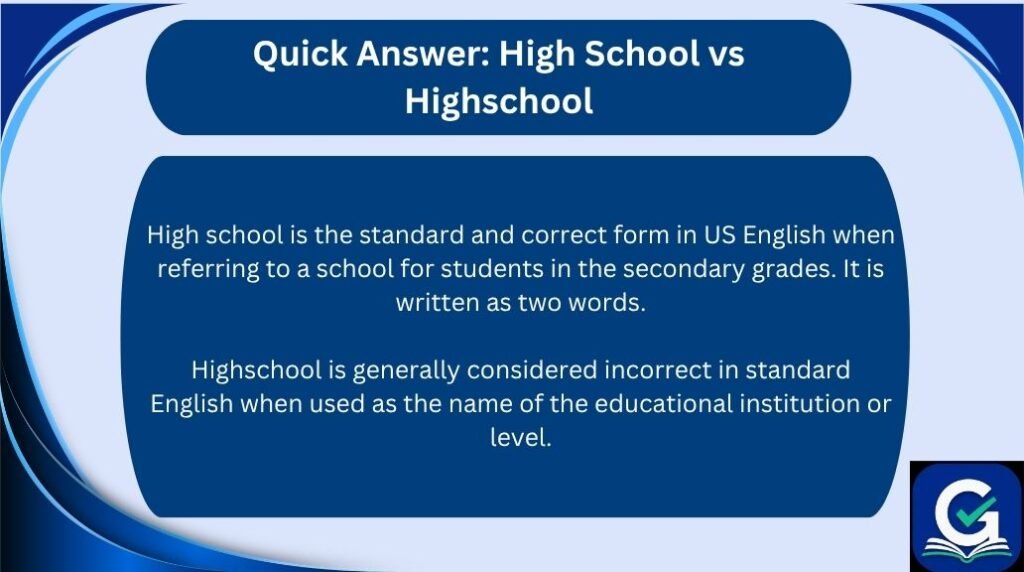
High school is the standard and correct form in US English when referring to a school for students in the secondary grades. It is written as two words.
Highschool is generally considered incorrect in standard English when used as the name of the educational institution or level.
Correct: I graduated from high school in 2024.
Incorrect: I graduated from highschool in 2024.
The easiest rule to remember is: When you mean secondary school, write “high school” as two words.
Understanding the Basics of High School vs Highschool
The main difference between high school vs highschool is not meaning but spelling and standard usage.
High school is a compound noun made up of two words. The adjective high modifies the noun school. Together, they refer to an educational institution or level of education generally attended after middle school and before college.
By contrast, highschool combines the two words into a single form. Although people may occasionally type or use it informally, it is not the standard spelling used in formal US English.
Comparison Table
| Form | Type | Meaning | Example | Correct/Incorrect |
|---|---|---|---|---|
| high school | Compound noun | A secondary school or educational level | She attends high school. | ✅ Correct |
| highschool | Nonstandard closed form | Intended to mean high school | She attends highschool. | ❌ Generally incorrect |
| high-school | Hyphenated form | Rare or context-dependent modifier | A high-school program | ⚠️ Usually unnecessary in modern US usage |
The standard choice is therefore high school.
Why Are There Two Words?
English contains many compound expressions that develop over time. Some compounds become closed into one word, while others remain open.
For example:
- high school → two words
- middle school → two words
- elementary school → two words
- college student → two words
- schoolhouse → one word
- classroom → one word
There is no universal rule that says every compound must eventually become one word. Established usage determines the conventional form.
Correct Meanings and Uses
High School as a Noun
The most common use of high school is as a noun referring to a secondary educational institution.
For example:
I went to high school in Texas.
Here is the sentence breakdown:
- I = subject
- went = verb
- to = preposition
- high school = noun phrase
- in Texas = location phrase
The phrase high school functions as the name of the type of educational institution.
Another example:
My sister starts high school next year.
In this sentence, high school refers to the stage of education the speaker’s sister will enter.
High School as an Educational Level
The phrase can also describe the period of education itself.
For example:
We became friends in high school.
The speaker is not necessarily emphasizing the physical school building. Instead, high school identifies a particular period of life and education.
Other examples include:
- I played basketball in high school.
- She studied Spanish in high school.
- He met his best friend during high school.
- They moved to another city before high school.
- My cousin is still in high school.
In all these examples, the correct form is high school.
High School as Part of a Compound Modifier
Things become slightly more interesting when high school modifies another noun.
For example:
high school student
Here, high school describes what kind of student the person is.
You can also write:
- high school teacher
- high school graduation
- high school football
- high school diploma
- high school education
- high school curriculum
- high school principal
- high school classroom
In standard US English, high school normally remains two words in these common combinations.
How to Remember the Correct Form
A simple memory trick can make this spelling much easier.
Think of high school as describing a school that is high in the educational system, rather than a single object with a special one-word name.
Whenever you are talking about secondary education, use:
high + school = high school
Do not automatically combine them just because they function together as one idea.
You can also compare it with middle school.
We write:
I am in middle school.
We do not normally write:
I am in middleschool.
Since high school follows the same open-compound pattern, remembering middle school can help reinforce the correct spelling.
Test Tip 📝
Try replacing high school with secondary school.
If the sentence still makes sense, you almost certainly need the standard two-word phrase high school.
For example:
She graduated from high school.
Replace it:
She graduated from secondary school.
The meaning remains clear. That tells you high school is functioning as an educational noun phrase.
High School vs Highschool in Real-Life Writing
Imagine that you are writing a job application and want to mention your education.
You might write:
I earned my high school diploma in 2022.
That looks natural and professional.
Writing:
I earned my highschool diploma in 2022.
creates a spelling problem because highschool is not the standard form.
The difference is small visually, but professional writing often depends on small details. A resume containing unnecessary spelling errors may appear less polished.
The same principle applies to:
- college applications
- scholarship essays
- job applications
- professional emails
- academic assignments
- school websites
- formal reports
- biographies
Using the standard spelling helps readers understand your writing immediately.
Case Study: A Professional Email
Consider this short workplace email.
A person is applying for an internship and writes:
I completed highschool in California and later attended college in Arizona.
The intended meaning is obvious, but the spelling of highschool is nonstandard.
A polished version would be:
I completed high school in California and later attended college in Arizona.
The second version is better because high school is the established US English form.
What Does This Example Teach?
The mistake may seem minor, but it illustrates an important writing principle: familiar words still need correct standard spelling.
Readers may not stop and consciously notice every spelling mistake. However, repeated small errors can affect how polished a piece of writing appears.
Grammar Rules Behind High School
Why is high school written as two words?
The answer lies in its grammatical structure.
High is an adjective, while school is a noun. Together, they form a noun phrase.
In:
She attends high school.
the word school is the head noun, while high describes it.
The same grammatical structure appears in expressions such as:
- public school
- private school
- elementary school
- middle school
- graduate school
- boarding school
These phrases are generally written as separate words.
What Do Major Dictionaries Show?
Standard American dictionaries, including Merriam-Webster, recognize high school as the standard expression for a secondary school or the level of education associated with it.
That dictionary treatment reflects established English usage.
The important takeaway is simple: “High school” is the conventional standard form.
Why “Highschool” Looks Correct to Some Writers
If high school represents one idea, why does highschool feel tempting?
There are several reasons.
It Sounds Like One Unit
When we say the phrase quickly, the words blend together in normal speech. We do not pause noticeably between high and school.
This can make writers assume that the phrase should be written as one word.
English Has Many Closed Compounds
English has numerous compound words that are written without spaces:
- classroom
- schoolhouse
- textbook
- notebook
- homework
- football
Because writers already know these words, they may assume that highschool follows the same pattern.
It does not.
Digital Communication Encourages Shortcuts
Typing quickly on phones and computers can lead people to remove spaces accidentally. Once a nonstandard spelling becomes familiar, a writer may repeat it without noticing.
Common Mistakes With High School vs Highschool
The most common error is simply removing the space.
Mistake 1: Writing Highschool
❌ I am a highschool student.
✅ I am a high school student.
The noun phrase high school should normally remain open.
Mistake 2: Using Highschool in Formal Writing
❌ My highschool education prepared me for college.
✅ My high school education prepared me for college.
The second sentence follows standard US English usage.
Mistake 3: Assuming Every Compound Is One Word
Not every phrase that expresses one concept becomes a single word.
For example:
- high school
- post office
- real estate
- health care
- ice cream
Some compounds are traditionally written as separate words.
Similar Grammar and Spelling Confusions
The high school vs highschool issue is part of a much larger pattern in English. Writers frequently confuse words because they sound similar, look similar, or are commonly typed quickly.
| Confusing Forms | Correct Standard Form | Main Reason for Confusion |
|---|---|---|
| high school / highschool | high school | Compound noun spacing |
| its / it’s | its or it’s, depending on meaning | Possession vs contraction |
| your / you’re | your or you’re, depending on meaning | Possession vs contraction |
| their / they’re | their or they’re, depending on meaning | Possession vs contraction |
| alot / a lot | a lot | Informal spelling habit |
| everyday / every day | Depends on function | Adjective vs time expression |
| setup / set up | Depends on function | Noun vs verb |
| login / log in | Depends on function | Noun/adjective vs verb |
| online / on line | Usually online | Modern usage change |
These examples demonstrate why spelling should not always be determined by sound alone.
Why Do These Errors Happen?
Fast Typing
When people type quickly, they may accidentally remove spaces, omit punctuation, or combine words.
Autocorrect
Autocorrect systems sometimes reinforce a user’s existing habits. A person who frequently types an unusual form may not notice the error.
Lack of Knowledge
Sometimes the writer simply has never learned which form is standard.
That is completely understandable. English contains many irregular patterns, and knowing the correct form comes with exposure and practice.
Usage in Different Contexts
Everyday Conversation
In everyday conversation, high school is extremely common.
Examples:
What high school did you attend?
My brother is still in high school.
We met in high school.
Even though conversation is informal, the standard written form remains high school.
Professional Writing
Professional documents should use the standard spelling.
Examples:
She earned her high school diploma in 2020.
The position requires a high school education or equivalent experience.
He taught mathematics at a local high school.
Using high school helps maintain a polished and professional tone.
Academic Writing
Academic writing also favors the standard two-word form.
For example:
High school students often face significant academic and social changes.
The study examined reading habits among high school students.
Academic work requires careful spelling and formatting, so highschool should be avoided.
Creative Writing
Creative writers may intentionally use unusual spelling to represent dialogue, slang, branding, or a character’s voice.
However, intentional stylistic use is different from standard spelling.
If a fictional character writes highschool in a text message, that could be a deliberate characterization choice. In ordinary narrative prose, however, high school remains the standard form.
Social Media and Texting
Social media and texting are more flexible. People often omit spaces, punctuation, or capitalization.
You might see:
highschool memories ❤️
Although readers will understand the meaning, the standard spelling remains high school.
If you are creating a professional social media post, educational content, or public-facing website, use high school.
Why It Matters
At first glance, the difference between high school vs highschool may seem too small to matter. After all, most readers understand both forms.
However, correct spelling contributes to clear and professional communication.
Clarity
Standard spelling makes your writing easier to process. Readers recognize familiar expressions instantly.
Professionalism
A resume, application, or formal email should demonstrate attention to detail. Using established spellings supports a polished impression.
Digital Communication
Online content is often scanned quickly. Correct spelling helps search engines, readers, editors, and automated systems interpret your content consistently.
Academic Accuracy
Students frequently use the phrase high school in essays, assignments, applications, and research papers. Learning the correct form prevents repeated mistakes.
Small spelling choices can make a big difference in clear writing.
The goal is not to make every sentence complicated. It is simply to use familiar words in their accepted forms.
Special Exception: Names and Branding
There can be exceptions when Highschool appears as part of a specific name, username, title, organization, or brand.
For example, a fictional organization could deliberately call itself Highschool Media. A website, username, product, or creative project might also use Highschool as a stylistic choice.
In such cases, the spelling is part of the proper name or branding.
That does not change the general grammar rule.
If you are referring to the educational institution or educational level in ordinary US English, use:
high school
A proper name or brand may follow its own capitalization and spelling conventions.
High School vs Highschool in Example Sentences
Here are several examples to make the distinction easier to remember.
Correct Examples
- I graduated from high school last year.
- My daughter starts high school in August.
- He played football in high school.
- She teaches at a local high school.
- We became friends during high school.
- My high school diploma is required for the position.
- The high school students organized a fundraiser.
- I still keep in touch with my high school friends.
Incorrect Standard Usage
- ❌ I graduated from highschool last year.
- ❌ My daughter starts highschool in August.
- ❌ He played football in highschool.
- ❌ She teaches at a local highschool.
- ❌ We became friends during highschool.
In standard US English, replace highschool with high school.
High School Student vs Highschool Student
One especially common phrase is high school student.
The correct construction is:
She is a high school student.
Here, high school works together as a descriptive phrase modifying student.
You should not normally write:
She is a highschool student.
The same rule applies to other common expressions:
- high school student
- high school teacher
- high school graduate
- high school athlete
- high school counselor
- high school principal
- high school course
- high school program
The phrase high school remains open.
High School Graduation and Other Common Expressions
Writers often use high school in phrases related to education and adolescence.
Here are some common examples:
High School Graduation
Her high school graduation is next Saturday.
High School Diploma
He received his high school diploma in June.
High School Teacher
My aunt is a high school teacher.
High School Sports
High school sports can bring communities together.
High School Years
I remember my high school years fondly.
High School Education
A high school education is often a basic requirement for entry-level positions.
Each expression uses the standard two-word form.
Quick Recap Checklist
Use this checklist whenever you are unsure about high school vs highschool.
| Question | If Yes → Use |
|---|---|
| Are you referring to secondary education? | high school |
| Are you talking about a secondary school? | high school |
| Are you writing a formal document? | high school |
| Are you describing a student, teacher, or graduate? | high school |
| Is “Highschool” part of an official brand or proper name? | Follow the official name |
| Are you simply combining the words because they sound connected? | Still use high school |
Practice Examples
Choose the correct form:
1. My brother attends ______ in California.
Answer: high school
2. She met her best friend in ______.
Answer: high school
3. He received his ______ diploma last year.
Answer: high school
The pattern is consistent: use high school as two words.
A Simple Rule to Remember
If you are talking about secondary education, high school is almost always the form you want.
Think:
high + school = high school
Do not remove the space simply because the phrase represents one idea.
This is similar to other open compounds in English. A phrase can have a unified meaning without becoming one word.
For example:
- high school
- middle school
- public school
- private school
- graduate school
Learning these patterns is much easier than trying to memorize every compound individually.
FAQs
1. Is “high school” one word or two?
High school is two words. It is the standard US English form used to describe a secondary school or the corresponding level of education.
2. Is “highschool” correct in American English?
Generally, no. “Highschool” is not the standard spelling when referring to secondary education. Use high school instead.
3. Should I write “high school student” or “highschool student”?
Write high school student. The phrase high school remains two words when it modifies another noun.
4. Why do people write “highschool”?
The mistake often happens because the phrase sounds like one unit when spoken. Fast typing, autocorrect, and uncertainty about compound words can also cause people to remove the space.
5. Is “high school” hyphenated?
In ordinary US English, high school is normally written as two words without a hyphen. A hyphen may appear in unusual constructions depending on sentence structure or a particular style guide, but it is not normally needed in common expressions such as “high school student.”
6. Can “Highschool” ever be correct?
It can appear as part of a specific brand, title, username, fictional name, or other proper name that intentionally uses that spelling. Outside such special cases, high school is the standard form.
Conclusion
When comparing high school vs highschool, the choice is simple: high school is the standard form in US English. It is written as two separate words when referring to a secondary school, the educational level, or something associated with that level of education.
You should write high school student, high school diploma, high school teacher, and high school graduation. The closed form highschool is generally considered nonstandard and should be avoided in formal, academic, professional, and most general writing.
The confusion is understandable because English contains many compound words that are written as one word. However, not every compound expression follows the same pattern. In this case, the established form is easy to remember: high school = two words.
So, the next time you hesitate, do not overthink it. If you mean secondary education, give the phrase its proper space.
Remember: Good writing is often about getting the small things right—and “high school” starts with a space.

I’m Jordan Hayes, a proofreading and editing writer at Gramfino, focused on clear and accurate English.
I enjoy finding common writing mistakes and sharing simple ways to make sentences stronger and easier to read.

[…] use each word, and provide practical examples so you can choose the correct spelling confidently. High School vs Highschool | Trek vs Treck | Truly vs […]
[…] mistakes, and practical examples so you can choose the right spelling confidently. Aide vs Aid | High School vs Highschool | Trek vs […]