Have you ever written a professional email and suddenly wondered whether authorization vs authorisation is the correct spelling? 🤔 You may have seen both versions in emails, websites, legal documents, and software applications, which can make the choice confusing. The good news is that you do not have to memorize two completely different words.
Authorization and authorisation have the same basic meaning, but they belong to different English spelling conventions. Authorization is the preferred form in American English, while authorisation is commonly used in British English. If you are writing for a US audience, authorization is the spelling you should normally choose.
If your readers use British English, authorisation is appropriate. Understanding this small regional difference can help you write with greater confidence, consistency, and accuracy. 🇺🇸🇬🇧 Treat vs Treet | Phoenix vs Pheonix | Flutist vs Flautist
Quick Answer: Authorization vs Authorisation
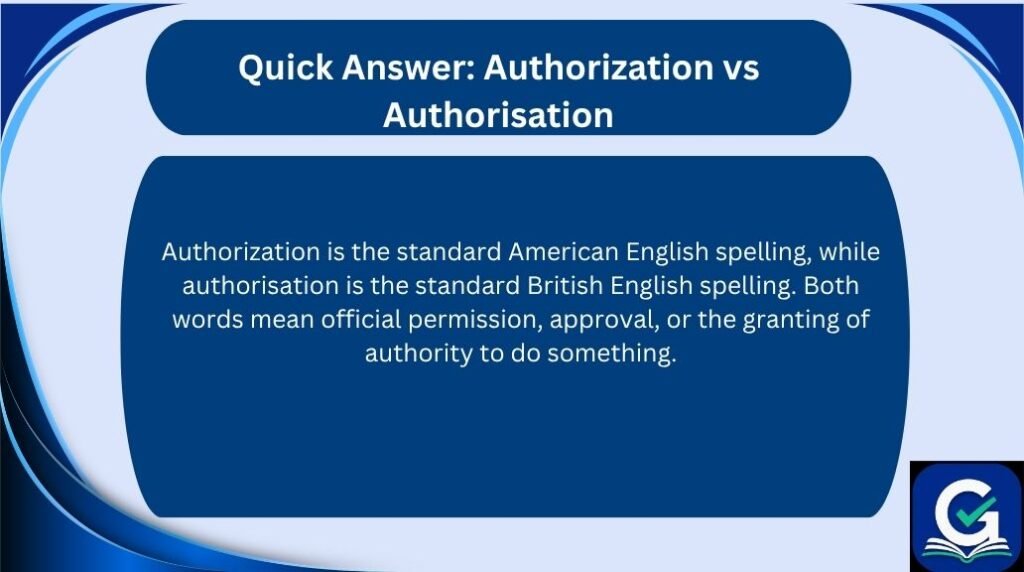
Authorization is the standard American English spelling, while authorisation is the standard British English spelling. Both words mean official permission, approval, or the granting of authority to do something.
The quick rule is:
- 🇺🇸 American English: authorization
- 🇬🇧 British English: authorisation
- ✅ Both forms are correct.
- ❌ Authorisation is not simply a spelling mistake.
- 📝 Choose the form that matches your audience and style guide.
Understanding the Basics of Authorization vs Authorisation
The main difference in authorization vs authorisation is spelling, not meaning.
American English commonly uses the spelling authorize, which produces the noun authorization. British English commonly uses authorise, which produces authorisation.
For example:
The manager gave me authorization to access the files.
A British English writer may write:
The manager gave me authorisation to access the files.
Both sentences communicate the same idea.
The difference becomes easier to understand when you compare the complete word families.
| American English | British English |
|---|---|
| authorize | authorise |
| authorization | authorisation |
| authorized | authorised |
| authorizing | authorising |
This is similar to other well-known differences such as color/colour, favorite/favourite, and organize/organise.
Comparison Table
| Form | Type | Meaning | Example | Correct/Incorrect |
|---|---|---|---|---|
| authorization | Noun | Official permission or approval | I received authorization to enter. | ✅ US English |
| authorisation | Noun | Official permission or approval | I received authorisation to enter. | ✅ UK English |
| authorize | Verb | To officially permit | The director will authorize the payment. | ✅ US English |
| authorise | Verb | To officially permit | The director will authorise the payment. | ✅ UK English |
| authorized | Adjective/verb form | Officially permitted | He is an authorized user. | ✅ US English |
| authorised | Adjective/verb form | Officially permitted | He is an authorised user. | ✅ UK English |
The most important thing to remember is that authorization and authorisation do not describe two different concepts. They are regional spelling variants.
What Does Authorization Mean?
Authorization is a noun that refers to official permission, approval, or authority to perform an action.
For example:
The employee received authorization to enter the restricted area.
Here, authorization means that the employee was officially permitted to enter.
Another example is:
The bank requires authorization before processing the transaction.
In this sentence, authorization means official approval.
The word often appears when permission involves a person, organization, system, or authority that has the right to approve something.
Common Uses of Authorization
You may encounter authorization in many situations, including:
- authorization to access an account
- authorization to enter a building
- authorization to make a payment
- authorization to sign a contract
- authorization to release information
- authorization to use copyrighted material
- authorization to perform a procedure
- authorization to access confidential records
The word is especially common in formal, professional, legal, financial, and technological communication.
Example Sentence Breakdown
Consider this sentence:
The director gave Maria authorization to sign the agreement.
The sentence contains several important parts:
- The director = the person with authority
- gave = granted
- Maria = the person receiving permission
- authorization = official permission
- to sign the agreement = the action she is allowed to perform
This example shows that authorization can mean more than casual permission. It can involve formally granting someone the right to act.
What Does Authorisation Mean?
Authorisation has the same basic meaning as authorization. The main difference is that it follows British spelling conventions.
For example:
The manager gave me authorisation to access the records.
This is standard British English.
An American English writer would normally write:
The manager gave me authorization to access the records.
Therefore, when discussing authorization vs authorisation, it is important not to label authorisation as incorrect simply because it looks unfamiliar to American readers.
Why Authorisation Looks Different
The spelling difference comes from the related verbs:
- American English: authorize
- British English: authorise
The noun follows the same pattern:
- American English: authorization
- British English: authorisation
The pronunciation and basic meaning remain essentially the same.
Correct Meanings and Uses
Understanding authorization vs authorisation becomes much easier when you focus on the meaning first and the spelling second.
Both forms can describe several closely related ideas.
Official Permission
The most common use refers to formal permission.
You need authorization to enter this office.
The sentence means that you need official permission before entering.
A British version would be:
You need authorisation to enter this office.
Formal Approval
Authorization can also mean approval for a specific action.
The purchase requires authorization from the finance manager.
The finance manager must approve the purchase.
Authority to Act
Authorization may also mean that someone has been given the right or power to act.
She received authorization to negotiate on behalf of the company.
This means she was officially permitted to represent the company in that situation.
Permission to Access Information
The term is common in technology and data security.
Users need authorization to access private files.
The files are restricted, and only users with appropriate permission can access them.
Authorization in Technology
One of the most common modern uses of authorization appears in software, cybersecurity, and online services.
For example:
Authorization is required before you can access the dashboard.
In technical contexts, authorization generally concerns whether a user, application, or system has permission to access a resource or perform a particular action.
This creates an important distinction between authentication and authorization.
Authentication vs. Authorization
These two terms are related but have different purposes.
Authentication asks:
Who are you?
Authorization asks:
What are you allowed to do?
For example, imagine logging into an online banking application.
First, the system verifies your identity. That is authentication.
After identifying you, the system determines which actions you are allowed to perform. That is authorization.
So:
Authentication = identity
Authorization = permissions
This distinction is especially important in technical writing.
Authorization in Professional Writing
Professional communication frequently uses authorization because workplaces often require formal approval.
For example:
I am requesting authorization to purchase new equipment.
Another example:
The transaction requires authorization from the department manager.
You might also write:
Please confirm that you have authorization to access these files.
These sentences sound formal because the situations involve official permission.
For a US audience, authorization is normally the preferred spelling.
A British company may instead write:
The transaction requires authorisation from the department manager.
The meaning does not change.
Case Study: A Workplace Email
Imagine that an employee needs approval to purchase a new laptop.
A US English employee might write:
Subject: Request for Authorization
Hi Sarah,
I would like to request authorization to purchase a new laptop for my work. My current device is no longer performing reliably, and a replacement would help me complete my projects more efficiently.
Please let me know if you approve the request.
Thank you,
Daniel
The word authorization works well because the employee is requesting formal approval.
A British English version could say:
I would like to request authorisation to purchase a new laptop.
Both versions are grammatically correct.
What This Case Study Teaches
This example demonstrates that the choice between authorization vs authorisation depends on the variety of English being used.
The situation remains exactly the same.
Only the spelling changes.
Grammar Rules for Authorization vs Authorisation
Both authorization and authorisation function as nouns.
They describe the act of authorizing someone or the permission or authority that has been granted.
Their related forms can be summarized like this:
| Word | Part of Speech | Example |
|---|---|---|
| authorize | Verb | The manager will authorize the payment. |
| authorization | Noun | We need authorization for the payment. |
| authorized | Adjective/verb form | She is an authorized representative. |
| authorizing | Verb form | The director is authorizing the transaction. |
| authorise | Verb, British | The manager will authorise the payment. |
| authorisation | Noun, British | We need authorisation for the payment. |
| authorised | Adjective/verb form, British | She is an authorised representative. |
Major dictionaries recognize the regional distinction between these forms.
Merriam-Webster lists authorisation as a British spelling of authorization, while its entry for authorize connects the verb with granting permission or authority.
Is Authorisation Incorrect?
No.
This is one of the most important points about authorization vs authorisation.
Authorisation is not a spelling error when British English is being used.
Similarly, authorization is not an error when American English is being used.
The correct choice depends on the language standard your writing follows.
Test Tip: How to Choose the Correct Form
If you are unsure which spelling to use, follow these three steps.
Step 1: Identify Your Audience
Ask yourself:
Who will read this content?
If your audience is American, use:
authorization
If your audience is British, use:
authorisation
Step 2: Check Your Style Guide
Businesses, universities, publishers, and websites may have specific style guides.
If the style guide says to use American English, write authorization.
If it requires British English, write authorisation.
Step 3: Check Related Words
Look at how your document spells the related verb.
If you use:
authorize
then use:
authorization
If you use:
authorise
then use:
authorisation
This is an easy way to maintain consistency.
Common Mistakes With Authorization vs Authorisation
Many mistakes involving authorization vs authorisation happen because writers see both forms online.
The internet contains content from many English-speaking countries, so you may encounter American and British spelling conventions on the same website or across different websites.
Mistake 1: Assuming Authorisation Is Wrong
An American writer may see authorisation and think the word contains a spelling error.
That assumption is incorrect.
Authorisation is a standard British spelling.
Mistake 2: Assuming Authorization Is Wrong
A British English writer may be more accustomed to authorisation and wonder whether authorization is incorrect.
It is not.
Authorization is the standard American form.
Mistake 3: Mixing Regional Styles
A document can appear inconsistent when it randomly combines American and British spellings.
For example:
The company will authorize the payment and organise the records.
If the document is intended to use American English, the writer would normally use organize instead.
The same principle applies to other spelling choices.
Why Do These Mistakes Happen?
Several everyday factors can cause confusion:
- Fast typing: Writers may not stop to consider spelling conventions.
- Autocorrect: Software can automatically change words according to its language settings.
- Lack of knowledge: Some people do not know that both forms are correct.
- International content: Readers regularly encounter multiple English varieties online.
- Copied text: Writers may copy words from sources using a different regional standard.
Similar Grammar and Spelling Confusions
The confusion surrounding authorization vs authorisation is similar to many other common English questions.
| Common Confusion | Correct Explanation |
|---|---|
| it’s / its | it’s = it is; its = possessive |
| your / you’re | your = possessive; you’re = you are |
| they’re / their / there | Three different words with different functions |
| affect / effect | Usually different grammatical roles and meanings |
| then / than | then relates to time or sequence; than is used in comparisons |
| accept / except | accept means receive; except means exclude |
| authorization / authorisation | American vs. British spelling |
These examples show why spelling should always be considered in context.
Usage in Different Contexts
The choice between authorization vs authorisation depends largely on the English variety used by your audience.
Everyday Conversation
In spoken conversation, the distinction is not noticeable because the listener does not see the spelling.
For example:
Do I have authorization to use this room?
A British speaker may say:
Do I have authorisation to use this room?
Both communicate the same idea.
Professional Writing
Professional documents should use a consistent spelling system.
US English:
Employees must obtain authorization before accessing confidential information.
UK English:
Employees must obtain authorisation before accessing confidential information.
Creative Writing
Creative writers can use either form depending on the character, setting, or intended audience.
For example, a British character might naturally use authorisation, while an American character might use authorization.
Social Media and Texting
Casual online communication is generally more flexible.
However, professional social media accounts should follow the organization’s chosen language style.
A US company will generally prefer authorization, while a UK organization may prefer authorisation.
Why Authorization vs Authorisation Matters
At first, the difference between these two spellings may seem very small. After all, only one letter changes. However, understanding authorization vs authorisation can improve the quality and consistency of your writing.
Clarity in Communication
Consistent spelling helps readers recognize the English variety being used.
Professionalism
A consistent style makes emails, reports, websites, and business documents look more polished.
Writing Accuracy
Knowing regional spelling conventions helps you avoid incorrectly labeling a valid word as a typo.
Digital Communication
Online content often reaches readers from different countries. Choosing a clear language standard gives your content a more professional voice.
A simple reminder is:
Good writing is not only about being understood; it is also about being consistent.
Special Exception: Style Guides and Organizations
There is no rule saying that every international company must use either authorization or authorisation.
Organizations can establish their own editorial standards.
For example, a global company might choose American English for all of its software documentation.
Another international organization may prefer British English throughout its website.
The important thing is to follow the established style.
What If Your Audience Is International?
If your audience includes readers from several countries, choose one primary English variety and use it consistently.
For example, you might decide to use American English throughout your website.
In that case, use:
authorization
You can still mention the British alternative when discussing spelling differences:
In British English, the word is commonly spelled authorisation.
This approach keeps your main content consistent while acknowledging regional variation.
Authorization vs Authorisation in SEO Content
For SEO writing, spelling should match the audience you want to reach.
If your website targets readers in the United States, authorization should normally be your preferred form.
If you target readers in the United Kingdom, authorisation may be more appropriate.
For an article specifically targeting authorization vs authorisation, it is useful to naturally include related phrases such as:
- authorization meaning
- authorisation meaning
- authorize vs authorise
- American English spelling
- British English spelling
- authorization definition
- official permission
- formal approval
- authorization request
- authorization form
- authorized access
- authorization process
These semantic terms help explain the topic thoroughly without unnecessarily repeating the exact keyword in every sentence.
Quick Recap Checklist
Use this checklist whenever you are unsure about authorization vs authorisation.
| Question | If Yes → Use |
|---|---|
| Am I writing for a US audience? | authorization |
| Am I writing for a UK audience? | authorisation |
| Does my company use American English? | authorization |
| Does my company use British English? | authorisation |
| Does my style guide specify a spelling? | Follow the style guide |
| Am I writing for an international audience? | Choose one style and stay consistent |
Practice Example 1
Situation: You are writing an American business email.
Correct:
Please provide authorization before we proceed.
Practice Example 2
Situation: You are writing a British business document.
Correct:
Please obtain authorisation before proceeding.
Practice Example 3
Situation: You are creating a US software guide.
Correct:
User authorization is required to access the dashboard.
Easy Memory Trick
Need a quick way to remember the difference? Try this:
🇺🇸 American English = Z
authoriZation
🇬🇧 British English = S
authoriSation
You can also remember the related verbs:
authorize → authorization
authorise → authorisation
This simple pattern makes the difference much easier to remember.
FAQs
1. Is authorization or authorisation correct?
Both are correct. Authorization is the preferred American English spelling, while authorisation is the preferred British English spelling. Both refer to official permission, approval, or authority.
2. Is authorisation British or American?
Authorisation is the British English spelling. American English normally uses authorization.
3. Should I use authorization in the United States?
Yes. If you are writing standard US English, authorization is the preferred form.
For example:
The transaction requires authorization.
4. Does authorization mean permission?
Yes. Authorization can mean official permission, formal approval, or authority to perform a particular action.
For example:
The employee received authorization to access the records.
5. Are authorize and authorise different words?
They have the same basic meaning but follow different regional spelling conventions. Authorize is the common American spelling, while authorise is the common British spelling.
6. Is authorization more correct than authorisation?
Neither is universally more correct. Authorization is correct in American English, while authorisation is correct in British English. Your audience and style guide should determine which form you use.
Conclusion
The difference between authorization vs authorisation is easy to understand once you recognize the role of regional English. Authorization is the preferred spelling in American English, while authorisation is commonly used in British English. Both words have the same basic meaning and can refer to official permission, formal approval, or authority to perform an action.
If you are writing for a US audience, choose authorization. If you are following British English conventions, choose authorisation. Neither spelling should automatically be considered a mistake. The most important thing is to identify your audience and remain consistent throughout your writing.
Remember the simplest rule: American English uses Z — authorization; British English uses S — authorisation. 🇺🇸🇬🇧
Once you understand that small regional difference, you will never have to second-guess this spelling choice again.
Choose the spelling your audience expects, stay consistent, and let your writing speak with confidence.

I’m Ethan Carter, a grammar writer at Gramfino, where I explain English grammar in a simple and practical way.
I enjoy helping readers understand sentence structure, grammar rules, and common writing mistakes.

[…] examples, common mistakes, and the best choice for different writing situations. ✍️ Authorization vs Authorisation Treat vs Treet | Phoenix vs […]
[…] tricks, and practical uses so you can confidently use both words in your writing. Lefty vs Leftie | Authorization vs Authorisation | Treat vs […]