Have you ever written about a musician who plays the flute and suddenly wondered whether the correct word is flutist vs flautist? 🤔 This common spelling question can be surprisingly confusing because both words look similar, sound related, and refer to the same type of musician. The difference becomes even less obvious when you read American and British English, where different forms may be preferred.
So, flutist vs flautist—which one should you use?
The good news is that you do not have to memorize a complicated grammar rule. Both “flutist” and “flautist” are accepted English words for a person who plays the flute. However, they differ mainly in regional preference. In US English, flutist is generally the more common and natural choice, while flautist is especially common in British English.
Understanding this small distinction can help you choose the right word for your audience, whether you are writing a school assignment, professional biography, concert announcement, blog post, or social media caption. 🎶
In this guide, we will break down the meaning, usage, regional differences, grammar, common mistakes, examples, and practical rules for choosing between flutist and flautist. Seamless vs. Seemless | Wracking vs. Racking | Babies vs Babys
Quick Answer: Flutist vs Flautist
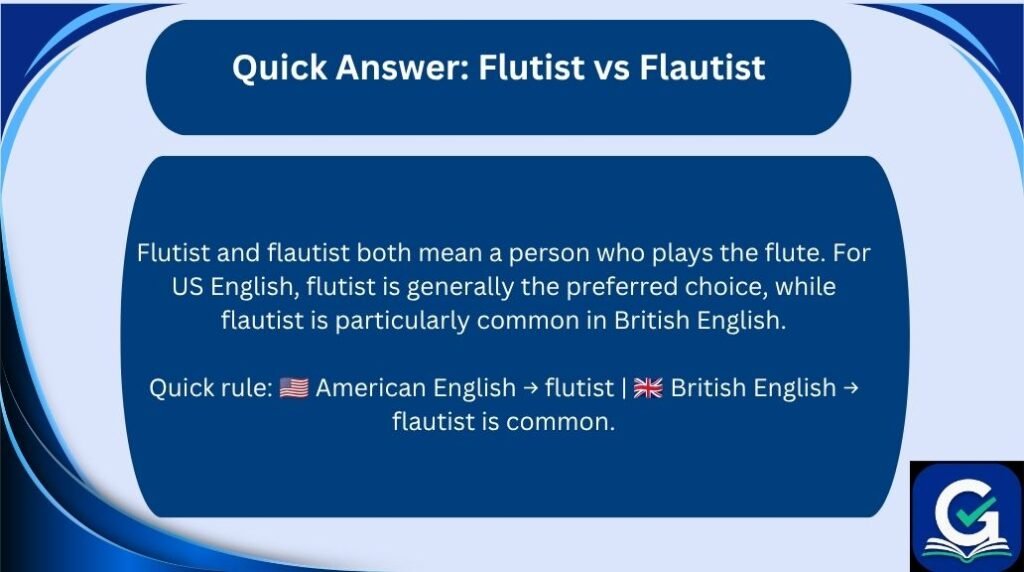
Flutist and flautist both mean a person who plays the flute. For US English, flutist is generally the preferred choice, while flautist is particularly common in British English.
Quick rule: 🇺🇸 American English → flutist | 🇬🇧 British English → flautist is common.
Understanding the Basics: Flutist vs Flautist
At first glance, flutist and flautist appear to be competing spellings of the same word. In practical modern English, that is essentially what they are.
Both are nouns. Both describe someone who plays the flute. The main difference is regional and stylistic preference, not meaning.
Merriam-Webster gives flutist the definition “one who plays a flute.” Its separate entry for flautist simply defines the word as flutist.
Cambridge Dictionary makes the regional distinction particularly clear: its US entry for flutist defines it as a flute player, while its entry for flautist describes a person who plays the flute and identifies flutist as the US equivalent.
Comparison Table
| Form | Type | Meaning | Example | Correct/Incorrect |
|---|---|---|---|---|
| flutist | Noun | A person who plays the flute | “The flutist performed beautifully.” | Correct |
| flautist | Noun | A person who plays the flute | “The flautist performed beautifully.” | Correct |
| flutists | Plural noun | More than one flute player | “The flutists rehearsed together.” | Correct |
| flautists | Plural noun | More than one flute player | “The flautists rehearsed together.” | Correct |
| fluter | Noun | Historically, a flute player; now uncommon in this sense | “The old text refers to a fluter.” | Rare/archaic for this meaning |
Merriam-Webster records fluter as an archaic word for flutist, while its modern entries recognize both flutist and flautist.
The key point
There is no meaning difference between flutist and flautist in ordinary modern usage.
You are not describing two different kinds of musicians.
For example:
“The flutist played a solo.”
and
“The flautist played a solo.”
Both sentences describe a person who played the flute.
The important difference is which variety of English you are using.
What Does “Flutist” Mean?
Flutist is a noun meaning a person who plays the flute.
It is especially natural in American English. Merriam-Webster lists flutist as a standard noun and gives its first known use as 1603.
Example
The flutist performed a beautiful solo during the concert.
Breakdown:
- The = definite article
- flutist = noun identifying the musician
- performed = past-tense verb
- a beautiful solo = object of the verb
- during the concert = prepositional phrase
Here, flutist simply identifies the person playing the flute.
More examples
- The flutist joined the orchestra last year.
- Our school’s flutist won the music competition.
- The principal invited a professional flutist to speak to the students.
- The famous flutist performed three pieces.
- She hopes to become a professional flutist.
For US-focused writing, these sentences sound natural and conventional.
What Does “Flautist” Mean?
Flautist is also a noun meaning a person who plays the flute.
The difference is primarily one of regional usage and tradition.
Cambridge Dictionary defines flautist as a person who plays the flute and explicitly notes that “US also flutist.”
Merriam-Webster also recognizes flautist and defines it simply as flutist. It traces the word to Italian flautista, from flauto, meaning flute, and gives its first known use as 1860.
Example
The flautist performed a solo before the orchestra.
This sentence is grammatically correct.
The word may sound more natural to readers accustomed to British English, but American readers can understand it easily.
More examples
- The flautist practiced for several hours.
- The orchestra hired an experienced flautist.
- A talented flautist opened the festival.
- The young flautist received a scholarship.
- Several flautists performed at the event.
Again, none of these uses is grammatically wrong.
Flutist vs Flautist: The Real Difference
The most useful way to think about the issue is this:
Flutist and flautist differ mainly in regional preference, not definition.
In American English
Flutist is generally the better default.
For example:
The American orchestra hired a talented flutist.
This sounds completely natural in US English.
In British English
Flautist is very common.
For example:
The British orchestra hired a talented flautist.
This is perfectly natural in British English.
In international writing
Either form may appear.
A multinational publication might use flautist because its editorial style follows British English. An American publication may use flutist.
This is why you may encounter both spellings while reading articles, concert programs, biographies, or music websites.
Is “Flutist” More Correct Than “Flautist”?
Not exactly.
It would be inaccurate to say that flutist is “correct” and flautist is “incorrect.”
Both are established English nouns.
Merriam-Webster explicitly treats flautist as a synonym of flutist.
The better question is:
Which form is more appropriate for my audience?
If you are writing in US English, use flutist as your default.
If you are writing in British English, flautist may be the more natural choice.
Think of it as a style choice
The situation is similar to many regional differences in English vocabulary and spelling.
English has developed differently in different countries. A word can be perfectly legitimate in one variety while another form is more common elsewhere.
Therefore, flutist vs flautist is not a simple right-versus-wrong grammar battle.
It is mainly a question of regional usage and editorial consistency.
Correct Meanings and Uses
1. Referring to one flute player
Use the singular noun when talking about one person.
The flutist arrived early for rehearsal.
Or:
The flautist arrived early for rehearsal.
Both are correct.
The choice depends on the English variety or style guide you are following.
2. Referring to multiple flute players
The plural forms are:
- flutists
- flautists
Examples:
The flutists practiced their parts together.
The flautists practiced their parts together.
Both are grammatically correct.
Notice that the plural is formed by adding -s.
Singular → plural
- flutist → flutists
- flautist → flautists
Do not write flutistes or flautistes in standard English.
3. Using the word as a job or professional description
Both forms can describe a professional musician.
She is a professional flutist.
He works as a professional flautist.
The noun can describe an occupation, specialization, or skill.
It does not necessarily mean the person plays professionally. Someone who plays the flute as a hobby can also be called a flutist or flautist.
4. Using the word in music writing
The word is common when discussing orchestras, ensembles, concerts, performances, and musicians.
For example:
The principal flutist opened the second movement with a delicate melody.
Or:
The principal flautist opened the second movement with a delicate melody.
Again, the meaning remains unchanged.
Sentence Breakdown: How the Word Works
Consider this sentence:
The young flutist practiced every evening.
The sentence contains:
- The — article
- young — adjective
- flutist — noun
- practiced — verb
- every evening — adverbial time phrase
The word flutist functions as the subject of the sentence.
Now change it to flautist:
The young flautist practiced every evening.
The grammar remains exactly the same.
That is an important clue: the two words have the same grammatical function and meaning.
Test Tip: How Can You Check Which Word to Use?
When you are unsure, ask yourself three questions:
- Am I writing in US English?
- Is there a house style or publication style I need to follow?
- Does the person or organization prefer one form?
If the answer to the first question is yes and there is no special style requirement, choose:
flutist
If you are writing in British English, flautist may be the more natural choice.
Easy memory trick
Think:
US → flute → flutist
The shorter form is often the safest choice for American readers.
But remember: this is a usage preference, not a rule that makes flautist grammatically wrong.
Case Study: A Real-Life Workplace Example
Imagine that you work for an American performing arts organization.
Your team is preparing an email announcing an upcoming concert.
You write:
“We are excited to welcome Sarah Mitchell, a renowned flutist, to our spring concert.”
That sentence is a natural choice for a US audience.
Now imagine that the organization is based in London and follows British English:
“We are excited to welcome Sarah Mitchell, a renowned flautist, to our spring concert.”
That version is equally appropriate.
What if the musician calls herself a “flautist”?
Then it is sensible to respect that terminology, particularly in a biography, interview, profile, or promotional material.
For example:
“In her biography, the musician describes herself as a flautist.”
Changing someone’s preferred professional description simply to match a presumed regional preference may be unnecessary.
Practical lesson
Audience + context + consistency should guide your choice.
Grammar Rules: Why Are Both Forms Correct?
The simplest explanation is that English has more than one established noun for a person who plays the flute.
Merriam-Webster recognizes flutist as a noun meaning someone who plays a flute. Its separate flautist entry defines the word as flutist.
Cambridge Dictionary provides similar evidence. Its American entry defines flutist as a flute player, while its flautist entry defines the word as a person who plays the flute and identifies flutist as a US form.
This means there is no grammatical rule saying:
“Flautist is wrong.”
There is also no grammatical rule saying:
“Flutist is the only acceptable form.”
Instead, English usage has developed two recognized forms.
Why does “flautist” look different?
The spelling flautist reflects a form connected historically with flauto, the Italian word for flute. Merriam-Webster traces flautist through Italian flautista.
Flutist, meanwhile, is the established English form derived directly from flute.
The two forms eventually became standard alternatives.
Why Do People Get “Flutist vs Flautist” Wrong?
The confusion is understandable.
1. Fast typing
When people type quickly, they often choose the spelling that first comes to mind.
A writer might type flautist because they have seen it frequently in British publications.
Another writer might automatically type flutist because that is the form they learned in school.
2. Autocorrect
Autocorrect can make things even more confusing.
If your device recognizes one word more readily than another, you may assume that the less familiar spelling must be wrong.
That is not a reliable grammar test.
Dictionary software and spell-checkers do not always reflect every regional variation equally.
3. Lack of knowledge about regional English
Many learners assume that English has one universal vocabulary.
In reality, American, British, Canadian, Australian, and other forms of English can differ in spelling, vocabulary, pronunciation, and preferred usage.
4. Seeing one form more often
If you mostly read American websites, flutist may look normal while flautist looks unusual.
If you mostly read British publications, the opposite may happen.
Frequency creates familiarity, but familiarity does not automatically determine correctness.
Similar Grammar and Spelling Confusions
The flutist vs flautist question belongs to a larger group of English-language confusions.
| Confusion | Correct forms | Main difference |
|---|---|---|
| it’s / its | Both correct | It’s = it is; its = possessive |
| your / you’re | Both correct | Your = possessive; you’re = you are |
| there / their / they’re | All correct | Different meanings and functions |
| affect / effect | Both correct | Usually different grammatical roles and meanings |
| then / than | Both correct | Time/order vs comparison |
| advice / advise | Both correct | Noun vs verb |
| practice / practise | Both exist | US English generally uses practice for both noun and verb |
| flutist / flautist | Both correct | Primarily regional preference |
The important lesson is that different does not automatically mean incorrect.
English contains many pairs and groups of words that vary according to meaning, grammar, region, or style.
Flutist vs Flautist in Different Contexts
Everyday Conversation
In casual American conversation, flutist is likely to sound more familiar.
“My daughter is a flutist.”
A British speaker might naturally say:
“My daughter is a flautist.”
Neither sentence causes a grammatical problem.
If your goal is natural US English, choose flutist.
Professional Writing
Professional writing requires consistency.
If you are preparing:
- a resume
- a biography
- a press release
- a concert announcement
- a school newsletter
- a newspaper article
- a business website
choose the form that fits your publication’s audience and style.
For US-facing content, flutist is generally the safer default.
Creative Writing
Creative writers have more flexibility.
An author may choose flautist because it:
- fits the character’s background
- matches the setting
- reflects British English
- creates a particular tone
- matches surrounding terminology
For example:
“The old flautist played beneath the streetlamp.”
There is nothing grammatically wrong with that sentence.
A US author could just as naturally write:
“The old flutist played beneath the streetlamp.”
Social Media and Texting
Social media is even more flexible.
You might see:
“Amazing flutist! 🎶”
or:
“Such an incredible flautist! 🎵”
Both are understandable and grammatically acceptable.
Because social media often mixes regional varieties of English, you may encounter both forms in the same online community.
Why It Matters
You might wonder why such a small spelling difference deserves attention.
It matters because clear communication depends on choosing language that fits your audience.
1. Clarity
Using the form familiar to your readers can make your writing feel more natural.
For American readers, flutist is generally the most straightforward choice.
2. Professionalism
Consistent language makes professional writing look deliberate.
If your article uses American English throughout, suddenly switching to British terminology without a reason can make the writing feel inconsistent.
3. Digital communication
Online writing reaches people from many countries.
A word that feels completely normal to one reader may look unfamiliar to another.
Knowing regional differences helps writers communicate confidently across borders.
4. Respect for language variation
English does not belong to one country.
Different varieties have their own conventions, and recognizing those conventions is part of strong language awareness.
Good writing is not only about being correct; it is also about choosing language that fits your audience.
That principle applies far beyond flutist vs flautist.
Special Exception: What About “Fluter”?
You may occasionally encounter fluter.
However, it is not the normal modern word for a person who plays the flute.
Merriam-Webster identifies fluter as an archaic term for flutist. The same entry also gives other meanings related to something that creates fluting or grooves.
Therefore, modern writers should generally avoid fluter when they simply mean “a person who plays the flute.”
Modern preference
Use:
- flutist in US English
- flautist where that regional or stylistic form is preferred
- flute player when you want the clearest, most neutral wording
What About “Flute Player”?
There is a third option that is completely straightforward:
flute player
For example:
“She is an accomplished flute player.”
This expression avoids the regional question entirely.
It can be especially useful when writing for a broad international audience or when your readers may not be familiar with either flutist or flautist.
However, flutist and flautist are both concise, established nouns, so there is usually no need to avoid them.
Pronunciation and Spelling
The word flute itself is pronounced with the long “oo” sound in standard English. Cambridge lists the pronunciation of flute as /fluːt/.
The derived words can vary somewhat in pronunciation across regions.
The spelling distinction is easier to remember:
flute + -ist → flutist
while:
flautist contains flau- rather than flu-.
Do not assume that the spelling tells you which word is grammatically correct. Both forms are established.
Flutist vs Flautist: Which One Should You Use in SEO Content?
If you are writing an article for a US English audience, use flutist as the primary term.
That does not mean you should avoid flautist. In fact, mentioning the alternative can make your article more useful because people search for both forms.
A well-optimized article can naturally include related phrases such as:
- flutist vs flautist
- is flutist correct
- is flautist correct
- flutist meaning
- flautist meaning
- flutist in American English
- flautist in British English
- American spelling of flutist
- British spelling of flautist
- flute player
- person who plays the flute
- plural of flutist
- plural of flautist
The goal is not to repeat the same keyword unnecessarily.
Instead, answer the questions readers are actually asking.
That approach improves readability while also making the content easier for search engines and answer engines to understand.
Quick Recap Checklist
| Question | If Yes → Use |
|---|---|
| Are you writing primarily for a US audience? | flutist |
| Are you writing primarily for a British audience? | flautist is a natural choice |
| Are you describing a person who plays the flute? | flutist or flautist |
| Are you writing about several flute players? | flutists or flautists |
| Does a musician have a stated preference? | Use their preferred form |
| Are you following a publication’s style guide? | Follow the style guide |
| Do you want completely neutral wording? | flute player |
| Is “flautist” automatically wrong in US English? | No |
| Is “flutist” automatically wrong in British English? | No |
Practice Examples
Example 1
Maria is an excellent ___.
For US English: flutist
For British English: flautist is also natural.
Example 2
The orchestra invited three ___ to perform.
Possible answers:
- flutists
- flautists
Both are correct.
Example 3
The musician’s biography describes her as a ___.
Use the form that matches the biography’s regional style or the musician’s own preference.
FAQs
1. Is “flutist” or “flautist” correct?
Both are correct. Both words refer to a person who plays the flute. In US English, flutist is generally the preferred form, while flautist is especially common in British English. Merriam-Webster lists flautist as a synonym of flutist.
2. Is “flautist” British or American?
Flautist is particularly associated with British English, although it is also used in American English. Cambridge identifies flautist as a word for a person who plays the flute and notes that flutist is the US form.
3. Should Americans say “flutist” or “flautist”?
For a standard US-English audience, flutist is usually the best default. It is concise, widely recognized, and listed as the US form by Cambridge.
However, flautist is not grammatically wrong in American English.
4. What is the plural of flutist?
The plural of flutist is flutists.
Example:
The three flutists performed together.
The plural of flautist is flautists.
5. Is “flautist” more formal than “flutist”?
Not necessarily. The difference is mainly regional and stylistic, not a formal-versus-informal distinction. Both words can be used in professional, academic, journalistic, and everyday writing.
6. Can I use “flute player” instead?
Yes. Flute player is a clear and neutral alternative. It may be especially useful when writing for an international audience or when you want to avoid regional terminology.
Conclusion
When deciding between flutist vs flautist, there is no need to think in terms of one word being correct and the other being wrong. Both are established English nouns meaning a person who plays the flute. Merriam-Webster recognizes both, while Cambridge highlights the regional distinction between them.
For US English, however, flutist is generally the best default. If you are writing for a British audience, flautist may sound more natural. In international writing, either form can work, provided you use it consistently.
The most important rule is simple:
US English → flutist.
British English → flautist is common.
Both → correct.
So the next time you pause over the spelling, remember that you are not choosing between a correct word and a mistake. You are choosing between two legitimate forms shaped by the history and regional variety of English.
When in doubt for an American audience, choose “flutist”—and keep the music playing. 🎶

I’m Mason Reed, a grammar researcher at Gramfino, where I explore grammar rules and common English mistakes.
I turn my research into clear explanations and practical examples that readers can easily follow.

[…] explore common mistakes, and give you simple tricks for remembering the correct spelling. 📝 Flutist vs Flautist | Seamless vs. Seemless | Wracking vs. […]
[…] of treat vs treet so you can confidently choose the right form every time. Phoenix vs Pheonix | Flutist vs Flautist | Seamless vs. […]