Have you ever typed a sentence and stopped because you could not decide between canvas vs canvass? You are definitely not alone. These two words look almost identical and sound very similar, but they have completely different meanings.
I know this kind of spelling confusion can be surprisingly frustrating, especially when you are writing an email, school assignment, business report, or social media post and want every word to be correct. The good news is that learning the difference between canvas vs canvass does not have to be difficult.
Canvas usually refers to a strong fabric, an artist’s painting surface, or a figurative blank space. Canvass, however, is mainly a verb meaning to ask people for opinions, votes, information, support, or donations. Once you connect each word with its specific meaning, choosing the right one becomes much easier.
In this complete guide, we will explore their definitions, grammar, examples, common mistakes, memory tricks, and practical uses so you can confidently use both words in your writing. Lefty vs Leftie | Authorization vs Authorisation | Treat vs Treet
Quick Answer: Canvas vs Canvass
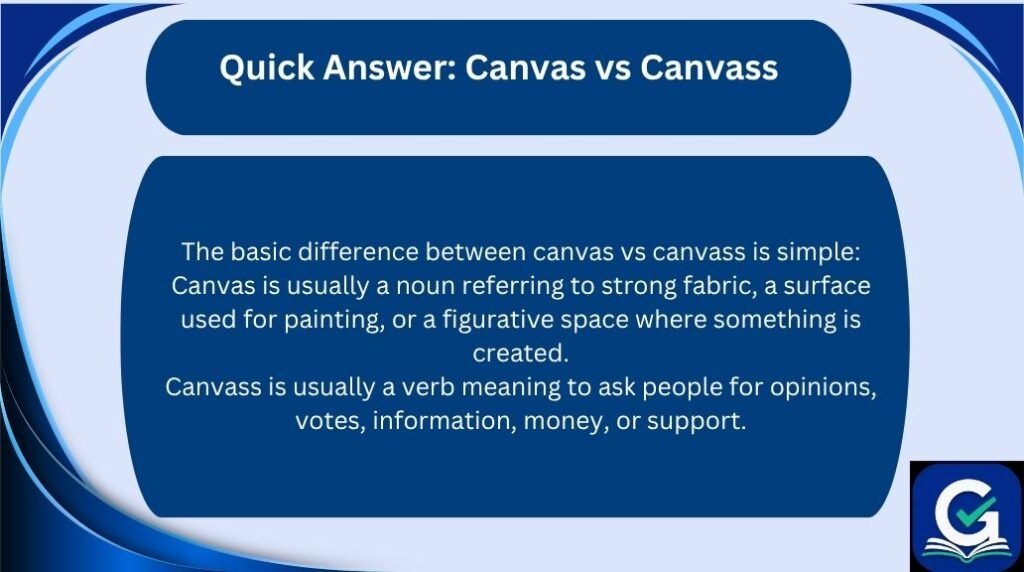
The basic difference between canvas vs canvass is simple:
Canvas is usually a noun referring to strong fabric, a surface used for painting, or a figurative space where something is created.
Canvass is usually a verb meaning to ask people for opinions, votes, information, money, or support.
Quick examples:
- The artist painted the landscape on a canvas.
- Volunteers canvassed the neighborhood before the election.
- She bought a canvas bag.
- The organization canvassed residents for their opinions.
Easy rule:
Canvas = art or material. 🎨
Canvass = asking people. 🗣️
That simple distinction will help you avoid most mistakes involving these two words.
Understanding the Basics of Canvas vs Canvass
Although canvas and canvass differ by only one letter, they function differently and communicate different ideas.
Canvas is most commonly used as a noun. It can describe a durable woven fabric or the surface on which an artist paints.
Canvass is commonly used as a verb. It describes the act of approaching people to ask questions, collect opinions, seek votes, request donations, or gain support.
The following table makes the distinction easier to see.
| Form | Type | Meaning | Example | Correct/Incorrect |
|---|---|---|---|---|
| Canvas | Noun | Strong fabric | The tent is made of canvas. | ✅ Correct |
| Canvas | Noun | Painting surface | She painted on a blank canvas. | ✅ Correct |
| Canvass | Verb | Ask people for opinions | They canvassed local residents. | ✅ Correct |
| Canvass | Verb | Seek votes or support | Volunteers canvassed voters. | ✅ Correct |
| Canvass | Noun | An organized effort to contact people | The campaign organized a canvass. | ✅ Correct |
| Canvas | Verb for asking people | Incorrect word choice | They canvas voters. | ❌ Incorrect |
The most important thing to remember is that these words are not interchangeable.
What Does Canvas Mean?
Canvas as a Type of Fabric
The word canvas originally refers to a strong, durable fabric. It is commonly associated with materials used for practical items because of its strength.
Canvas can be used to make:
- Tents
- Bags
- Shoes
- Tarps
- Awnings
- Backpacks
- Outdoor equipment
- Furniture coverings
For example:
The workers repaired the old canvas tent.
In this sentence, canvas describes the material used to make the tent.
Another example is:
He carried his books in a heavy canvas backpack.
Here, canvas is functioning as an adjective describing the backpack’s material.
Canvas as an Artist’s Surface
One of the most familiar meanings of canvas is the surface used for painting.
For example:
The artist painted a beautiful mountain scene on a large canvas.
The canvas is the surface that holds the paint.
You might also say:
She bought three blank canvases for her art class.
In this sentence, canvases is the plural form of canvas.
Canvas as a Figurative Surface
Writers also use canvas metaphorically.
A canvas can represent an empty space where ideas, creativity, or possibilities can develop.
For example:
The empty room became a canvas for her creative ideas.
The room is not literally made of fabric. Instead, the writer compares it to an artist’s blank surface.
Another example:
The night sky was a dark canvas filled with stars.
This figurative use creates a strong visual image.
What Does Canvass Mean?
Canvass as a Verb
Canvass means to approach people and ask for information, opinions, votes, support, or donations.
For example:
Volunteers canvassed the neighborhood before Election Day.
The volunteers were contacting residents, usually to discuss the election or identify potential supporters.
Another example:
The researchers canvassed residents about the proposed highway.
Here, the researchers were asking people for their opinions.
Canvass for Votes
Politics is one of the most common contexts in which you will encounter canvass.
For example:
Campaign workers canvassed voters throughout the district.
This means the workers contacted voters to learn about their preferences, encourage support, or provide campaign information.
Another example:
Volunteers are canvassing local neighborhoods this weekend.
Again, the meaning involves contacting people.
Canvass for Opinions
The word does not only apply to politics.
Businesses, researchers, schools, charities, and community groups can also canvass people.
For example:
The company canvassed customers about the new product.
The company wanted to collect customer opinions.
You could also write:
The school canvassed parents before changing its schedule.
The school asked parents for feedback.
Canvass for Donations or Support
Canvass can also mean to seek financial support or other forms of assistance.
For example:
Volunteers canvassed the community for donations.
The volunteers approached members of the community and asked them to contribute.
Another example:
The nonprofit canvassed local businesses for sponsorships.
The organization contacted businesses to request support.
Canvas vs Canvass: The Easiest Memory Trick
If you regularly forget which spelling to use, try this simple technique.
Think “Paint” for Canvas
When you see canvas, think of:
🎨 Paint
🖌️ Brush
🖼️ Artwork
🧵 Fabric
For example:
The painter worked on a large canvas.
If the sentence makes you imagine an artist, canvas is probably correct.
Think “People” for Canvass
When you see canvass, think of:
👥 People
🗣️ Questions
🗳️ Votes
📋 Opinions
🤝 Support
For example:
Volunteers canvassed the neighborhood.
If people are being contacted or asked for something, canvass is the correct choice.
The Paint-or-People Test
Ask yourself:
Am I talking about paint, fabric, or a creative surface?
Use canvas.
Am I talking about asking people questions or seeking their support?
Use canvass.
This quick test works in most situations.
Correct Usage in Sentences
Let’s examine several examples of canvas vs canvass in real sentences.
Examples With Canvas
The artist bought a new canvas.
Here, canvas means a painting surface.
The tent was made from waterproof canvas.
Here, canvas refers to durable fabric.
She carried a canvas tote bag.
Here, canvas describes the bag’s material.
The blank wall became a canvas for the mural.
Here, canvas is being used figuratively.
Examples With Canvass
The volunteers canvassed the neighborhood.
Here, canvassed means they contacted people.
The campaign plans to canvass voters tomorrow.
Here, canvass means to seek voters’ support or opinions.
Researchers canvassed residents about the proposal.
Here, the researchers asked residents for their views.
The charity canvassed local businesses for donations.
Here, canvassed means the charity approached businesses to request support.
Sentence Breakdown: Understanding the Difference
Sometimes the easiest way to understand canvas vs canvass is to examine how each word functions inside a sentence.
Consider:
The painter placed the finished portrait on a canvas.
The important word is canvas because it refers to the physical surface holding the artwork.
Now consider:
The volunteers canvassed the neighborhood.
The important word is canvassed because it describes an action. The volunteers went out and contacted people.
This gives us another useful distinction:
Canvas → thing
Canvass → action
This is not an absolute rule because canvass can also be used as a noun, but it is an excellent beginner-friendly memory aid.
Test Tip: Replace the Word With a Simple Phrase
When you are unsure between canvas vs canvass, replace the confusing word with a simpler phrase.
If the intended meaning is:
“painting surface”
Use canvas.
If the intended meaning is:
“ask people”
Use canvass.
Example
The organization will ___ residents about the project.
Replace the blank:
The organization will ask residents about the project.
Therefore:
The organization will canvass residents about the project.
Now try:
She painted the portrait on a ___.
Replace the blank:
She painted the portrait on a painting surface.
Therefore:
She painted the portrait on a canvas.
This substitution method is especially helpful for students and English learners.
A Real-Life Workplace Case Study
Imagine a company preparing to launch a new product.
The marketing department wants to know how customers feel about the product. The manager sends this email:
Subject: Customer Feedback Survey
Our marketing team will canvass customers next week to learn more about their experience with our new product. Please record the responses carefully and submit your findings by Friday.
In this situation, canvass is correct because employees will contact customers and ask questions.
Now imagine the company’s design department is preparing promotional artwork.
The manager writes:
Please order five large canvases for the new promotional artwork.
Here, canvas is correct because the company needs physical surfaces for artwork.
This workplace example shows how dramatically the meanings change even though the spellings are almost identical.
Grammar Rules You Need to Know
The distinction between canvas vs canvass is supported by standard dictionary usage.
Merriam-Webster defines canvas in relation to a strong fabric and the material or surface used for artistic work. Canvass, meanwhile, is associated with soliciting or gathering opinions, votes, information, or support.
The words therefore represent different vocabulary items rather than two spellings of the same word.
Is Canvas Ever Used as a Verb?
If you mean “to ask people for opinions or votes,” standard usage calls for canvass, not canvas.
Incorrect:
The volunteers will canvas voters.
Correct:
The volunteers will canvass voters.
The second s is essential.
Can Canvass Be a Noun?
Yes.
Although canvass is commonly used as a verb, it can also function as a noun.
For example:
The campaign conducted a door-to-door canvass.
Here, canvass refers to the organized activity of contacting people.
Therefore, you should not memorize the distinction as simply:
Canvas = noun
Canvass = verb
A better rule is:
Canvas = fabric, artwork, or figurative surface.
Canvass = contacting people to seek information, opinions, votes, or support.
Common Mistakes With Canvas vs Canvass
Mistake 1: Using Canvas for Political Outreach
Incorrect:
Volunteers will canvas voters this weekend.
Correct:
Volunteers will canvass voters this weekend.
The activity involves contacting people, so canvass is required.
Mistake 2: Using Canvass for Artwork
Incorrect:
The artist painted the picture on a canvass.
Correct:
The artist painted the picture on a canvas.
The painting surface is a canvas.
Mistake 3: Forgetting the Second S
Incorrect:
The researchers canvased the residents.
Correct:
The researchers canvassed the residents.
The verb is spelled canvass, so its past tense is canvassed.
Why Do These Mistakes Happen?
There are several common reasons.
Fast typing: People may know the correct word but accidentally omit a letter.
Autocorrect: Technology may recognize both words as valid and fail to understand the intended meaning.
Pronunciation: The words sound extremely similar, making them difficult to distinguish when heard rather than read.
Lack of vocabulary knowledge: English learners may know one word but not realize that the second spelling has a different meaning.
Visual similarity: The difference between one and two final s’s is easy to overlook.
Similar English Word Confusions
The canvas vs canvass problem belongs to a larger group of commonly confused English words.
| Confusing Words | Difference |
|---|---|
| Canvas / Canvass | Fabric or painting surface / ask people for information or support |
| Your / You’re | Possessive / you are |
| Its / It’s | Possessive / it is |
| Their / There / They’re | Possession / place / they are |
| Affect / Effect | Usually a verb meaning influence / usually a noun meaning result |
| Advice / Advise | Noun / verb |
| Than / Then | Comparison / time or sequence |
| Accept / Except | Receive or agree / exclude |
| Principal / Principle | Person or main item / rule or belief |
The solution to all these problems is similar: learn the meaning instead of memorizing spelling alone.
Usage in Everyday Conversation
In casual conversation, canvas is commonly used when talking about materials or artwork.
For example:
I bought a canvas bag yesterday.
You might also say:
That painting looks great on canvas.
Canvass is less common in casual everyday conversation, but it appears when people discuss elections, surveys, community activities, or research.
For example:
The volunteers are canvassing the neighborhood.
Both words are perfectly normal English. Their frequency simply depends on the context.
Usage in Professional Writing
Professional writing requires careful word choice because a small mistake can make your message appear less polished.
Consider:
Our team will canvas customers next month.
A reader may understand the intended meaning, but the spelling is incorrect for the context.
The professional version is:
Our team will canvass customers next month.
In business communication, this distinction matters in:
- Reports
- Surveys
- Emails
- Research documents
- Marketing plans
- Election materials
- Community notices
- Presentations
Accurate vocabulary makes professional writing clearer and more credible.
Usage in Creative Writing
Creative writing provides many opportunities to use canvas metaphorically.
For example:
The desert became a golden canvas beneath the setting sun.
This does not mean the desert is literally made from fabric. Instead, the writer compares the landscape to an artist’s surface.
Another example:
His imagination was a blank canvas waiting for a new idea.
This metaphor is common because a blank canvas represents possibility and creativity.
Canvass can also appear in creative writing when a character is gathering information.
For example:
She spent the morning canvassing the town for clues.
Here, the character is moving from place to place and asking people questions.
Usage in Texting and Social Media
Digital communication makes word confusion more common because people often type quickly.
A social media caption might say:
New painting on canvas! 🎨
That is correct.
A community post might say:
Volunteers are canvassing the area today. 🗳️
That is also correct.
Texting may be informal, but the distinction remains the same.
Remember:
Canvas = object/material
Canvass = activity/action
Why This Difference Matters
At first glance, canvas vs canvass may seem like a tiny spelling issue. However, accurate word choice has several important benefits.
It Improves Clarity
The right word immediately tells your reader what you mean.
Compare:
The team will canvas residents.
with:
The team will canvass residents.
The second sentence clearly indicates that the team will contact residents.
It Improves Professionalism
Correct word choice makes emails, reports, and business documents look carefully prepared.
A single wrong word may not destroy your message, but repeated vocabulary errors can affect how readers perceive your writing.
It Prevents Misunderstandings
English contains many words that look similar but mean different things. Choosing the correct one prevents unnecessary confusion.
It Makes Digital Writing More Accurate
Spell-checkers are helpful, but they cannot always detect contextual errors.
Because canvas is a legitimate English word, a spelling program may not flag it when you accidentally use it instead of canvass.
That means human proofreading and vocabulary knowledge still matter.
Clear word choice turns correct spelling into effective communication.
Special Exceptions and Edge Cases
There is one important point to remember: Canvas can appear as a proper name.
For example, a company, software product, organization, school platform, or brand may officially use Canvas as its name.
When a word is part of a proper name, follow the official capitalization and spelling of that name.
However, a brand name does not change the ordinary English meanings of the words.
In standard vocabulary:
- canvas = fabric, painting surface, or figurative surface
- canvass = ask people for information, opinions, votes, or support
So always examine the context before deciding which spelling is appropriate.
Common Forms of Canvas
Knowing related forms can help reinforce the correct spelling.
Singular
The artist bought a canvas.
Plural
The gallery displayed several canvases.
Compound expressions
- Canvas bag
- Canvas shoes
- Canvas tent
- Canvas painting
- Canvas material
The word remains canvas.
Common Forms of Canvass
The verb changes according to tense.
Present
Volunteers canvass the neighborhood.
Third-person singular
She canvasses local businesses.
Past tense
They canvassed voters yesterday.
Present participle
The volunteers are canvassing residents.
Noun
The campaign organized a canvass.
Notice the spelling carefully:
canvass → canvasses → canvassed → canvassing
The double s remains important.
Five-Minute Practice Exercise
Choose canvas, canvass, canvassed, or canvases.
- The artist displayed three large ______.
- Volunteers will ______ the neighborhood.
- The company ______ customers about the new service.
- The tent is made from strong ______.
- She painted the flowers on a white ______.
Answers
- canvases
- canvass
- canvassed
- canvas
- canvas
If you got all five correct, you have probably mastered the basic distinction.
Quick Recap Checklist
Use this checklist whenever you are uncertain about canvas vs canvass.
| Question | If Yes → Use |
|---|---|
| Is it a painting surface? | Canvas |
| Is it a strong fabric? | Canvas |
| Is it related to artwork? | Canvas |
| Is it a metaphorical blank surface? | Canvas |
| Are people being asked questions? | Canvass |
| Are voters being contacted? | Canvass |
| Are opinions being collected? | Canvass |
| Is support being requested? | Canvass |
| Are donations being solicited? | Canvass |
Three Final Practice Examples
1. The painter prepared a fresh ______.
Answer: canvas
2. The campaign plans to ______ voters next week.
Answer: canvass
3. Researchers ______ residents about the proposed changes.
Answer: canvassed
FAQs About Canvas vs Canvass
What is the main difference between canvas and canvass?
Canvas refers to strong fabric, a painting surface, or a figurative blank surface. Canvass usually means to approach people to ask for opinions, votes, information, support, or donations.
Is “canvas” or “canvass” correct for asking voters questions?
Canvass is correct. For example, “Volunteers will canvass voters before the election.” The spelling with two s’s is required for this meaning.
Is “canvass” correct when talking about a painting?
No. The correct word is canvas. For example, “The artist painted the portrait on a canvas.”
What is the past tense of canvass?
The past tense is canvassed, spelled with two s’s before the -ed ending.
Example:
The volunteers canvassed the neighborhood yesterday.
Why are canvas and canvass so easy to confuse?
They look and sound almost identical, but they have different meanings. Fast typing, autocorrect, pronunciation, and lack of familiarity with the words can all contribute to mistakes.
How can I quickly remember the difference?
Use the paint-or-people rule. If you are thinking about paint, fabric, or artwork, use canvas. If you are thinking about asking or contacting people, use canvass.
Conclusion
The difference between canvas vs canvass is much easier to understand when you focus on meaning rather than spelling alone. Canvas refers to strong fabric, a surface used for painting, or a figurative space for creativity.
Canvass means to contact people to gather opinions, information, votes, donations, or support. Although the two words sound nearly identical, they should not be used interchangeably.
Whenever you are uncertain, use the simple paint-or-people test. If the sentence makes you think about an artist, fabric, or a blank creative surface, choose canvas. If it involves people being contacted, questioned, or asked for support, choose canvass.
The extra s in canvass is worth remembering because it can completely change the meaning of your sentence.
Paint on a canvas; canvass people for answers. Once you remember that, this confusing word pair becomes easy. 🎨🗣️

I’m Mason Reed, a grammar researcher at Gramfino, where I explore grammar rules and common English mistakes.
I turn my research into clear explanations and practical examples that readers can easily follow.
[…] conversations, and practical tips. By the end, you will know exactly when to use each word. ✍️ Canvas vs Canvass | Lefty vs Leftie | Authorization vs […]