Have you ever typed “optimize” and wondered whether it should actually be “optimise”? If so, you are not alone. These two spellings look almost identical, sound the same in most varieties of English, and have exactly the same basic meaning. The difference is mainly a matter of regional spelling conventions, not grammar or meaning.So, when should you use optimize vs optimise?
If you are writing for an American audience, optimize is the standard choice. If you are writing in British English, optimise is commonly preferred. Both forms are legitimate English words, but your choice should match the variety of English you are using.
This distinction matters in business writing, academic work, websites, software documentation, SEO content, emails, and everyday communication. Consistent spelling makes your writing look polished and intentional.
In this guide, we will explain optimize vs optimise, show how each form works in sentences, examine common mistakes, and give you simple tests you can use whenever you are unsure. 😊Practices vs Practises | Hoarder vs Horder | Premise vs Premises
Quick Answer: Optimize vs Optimise
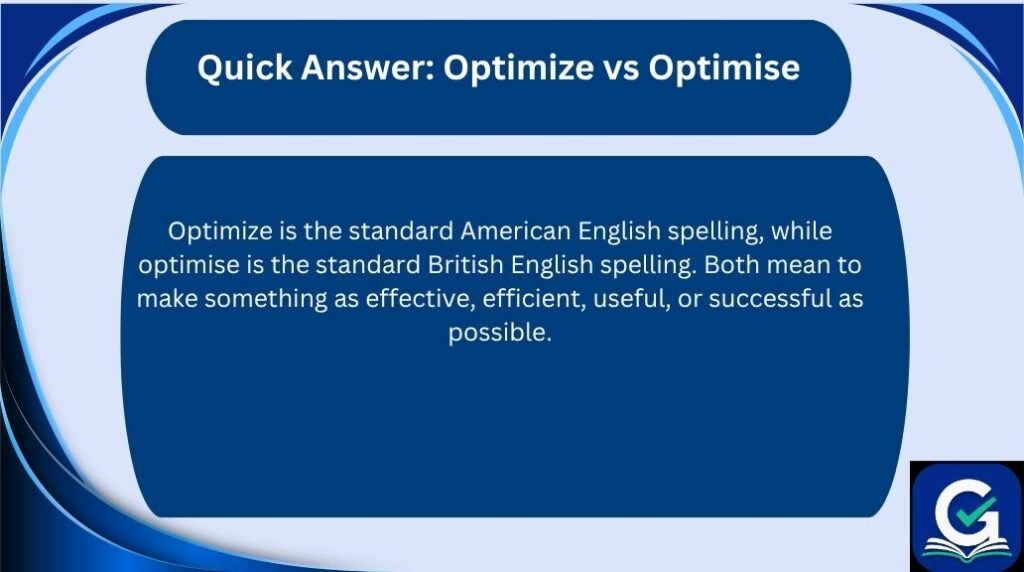
Optimize is the standard American English spelling, while optimise is the standard British English spelling. Both mean to make something as effective, efficient, useful, or successful as possible.
For US English, use optimize:
We need to optimize the website for mobile users.
For British English, optimise is generally preferred:
We need to optimise the website for mobile users.
Neither spelling changes the fundamental meaning of the sentence.
Understanding the Basics of Optimize vs Optimise
The easiest way to understand optimize vs optimise is to think of them as two regional spellings of the same verb.
The difference is similar to other American and British spelling differences, such as:
- color / colour
- organize / organise
- realize / realise
- analyze / analyse
- center / centre
- behavior / behaviour
In American English, -ize is generally used in words such as optimize. In British English, -ise is commonly used instead.
However, there is an important detail: British English can also use -ize spellings in some words and style systems. Therefore, it is not accurate to say that every British writer must use -ise. What matters most is following the spelling convention or style guide you have chosen and maintaining consistency.
Optimize vs Optimise Comparison Table
| Form | Type | Meaning | Example | Correct/Incorrect |
|---|---|---|---|---|
| optimize | Verb | Make something as effective or efficient as possible | We need to optimize the process. | Correct in US English |
| optimise | Verb | Make something as effective or efficient as possible | We need to optimise the process. | Correct in British English |
| optimization | Noun | The process of making something more effective | The optimization improved performance. | Standard US English |
| optimisation | Noun | The process of making something more effective | The optimisation improved performance. | Common British English form |
| optimized | Past tense/past participle | Made something more effective | The system was optimized. | Standard US English |
| optimised | Past tense/past participle | Made something more effective | The system was optimised. | Common British English |
| optimizing | Present participle | Making something more effective | We are optimizing the system. | Standard US English |
| optimising | Present participle | Making something more effective | We are optimising the system. | Common British English |
The Main Rule
If your audience expects US English, choose:
optimize → optimized → optimizing → optimization
If your audience expects British English and follows the common -ise convention, choose:
optimise → optimised → optimising → optimisation
The key is consistency.
What Does “Optimize” Mean?
Optimize is a verb meaning to make something as good, effective, functional, or efficient as possible.
Merriam-Webster defines optimize as “to make as perfect, effective, or functional as possible.”
For example:
The company wants to optimize its delivery process.
Here is the sentence breakdown:
- The company = subject
- wants = main verb
- to optimize = infinitive verb
- its delivery process = object
The company wants to improve the delivery process so that it works as effectively as possible.
Another example:
We optimized the software for faster performance.
Here, optimized is the past-tense form of optimize. It tells us that the improvement already happened.
The word can be used in many areas, including:
- business
- technology
- mathematics
- engineering
- marketing
- SEO
- finance
- manufacturing
- education
- everyday planning
The basic idea remains the same: improve something to get the best practical result.
What Does “Optimise” Mean?
Optimise has the same meaning as optimize. The spelling is simply associated more strongly with British English and other varieties that commonly follow British spelling conventions.
Cambridge lists optimize as the main entry and notes that British English usually uses optimise.
For example:
The team plans to optimise the production process.
The meaning is exactly the same as:
The team plans to optimize the production process.
There is no difference in:
- basic meaning
- grammatical function
- pronunciation in the relevant English varieties
- tense
- sentence structure
The visible difference is the letter z versus s.
Is “Optimize” or “Optimise” Correct?
Both are correct.
The better question is:
Which spelling is correct for your audience?
For US English, use optimize.
For British English, optimise is commonly used.
For example, if you are preparing an article specifically for readers in the United States, write:
Our developers optimized the application.
If you are following a British English style that uses -ise, write:
Our developers optimised the application.
Neither sentence is grammatically wrong.
The mistake would be using one spelling inconsistently within a document without a reason.
For example, this looks inconsistent:
We need to optimize the website and optimise the checkout page.
If the entire document is supposed to use US English, write:
We need to optimize the website and optimize the checkout page.
If you are following a British -ise style, write:
We need to optimise the website and optimise the checkout page.
Consistency is the important principle.
Optimize vs Optimise in American English
If your goal is to write in American English, optimize is the safest and most appropriate choice.
American English commonly uses -ize in words such as:
- optimize
- organize
- realize
- recognize
- customize
- maximize
- minimize
- standardize
So you might write:
We optimized the campaign to reduce costs.
Or:
The developer optimized the application for mobile devices.
Or:
The company is optimizing its workflow.
The corresponding noun is optimization.
For example:
The optimization reduced loading time.
Merriam-Webster recognizes optimization as the noun referring to the act or process of making something as effective or functional as possible.
Optimize vs Optimise in British English
British English commonly uses optimise.
Examples include:
The company plans to optimise its resources.
Engineers optimised the system for better performance.
The website is being optimised for mobile devices.
The related noun is commonly spelled optimisation.
For example:
The optimisation process took several weeks.
Merriam-Webster explicitly identifies optimise and optimisation as British spellings of optimize and optimization.
This is useful because it confirms that the -ise form is not a different word. It is a regional spelling variant.
The Grammar Behind “Optimize”
There is nothing grammatically unusual about optimize. It is a regular verb.
Its common forms are:
| Tense/Form | US English | British -ise Form |
|---|---|---|
| Base form | optimize | optimise |
| Third person | optimizes | optimises |
| Past tense | optimized | optimised |
| Past participle | optimized | optimised |
| Present participle | optimizing | optimising |
| Noun | optimization | optimisation |
Oxford also lists optimize as a verb meaning to make something as good as it can be or to use something in the best possible way. It gives optimise as a British English form.
Example 1: Base Form
We need to optimize the website.
Optimize follows need to, so the base form of the verb is required.
Example 2: Third Person Singular
She optimizes the company’s advertising strategy.
The subject she requires the third-person singular form:
optimize → optimizes
Example 3: Past Tense
The engineers optimized the software.
The action happened in the past, so use optimized.
Example 4: Present Participle
The team is optimizing the database.
The verb follows is, so the -ing form is required.
Example 5: Past Participle
The website has been optimized for mobile devices.
Here, optimized works as the past participle.
What Does “Optimize” Mean in Different Fields?
The word has become especially common because it can describe improvement in many different fields.
Optimize in Business
In business, to optimize something means to improve it so that it produces a better result, often with fewer resources.
The company optimized its inventory system.
This could mean the company reduced waste, improved stock levels, or made inventory management more efficient.
Another example:
We need to optimize our hiring process.
The goal might be to reduce delays, improve candidate selection, or use staff time more effectively.
Optimize in Technology
In technology, optimize often means modifying software, hardware, code, or systems so they perform more efficiently.
The developer optimized the application for low-memory devices.
Oxford specifically notes computing usage involving changes to data or software to improve efficiency or make it suitable for a particular purpose.
Optimize in SEO
In digital marketing, you will frequently see phrases such as:
- optimize a website
- optimize a webpage
- optimize content
- optimize a title tag
- optimize images
- optimize for search engines
- optimize for users
For example:
We optimized the article for search intent.
Here, optimized means the article was adjusted to better satisfy its intended purpose.
Optimize in Mathematics
In mathematics, optimization can involve finding the maximum or minimum value of a function under particular conditions. Merriam-Webster specifically notes this mathematical use of optimization.
For example:
The model was designed to optimize the objective function.
This is a more technical use than the everyday meaning of simply “make better.”
Optimize vs Optimise: Does the Meaning Change?
No.
The meaning does not change simply because the spelling changes.
Compare:
We optimized the website for speed.
and:
We optimised the website for speed.
Both communicate the same idea.
The distinction is primarily geographical and stylistic.
This is an important point because some writers mistakenly believe that optimise means something different from optimize. It does not.
Think of the two forms as spelling relatives:
optimize = US spelling
optimise = common British spelling
Test Tip: How Can You Remember Which One to Use?
Here is a simple test:
Ask: “Am I writing in US English?”
If the answer is yes, use optimize.
If you are writing for a British English audience and your chosen style uses -ise, use optimise.
Memory Trick 🧠
Think:
American English → Z → optimize
The Z can remind you of other common American spellings:
- organize
- realize
- recognize
- optimize
This is not an absolute rule for every word or every English variety, but it is a useful memory aid for this particular spelling choice.
Case Study: Optimize vs Optimise in the Workplace
Imagine an international software company with employees in both the United States and the United Kingdom.
An American manager sends this email:
We need to optimize the onboarding process before the next product launch.
A British colleague might write:
We need to optimise the onboarding process before the next product launch.
Both sentences are perfectly understandable and grammatically correct.
Now imagine the company has decided that all internal documents should follow US English.
In that case, the British employee may change:
optimise
to:
optimize
The reason is not that the original British spelling was wrong. The reason is style consistency.
This distinction is especially important for organizations that publish:
- product documentation
- websites
- manuals
- reports
- press releases
- marketing materials
- help-center articles
A consistent spelling system makes the organization appear more professional.
Grammar Rules: Why Are Both Forms Correct?
The difference between optimize and optimise is primarily a spelling convention.
Merriam-Webster lists optimize as a verb and defines it as making something as perfect, effective, or functional as possible. Its dictionary also identifies optimise as the British spelling.
Cambridge likewise gives optimize as the main form and notes that British English usually uses optimise.
Oxford also recognizes optimise as a British English form of optimize.
Therefore, it would be incorrect to describe optimise as a grammatical error.
Instead, think of it as a regional spelling variant.
What Is Actually Wrong?
The problem occurs when a writer ignores the required style.
For example, suppose a US-based academic paper consistently uses American spellings:
behavior
organization
color
optimize
Suddenly writing:
optimise
may create an unnecessary inconsistency.
The word is not grammatically wrong, but it does not match the document’s established spelling convention.
Common Mistakes With Optimize vs Optimise
Why do people confuse these forms?
Several factors contribute to the problem.
1. Fast Typing
When people type quickly, they often rely on habit rather than consciously choosing a spelling.
Someone who has read a lot of British English may automatically type optimise, even when writing for a US audience.
2. Autocorrect
Autocorrect and spell-check tools can reinforce regional spelling preferences.
A word processor configured for British English may accept or suggest optimise, while a US English setting may favor optimize.
3. Lack of Knowledge
Some writers simply do not realize that both spellings exist.
They may see optimise and assume it is a typo, or see optimize and assume the American spelling is incorrect.
4. Mixed-English Content
The internet exposes readers to many English varieties every day.
A single webpage may contain American, British, Canadian, Australian, and other forms of English.
As a result, regional spelling boundaries can become less obvious.
Similar Grammar and Spelling Confusions
The optimize vs optimise issue belongs to a larger family of English spelling and grammar problems.
| Confusion | Correct Usage | Main Difference |
|---|---|---|
| it’s / its | It’s raining. / The dog wagged its tail. | Contraction vs possessive |
| your / you’re | Your car is here. / You’re early. | Possessive vs contraction |
| they’re / their / there | They’re ready. / Their car. / Over there. | Three different functions |
| affect / effect | It affected sales. / The effect was significant. | Verb vs noun in common usage |
| then / than | Finish then leave. / Better than before. | Time vs comparison |
| advice / advise | She gave advice. / I advise caution. | Noun vs verb |
| practice / practise | Practice is useful. / British English may use practise as the verb. | Noun/verb distinction varies by dialect |
| optimize / optimise | We optimize the system. / We optimise the system. | US vs common British spelling |
The lesson is simple: English spelling often depends on context, grammar, and regional convention.
Optimize vs Optimise in Different Contexts
Everyday Conversation
In casual conversation, the spelling difference usually does not matter because people normally hear the word rather than see it.
You might say:
We should optimize our schedule.
A British speaker may say the same sentence with the British spelling convention:
We should optimise our schedule.
The pronunciation is generally close enough that the distinction is invisible in speech.
Professional Writing
Professional writing requires more attention to consistency.
If your company uses US English, use:
optimize
Examples:
We optimized the workflow.
The new process will optimize staff productivity.
The software is optimized for performance.
If the organization follows British English with -ise spellings, use:
optimise
The key is to follow the organization’s established style guide.
Academic Writing
Academic writing should follow the spelling conventions specified by the institution, publisher, journal, or style guide.
For an American publication, optimize is normally the natural choice.
For a British publication that follows -ise, optimise may be preferred.
Do not switch between the forms simply because both appear in sources you have read.
Your job as a writer is to make your document internally consistent.
Creative Writing
Creative writers have more flexibility.
A novelist can deliberately use regional spelling to reflect:
- a character’s background
- setting
- nationality
- dialogue
- narrative voice
For example, a British character’s written correspondence might use optimise, while an American character might naturally use optimize.
In creative work, consistency with the character and setting can matter more than imposing one spelling on every speaker.
Social Media and Texting
Social media users rarely worry about the difference.
A US user might post:
Finally optimized my workflow! 🎯
A British user might write:
Finally optimised my workflow! 🎯
Both are fine within their respective spelling conventions.
Social media is also full of international audiences, so readers are accustomed to seeing both forms.
Optimize vs Optimise in SEO Content
Because optimize is a common SEO term, this distinction deserves special attention for content creators.
If you are producing US English SEO content, use phrases such as:
- optimize content
- optimize a website
- optimize images
- optimize for Google
- optimize page speed
- optimize user experience
- SEO optimization
If your audience is primarily British, your content may use:
- optimise content
- optimise a website
- optimise images
- optimise for search engines
- optimise page speed
- optimise user experience
- SEO optimisation
The important SEO lesson is not to force both spellings into the same article.
Search engines can understand spelling variations, but readers also matter. If your article is explicitly written in US English, optimize will feel more natural to that audience.
Why the Difference Matters
At first glance, one letter may seem unimportant.
But spelling choices communicate more than many writers realize.
1. Clarity
Consistent spelling makes a document easier to read.
Readers do not have to stop and wonder whether different spellings indicate different meanings.
2. Professionalism
A consistent style suggests that the writer or organization pays attention to detail.
This is especially important in:
- resumes
- proposals
- reports
- business emails
- websites
- academic papers
- technical documentation
3. Brand Consistency
Companies often create formal editorial guidelines.
A brand that uses US English may choose:
optimize
and use related forms such as:
optimization
throughout its materials.
A British-English brand may choose:
optimise
and:
optimisation
The goal is a unified voice.
4. Digital Communication
Online writing crosses national boundaries.
A reader may understand both forms, but consistent regional spelling helps establish the intended variety of English.
A Useful Reminder
Good writing is not only about choosing the right word; it is also about choosing a consistent style.
Special Exception: British “-ize” Spelling
There is an important edge case.
It is too simplistic to say that British English always uses -ise.
British English can also use -ize spellings. Some British dictionaries, publishers, and style systems recognize or prefer the -ize form for certain words.
Therefore:
British English does not automatically mean every word must end in -ise.
The safest approach is to identify the style guide you are following.
For example, if a British publisher specifies -ize spellings, then optimize may be the preferred form even though many British writers commonly use optimise.
This is why dictionaries such as Oxford and Cambridge are useful references rather than relying on a simple “S equals British, Z equals American” rule. Cambridge specifically describes optimise as the usual British form, while Oxford lists optimise as a British English alternative.
So the practical rule is:
US English → optimize
British English → usually optimise, depending on the chosen style
Optimize vs Optimise: Which One Should You Use?
If you are specifically writing US English, the answer is straightforward:
Use “optimize.”
Examples:
- optimize performance
- optimize content
- optimize resources
- optimize a website
- optimize a process
- optimize efficiency
- optimize for mobile devices
- optimize the user experience
Avoid switching to optimise simply because you have seen it in British publications.
Likewise, if you are writing according to a British style that uses -ise, use optimise consistently.
Quick Recap Checklist
Use this checklist whenever you are unsure:
| Question | If Yes → Use |
|---|---|
| Am I writing standard US English? | optimize |
| Am I writing for a US audience? | optimize |
| Does my US style guide use -ize spellings? | optimize |
| Am I following a British style that uses -ise? | optimise |
| Does my publisher require -ise? | optimise |
| Am I writing informal international English? | Choose one form and stay consistent |
Practice Examples
Example 1
We need to ___ the website for mobile users.
US English → optimize
We need to optimize the website for mobile users.
Example 2
The engineers ___ the system last week.
US English → optimized
The engineers optimized the system last week.
Example 3
The British team plans to ___ the production process.
British -ise style → optimise
The British team plans to optimise the production process.
FAQs
1. Is “optimize” or “optimise” correct?
Both are correct. Optimize is the standard US English spelling, while optimise is commonly used in British English. The two words have the same meaning.
2. Is “optimise” wrong in American English?
It is not necessarily unintelligible or meaningless to American readers, but optimize is the standard spelling to use when following US English conventions.
3. Is “optimize” British or American?
Optimize is used in both varieties of English, but it is the standard spelling in American English. British English commonly uses optimise, although some British style systems use -ize spellings.
4. Does optimize mean the same as optimise?
Yes. Both words mean to make something as effective, useful, functional, or efficient as possible.
5. Which spelling should I use for a US English article?
Use optimize.
You should also use the related US forms optimized, optimizing, and optimization when appropriate.
6. Is “optimization” American and “optimisation” British?
Generally, yes. Optimization is the standard US spelling, while optimisation is commonly used in British English. Merriam-Webster identifies optimisation as the British spelling of optimization.
Conclusion
The difference between optimize vs optimise is simple once you know the rule. Both forms are legitimate English spellings, and both mean to make something as effective, efficient, functional, or useful as possible.
For US English, use optimize. Its related forms are optimized, optimizing, and optimization. For British English, optimise, optimised, optimising, and optimisation are commonly used, depending on the chosen style guide.
The most important point is not that one spelling is universally “right” and the other is “wrong.” Instead, choose the spelling that matches your target variety of English and use it consistently.
If you are writing for American readers, remember the easiest rule:
US English → optimize. 🇺🇸
When in doubt, do not let one letter slow down your writing. Choose your English variety, stay consistent, and optimize your words for clarity.

I’m Clara Bennett, a vocabulary and language specialist at Gramfino, where I write about word meanings and proper usage.
I love helping readers choose the right words and build stronger English vocabulary with confidence.
[…] you which form is correct, and provide clear examples to help you use the right word confidently. Optimize vs Optimise | Practices vs Practises | Hoarder vs […]