Have you ever typed a sentence like “She publicly apologized” and suddenly wondered whether it should be publically instead? You are not alone. The confusion between publicly vs publically is surprisingly common because many English words ending in -ic form adverbs with -ally, such as basically, logically, and automatically.
That pattern can make publically look perfectly natural. However, English has an interesting exception here. Publicly is the standard and overwhelmingly preferred spelling in modern American English, while publically is recognized by some dictionaries as a less common or disputed variant. Merriam-Webster lists publicly as the main form and identifies publically as a less common variant.
So, if you are writing an email, article, school assignment, business report, or professional document, which form should you choose? The safest answer is publicly.
In this guide, I will explain why, show you how to use it correctly, compare both spellings, and give you practical examples that make the difference easy to remember. 😊 Chili vs Chile | Counsel vs Council | Surprise vs Suprise
Quick Answer: Publicly vs Publically
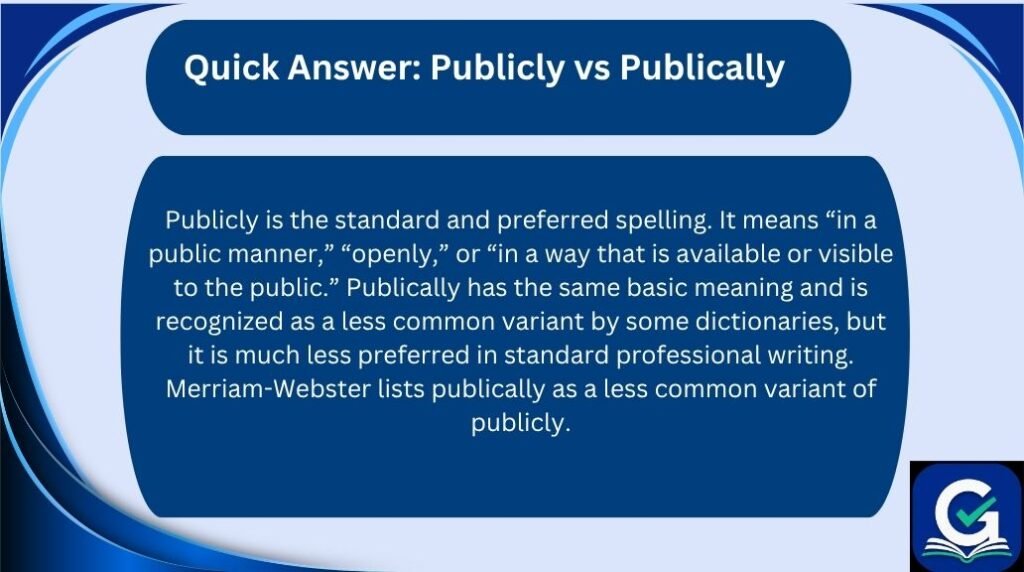
Publicly is the standard and preferred spelling. It means “in a public manner,” “openly,” or “in a way that is available or visible to the public.” Publically has the same basic meaning and is recognized as a less common variant by some dictionaries, but it is much less preferred in standard professional writing. Merriam-Webster lists publically as a less common variant of publicly.
Best choice:
✅ The company publicly announced the changes.
Less common variant:
⚠️ The company publically announced the changes.
For formal, academic, business, and general US English, choose publicly.
Understanding the Basics of Publicly vs Publically
The simplest way to understand this spelling question is to focus on what the two words have in common.
Both publicly and publically function as adverbs. Both are used to describe something done openly, in front of other people, or in a way that is accessible to the public.
The main difference is standard usage and frequency, not meaning.
Publicly
Publicly is the standard spelling.
It is formed from the adjective public plus the adverbial ending -ly:
public + ly = publicly
Examples:
- She publicly supported the proposal.
- The CEO publicly apologized.
- The information is publicly available.
- He refused to discuss the matter publicly.
- The organization publicly announced its new policy.
Cambridge Dictionary defines publicly as an adverb used when something is done so that everyone can know about it. It also uses the word for things done by or involving the government or the public.
Publically
Publically is an alternative spelling that exists in English, but it is much less common and is not the preferred choice in standard writing.
It is formed as:
public + ally = publically
The spelling may seem logical because many adjectives ending in -ic form adverbs with -ally. For example:
- basic → basically
- dramatic → dramatically
- automatic → automatically
- realistic → realistically
- economic → economically
That pattern can lead writers to assume:
public → publically
But publicly is the established standard form.
Merriam-Webster specifically lists publically as a less common variant of publicly. Collins likewise describes publically as a variant and, in its British English entry, marks it as nonstandard.
Comparison Table
| Form | Type | Meaning | Example | Correct/Incorrect |
|---|---|---|---|---|
| publicly | Adverb | Openly; in public; by or for the public | She publicly admitted her mistake. | ✅ Standard |
| publically | Adverb | Same basic meaning as publicly | She publically admitted her mistake. | ⚠️ Less common variant |
| public | Adjective/Noun | Relating to people generally or open to people | This is a public event. | ✅ Correct |
| publicity | Noun | Public attention or promotion | The event received publicity. | ✅ Correct |
| publicize | Verb | To make something known publicly | They publicized the announcement. | ✅ Correct |
The key point is simple: when you need the adverb, use publicly.
Correct Meanings and Uses of Publicly
The word publicly can be used in several closely related ways. Understanding these uses will help you recognize it naturally in everyday writing.
1. Publicly Means “Openly”
The most common use of publicly is to describe something done openly rather than privately.
For example:
She publicly criticized the decision.
Sentence breakdown
- She = subject
- criticized = verb
- the decision = object
- publicly = adverb describing how she criticized it
The sentence tells us that her criticism was not private. She expressed it openly.
More examples:
- He publicly disagreed with the proposal.
- The athlete publicly thanked her supporters.
- The politician publicly defended the policy.
- She publicly apologized for the misunderstanding.
In each case, publicly tells us that the action happened openly or in front of others.
2. Publicly Means “In Front of Other People”
You can also use publicly when someone does something where other people can observe it.
For example:
The manager praised the employee publicly.
This means the manager praised the employee in front of other people.
Compare:
The manager praised the employee privately.
The two adverbs create opposite situations.
- publicly = openly or where others can know
- privately = away from public attention
This contrast is useful when deciding whether publicly is appropriate.
3. Publicly Means “Available to the Public”
Another common use appears in phrases such as:
publicly available
This means something can be accessed or seen by members of the public.
Examples:
- The report is publicly available.
- The data is publicly accessible.
- The documents were made publicly available.
- The records can be viewed publicly.
The phrase publicly available is especially common in professional, academic, legal, and online contexts.
Cambridge Dictionary gives examples involving information that is publicly available and explains publicly in terms of information or actions being open to everyone.
4. Publicly Can Refer to Government Funding or Action
Publicly can also be used in contexts involving government or public funding.
For example:
The project is publicly funded.
Here, publicly funded means that the project receives funding from the government or public sources.
Other examples include:
- publicly funded schools
- publicly financed programs
- publicly owned facilities
- publicly supported services
- publicly operated transportation
Cambridge specifically recognizes this government-related meaning of publicly.
5. Publicly in Business and Finance
The word is also extremely common in business writing.
Consider:
The company is publicly traded.
This means the company’s shares are available for public trading.
Other common expressions include:
- publicly traded company
- publicly held company
- publicly listed company
- publicly available information
- publicly disclosed information
- publicly announced results
For example:
The publicly traded company released its quarterly results.
Here, publicly modifies traded and helps describe the company’s status.
Why Do People Write Publically?
If publicly is standard, why does publically appear so often?
There is a logical reason.
English has many adverbs formed from adjectives ending in -ic by adding -ally.
For example:
| Adjective | Adverb |
|---|---|
| basic | basically |
| dramatic | dramatically |
| automatic | automatically |
| scientific | scientifically |
| realistic | realistically |
| economic | economically |
| specific | specifically |
Because this pattern is so common, publically looks reasonable.
A writer may unconsciously apply the pattern:
public → publically
But English is not always perfectly predictable.
The standard form developed as:
public → publicly
That makes publicly an important spelling exception to remember.
Test Tip: How to Choose the Right Form
When you are unsure about publicly vs publically, use this simple test:
Ask yourself:
Am I trying to say “openly,” “in public,” or “in a way that everyone can know about”?
If yes, use:
publicly
For example:
She spoke publicly about the issue.
If you are writing for school, work, journalism, business, publishing, or a professional website, publicly is the safest choice.
Easy memory trick
Think:
public + ly = publicly
Do not let the -ic → -ically pattern trick you.
You can remember it with this sentence:
The public speaks publicly.
The words visually connect:
public → publicly
That simple association can prevent the spelling mistake.
Publicly vs Publically in Real-Life Writing
Imagine you work for a company and need to write an email after a customer complaint.
You might write:
We publicly apologized for the inconvenience and announced several steps to improve our service.
This sounds natural and professional.
Now imagine writing:
We publically apologized for the inconvenience.
Although some dictionaries recognize publically as a variant, many professional readers will expect publicly. Since publicly is the standard form, there is little reason to choose the less common spelling.
This is particularly important when you are writing:
- Business emails
- Press releases
- Reports
- Academic papers
- Website content
- Resumes
- News articles
- Official statements
- Marketing materials
When two forms have the same meaning but one is much more established, choosing the standard form is usually the better editorial decision.
Case Study: A Workplace Announcement
Consider this realistic workplace situation.
A company’s CEO discovers that a product update caused unexpected problems for customers. The company decides to address the issue openly.
An employee drafts the following sentence:
The CEO publically acknowledged the problem during the press conference.
The sentence communicates the intended meaning, but the spelling may distract readers.
A cleaner version is:
The CEO publicly acknowledged the problem during the press conference.
Why is the second version better?
Because publicly is the standard form and is overwhelmingly more familiar to readers.
The sentence also demonstrates the normal grammatical role of the word:
- The CEO = subject
- acknowledged = verb
- the problem = object
- publicly = adverb modifying the verb
The adverb tells readers how the CEO acknowledged the problem.
This is a good example of why spelling choices matter even when the intended meaning remains understandable.
Grammar Rules Behind Publicly
The spelling of publicly can seem unusual because many similar words behave differently.
The adjective public ends with the letters -ic, but its standard adverb is:
publicly
rather than:
publically
The standard form is not determined simply by adding a suffix according to a universal rule. English contains many historical spelling patterns and exceptions.
Merriam-Webster lists publicly as an adverb meaning “in a manner observable by or in a place accessible to the public” and also gives related meanings involving the public and government. It identifies publically as a less common variant.
This is an important distinction.
It would be inaccurate to say that publically is completely nonexistent. It is recognized in some dictionaries. Collins, for example, lists it as a variant spelling, while also identifying publicly as the standard form in its British English entry.
Therefore, the most accurate rule is:
Publicly is the standard and preferred spelling; publically is a less common variant that should generally be avoided in formal US English.
That is more precise than simply calling publically an impossible word.
Common Mistakes With Publicly vs Publically
Spelling confusion usually happens for understandable reasons.
1. Applying a Common Spelling Pattern
As mentioned earlier, writers see:
- automatic → automatically
- dramatic → dramatically
- basic → basically
and assume:
- public → publically
The reasoning makes sense, but English has exceptions.
2. Fast Typing
When people type quickly, they often write what sounds or looks natural.
Because publically follows a familiar spelling pattern, it can appear automatically during fast typing.
This is especially common when drafting:
- Text messages
- Social media posts
- Emails
- Notes
- Comments
A quick proofreading pass can catch it.
3. Autocorrect
Autocorrect can make the situation even more confusing.
Some software may recognize publically because it exists as a dictionary-listed variant. Other tools may suggest publicly instead.
As a result, writers should not assume that a spelling accepted by a keyboard or spell-checker is necessarily the best editorial choice.
A dictionary can help, but context and style also matter.
4. Lack of Familiarity
People who have mostly encountered the word in speech may not know which spelling is standard.
Both forms are pronounced similarly, so listening does not solve the problem.
That is why publicly vs publically is primarily a spelling and usage question rather than a pronunciation question.
Similar Grammar and Spelling Confusions
English has many pairs where one small change can affect correctness, meaning, or standard usage.
| Confusion | Correct Standard Form | Meaning |
|---|---|---|
| its / it’s | its / it’s | Possession / it is |
| your / you’re | your / you’re | Possession / you are |
| their / they’re | their / they’re | Possession / they are |
| affect / effect | affect / effect | Usually verb / noun |
| then / than | then / than | Time / comparison |
| accept / except | accept / except | Receive / excluding |
| definitely / definately | definitely | Certainly |
| separate / seperate | separate | Apart or distinct |
| publicly / publically | publicly | Openly or in public |
These mistakes happen for many of the same reasons: fast typing, sound-based spelling, unfamiliarity, and assumptions about common spelling patterns.
Publicly vs Publically in Different Contexts
Knowing the preferred spelling is useful, but it is also important to know how publicly works in different types of writing.
Everyday Conversation
In everyday conversation, you might say:
He publicly thanked everyone.
Or:
She didn’t want to discuss it publicly.
These sentences are natural and easy to understand.
In casual speech, the spelling is not visible, but the distinction becomes important when you write the sentence.
Professional Writing
In professional writing, publicly is the clear choice.
Examples:
The company publicly announced its new policy.
The manager publicly recognized the team’s achievement.
The report is publicly available.
Using the standard form creates a polished impression.
Academic Writing
Academic writing generally values consistency, precision, and standard usage.
Examples:
The researchers publicly released the findings.
The dataset is publicly available.
The author publicly challenged the previous interpretation.
For academic work, use publicly rather than the less common publically.
Creative Writing
Creative writers have greater freedom with language.
An author may encounter or intentionally use publically, particularly when reproducing a character’s distinctive style or preserving historical wording.
However, unless there is a deliberate stylistic reason, publicly remains the safer spelling.
Social Media and Texting
Social media is more relaxed.
You may encounter both forms online:
She publicly announced her engagement.
and:
She publically announced her engagement.
The second spelling may appear because it is recognized as a variant, because of typing habits, or because writers are unaware of the preferred form.
If you are creating polished social media content for a business or professional brand, choose publicly.
Why Publicly vs Publically Matters
At first glance, this may seem like a tiny spelling issue. After all, both forms can communicate the same basic idea.
But accurate spelling matters for several reasons.
1. Clarity
Standard spelling helps readers process your writing quickly.
When readers see a familiar word such as publicly, they recognize it immediately.
2. Professionalism
Small spelling choices can affect how polished your writing appears.
In a formal report, job application, business proposal, or published article, using the standard form shows attention to detail.
3. Digital Communication
Online writing is often read quickly.
Readers may encounter your content in:
- Search results
- Blog posts
- Emails
- Social media
- Business websites
- News articles
- Online documentation
Standard spelling makes your writing look more authoritative and trustworthy.
4. Search and Content Quality
For online content, using the most widely accepted spelling can also make your language more natural.
If your audience searches for publicly, using that form consistently helps your article align with normal English usage.
SEO is not simply about repeating a keyword. Good optimization also means producing content that reads naturally and answers the reader’s question clearly.
As a general writing principle:
Choose the spelling your readers expect.
For this word, that means publicly.
A Short Quote to Remember
“When in doubt, choose the standard form your readers recognize first.”
That principle works especially well for publicly vs publically.
Is Publically Ever Acceptable?
Yes, but with an important qualification.
Publically is not simply a meaningless misspelling. Some dictionaries recognize it as a variant of publicly. Merriam-Webster lists it as a less common variant, while Collins describes it as a variant or disputed variant depending on the dictionary entry.
The American Heritage Dictionary, however, labels publically a nonstandard variant of publicly.
This means dictionary treatment is not completely uniform.
So if you encounter publically in published writing, it does not necessarily mean the writer invented a nonexistent word. However, if you are choosing the spelling yourself, publicly is the stronger choice.
When might publically appear?
You may encounter it in:
- Older texts
- Informal writing
- User-generated online content
- Publications that accept variants
- Historical quotations
- Writing influenced by the common -ically pattern
For modern professional US English, however:
Use publicly.
Publicly vs Publically: Quick Recap Checklist
Use this checklist whenever you are unsure.
| Question | If Yes → Use |
|---|---|
| Do you mean “openly”? | publicly |
| Do you mean “in front of other people”? | publicly |
| Do you mean “available to everyone”? | publicly |
| Are you writing a professional document? | publicly |
| Are you writing an academic paper? | publicly |
| Are you writing website content? | publicly |
| Are you tempted to write “publically” because of words like “basically”? | Stop and choose publicly |
| Are you discussing an existing historical or variant spelling? | publically may be relevant |
Practice Example 1
❌ The company publically released the report.
✅ The company publicly released the report.
Practice Example 2
❌ She publically apologized for the mistake.
✅ She publicly apologized for the mistake.
Practice Example 3
❌ The information is publically available online.
✅ The information is publicly available online.
Easy Ways to Remember the Correct Spelling
If you regularly confuse these forms, try one of these memory techniques.
Memory Trick 1: Public + ly
Think of the word as:
public + ly = publicly
Do not add the extra a.
Memory Trick 2: Pair It With Privately
These two words make a useful contrast:
publicly ↔ privately
Both have a simple -ly ending.
For example:
She discussed the matter privately before speaking publicly.
This pairing makes the spelling easier to remember.
Memory Trick 3: Memorize One Common Phrase
Learn:
publicly available
This phrase appears frequently in professional and online writing.
Once you remember that phrase, you are more likely to automatically spell the word correctly in other contexts.
Publicly vs Publically: Examples at a Glance
Here are additional examples to reinforce the difference.
Correct
- The mayor publicly supported the proposal.
- The company publicly apologized to customers.
- She publicly defended her decision.
- The results are publicly available.
- He publicly announced his retirement.
- The organization publicly criticized the policy.
- The information was made publicly accessible.
- The team publicly thanked its supporters.
- The government publicly released the report.
- The actor publicly addressed the rumors.
Less Preferred
- The mayor publically supported the proposal.
- The company publically apologized to customers.
- She publically defended her decision.
- The results are publically available.
- He publically announced his retirement.
Again, the second group is not presented as having a different meaning. The issue is that publicly is the standard and preferred form.
FAQs
1. Is publicly or publically correct?
Publicly is the standard and preferred spelling in modern English, especially in formal and professional writing. Publically is recognized by some dictionaries as a less common variant, but it is generally better to use publicly.
2. Is publically a real word?
Yes. Publically is recognized as a variant by some dictionaries, including Merriam-Webster and Collins. However, it is much less common and may be labeled nonstandard or disputed depending on the dictionary.
3. What does publicly mean?
Publicly is an adverb meaning openly, in public, or in a way that can be known, seen, or accessed by the public. It can also describe actions or resources involving government or public funding.
4. Why is publicly spelled without an “a”?
The standard spelling developed as public + -ly, producing publicly. Although many adjectives ending in -ic form adverbs with -ically, publicly is an established exception to that pattern.
5. Should I use publically in formal writing?
Generally, no. Even though publically is recognized as a variant in some dictionaries, publicly is more widely accepted and familiar. For academic, professional, business, and formal US English, publicly is the safest choice.
6. Is publicly more common than publically?
Yes. Publicly is substantially more common and is the standard form used in major dictionaries and modern professional writing. Merriam-Webster lists publicly as the main entry and publically as a less common variant.
Conclusion
The confusion between publicly vs publically comes from a perfectly understandable English spelling pattern. Many words ending in -ic form adverbs with -ally, so publically may look natural at first glance. However, the standard and preferred spelling is publicly. It means openly, in public, or in a way that can be known, seen, or accessed by the public.
Merriam-Webster recognizes publically as a less common variant, so it is not accurate to claim that the spelling never exists. Still, if you are writing an email, academic paper, business document, website, report, or other polished content, publicly is the clear choice.
The easiest rule to remember is simple:
Public + ly = publicly.
When you want your writing to sound natural, professional, and standard, choose publicly. One small spelling choice can make a big difference in polished communication. ✍️

I’m Ethan Carter, a grammar writer at Gramfino, where I explain English grammar in a simple and practical way.
I enjoy helping readers understand sentence structure, grammar rules, and common writing mistakes.

[…] and practical differences between wacky vs. whacky, with simple examples you can remember. ✍️ Publicly vs Publically | Chili vs Chile | Counsel vs […]
[…] rules, provide practical examples, and give you simple tricks for remembering the spelling. 🏆 Publicly vs Publically | Wacky vs. Whacky | Wheelbarrow vs […]
[…] mistakes, and practical tips so you can choose the correct word confidently. 😊 Winner vs Winer | Publicly vs Publically | Wacky vs. […]