Passed away vs past away is a common English grammar confusion that can make even careful writers stop and think. Have you ever needed to write a condolence message, talk about someone who died, or mention a family loss and suddenly wondered which spelling is correct? You are not alone.
The two expressions sound very similar, but only one is correct when you mean that someone died. “Passed away” is the standard and respectful expression, while “past away” is incorrect in this context. I know how easy it is to confuse these words because passed and past are pronounced similarly in everyday speech.
In this guide, we will explore the difference between passed away vs past away, explain the grammar behind each word, provide simple examples, and share an easy memory trick. By the end, you will know exactly which expression to use with confidence. ✅ Pray vs Prey | Licensed vs Licenced | referred vs refered
Quick Answer: Passed Away vs Past Away
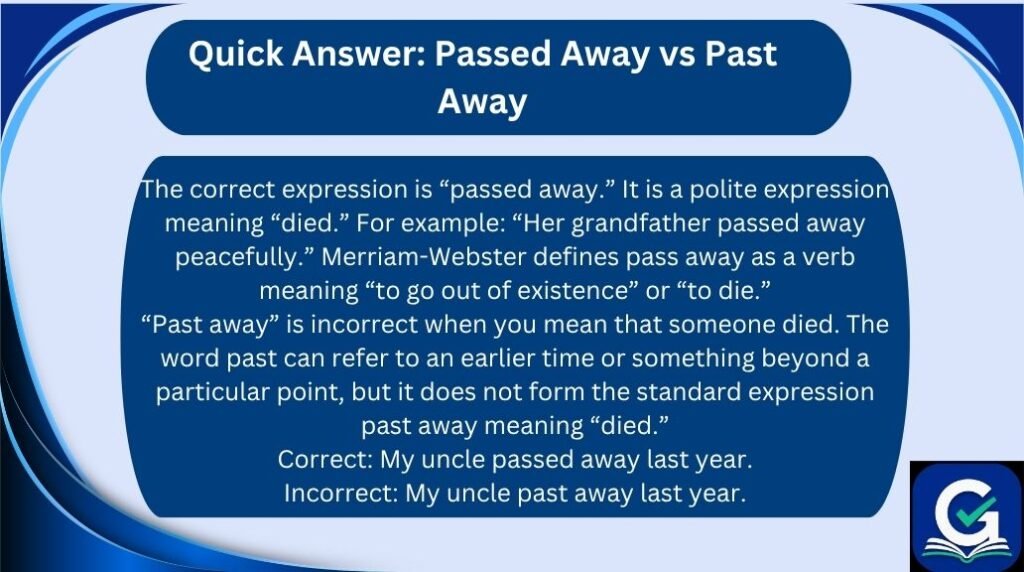
The correct expression is “passed away.” It is a polite expression meaning “died.” For example: “Her grandfather passed away peacefully.” Merriam-Webster defines pass away as a verb meaning “to go out of existence” or “to die.”
“Past away” is incorrect when you mean that someone died. The word past can refer to an earlier time or something beyond a particular point, but it does not form the standard expression past away meaning “died.”
Correct: My uncle passed away last year.
Incorrect: My uncle past away last year.
Understanding the Basics of Passed Away vs Past Away
To understand passed away vs past away, start with the difference between passed and past.
What Does “Passed Away” Mean?
Passed away is a phrasal verb. It is a polite or softer way of saying that someone died.
Examples:
- My grandmother passed away peacefully.
- His father passed away last month.
- We were saddened to hear that her mother passed away.
- The famous author passed away at the age of 82.
Cambridge Dictionary also defines pass away as a polite expression for “die.”
The expression is commonly used when discussing death in respectful, sensitive, or formal situations.
What Does “Past” Mean?
Past has several grammatical roles. It can function as an adjective, preposition, noun, or adverb.
Examples include:
- Past experience helped her solve the problem.
- We drove past the school.
- The past cannot be changed.
- It is past midnight.
Merriam-Webster lists meanings of past related to earlier time, something that has already happened, and movement beyond a point.
However, past away is not the standard English expression for death.
Comparison Table
| Form | Type | Meaning | Example | Correct/Incorrect |
|---|---|---|---|---|
| passed away | Phrasal verb | Died | She passed away peacefully. | ✅ Correct |
| past away | Nonstandard combination | No standard meaning of “died” | She past away peacefully. | ❌ Incorrect |
| passed | Past-tense verb | Moved, succeeded, transferred, etc. | He passed the exam. | ✅ Correct |
| past | Adjective/preposition/noun/adverb | Earlier time or beyond | We walked past the store. | ✅ Correct |
| pass away | Phrasal verb | Die | He may pass away soon. | ✅ Correct |
| passing away | Present participle | Dying | The patient was passing away. | ✅ Correct |
The key point is simple:
Use “passed away” when you mean “died.”
Correct Meanings and Uses
1. “Passed Away” Means Died
The most important use of passed away is to refer respectfully to someone’s death.
For example:
My grandfather passed away in 2022.
Here, passed away means died.
Sentence Breakdown
- My grandfather = subject
- passed away = phrasal verb
- in 2022 = time expression
The verb passed is the past tense of pass. The word away forms part of the phrasal verb.
Another example:
Sarah’s beloved dog passed away peacefully.
In this sentence, passed away tells us that Sarah’s dog died.
Why Do People Say “Passed Away”?
The phrase is often preferred because it sounds gentler and more respectful than the direct word died.
Compare:
- His father died yesterday.
- His father passed away yesterday.
Both sentences communicate the same basic fact, but passed away can sound more considerate in sensitive situations.
Cambridge specifically describes pass away as a polite expression for die.
2. “Passed Away” Is the Past-Tense Form
When talking about a death that already happened, passed away is normally the form you need.
Examples:
- My aunt passed away last summer.
- His grandfather passed away peacefully.
- The actor passed away at age 90.
- She passed away after a long illness.
- Their family dog passed away two weeks ago.
The base form is:
pass away
The past tense is:
passed away
The -ed ending is important because it tells the reader that the event happened in the past.
Verb Forms
| Tense/Form | Example |
|---|---|
| Present | He passes away |
| Base form | He may pass away |
| Past | He passed away |
| Present participle | He is passing away |
| Perfect | He has passed away |
Notice that past away never appears as the standard verb form.
3. “Past” Refers to Time or Movement
The word past has nothing to do with the standard expression meaning “died.”
For example:
We drove past the hospital.
Here, past means moving beyond or alongside a place.
Another example:
The meeting is now in the past.
Here, past refers to an earlier period of time.
You can also use past in time expressions:
- past midnight
- past experience
- past events
- past mistakes
- the past year
- the past decade
Merriam-Webster lists past as an adjective, preposition, noun, and adverb with meanings involving earlier time and movement beyond a point.
Why “Past Away” Is Incorrect
One reason past away looks believable is that past and passed are pronounced similarly in many varieties of English.
However, pronunciation does not determine spelling.
Consider these examples:
- passed = past tense of pass
- past = a word referring to earlier time or something beyond a point
When you say:
She passed away.
you are using the past tense of the verb pass.
When you say:
She walked past the house.
you are using past to describe movement beyond the house.
The two words may sound alike, but they perform different grammatical jobs.
Merriam-Webster lists pass as a verb whose meanings include moving, going away, and dying, while past has separate meanings associated with time, previous events, and movement beyond a point.
A Simple Trick to Remember the Difference
Here is an easy memory trick:
If You Mean “Died,” Think “Passed.”
Passed away = died.
You can remember it with this sentence:
People pass away; they do not past away.
Another useful trick is to replace the phrase with died.
For example:
My grandmother ___ away last year.
Try replacing the blank:
My grandmother died last year.
Because passed away means died, the correct answer is:
My grandmother passed away last year.
You would never say:
My grandmother past died last year.
So past away should immediately look suspicious.
Test Tip
Whenever you are unsure about passed away vs past away, ask:
“Am I talking about someone dying?”
- If yes → use passed away.
- If no → determine whether past or another word fits your sentence.
Examples of “Passed Away” in Sentences
Understanding examples makes the difference easier to remember.
Example 1
My grandmother passed away peacefully at home.
Meaning: My grandmother died peacefully at home.
Example 2
We were deeply saddened when our neighbor passed away.
Meaning: Our neighbor died, and we felt sad about it.
Example 3
His father passed away several years ago.
Meaning: His father died several years ago.
Example 4
I learned that her beloved cat had passed away.
Meaning: Her cat had died.
Example 5
The community mourned after the longtime teacher passed away.
Meaning: The teacher died, and the community mourned.
Each sentence uses passed away correctly because the expression refers to death.
Examples of “Past” in Sentences
Now compare those examples with legitimate uses of past.
Example 1
We walked past the library.
Here, past means beyond the library.
Example 2
She learned from her past mistakes.
Here, past refers to mistakes that happened earlier.
Example 3
It is past midnight.
Here, past means after midnight.
Example 4
He has extensive past experience.
Here, past describes previous experience.
Example 5
Let’s leave the past behind us.
Here, past refers to previous events or time.
These uses show why past is a real and important English word. The problem is simply using it in the expression past away.
Case Study: A Real-Life Workplace Example
Imagine that an employee’s father has died. A manager wants to send a respectful email to the employee.
A careless version might say:
I’m sorry to hear that your father past away. Please accept my condolences.
The intended meaning is clear, but the spelling is incorrect.
A polished version would be:
I’m sorry to hear that your father passed away. Please accept my sincere condolences during this difficult time.
Why the Second Version Is Better
The phrase passed away is the standard expression for referring politely to someone’s death.
It is appropriate for:
- workplace emails
- condolence cards
- formal announcements
- personal messages
- obituaries
- sympathy notes
The mistake past away may appear minor, but errors in sensitive communications can distract from the message and make the writing appear less careful.
Grammar Rules Behind “Passed Away”
The grammar becomes much easier when you understand the verb pass.
Merriam-Webster lists pass as a verb and includes die among its meanings. Its dictionary entry also gives the verb forms passed; passing; passes.
When pass is used with away, it becomes the phrasal verb:
pass away
Because pass is the verb, its past-tense form is:
passed away
This is exactly the same grammatical pattern you see in other verbs:
- walk → walked
- talk → talked
- call → called
- pass → passed
Therefore:
pass away → passed away
not:
past away
What About “Past”?
Past is not the past-tense form of pass.
This is a crucial point.
Some English learners assume:
pass → past
But that is incorrect.
The past tense of pass is:
passed
The word past is a separate word.
Merriam-Webster confirms that pass has the forms passed, passing, passes.
Passed vs. Past: The Bigger Grammar Difference
The confusion between passed and past extends beyond the phrase passed away.
Passed
Passed is usually a verb.
Examples:
- She passed the exam.
- He passed me the salt.
- The car passed the truck.
- Time passed quickly.
- Her grandfather passed away.
Past
Past can be an adjective, preposition, noun, or adverb.
Examples:
- He has a difficult past.
- We drove past the house.
- The time is past.
- She walked past me.
This distinction can help you avoid many other spelling mistakes.
Common Mistakes With Passed Away vs Past Away
Why do people write past away if it is incorrect?
There are several common reasons.
1. Fast Typing
When people type quickly, they often choose a word based on sound rather than spelling.
Because passed and past can sound almost identical, a person may type the shorter word automatically.
2. Autocorrect
Autocorrect and predictive text can sometimes suggest a familiar word that does not fit the sentence.
If someone types quickly, they may accept the suggestion without reviewing it.
3. Lack of Knowledge
Some people simply have never learned the distinction between passed and past.
This is particularly common among English learners because the two words are easy to confuse.
4. Similar Pronunciation
In everyday speech, passed and past can sound very similar.
When people learn words primarily through conversation, they may understand the meaning but not remember the spelling.
5. Confusion About Verb Forms
Some writers mistakenly think past is the past-tense form of pass. It is not.
The correct forms are:
pass → passed
Similar Grammar Confusions
The English language contains many pairs that sound similar but have different meanings or grammatical functions.
| Confusing Pair | Correct Difference | Example |
|---|---|---|
| passed / past | Verb vs. time/direction word | She passed the store. / She walked past it. |
| it’s / its | Contraction vs. possessive | It’s cold. / Its color is blue. |
| your / you’re | Possessive vs. contraction | Your phone / You’re helpful |
| their / there / they’re | Possession, place, contraction | Their car is there. They’re ready. |
| then / than | Time/order vs. comparison | First eat, then leave. / Taller than me |
| to / too / two | Direction, excess/also, number | Go to school. / Too much. / Two books |
| affect / effect | Usually verb vs. noun | It affected me. / It had an effect. |
| principal / principle | Person/school leader vs. rule | The principal spoke. / A moral principle |
These mistakes are normal, but learning the difference improves your writing significantly.
Usage in Different Contexts
Everyday Conversation
Passed away is common in everyday conversation when speaking respectfully about someone’s death.
Example:
I heard that Mr. Wilson passed away.
It is often softer than simply saying:
Mr. Wilson died.
Both are grammatically correct, but the choice depends on tone and context.
Professional Writing
In professional communication, passed away is often appropriate when discussing someone’s death sensitively.
Example:
We are saddened to announce that our longtime colleague, Robert Miller, passed away on Monday.
It can be used in:
- company announcements
- workplace emails
- newsletters
- formal statements
- condolence messages
Always consider the audience and the tone required.
Creative Writing
Authors can choose between died and passed away depending on the character, narrator, and emotional tone.
For example:
Her father passed away when she was young.
This sounds gentle and reflective.
By contrast:
His character died in the final chapter.
The word died may sound more direct and dramatic.
Creative writing allows stylistic choices, but past away is still not the standard expression meaning “died.”
Social Media and Texting
People frequently use passed away in social media announcements.
For example:
We are heartbroken to share that our beloved grandmother passed away peacefully.
In a text message, someone might write:
I’m so sorry to hear that your dad passed away.
Because social media posts and texts can be shared widely, correct spelling remains important.
A typo such as past away can be especially noticeable in a public post.
Is “Passed Away” Always the Best Choice?
Not necessarily.
The expression is polite, but died is also correct English.
For example:
The patient died peacefully.
This sentence is grammatically correct and direct.
You might choose passed away when you want a softer or more compassionate tone.
You might choose died when you need directness, precision, or a clinical style.
Other expressions include:
- died
- passed on
- passed
- departed
- lost his/her life
- left us
However, each expression has its own tone and context.
Why This Difference Matters
At first glance, passed away vs past away may seem like a tiny spelling issue. However, accurate word choice matters for several reasons.
1. Clarity in Communication
Using the correct expression helps readers understand your meaning immediately.
Her mother passed away.
There is no confusion about what happened.
2. Professionalism
Correct grammar and spelling make emails, announcements, and formal writing appear more polished.
A condolence message deserves special care because it addresses an emotional situation.
3. Digital Communication
Text messages, social media posts, and online announcements can be seen by many people.
A small spelling mistake can become more noticeable when it appears publicly.
4. Respectful Tone
When discussing death, wording matters.
Passed away is widely recognized as a polite expression for died. Cambridge Dictionary specifically identifies it as such.
A Short Reminder
When the subject is death, “passed away” is the phrase to remember.
Special Exception: Is “Past Away” Ever Correct?
As a standard English expression meaning “died,” past away is incorrect.
However, individual words can occasionally appear next to each other in unusual constructions where past has its normal meaning and away belongs to another part of the sentence.
For example:
The trail continued past, away from the main road.
Here, past is not part of a verb meaning “died.” It is functioning separately, and away belongs to the larger description.
This is very different from:
He past away.
That sentence is incorrect if the intended meaning is that he died.
So for ordinary writing, remember:
passed away = died
past away = not the standard expression
Quick Recap Checklist
Use this checklist whenever you are unsure about passed away vs past away.
| Question | If Yes → Use |
|---|---|
| Am I saying that someone died? | passed away |
| Am I using the past tense of “pass”? | passed |
| Am I describing earlier time? | past |
| Am I describing movement beyond something? | past |
| Am I writing a condolence message? | passed away |
| Am I saying someone moved beyond a location? | passed or past, depending on the sentence |
Practice Example 1
My uncle ___ away last year.
Answer:
My uncle passed away last year.
Practice Example 2
We walked ___ the old church.
Answer:
We walked past the old church.
Practice Example 3
She ___ the final exam.
Answer:
She passed the final exam.
These three examples demonstrate the entire distinction.
Passed Away vs Past Away: Easy Memory Formula
If you want one formula to remember forever, use this:
Death = Passed Away
Earlier Time = Past
Movement Beyond = Past / Passed, Depending on Grammar
For example:
His grandfather passed away.
Death.
His past experiences shaped him.
Earlier time.
The car passed the truck.
Movement.
The car drove past the truck.
Direction or position.
This simple framework can eliminate most confusion.
Frequently Asked Questions
1. Is “passed away” correct?
Yes. Passed away is correct and is a polite expression meaning died. For example: “Her grandmother passed away peacefully.” Both Merriam-Webster and Cambridge Dictionary recognize pass away as an expression meaning to die.
2. Is “past away” grammatically correct?
No, not when you mean that someone died. Past away is not the standard English expression for death. The correct phrase is passed away.
3. What is the difference between passed and past?
Passed is generally a verb form, specifically the past tense of pass. Past can function as an adjective, preposition, noun, or adverb and commonly refers to earlier time or movement beyond something.
4. Can I say “passed” instead of “passed away”?
Yes. In American English, passed can be used by itself to mean died in certain contexts. Cambridge identifies this usage as mainly American.
For example:
Her father passed last year.
However, passed away is often clearer and more widely understood as a polite expression.
5. Is “passed away” more polite than “died”?
Often, yes. Passed away is commonly used as a softer or more respectful way to refer to death. Cambridge explicitly describes it as a polite expression for die.
However, died is not grammatically or morally wrong. It is simply more direct.
6. How can I remember “passed away”?
Remember this simple rule:
If you mean “died,” use “passed away.”
Think of the phrase as a complete expression rather than trying to choose between past and passed based only on pronunciation.
Conclusion
The difference between passed away vs past away is simple once you know what each word does. Passed away is the correct expression when you mean that someone died. It is a widely used, respectful alternative to the direct word died, and both Merriam-Webster and Cambridge Dictionary recognize pass away as a verb meaning to die.
By contrast, past away is incorrect when used to express death. The word past has different grammatical functions and commonly relates to earlier time, previous events, or movement beyond a point. The past tense of pass is passed, not past.
So, whenever you are writing a condolence message, email, announcement, or personal note, remember the simplest rule:
If someone died, they “passed away,” not “past away.” ✅

I’m Ethan Carter, a grammar writer at Gramfino, where I explain English grammar in a simple and practical way.
I enjoy helping readers understand sentence structure, grammar rules, and common writing mistakes.
[…] this small spelling rule can help you write with greater confidence and accuracy. 😊 Passed Away vs Past Away | Pray vs Prey | Licensed vs […]