Have you ever stopped while writing because you could not remember which spelling was correct: referred vs refered? This is a common English spelling question, especially when people are forming the past tense of the verb refer. At first, refered may look logical because many English verbs simply take -ed in the past tense.
However, the correct spelling is referred, with a double r before -ed. The spelling refered is incorrect in standard English. Once you understand the spelling pattern, this mistake becomes much easier to avoid. Whether you are writing an email, school assignment, business report, social media post, or everyday message, knowing the difference can make your writing more accurate and polished.
In this guide, we will explain the rule in simple language, explore the meanings of referred, provide practical examples, discuss common mistakes, and give you an easy memory trick. Savvy vs Savy | Tires vs Tyres | Among vs Amongst
Quick Answer: referred vs refered
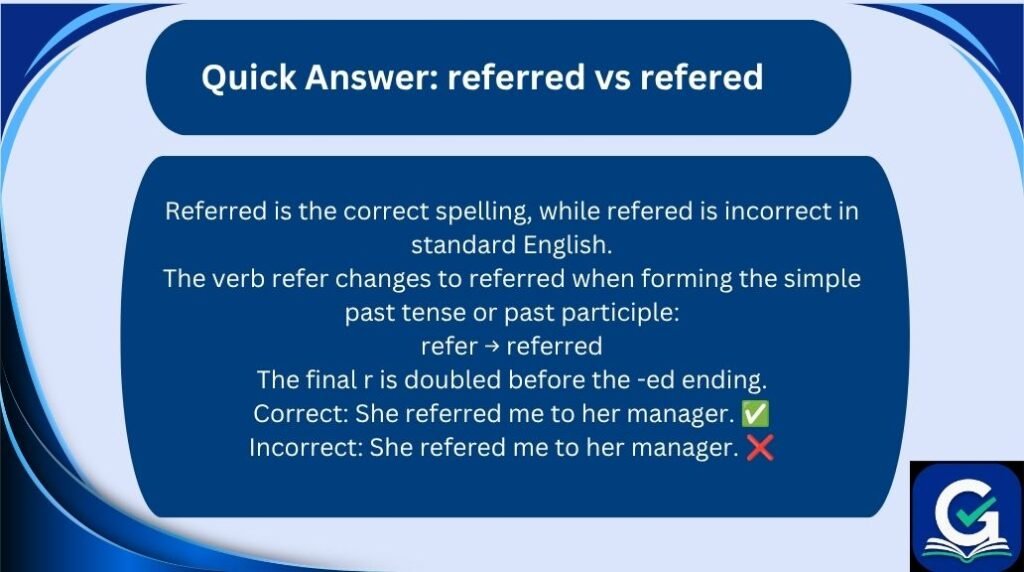
Referred is the correct spelling, while refered is incorrect in standard English.
The verb refer changes to referred when forming the simple past tense or past participle:
refer → referred
The final r is doubled before the -ed ending.
Correct: She referred me to her manager. ✅
Incorrect: She refered me to her manager. ❌
referred vs refered: The Basic Difference
The difference between referred vs refered is a spelling issue, not a difference in meaning. Referred is an accepted English word, while refered is a misspelling.
The Correct Form: Referred
Referred is the past-tense and past-participle form of refer.
Examples:
The teacher referred me to the counselor.
The manager referred the complaint to HR.
She referred to the report during the meeting.
The Incorrect Form: Refered
Refered is not the standard spelling.
Incorrect:
The manager refered the complaint to HR. ❌
Correct:
The manager referred the complaint to HR. ✅
Comparison Table
| Form | Type | Meaning | Example | Status |
|---|---|---|---|---|
| refer | Base verb | Mention, direct, or consult | Please refer to the guide. | ✅ Correct |
| refers | Present tense | Mentions or relates to | The article refers to the study. | ✅ Correct |
| referred | Past tense/past participle | Mentioned, directed, or consulted | She referred me to a specialist. | ✅ Correct |
| referring | Present participle | Mentioning or directing | He is referring to the report. | ✅ Correct |
| refered | Misspelling | Intended to mean referred | She refered me to a specialist. | ❌ Incorrect |
Why Is “Referred” Spelled With Two Rs?
The main reason people struggle with this word is the double r.
When refer takes the -ed ending, the final consonant is doubled:
refer → referred
It is not:
refer → refered ❌
Instead, think of the word as:
refer + r + ed = referred
The same pattern can be seen in the -ing form:
refer → referring
This gives you a useful pair to remember:
referred / referring
Both contain the double r.
A Simple Memory Trick
Think:
REFER + R + ED = REFERRED
If you remember that refer gets another R, you are much less likely to leave out the second r.
referred vs refered: What Does “Referred” Mean?
The meaning of referred depends on the context in which it appears.
The verb refer can have several meanings, including mentioning something, directing someone to another person, or consulting a source.
“Referred” Means Mentioned
When followed by to, referred to can mean mentioned or discussed.
For example:
The speaker referred to the new policy.
This means:
The speaker mentioned the new policy.
Another example:
The teacher referred to the previous lesson.
This means that the teacher mentioned or discussed the previous lesson.
More examples include:
The writer referred to several historical events.
He referred to your earlier comment.
The article referred to a recent study.
In these sentences, referred to means mentioned or discussed.
“Referred” Means Directed
Another common meaning is directed or sent to another person or department.
For example:
The customer was referred to the billing department.
The customer was directed to that department for assistance.
Another example:
The complaint was referred to the manager.
The complaint was sent to the manager for review.
This use is common in business, government, customer service, and workplace communication.
“Referred” Means Sent to a Specialist
In medical contexts, referred often means that a patient was directed to a specialist.
For example:
The doctor referred the patient to a specialist.
The doctor directed the patient to another medical professional for specialized care.
Another example:
She was referred to a dermatologist.
The meaning is that she was directed to that specialist.
“Referred” Means Consulted
The phrase referred to can also mean consulted or looked at for information.
For example:
I referred to the manual before installing the equipment.
This means:
I consulted the manual.
Another example:
She referred to her notes before answering the question.
She looked at her notes to help answer the question.
This use is particularly common in academic and professional writing.
referred vs refered: Grammar Forms You Should Know
Understanding the forms of refer makes the spelling easier to remember.
| Grammar Form | Word | Example |
|---|---|---|
| Base form | refer | Please refer to the instructions. |
| Present tense | refers | This article refers to the study. |
| Simple past | referred | She referred to the study yesterday. |
| Past participle | referred | The matter has been referred to HR. |
| Present participle | referring | He is referring to the report. |
Notice that referred is used for both the simple past and past participle.
Simple Past
She referred to the report yesterday.
The action happened in the past.
Past Participle
She has referred to the report several times.
Here, referred works with the helping verb has.
Sentence Breakdown
Understanding the role of the word in a sentence can also help.
Example
The doctor referred the patient to a specialist.
- The doctor = subject
- referred = past-tense verb
- the patient = object
- to a specialist = destination of the referral
Another example:
The professor referred to the previous chapter.
- The professor = subject
- referred = past-tense verb
- to the previous chapter = what was mentioned or consulted
These examples show how the same word can work in slightly different contexts.
Why Do People Write “Refered”?
The spelling mistake has several common causes.
Fast Typing
When people type quickly, repeated letters are easy to miss.
Someone may know the correct spelling but accidentally type:
refered
instead of:
referred
This is especially common on phones and keyboards.
Pronunciation
The double r is not pronounced as two separate letters. Because pronunciation does not clearly reveal the spelling, writers may forget the second r.
Overgeneralizing the “-ed” Rule
Many learners know that English verbs form their past tense by adding -ed.
For example:
walk → walked
talk → talked
clean → cleaned
It is easy to assume:
refer → refered
However, some verbs require consonant doubling.
For example:
stop → stopped
plan → planned
prefer → preferred
refer → referred
Autocorrect
Spell-checking tools can catch many errors, but they should not be treated as a replacement for proofreading.
Lack of Familiarity
Someone may know the verb refer but rarely use its past form. Seeing referred frequently is one of the best ways to become comfortable with the spelling.
referred vs refered: Easy Ways to Remember the Difference
If you regularly make this spelling mistake, try one of these memory methods.
Method 1: Add Another R
Start with:
REFER
Add another R:
REFERR
Add ED:
REFERRED
Method 2: Remember “Referring”
Think about the related form:
referring
Since referring has two r’s, referred does too.
Method 3: Memorize the Pair
Write these together:
referred — referring
Seeing the forms as a pair makes the double r easier to remember.
Test Tip
Whenever you type refered, stop and ask:
“Does this look like referring without -ing?”
If the answer reminds you of the missing r, correct it to referred.
A Real-Life Workplace Case Study
Imagine that Sarah works in customer support.
A customer sends an email:
“My order arrived damaged. What should I do?”
Sarah checks the customer’s account and realizes that the shipping department needs to investigate.
She writes:
“Thank you for contacting us. I have referred your case to our shipping department. They will review the issue and contact you shortly.”
The sentence is correct.
Now imagine Sarah writes:
“I have refered your case to our shipping department.”
The customer can probably understand the message, but the spelling is incorrect.
Why the Correct Form Matters
Professional writing should be clear and accurate. A spelling mistake may seem small, but repeated errors can make a business message appear less polished.
The correct sentence is:
I have referred your case to our shipping department.
Professional Usage
You are likely to see referred in many professional situations.
Examples:
Your request has been referred to the appropriate department.
The matter was referred to senior management.
I have referred your question to our finance team.
The complaint has been referred for further review.
Your application has been referred to the relevant department.
The word is especially useful when describing the movement of a request, complaint, case, or question from one person or department to another.
Academic Usage
Academic writing also uses referred frequently.
For example:
The researcher referred to several previous studies.
Here, the researcher mentioned or consulted those studies.
Another example:
The author referred to the theory in the second chapter.
The writer mentioned or discussed the theory.
You may also see:
The paper referred to data collected during the experiment.
Correct spelling is important in academic writing because formal documents are expected to follow standard English conventions.
Medical Usage
The word is common in healthcare communication.
Examples:
The patient was referred to a specialist.
The doctor referred him to a cardiologist.
She was referred for additional testing.
The physician referred the patient to another department.
In these sentences, referred generally means directed or sent to another medical professional or service.
The related noun is referral:
The patient received a referral to a specialist.
Everyday Conversation
The word is also completely normal in casual speech.
For example:
“You referred me to this restaurant last week.”
“She referred to you as her best friend.”
“My brother referred me to a good mechanic.”
These sentences show that referred is not limited to formal writing.
The spelling stays the same regardless of the level of formality.
Creative Writing and Social Media
Creative writers can use referred naturally in stories and dialogue.
For example:
“You referred to him as your oldest friend,” she said.
On social media, you might write:
“My friend referred me to this page.”
Informal writing may contain abbreviations or slang, but the standard spelling of the verb does not change.
If you accidentally type refered, it remains a spelling mistake.
Common Spelling Confusions
The referred vs refered issue is similar to several other consonant-doubling mistakes.
| Correct Form | Common Mistake |
|---|---|
| referred | refered |
| preferred | prefered |
| occurred | occured |
| committed | commited |
| omitted | omited |
| planned | planed |
| stopped | stoped |
| beginning | begining |
Other common English confusions include:
| Word Pair | Meaning |
|---|---|
| its / it’s | possession / it is |
| your / you’re | possession / you are |
| their / they’re | possession / they are |
| than / then | comparison / sequence |
| affect / effect | commonly a verb / commonly a noun |
Recognizing these patterns can improve your proofreading skills.
referred vs refered in Professional Communication
Using the correct spelling matters most when your writing represents you or your organization.
Consider these two sentences:
I have referred your request to the appropriate team. ✅
I have refered your request to the appropriate team. ❌
The first version is polished and professional. The second contains a spelling mistake.
This is especially important in:
- business emails
- resumes
- cover letters
- reports
- customer-service responses
- academic assignments
- official documents
Correct spelling helps readers focus on your message rather than your mistakes.
Is “Refered” Ever Correct?
In standard English, refered is not the accepted past-tense spelling of refer.
You may occasionally encounter it online as a typo. An unusual spelling could also appear as part of a username, fictional name, or intentionally created brand name.
Those special cases do not change the standard English spelling.
For normal writing:
referred ✅
refered ❌
American English uses referred as the standard form.
Referred, Referring, and Referral
These related words are useful to learn together.
Refer
Base form:
Please refer to the instructions.
Referred
Past form:
She referred to the instructions.
Referring
Present participle:
She is referring to the instructions.
Referral
Noun:
The doctor made a referral.
Although these words come from the same word family, they serve different grammatical purposes.
Quick Practice
Try these sentences yourself.
1.
The doctor ______ the patient to a specialist.
Answer: referred
2.
The speaker ______ to the report during the meeting.
Answer: referred
3.
I ______ to my notes before answering.
Answer: referred
4.
The manager ______ the complaint to HR.
Answer: referred
5.
She has ______ to this issue several times.
Answer: referred
The spelling is the same in every example.
Quick Recap Checklist
| Question | If Yes → Use |
|---|---|
| Are you using the past tense of refer? | referred |
| Are you using the past participle? | referred |
| Do you mean “mentioned”? | referred to |
| Do you mean “directed”? | referred |
| Do you mean “consulted”? | referred to |
| Are you tempted to write refered? | referred |
| Are you writing formal English? | referred |
Three Final Practice Examples
The teacher referred me to the counselor.
The author referred to an earlier study.
The manager referred the complaint to HR.
FAQs
1. Is “referred” or “refered” correct?
Referred is correct. Refered is a misspelling in standard English. The correct past-tense and past-participle form of refer is referred.
2. Why does “refer” become “referred”?
The final r is doubled before the -ed ending. Therefore, the correct spelling is refer → referred, not refer → refered.
3. Does “referred to” mean “mentioned”?
Yes. Referred to can mean mentioned, discussed, or talked about.
For example:
The professor referred to the previous study.
This means the professor mentioned or discussed the study.
4. Can “referred” mean “sent to a specialist”?
Yes. Referred can mean directed or sent to another professional, specialist, department, or service.
For example:
The doctor referred the patient to a specialist.
5. Is “refered” correct in American English?
No. Refered is not the standard American-English spelling. The correct form is referred.
Conclusion
The spelling question referred vs refered has a simple answer: referred is the correct spelling, while refered is incorrect in standard English. The word is the past-tense and past-participle form of refer, and the final r is doubled before the -ed ending.
Remember the basic pattern:
refer → referred
You can use referred when someone mentioned something, consulted a source, directed someone to another person, or sent a matter to another department. The exact meaning depends on the context, but the spelling remains unchanged.
If you often forget the spelling, use the easiest memory trick:
Refer gets another R.
You can also remember the related form referring, which contains the same double r.
So, whenever you face referred vs refered, choose referred.
One extra R makes the spelling right: refer → referred. ✨

I’m Mason Reed, a grammar researcher at Gramfino, where I explore grammar rules and common English mistakes.
I turn my research into clear explanations and practical examples that readers can easily follow.
[…] give you simple examples and memory tricks so you can choose the right spelling with confidence. referred vs refered | Savvy vs Savy | Tires vs […]