Have you ever written a sentence and suddenly stopped because you could not decide between among vs amongst? You are not alone. These two words look almost identical, and in most situations, they carry the same basic meaning.
That is exactly why the choice can feel confusing. If you are writing an email, school assignment, blog post, business report, or social media caption, you may wonder whether one is grammatically correct and the other is wrong. The good news is that the answer is not that complicated. Among and amongst are both legitimate English prepositions. The main difference is not their basic meaning but their frequency, regional use, and style.
In modern American English, among is generally more common and natural, while amongst can sound more British, traditional, or literary. Once you understand this small distinction, choosing the right form becomes much easier. 😊 Specialty vs Speciality | Inquiry vs Enquiry | Madam vs Madame
Quick Answer: Among vs Amongst
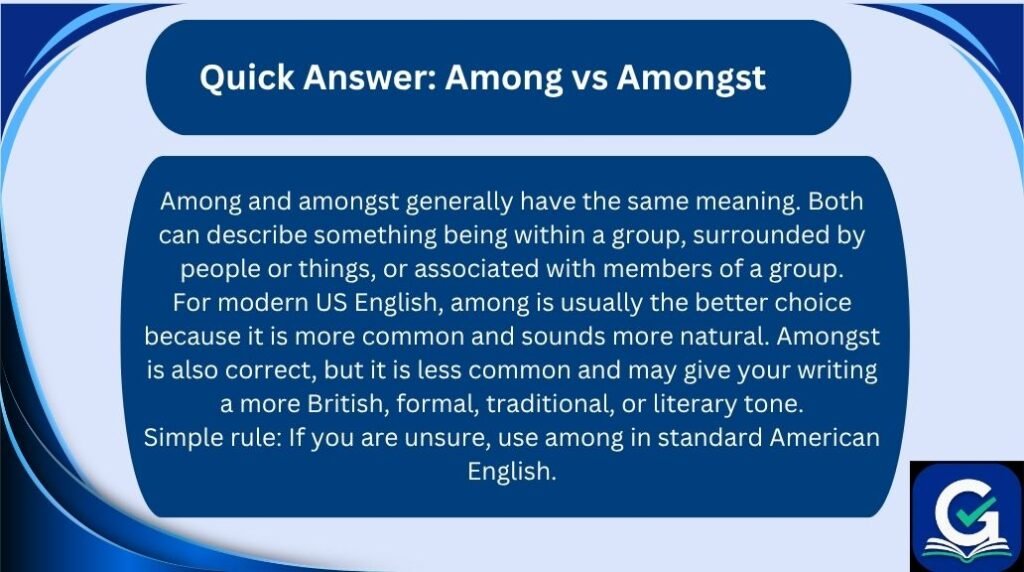
Among and amongst generally have the same meaning. Both can describe something being within a group, surrounded by people or things, or associated with members of a group.
For modern US English, among is usually the better choice because it is more common and sounds more natural. Amongst is also correct, but it is less common and may give your writing a more British, formal, traditional, or literary tone.
Simple rule: If you are unsure, use among in standard American English.
Understanding the Basics
The first thing to understand about among vs amongst is that they are not completely different words.
Both are prepositions. They can be used before nouns and noun phrases to show a relationship between something and a group.
For example:
She was sitting among her friends.
You could also write:
She was sitting amongst her friends.
The basic meaning remains the same. In both sentences, the person is in the company of her friends.
The difference comes mainly from style and frequency.
Comparison Table
| Form | Type | Meaning | Example | Correct/Incorrect |
|---|---|---|---|---|
| among | Preposition | Within or surrounded by a group | She sat among her friends. | ✅ Correct |
| amongst | Preposition | Within or surrounded by a group | She sat amongst her friends. | ✅ Correct |
| among | Preposition | Included in a group | He was among the finalists. | ✅ Correct |
| amongst | Preposition | Included in a group | He was amongst the finalists. | ✅ Correct |
| among | Preposition | Distributed within a group | The money was divided among the children. | ✅ Correct |
| amongst | Preposition | Distributed within a group | The money was divided amongst the children. | ✅ Correct |
The biggest takeaway is simple:
Among is more common in modern American English, while amongst is a less common variant.
What Does “Among” Mean?
Among means being in, surrounded by, or connected with a group of people or things.
It can have several related meanings.
1. Being Surrounded by Something
Consider this sentence:
The house stood among the trees.
Here, among the trees tells us that the house was surrounded by or positioned within a group of trees.
Another example:
The deer disappeared among the bushes.
The deer moved into an area containing many bushes.
2. Being in Someone’s Company
Consider:
I feel comfortable among my friends.
The phrase among my friends means that the speaker feels comfortable while in the company of their friends.
3. Being Part of a Group
For example:
She was among the top students in her class.
Here, among the top students means she was one of the students included in that group.
4. Distribution Within a Group
For example:
The teacher distributed the worksheets among the students.
The worksheets were given to members of the group.
5. Something Happening Within a Group
For example:
There was disagreement among the committee members.
The disagreement occurred within the committee.
What Does “Amongst” Mean?
Amongst generally means the same thing as among.
For example:
The flowers grew amongst the rocks.
This means the flowers grew within or surrounded by the rocks.
You could rewrite it as:
The flowers grew among the rocks.
The meaning is essentially unchanged.
Another example is:
She was respected amongst her colleagues.
This means that her colleagues respected her.
The sentence could also be written:
She was respected among her colleagues.
Again, the basic meaning remains the same.
The important point is that amongst is not grammatically incorrect. It is simply less common, particularly in American English.
Among vs Amongst: Which One Should You Use?
When choosing between among vs amongst, consider three things: your audience, your region, and your tone.
If you are writing for an American audience, among is generally the safest option.
For example:
There was strong support among employees.
This sounds natural and neutral in US English.
You could also write:
There was strong support amongst employees.
That sentence is grammatically acceptable, but it may sound somewhat more formal or British to many American readers.
Use “among” when you want:
- Modern American English
- A neutral tone
- Professional writing
- Academic writing
- Everyday conversation
- Clear online content
- Straightforward communication
Consider “amongst” when you want:
- A British English flavor
- A traditional tone
- A literary atmosphere
- Historical-style language
- A deliberate stylistic effect
Why Is “Among” More Common?
Language changes over time, and English has many words with multiple forms.
Among is the standard form most American speakers and writers encounter regularly.
For example, these phrases are extremely familiar:
- among friends
- among students
- among employees
- among the trees
- among the crowd
- among other things
- among the finalists
The same expressions can technically use amongst, but they may sound less familiar to an American reader.
This is why among is generally the better default for US English.
It is not because amongst is wrong. It is because among is more frequent and stylistically neutral.
Correct Uses in Everyday English
In everyday American English, among is usually the most natural choice.
Example 1
I enjoy being among my friends.
This means the speaker enjoys being in the company of their friends.
Example 2
She felt nervous among strangers.
This means she felt nervous while surrounded by people she did not know.
Example 3
He was among the first people to arrive.
This means he was included in the group of early arrivals.
Example 4
The children searched among the boxes.
This means they searched within a collection of boxes.
These are all common and natural uses.
When “Amongst” Works Well
Although among is usually preferable in US English, there is nothing inherently wrong with amongst.
Literary Writing
A writer may choose:
The castle stood amongst the misty hills.
The word amongst can contribute to an old-fashioned or literary atmosphere.
Historical Fiction
A historical character might naturally say:
Search amongst these old papers.
The word can help establish the character’s voice.
British English
British speakers and writers use amongst more often than Americans do. It can sound perfectly ordinary in British English.
Poetry
Poetry often depends on rhythm and sound.
A poet may prefer:
Lost amongst the stars.
instead of:
Lost among the stars.
The extra syllable may fit the rhythm better.
A Real-Life Workplace Case Study
Imagine that a company manager is writing a message to employees.
Version A
We noticed strong cooperation among the departments during the project.
Version B
We noticed strong cooperation amongst the departments during the project.
Both versions are grammatically possible.
However, for a standard American business email, Version A is generally the better choice.
Why?
Because among sounds neutral, direct, and familiar.
The manager does not need to create a literary or traditional tone. The goal is simply to communicate information clearly.
Now imagine the sentence appearing in a historical novel:
The old commander searched amongst his soldiers for someone he could trust.
In that setting, amongst may work better because the writer is deliberately creating a particular atmosphere.
Case Study Lesson
The choice is not simply:
Correct = among
Incorrect = amongst
Instead, it is:
Common and neutral = among
Less common and stylistically marked = amongst
That distinction will help you make better decisions.
Grammar Rules Explained
According to standard dictionary usage, amongst is a variant of among. Merriam-Webster identifies amongst as a less common form and notes that it is more common in British English than American English.
That means there is no universal grammar rule saying:
Never use amongst.
Such a rule would be inaccurate.
The better rule is:
Use among as your default in modern American English. Use amongst when its regional or stylistic tone is appropriate.
Both words function as prepositions.
Sentence Structure
Consider:
The child was hiding among the trees.
The structure is:
- The child — subject
- was hiding — verb phrase
- among the trees — prepositional phrase
Now change the preposition:
The child was hiding amongst the trees.
The grammatical structure remains the same.
Only the preposition changes.
This demonstrates why the two forms are generally interchangeable.
Is “Amongst” More Formal?
It can sound more formal, but formal is not always the best description.
Depending on context, amongst may sound:
- British
- literary
- traditional
- old-fashioned
- poetic
- slightly unusual to an American reader
For example:
She found peace among the mountains.
This sounds natural and modern.
She found peace amongst the mountains.
This sounds somewhat more literary.
Neither sentence is grammatically defective.
The difference is primarily one of tone.
Common Mistakes With These Words
Mistake 1: Believing “Amongst” Is Wrong
This is the most common misconception.
Some people learn that among is correct and assume amongst must be an error.
That is not true.
Amongst is a legitimate English word.
Mistake 2: Using “Amongst” to Sound More Intelligent
Longer words do not automatically make writing better.
For example:
The results were discussed amongst the researchers.
is not inherently more sophisticated than:
The results were discussed among the researchers.
For American professional writing, the second version is often more natural.
Mistake 3: Changing Forms Without a Reason
A writer might use among in one paragraph and amongst in the next without any stylistic purpose.
That can make the writing feel inconsistent.
If you are writing in neutral US English, using among consistently is usually the cleanest approach.
Mistake 4: Assuming Every Difference Is a Grammar Error
English contains many regional and stylistic variations.
A different form is not necessarily an incorrect form.
Why Do People Make These Mistakes?
Several everyday factors contribute to confusion.
Fast Typing
When people type quickly, they may not stop to consider regional or stylistic differences.
Autocorrect
Autocorrect can correct spelling, but it does not always explain why one form may be more appropriate than another.
Lack of Knowledge
Many people are taught simple grammar rules without learning about regional variations.
Exposure to British English
Someone who regularly reads British books or watches British television may encounter amongst frequently.
As a result, both forms may seem equally natural.
Similar Grammar Confusions
The among vs amongst question is part of a much larger group of English-language confusions.
| Common Confusion | Basic Difference |
|---|---|
| its / it’s | Possessive / it is or it has |
| your / you’re | Possessive / you are |
| their / there / they’re | Possession / place / they are |
| then / than | Time or sequence / comparison |
| affect / effect | Usually verb / usually noun, with exceptions |
| advice / advise | Noun / verb |
| compliment / complement | Praise / something that completes |
| principal / principle | Main person or thing / rule or belief |
| among / amongst | Same basic meaning; different frequency and style |
Understanding these distinctions makes your writing more accurate and confident.
Usage in Different Contexts
The best choice can change slightly depending on where you are writing.
Everyday Conversation
Choose among in most American conversations.
I love being among friends.
It sounds relaxed and natural.
Professional Writing
Among is generally preferable.
Communication among team members is important.
It is direct and professional.
Academic Writing
Again, among is normally the safer choice.
The study compared differences among participants.
Academic writing usually benefits from neutral language rather than unnecessary stylistic variation.
Creative Writing
Both forms can work.
The bird disappeared among the trees.
or:
The bird disappeared amongst the trees.
Choose the version that best matches your narrative voice.
Social Media and Texting
Among is usually more natural for casual American communication.
Lucky to be among such amazing people! ❤️
Using amongst is not wrong, but it may give the sentence a more formal or literary feel.
Among vs Amongst in Formal Writing
If you are preparing a formal document for an American audience, you should normally choose among.
Examples include:
The agreement was reached among the participating organizations.
The survey identified differences among age groups.
The responsibilities were divided among the team members.
The findings were shared among the researchers.
These sentences are clear and professional.
Using amongst would not necessarily make them incorrect, but it could make the writing feel less neutral.
Among vs Amongst in British English
Regional English matters.
British English uses amongst more frequently than American English.
For a British audience, sentences such as these may sound perfectly natural:
She walked amongst the crowd.
The issue was debated amongst politicians.
The flowers grew amongst the rocks.
An American reader can understand these sentences easily, but may notice the stylistic difference.
This is a useful reminder that English does not have one single global vocabulary preference.
Words can vary by region without becoming grammatically wrong.
Among vs Amongst and “Between”
Another common source of confusion is the relationship between among and between.
A traditional rule says:
Use between for two and among for more than two.
That rule is useful for beginners, but it is not absolute.
For example:
The negotiations between the three countries continued.
This can be correct because the three countries are being treated as separate parties.
On the other hand:
There was disagreement among the students.
Here, the students are viewed as a group.
So the choice between between and among depends on the relationship being described, not simply on counting the nouns.
This issue is separate from among vs amongst, because amongst generally has the same grammatical function as among.
Why This Difference Matters
At first, among vs amongst may seem like a tiny language question.
But word choice affects how readers experience your writing.
Clarity
Common wording helps readers understand your message quickly.
Professionalism
In American professional writing, among generally sounds polished and neutral.
Consistency
Choosing one form according to your intended style helps your writing feel intentional.
Audience Awareness
A word that feels ordinary in British English may sound unusual to an American audience.
Good writers consider their readers.
The best word is not always the fanciest word; it is the word that communicates your meaning most naturally.
That principle applies far beyond this particular grammar question.
Special Exception: Fixed Expressions
Some expressions strongly favor among.
One familiar example is:
You’re among friends.
This means that you are in the company of people who are friendly and trustworthy.
Although amongst friends can be grammatically understood, among friends is the more established and natural expression in American English.
Other familiar phrases include:
- among other things
- among the first
- among the best
- among friends
- among the many reasons
- among the options
When an expression is already familiar, there is usually little reason to replace among with amongst.
A Simple Test for Choosing the Right Form
When you are unsure, use this three-question test.
Question 1: Am I writing for an American audience?
If yes, choose among unless you have a specific stylistic reason not to.
Question 2: Is the writing professional or academic?
If yes, among is usually the better option.
Question 3: Do I intentionally want a literary, historical, or British tone?
If yes, amongst may be appropriate.
This test takes only a few seconds and can prevent unnecessary uncertainty.
Quick Recap Checklist
| Question | If Yes → Use |
|---|---|
| Am I writing standard US English? | Among |
| Am I writing a business email? | Among |
| Am I writing an academic paper? | Among |
| Am I writing everyday American English? | Among |
| Do I want a neutral tone? | Among |
| Am I writing British English? | Among or Amongst |
| Am I writing literary prose? | Among or Amongst |
| Do I want an old-fashioned tone? | Amongst may work |
| Am I using “among friends”? | Usually Among |
Practice Examples
1. The teacher divided the materials ___ the students.
Answer: among
The teacher divided the materials among the students.
2. She was one of the most respected people ___ her colleagues.
Answer: among
She was one of the most respected people among her colleagues.
3. The old village was hidden ___ the hills.
Answer: among or amongst
Both can be grammatically correct. Amongst may create a more literary tone.
FAQs
1. Is “amongst” grammatically correct?
Yes. Amongst is grammatically correct. It is a recognized variant of among, although it is less common overall and particularly less common in American English.
2. Which is better, among or amongst?
For standard US English, among is usually better. It is more common, neutral, and natural. Amongst is appropriate when a British, literary, traditional, or stylistic tone is intended.
3. Are among and amongst interchangeable?
In most contexts, yes. They generally have the same basic meaning and grammatical function. The main difference is usage, frequency, and style.
4. Is amongst British English?
Amongst is used more frequently in British English than American English, but it is not exclusively British. American speakers and writers also use it.
5. Should I use “among” in formal writing?
Yes. Among is an excellent choice for formal American writing, including business documents, academic papers, reports, and professional correspondence.
6. Is “amongst friends” wrong?
No. Amongst friends can be grammatically correct. However, among friends is the more familiar and natural expression in standard American English.
Conclusion
The debate over among vs amongst becomes much easier once you understand that both forms are valid.
Among is the more common choice, especially in modern American English. It works naturally in everyday conversation, professional writing, academic work, websites, reports, and most other forms of contemporary communication.
Amongst is not an error. It is a less common variant that can be especially appropriate in British English or when a writer wants a traditional, literary, historical, or poetic tone.
So, if you are writing for an American audience and have no special reason to choose otherwise, go with “among.” It is simple, familiar, and clear.
The most important lesson is not to memorize amongst = wrong. Instead, remember this:
Among is the everyday default; amongst is a valid stylistic alternative.
Once you understand that distinction, you can stop second-guessing your writing and choose the form that best fits your audience, purpose, and voice.

I’m Clara Bennett, a vocabulary and language specialist at Gramfino, where I write about word meanings and proper usage.
I love helping readers choose the right words and build stronger English vocabulary with confidence.
[…] discuss common mistakes, and provide simple tests to help you remember the correct spelling. Among vs Amongst | Specialty vs Speciality | Inquiry vs […]