Have you ever started writing a sentence and suddenly wondered whether specialty vs speciality is the correct spelling? You are not alone. This is one of those English word differences that can be confusing because both forms are real words, both have the same basic meaning, and both appear in reputable dictionaries. The main difference is regional usage.
In American English, specialty is the standard and much more common spelling, while speciality is commonly preferred in British English. 🇺🇸🇬🇧 If you are writing for a U.S. audience, choosing specialty is generally the safest option. If you are writing for a British audience, speciality may be the natural choice. Neither spelling is simply a random misspelling of the other.
In this guide, I’ll explain specialty vs speciality in simple terms, show you how each word works in real sentences, and help you choose the right form with confidence. Inquiry vs Enquiry | Madam vs Madame | Echoes vs Echos
Quick Answer: Specialty vs Speciality
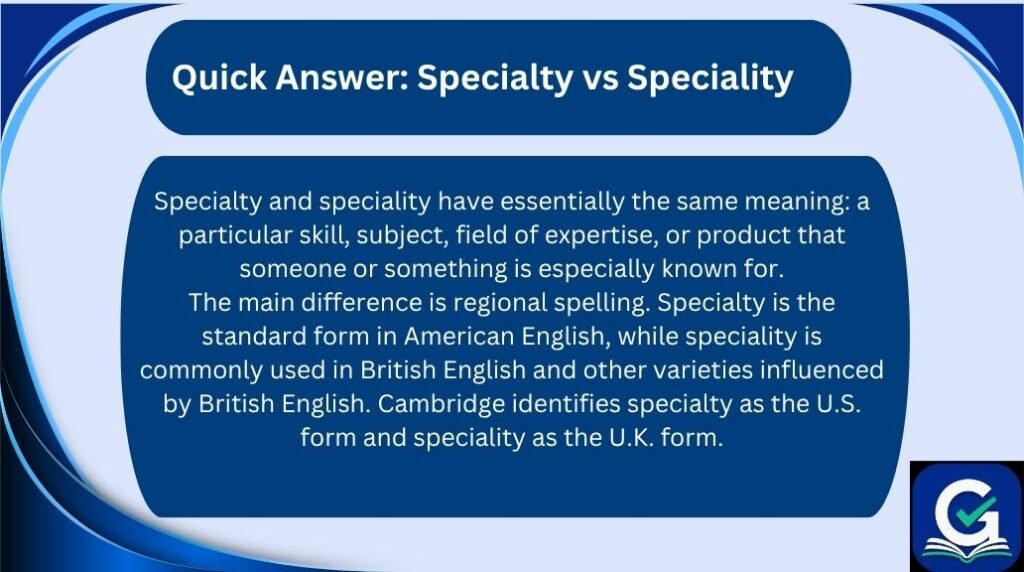
Specialty and speciality have essentially the same meaning: a particular skill, subject, field of expertise, or product that someone or something is especially known for.
The main difference is regional spelling. Specialty is the standard form in American English, while speciality is commonly used in British English and other varieties influenced by British English. Cambridge identifies specialty as the U.S. form and speciality as the U.K. form.
For American English: Use specialty.
For British English: Use speciality.
At a glance
🇺🇸 American English: specialty
🇬🇧 British English: speciality
💡 Meaning: A particular skill, field, subject, or product someone is especially known for.
Understanding the Basics of Specialty vs Speciality
The easiest way to understand this pair is to recognize that the two words are regional spelling variants.
They are not normally different words with completely different meanings. Instead, they represent two established forms used in different English-speaking regions.
For example:
- American English: “Pediatrics is her specialty.”
- British English: “Paediatrics is her speciality.”
The spelling changes, but the basic idea remains the same.
Merriam-Webster defines specialty as something in which a person specializes and also gives meanings connected with distinctive qualities and products of special excellence. It separately lists speciality as a noun and defines it in relation to specialty.
Specialty vs Speciality Comparison Table
| Form | Type | Meaning | Example | Correct/Incorrect |
|---|---|---|---|---|
| specialty | Noun | A particular skill, field, subject, or product | “Marketing is her specialty.” | Correct in American English |
| speciality | Noun | A particular skill, field, subject, or product | “Marketing is her speciality.” | Correct in British English |
| specialty | Noun | A product known for excellence | “The restaurant’s specialty is seafood.” | Correct |
| speciality | Noun | A product known for excellence | “The restaurant’s speciality is seafood.” | Correct |
| specialty | U.S. spelling | Standard American form | “His specialty is surgery.” | Preferred in U.S. English |
| speciality | U.K. spelling | Standard British form | “His speciality is surgery.” | Preferred in U.K. English |
So, if someone asks, “Which is correct: specialty or speciality?”, the most accurate answer is:
Both are correct. The preferred spelling depends on the variety of English you are using.
What Does “Specialty” Mean?
In American English, specialty is a noun referring to something that a person, business, place, or organization is particularly skilled at or known for.
Merriam-Webster gives several meanings for specialty, including a product of special excellence and something in which someone specializes.
1. A field of expertise
A specialty can be an area in which someone has advanced knowledge or skill.
Example:
“Cardiology is her specialty.”
Here is the sentence breakdown:
- Cardiology = the particular field
- is = linking verb
- her = possessive determiner
- specialty = the field in which she specializes
The sentence means that cardiology is the area in which she has particular expertise.
More examples:
- “Computer security is his specialty.”
- “Tax law is her specialty.”
- “Emergency medicine is Dr. Patel’s specialty.”
- “Graphic design is my specialty.”
2. A product or food item
The word can also describe a product or dish that a restaurant, region, store, or business is especially known for.
Example:
“Fresh seafood is the restaurant’s specialty.”
This means the restaurant is particularly known for its seafood.
Other examples include:
- “Barbecue is a regional specialty.”
- “Chocolate cake is the bakery’s specialty.”
- “Handmade pottery is the village’s specialty.”
- “This shop’s specialty is custom furniture.”
Cambridge similarly defines specialty as a product that is extremely good in a particular place and gives examples involving local food and restaurant dishes.
3. A particular skill
Specialty can also refer to a skill or activity someone does especially well.
For example:
“Making complicated topics easy to understand is her specialty.”
This does not necessarily describe a formal profession. It simply identifies something at which the person is particularly good.
What Does “Speciality” Mean?
Speciality has essentially the same meanings as specialty, but it is especially associated with British English.
Cambridge labels speciality as a U.K. noun and identifies specialty as the U.S. equivalent. It gives meanings related to both products and subjects someone knows a great deal about.
For example:
“Surgery is his speciality.”
A British English reader would understand this naturally as meaning that surgery is his particular field of expertise.
Other examples:
- “Teaching is her speciality.”
- “Local cheese is a regional speciality.”
- “The restaurant’s speciality is traditional British food.”
- “Engineering was his speciality at university.”
The important point
You should not assume that speciality is a spelling mistake simply because you are accustomed to seeing specialty.
Likewise, a British writer should not automatically consider specialty incorrect.
The choice is primarily about regional English conventions.
Specialty vs Speciality in American English
If your article, website, school assignment, business document, or professional communication is written specifically for a U.S. audience, use:
specialty
Examples:
- “Her medical specialty is dermatology.”
- “Italian food is the restaurant’s specialty.”
- “The company specializes in specialty coffee.”
- “His specialty is digital marketing.”
- “The store sells specialty products.”
This spelling is particularly important in American professional and academic writing because consistency matters.
If your document is otherwise written in American English, suddenly switching to speciality can make the text look inconsistent.
Specialty vs Speciality in British English
British English commonly uses:
speciality
Examples:
- “Her medical speciality is dermatology.”
- “The restaurant’s speciality is seafood.”
- “Engineering is his speciality.”
- “The region is famous for its local specialities.”
Cambridge identifies speciality as the British form and specialty as the American form.
British English also commonly uses other spellings that differ from American English, such as:
- colour vs color
- favourite vs favorite
- centre vs center
- organise vs organize
- specialised vs specialized
This does not mean one variety is more “correct.” They follow different spelling conventions.
Why Does the Extra “i” Matter?
At first glance, specialty and speciality may look like entirely different words. The difference is simply the presence of -i- before the final -ty.
Compare:
specialty
speciality
This small spelling variation is enough to make writers hesitate.
The pronunciation can also vary somewhat depending on the speaker and dialect. Cambridge provides separate pronunciation information for the two forms.
For most everyday communication, however, the spelling distinction is much more important than the pronunciation distinction.
A Simple Rule to Remember
Here is the easiest rule:
U.S. English → specialty 🇺🇸
U.K. English → speciality 🇬🇧
Think of it this way:
America likes the shorter form: specialty.
Britain commonly keeps the extra “i”: speciality.
This is not an absolute rule for every English-speaking country or every publication, but it is a reliable guideline for choosing between the two in standard U.S. and U.K. writing.
Correct Meanings and Uses
Specialty as a Field of Expertise
One of the most common uses of specialty is to describe a person’s professional or academic area of expertise.
For example:
“Pediatric medicine is her specialty.”
The sentence tells readers that pediatric medicine is the particular field in which she specializes.
More examples:
“Finance is his specialty.”
“Her specialty is environmental law.”
“Data analysis has become my specialty.”
In professional writing, this usage is extremely common.
Specialty as a Product
A specialty can also be a product that is particularly distinctive or excellent.
For example:
“The bakery’s specialty is sourdough bread.”
The word does not mean that sourdough is merely one product the bakery sells. It suggests that sourdough is something the bakery is particularly known for.
Another example:
“The region’s specialty is handmade pottery.”
This means handmade pottery is a distinctive product associated with that region.
Speciality in British Usage
The same meanings apply to speciality:
“Her speciality is environmental law.”
“The bakery’s speciality is sourdough bread.”
“The region is famous for its local speciality.”
The primary difference is spelling convention rather than meaning.
Specialty vs Speciality in Medical English
Medical writing is an especially useful area for understanding this distinction.
In American English, you will commonly see:
- medical specialty
- surgical specialty
- medical specialties
- specialty care
- specialty physician
- specialty clinic
Examples:
“Cardiology is a medical specialty.”
“The hospital offers several surgical specialties.”
Merriam-Webster’s medical definition describes specialty as something such as a branch of medicine in which someone specializes.
In British English, you may encounter:
- medical speciality
- medical specialities
- surgical speciality
The underlying meaning remains the same.
Plural forms
American English:
specialty → specialties
British English:
speciality → specialities
Examples:
“The hospital offers several medical specialties.”
“The hospital offers several medical specialities.”
Both sentences can be correct depending on the variety of English being used.
Test Tip: How Can You Check Which One to Use?
When you are unsure, ask yourself one question:
“Who am I writing for?”
If the answer is American readers, choose specialty.
If the answer is British readers, choose speciality.
You can also check the spelling conventions of the publication, university, employer, or style guide you are following.
For example:
- U.S. company → usually specialty
- American school assignment → specialty
- British newspaper → usually speciality
- British university → usually speciality
- International publication → follow its house style
Quick memory trick
Specialty = U.S.
Speciality = U.K.
That simple association will solve most usage questions.
Case Study: A Workplace Email
Imagine an American company is hiring a marketing manager.
An employee writes:
“Digital marketing is one of Sarah’s key specialities.”
The sentence is understandable, but if the company consistently follows American English, specialties would usually be the preferred spelling.
A revised version would be:
“Digital marketing is one of Sarah’s key specialties.”
Now imagine a British company writing the same sentence:
“Digital marketing is one of Sarah’s key specialities.”
That version fits British spelling conventions.
What does this teach us?
The problem is not that one sentence communicates a completely different idea. Both communicate the same meaning.
The important issue is consistency with the intended variety of English.
In professional writing, consistent spelling makes your communication look polished and intentional.
Grammar Rules: Is One Form Incorrect?
This is where many grammar articles oversimplify the issue.
It would be inaccurate to say:
“Speciality is wrong.”
It would also be inaccurate to say:
“Specialty is wrong.”
Both forms are established English words.
Merriam-Webster has separate entries for specialty and speciality, with speciality defined partly through its relationship to specialty.
Cambridge explicitly identifies specialty as the U.S. form and speciality as the U.K. form.
Therefore, the best grammar rule is:
Choose the spelling that matches the variety of English you are writing.
Important distinction
This is primarily a spelling and regional-usage issue, not a basic grammar issue.
The noun can function in the same grammatical ways in both varieties.
For example:
- “Cooking is her specialty.”
- “Cooking is her speciality.”
The grammatical structure is identical.
Only the spelling changes.
Common Mistakes with Specialty and Speciality
Why do writers get confused?
There are several reasons.
1. Fast typing
When people type quickly, they may write the form they see most often.
Someone who normally reads American English may automatically type specialty, even when writing for a British publication.
The reverse can happen to British English users.
2. Autocorrect
Autocorrect can make the situation even more confusing.
Depending on your keyboard language and dictionary settings, your device may prefer one spelling.
For example, an American English keyboard may favor:
specialty
A British English keyboard may recognize:
speciality
So do not assume your software’s suggestion is the only correct answer.
3. Lack of knowledge about regional English
Many people learn that American and British English use different spellings, but they do not realize how many words are affected.
Once you understand regional spelling, specialty vs speciality becomes much easier.
4. Mixing English varieties
Another common problem is inconsistent spelling.
For example, a writer might use:
- color
- favourite
- center
- specialty
- organise
This mixture may not make the writing impossible to understand, but it can make the document look inconsistent.
Similar Grammar and Spelling Confusions
Here are several common English pairs that create confusion:
| Confusion | American English | British English | Main Difference |
|---|---|---|---|
| specialty vs speciality | specialty | speciality | Regional spelling |
| color vs colour | color | colour | Regional spelling |
| center vs centre | center | centre | Regional spelling |
| favorite vs favourite | favorite | favourite | Regional spelling |
| organize vs organise | organize | organise | Regional spelling |
| license vs licence | license | licence | Noun/verb conventions vary |
| practice vs practise | practice | practice/practise | British noun/verb distinction |
| its vs it’s | its | its | Possessive vs contraction |
| your vs you’re | your | your | Possessive vs contraction |
| their vs they’re | their | their | Possessive vs contraction |
Notice that not every pair works exactly like specialty vs speciality.
For example:
- its is a possessive determiner.
- it’s means “it is” or “it has.”
- your shows possession.
- you’re means “you are.”
Those are grammatical distinctions.
By contrast, specialty vs speciality is primarily a regional spelling distinction.
Usage in Different Contexts
Everyday Conversation
In casual American conversation, specialty is natural:
“What’s your specialty?”
“Baking is my specialty.”
In British conversation, you may hear:
“What’s your speciality?”
Both are understandable.
If you are speaking casually with someone from another English-speaking country, there is usually no communication problem.
Professional Writing
For professional writing, consistency is more important.
If you are writing an American business report, use:
“Our specialty is customized software solutions.”
If you are writing for a British business audience, use:
“Our speciality is customized software solutions.”
Professional readers generally expect the spelling conventions associated with their variety of English.
Academic Writing
Academic writers should follow the style and regional conventions required by their institution or publication.
For a U.S. academic paper:
“Her specialty is developmental psychology.”
For a British academic paper:
“Her speciality is developmental psychology.”
If a professor or journal provides a style guide, follow it.
Creative Writing
Creative writers have more flexibility.
A U.S. novelist writing an American character would naturally use:
“Cooking was her specialty.”
A British novelist might write:
“Cooking was her speciality.”
In dialogue, spelling can also reflect the character’s background when the text itself makes regional language relevant.
Social Media and Texting
On social media, both forms appear.
However, your intended audience still matters.
For an American brand:
“Coffee is our specialty ☕”
For a British brand:
“Coffee is our speciality ☕”
Social media may be informal, but consistent spelling still helps establish a professional brand voice.
Specialty vs Speciality in Business and Marketing
Businesses often use these words to describe products, services, or areas of expertise.
Examples in American English include:
- specialty coffee
- specialty foods
- specialty products
- specialty store
- specialty services
- specialty retailer
- specialty market
Cambridge’s Business English material recognizes both forms and notes that speciality is used in British English, while specialty is also used in U.S. English.
For example:
“We provide specialty products for professional photographers.”
Here, specialty acts as part of a compound expression describing products designed for a particular market or purpose.
Why consistency matters in branding
Suppose an American company uses specialty throughout its website but suddenly publishes a page titled “Our Specialities.”
That inconsistency may make the page appear as though it was copied or edited using a different regional English setting.
This is not a major grammatical error, but professional consistency improves credibility.
Specialty vs Speciality in Food Writing
Food is one area where both words are particularly common.
American English:
“Barbecue is a regional specialty.”
British English:
“Barbecue is a regional speciality.”
Restaurant writing may also use the word to describe a signature dish:
“The chef’s specialty is grilled salmon.”
or:
“The chef’s speciality is grilled salmon.”
Cambridge gives examples involving local products and restaurant dishes, including the phrase “specialty of the house.”
Useful food-related expressions
In American English:
- house specialty
- local specialty
- regional specialty
- specialty dish
- specialty food
In British English:
- house speciality
- local speciality
- regional speciality
- speciality dish
- speciality food
Specialty vs Speciality in Education and Careers
The word can describe an area of study or professional expertise.
For example:
“Computer science was his specialty.”
This tells us that computer science was his particular area of expertise.
A British writer might say:
“Computer science was his speciality.”
Related words include:
- specialist
- specialize
- specialization
- specialized
Merriam-Webster defines a specialist as someone who specializes in a particular occupation, practice, or field of study.
So you can think of the word family like this:
specialist → a person with focused expertise
specialize → to focus on a particular field
specialization → the process or result of focusing on a field
specialty/speciality → the particular field or area of expertise
What About “Specialised” and “Specialized”?
This is another useful regional distinction.
American English generally uses:
specialized
British English commonly uses:
specialised
For example:
American:
“The hospital provides specialized care.”
British:
“The hospital provides specialised care.”
Merriam-Webster identifies specialised and specialisation as British spellings of specialized and specialization.
This reinforces the broader pattern:
American English often favors -ize spellings.
British English often uses -ise spellings in many words.
But specialty vs speciality is a separate spelling pattern and should be learned on its own.
Why This Difference Matters
At first, the distinction may seem too small to worry about.
After all, everyone understands both forms.
But accurate spelling still matters, especially when you are writing professionally.
1. Clarity in communication
Consistent regional spelling helps readers immediately recognize the variety of English being used.
2. Professionalism
A polished document should follow a consistent style.
If your audience is American, using specialty demonstrates awareness of U.S. spelling conventions.
3. Writing accuracy
Correct regional spelling is part of careful editing.
It is not enough for a word to be understandable. Good writing also considers audience, style, and consistency.
4. Digital communication
Websites, blogs, social media posts, emails, and online publications reach international audiences.
Choosing one spelling convention and using it consistently creates a stronger editorial voice.
A useful reminder
Good writing is not only about being understood; it is also about being consistent.
Special Exceptions and Edge Cases
There is no major exception in which specialty suddenly means something completely different from speciality in ordinary modern English.
However, there are a few things worth knowing.
Dictionaries may list both forms
Merriam-Webster includes separate entries for specialty and speciality, demonstrating that both forms are established words rather than a simple “correct versus incorrect” pair.
Organizations may have their own style
A publication, company, or institution can establish a house style.
For example, an international company might choose American English across all of its websites, even when operating in the United Kingdom.
In that situation, follow the organization’s style guide.
Historical or quoted material
If you are reproducing an original quotation, historical document, title, or official name, preserve the original spelling when appropriate.
Do not “correct” a quoted source simply because it uses speciality instead of specialty.
Is “Specialty” More Correct Than “Speciality”?
For American English, yes, specialty is the preferred standard form.
For British English, speciality is the preferred standard form.
But it is misleading to say that specialty is universally more correct.
The better explanation is:
Specialty is the standard American spelling, while speciality is the standard British spelling.
Cambridge explicitly marks the forms according to U.S. and U.K. usage.
This distinction is important because English does not have one single worldwide spelling system.
Quick Recap Checklist
Use this checklist whenever you are unsure.
| Question | If Yes → Use |
|---|---|
| Am I writing specifically for a U.S. audience? | specialty |
| Am I writing for a British audience? | speciality |
| Am I writing an American academic paper? | specialty |
| Am I writing for a British publication? | speciality |
| Does my company’s style guide specify U.S. English? | specialty |
| Does my publication use British spelling? | speciality |
| Am I quoting a source that uses one spelling? | Preserve the source’s spelling when appropriate |
| Am I writing casually for an international audience? | Choose one form and stay consistent |
Practice Examples
Example 1
“Her medical ___ is dermatology.”
For American English:
specialty
For British English:
speciality
Example 2
“The restaurant’s ___ is homemade pasta.”
American:
specialty
British:
speciality
Example 3
“Engineering is his area of ___.”
American:
specialty
British:
speciality
The meaning does not change. Only the regional spelling does.
FAQs
1. Is specialty or speciality correct?
Both are correct. Specialty is the standard spelling in American English, while speciality is commonly preferred in British English. The two forms have essentially the same meanings.
2. Should I use specialty in American English?
Yes. If you are writing standard American English, specialty is generally the preferred spelling.
For example:
“Marketing is her specialty.”
3. Is speciality a British spelling?
Yes. Speciality is commonly used in British English.
For example:
“Marketing is her speciality.”
Cambridge lists speciality as the U.K. form and specialty as the U.S. equivalent.
4. Does specialty mean the same thing as speciality?
Yes, in ordinary usage they have essentially the same meaning. Both can refer to a particular field of expertise, skill, product, or distinctive area.
5. What is the plural of specialty?
The American English plural is:
specialties
For example:
“The hospital offers several medical specialties.”
The British form speciality normally has the plural:
specialities
For example:
“The hospital offers several medical specialities.”
Merriam-Webster lists specialties as the plural of specialty and specialities as the plural of speciality.
6. Is specialty more common in the United States?
Yes. Specialty is the standard U.S. form and is the spelling American readers will generally expect.
Conclusion
The difference between specialty vs speciality is much simpler once you understand regional English. Both words are legitimate, and both describe a particular field of expertise, skill, product, or distinctive quality. The main difference is spelling convention.
For American English, choose specialty.
For British English, choose speciality.
The key is not to memorize one form as “right” and the other as “wrong.” Instead, identify your audience and follow the spelling system they expect. If you are writing for a U.S. website, business, school, or publication, specialty is the clear choice. If you are writing in British English, speciality is the natural choice.
Once you remember specialty = U.S. and speciality = U.K., this confusing pair becomes easy.
Choose the spelling that matches your audience, stay consistent, and your writing will always be on the right track. ✍️

I’m Amelia Parker, an English language writer at Gramfino, focused on making difficult language topics easier to understand.
I write about grammar, vocabulary, word usage, and everyday English to help readers communicate clearly.
[…] Once you understand this small distinction, choosing the right form becomes much easier. 😊 Specialty vs Speciality | Inquiry vs Enquiry | Madam vs […]