Have you ever started writing a formal email, letter, or message and suddenly wondered whether you should write madam vs madame? You are not alone. These two words look almost identical, sound similar in many English contexts, and share the same historical roots. However, they are not always interchangeable. The main difference is connected to language, cultural context, and usage. In modern US English, madam is generally the standard English form for politely addressing a woman, especially when her name is unknown or when it appears before a position or title. Madame, on the other hand, is a French form that English also uses in particular contexts, especially for French women, French titles, or expressions borrowed from French.
Understanding madam vs madame can help you avoid awkward wording and make your writing sound more natural. Whether you are writing a business email, creating dialogue for a story, addressing someone respectfully, or simply trying to improve your grammar, knowing which form fits the situation makes a difference. 😊 Echoes vs Echos | Themself vs Theirself | Counselor vs Councilor
Quick Answer: Madam vs Madame
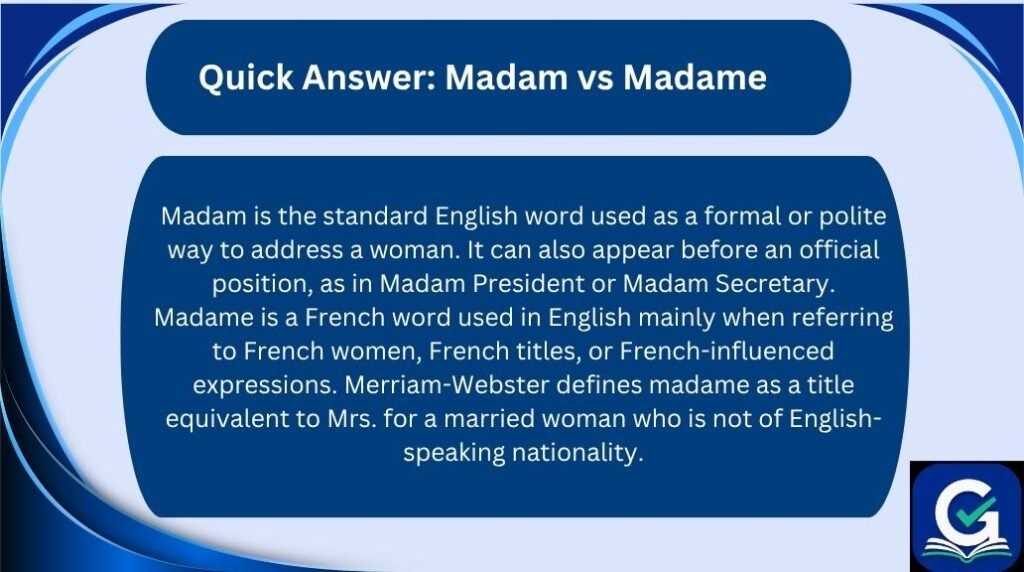
Madam is the standard English word used as a formal or polite way to address a woman. It can also appear before an official position, as in Madam President or Madam Secretary.
Madame is a French word used in English mainly when referring to French women, French titles, or French-influenced expressions. Merriam-Webster defines madame as a title equivalent to Mrs. for a married woman who is not of English-speaking nationality.
Simple rule:
👉 Use madam in ordinary English.
👉 Use madame when the French or cultural context makes it appropriate.
Understanding the Basics of Madam vs Madame
At first glance, madam and madame may seem like spelling variations of exactly the same word. Historically, they are closely related. Both ultimately trace back to expressions meaning “my lady.” Merriam-Webster dates the first known English use of madam to the 14th century and madame to the 17th century.
The important point is that English developed its own form: madam.
French retained madame as its normal title and form of address.
Comparison Table
| Form | Type | Meaning | Example | Correct/Incorrect |
|---|---|---|---|---|
| madam | English noun/title | A polite or formal way to address a woman | “Yes, madam.” | ✅ Correct |
| Madam | English title | Formal title before an office or rank | “Madam President will speak.” | ✅ Correct |
| madame | French noun/title | A French form of address for a woman | “Madame Dupont” | ✅ Correct in French/French contexts |
| madame | English borrowing | A French-style title or reference | “The painting depicts Madame Monet.” | ✅ Correct in appropriate context |
| madam in a French title | English form used instead of French | May remove the intended French context | “Madam Dupont” in a French-language document | ⚠️ Context-dependent |
| madame in ordinary US English | French borrowing | Often unnecessarily French-sounding | “Excuse me, madame” | ⚠️ Usually madam is more natural |
So, neither spelling is universally “wrong.” The correct choice depends on what language you are writing in and what context you are creating.
What Does “Madam” Mean?
Madam is a formal English term used to address a woman respectfully.
For example:
“Excuse me, madam. You dropped your wallet.”
Here, madam functions as a polite form of address.
Cambridge Dictionary describes madam as a formal and polite way of speaking to a woman. It also identifies Dear Madam as a traditional opening for a formal letter addressed to a woman whose name is unknown.
1. Madam as a Polite Form of Address
You might hear madam in formal customer service, traditional dialogue, official settings, or situations where someone wants to sound especially respectful.
Example:
“May I help you, madam?”
The word does not necessarily tell us the woman’s marital status.
It simply functions as a formal form of address.
2. Madam in Formal Letters
One traditional usage is:
Dear Madam:
This is used when the recipient is a woman whose name is unknown.
For example:
Dear Madam:
I am writing regarding your recent application.
However, modern business writing often favors a more specific greeting when the recipient’s name is available.
Instead of:
Dear Madam:
You might write:
Dear Ms. Johnson:
That is generally more personal and precise.
3. Madam Before an Official Position
Madam can also appear before a position or office.
Examples include:
- Madam President
- Madam Secretary
- Madam Speaker
- Madam Chair
Merriam-Webster specifically lists Madam as a conventional title used with a designation of rank or office.
For example:
“Madam President, may I respond?”
Here, Madam is functioning as part of a formal title.
What Does “Madame” Mean?
Madame is the French form of the title corresponding roughly to Mrs. or a respectful form of address for a woman.
In English, it is usually retained when the French context matters.
Merriam-Webster defines madame as a title equivalent to Mrs. for a married woman who is not of English-speaking nationality. It also lists mesdames as the plural form.
1. Madame in French
In French, madame is normal and standard.
For example:
Madame Dupont
This corresponds roughly to:
Mrs. Dupont
When you are writing in French, there is no reason to replace madame with the English madam.
2. Madame in English Writing
English sometimes uses madame as a borrowed French term.
You may encounter it when discussing:
- French culture
- French history
- French literature
- French people
- French businesses
- French titles
- historical figures
- fashion
- art
- cuisine
For example:
“Madame Curie became one of the most influential scientists in history.”
Here, Madame reflects the French title associated with the person being discussed.
3. Madame as a Cultural or Stylistic Term
English writers may deliberately choose madame to create a French or sophisticated atmosphere.
For example:
“Welcome, madame,” the waiter said with a theatrical bow.
The writer may choose madame because the scene has a French-inspired setting.
In ordinary American conversation, however, madam would generally be the more natural English choice.
Madam vs Madame: The Core Difference
The easiest way to remember the difference is this:
Madam = English
Madame = French or French-influenced
This is not an absolute rule because English has borrowed madame and uses it in certain established contexts. Still, it is an excellent starting point for everyday writing.
Consider these examples:
Example 1: Ordinary American English
“Excuse me, madam. You left your phone.”
✅ Madam is natural.
Example 2: French context
“Madame Laurent will meet us at noon.”
✅ Madame is appropriate.
Example 3: Government title
“Madam Secretary, the committee is ready.”
✅ Madam is correct.
Example 4: French-language correspondence
“Madame Dupont”
✅ Madame is correct.
The key is not to memorize hundreds of isolated examples. Instead, ask yourself:
“Am I using an English form of address, or am I deliberately using a French form?”
That question will solve most cases.
Correct Meanings and Uses
Madam as a Respectful Address
One of the most common meanings of madam is a polite way to address a woman.
Sentence:
“Thank you, madam.”
Breakdown
- Thank you = expression of gratitude
- madam = respectful form of address
- The word is not the subject of the sentence.
- It directly addresses the woman being spoken to.
This is called a vocative use because the word identifies the person being addressed.
Madam as a Formal Title
You can use Madam before certain offices or positions.
Examples:
Madam President
Madam Secretary
Madam Speaker
Notice that Madam is capitalized when it forms part of a formal title.
For example:
“Madam Speaker, I would like to make a statement.”
This is a formal political or parliamentary style.
Madame as a French Title
Madame is appropriate when the title itself is French.
For example:
“Madame Laurent owns the restaurant.”
The choice communicates a French context.
In English, the word may be translated depending on the circumstances, but keeping Madame can preserve the person’s cultural or linguistic context.
Madame in Historical and Cultural References
You may see Madame in biographies, historical writing, fiction, and discussions of French culture.
For example:
“Madame de Staël was an important intellectual figure.”
The French title is part of the historical presentation.
Similarly:
“The museum displayed a portrait of Madame Recamier.”
Here, Madame functions as part of the established name or historical reference.
Test Tip: How to Choose the Right Word
When you’re unsure about madam vs madame, use this quick test:
Ask: “Would I normally write this in English?”
If the answer is yes, use madam.
“Excuse me, madam.”
If the answer is no, I am deliberately using French, choose madame.
“Madame Dupont”
Another helpful test
Replace the word with Mrs. or Ms.
If you’re referring to a French title, madame may be appropriate.
If you’re simply politely addressing a woman in English, madam is usually the better choice.
A Real-Life Case Study
Imagine that you work at a hotel in the United States.
A guest approaches the front desk and says:
“I believe there is a problem with my reservation.”
You respond:
“Certainly, madam. Let me check that for you.”
Here, madam is appropriate because the conversation is taking place in English and the employee is using a formal, respectful form of address.
Now imagine a different situation.
You are writing an article about a French hotel:
“Madame Laurent welcomed the guests to her historic hotel in Paris.”
Here, madame works because the person and setting have a French cultural context.
The Lesson
The two words can communicate similar respect, but the linguistic setting changes the appropriate choice.
Madam vs Madame in Professional Writing
Professional writing requires precision.
Suppose you are sending a formal letter and you do not know the recipient’s name.
You might see:
Dear Madam:
This is grammatically valid, although somewhat traditional.
Cambridge Dictionary identifies Dear Madam as a conventional way to begin a formal letter to a woman whose name is unknown.
However, if you know the person’s name, a more specific greeting is usually preferable:
Dear Ms. Carter:
This gives the reader a clearer and more personalized form of address.
What About “Dear Madame”?
In ordinary US business English, Dear Madame is generally not the default choice.
If the correspondence is in English and there is no French context, Dear Madam is the traditional form.
If you are writing in French, however, Madame is appropriate.
Grammar Rules Behind Madam and Madame
The important thing to understand is that madam and madame are both legitimate words.
The question is not simply:
“Which spelling is correct?”
The better question is:
“Which form fits this language and context?”
Merriam-Webster recognizes both words separately. It defines madam as a polite form of address, a conventional title before a rank or office, and a noun with additional meanings.
It defines madame as a French title equivalent to Mrs. in relevant contexts and notes the plural mesdames.
So saying that madame is always incorrect would be inaccurate.
Likewise, saying that madam and madame are always interchangeable would also be misleading.
Capitalization Matters
Capitalize Madam when it functions as part of a formal title:
Madam President
But lowercase it when used as an ordinary form of address in a sentence:
“Thank you, madam.”
Similarly, Madame is normally capitalized when used as a title before a person’s name:
Madame Dupont
Capitalization can vary according to the style and language being used, but the basic principle remains consistent.
Common Mistakes With Madam and Madame
Why do people confuse these words?
There are several reasons.
1. They Look Almost Identical
The only obvious difference is the final e.
That makes it easy to type one when you mean the other.
2. They Share a Common History
Both words developed from the same historical expression.
That explains why their meanings overlap.
3. English Borrowed the French Form
English frequently borrows words from French.
Words such as ballet, café, genre, and madame appear in English writing.
This can make the language boundary less obvious.
4. Fast Typing
When people type quickly, they may automatically add or remove the final e.
5. Autocorrect
Autocorrect and predictive text can sometimes encourage the wrong spelling, especially when a word is used outside its most common context.
6. Lack of Contextual Knowledge
Someone may know that both words mean a respectful form of address but not understand when each belongs.
That is why memorizing definitions alone is not enough.
Similar Grammar Confusions
The madam vs madame question is part of a larger group of English word confusions.
| Confusion | Correct Forms | Main Difference |
|---|---|---|
| its / it’s | its / it’s | Possession vs. “it is” |
| your / you’re | your / you’re | Possession vs. “you are” |
| their / they’re | their / they’re | Possession vs. “they are” |
| then / than | then / than | Time/order vs. comparison |
| affect / effect | affect / effect | Usually verb vs. noun |
| accept / except | accept / except | Receive vs. excluding |
| advice / advise | advice / advise | Noun vs. verb |
| madam / madame | madam / madame | English vs. French/contextual use |
The lesson is simple: similar-looking words do not necessarily have identical functions.
Madam vs Madame in Different Contexts
Everyday Conversation
In everyday American English, madam is the standard choice when someone uses this formal form of address.
Examples:
“Excuse me, madam.”
“Yes, madam.”
“May I help you, madam?”
That said, ma’am is also common in US English and is a contraction of madam. Merriam-Webster defines ma’am as madam and describes it as a polite form of address used without a name.
For many Americans, ma’am sounds more natural in ordinary conversation than the full madam.
Professional Writing
In formal professional writing, madam may appear in traditional greetings and official contexts.
Examples:
Dear Madam:
Madam Secretary
Madam Chair
However, modern professional communication often favors using the person’s name whenever possible.
For example:
Dear Ms. Anderson:
is usually more direct than:
Dear Madam:
Creative Writing
Authors have greater freedom.
A novelist might deliberately choose madame to establish a French atmosphere:
“Come in, madame,” the shopkeeper said.
If the character is in an American setting, the author might instead use:
“Come in, madam.”
The choice can therefore contribute to characterization, setting, and tone.
Social Media and Texting
Social media is generally informal, so you will see fewer uses of either word.
Someone might jokingly write:
“Yes, madam! 😂”
This could sound playful or dramatic.
Madame may be used humorously to create a sophisticated or French-inspired tone:
“Madame has entered the chat. 🇫🇷”
Here, the spelling is stylistic rather than a strict grammatical requirement.
Why the Difference Matters
At first, madam vs madame may seem like a tiny spelling issue.
But word choice can communicate more than meaning.
1. Clarity
Using the appropriate form helps readers understand the intended linguistic context.
Madam generally signals English.
Madame can signal French language or culture.
2. Professionalism
Accurate titles matter in formal communication.
Using the wrong form can make an otherwise polished message feel careless.
3. Cultural Accuracy
Language is connected to culture.
Using madame in a French context respects the linguistic setting.
Using madam in ordinary English keeps the wording natural.
4. Digital Communication
Emails, websites, social media posts, and online forms are often read quickly.
A small spelling difference can affect the tone of a message.
“The right word is not just correct—it tells readers where your language belongs.”
That is particularly important when writing for an international audience.
A Note About Meaning: “Madam” Has Other Uses
There is one important detail that learners should know.
Madam has meanings beyond polite address.
Merriam-Webster also defines madam as a woman who runs a brothel and, in another sense, as a woman who is the head of a household or a wife.
Cambridge also lists the brothel-related meaning.
This means context matters.
For example:
“The hotel receptionist addressed the customer as madam.”
Here, the meaning is clearly a polite form of address.
But:
“The police arrested the madam who ran the illegal operation.”
Here, madam has a completely different meaning.
Writers should therefore consider the surrounding sentence rather than assuming the word has only one definition.
Special Exception: Madame in English Expressions
Madame has become established in certain English expressions and names.
One famous example is baroque madame, a French dish. The French expression is normally retained rather than translated into baroque madam.
You may also encounter Madame Tussauds, the famous wax museum brand.
Madame Tussauds
These examples demonstrate an important point:
A borrowed word does not have to follow the ordinary English substitution rule.
If a phrase is established under its original French form, changing madame to madam may make the expression incorrect or unnatural.
Madam vs Madame: Quick Recap Checklist
Use this checklist whenever you are unsure.
| Question | If Yes → Use |
|---|---|
| Am I politely addressing a woman in English? | madam |
| Am I using a formal English title before an office? | Madam |
| Am I writing “Dear ___” to an unnamed female recipient in traditional English correspondence? | Madam |
| Am I writing in French? | madame |
| Am I referring to a French woman using a French title? | madame |
| Is the expression traditionally French? | madame |
| Is Madame part of an established proper name or brand? | Madame |
Practice Example 1
“Excuse me, ___, you dropped your keys.”
Answer: madam
Why? You are politely addressing a woman in English.
Practice Example 2
“___ Dupont will attend the meeting.”
Answer: Madame
Why? The name is presented with a French title.
Practice Example 3
“___ President, the committee is ready.”
Answer: Madam
Why? It is a formal English title before an office.
Madam vs Madame: Easy Memory Trick
Here’s a simple trick:
Think of the final “E” as a French signal. 🇫🇷
madam → ordinary English
madame → French or French-related context
This is not a rule for every possible English sentence, but it is a useful memory aid.
You can also remember:
Madam = English form
Madame = French form
Once you understand the context, the spelling becomes much easier to remember.
FAQs
1. Is “madam” or “madame” correct?
Both are correct words, but they are used in different contexts. Madam is the standard English form for politely addressing a woman or referring to a woman with an official title. Madame is the French form and is used in French or French-influenced contexts.
2. Should I write “Dear Madam” or “Dear Madame”?
In traditional English correspondence, Dear Madam is the standard form when you do not know the woman’s name. Cambridge specifically identifies Dear Madam as a formal letter opening.
If you are writing in French, use Madame.
3. Is “Madam President” grammatically correct?
Yes. Madam President is a recognized formal title. Both Merriam-Webster and Cambridge list Madam as a form used before an official position or rank.
4. Is “madame” an English word?
Yes. Madame is used in English, although it originated in French and retains strong French associations. English dictionaries recognize it as a borrowed word used in particular contexts.
5. Is “ma’am” the same as “madam”?
Yes. Ma’am is a contraction of madam and is used as a polite form of address to a woman. It is especially common in spoken American English.
6. What is the plural of “madame”?
The traditional French-derived plural is mesdames. Merriam-Webster lists mesdames as the plural of madame.
Conclusion
Understanding madam vs madame becomes much easier once you focus on context rather than spelling alone. Madam is the standard English form used to address a woman politely, in traditional formal correspondence, and before certain official positions such as Madam President. Madame is the French form and is appropriate in French-language settings, French cultural references, established French expressions, and certain proper names.
The two words are historically related, which explains their similar meanings and appearance. Still, they have developed different roles in modern usage. When writing ordinary American English, madam is generally the safer choice. When French language or culture is intentionally involved, madame may be the better option.
So, the next time you hesitate between the two, remember the simple rule: English usually uses “madam”; French uses “madame.” When context changes, your spelling may change with it.

I’m Mason Reed, a grammar researcher at Gramfino, where I explore grammar rules and common English mistakes.
I turn my research into clear explanations and practical examples that readers can easily follow.
[…] can make your emails, articles, academic papers, and professional documents more polished. Madam vs Madame | Echoes vs Echos | Themself vs […]