Have you ever written a sentence with “themself” or “theirself” and then stopped to wonder whether either one is actually correct? You are not alone. This is a surprisingly common grammar question, especially as singular they becomes more common in everyday and professional English. At first glance, themself vs theirself can seem like a simple spelling difference, but there is an important grammatical distinction between the two forms.
The short answer is that themself is a recognized reflexive pronoun, especially when singular they refers to one person. Theirself, on the other hand, is chiefly dialectal and is not the standard choice in formal American English. Merriam-Webster defines themself as a gender-neutral reflexive form of singular they, while it labels theirself as chiefly dialectal.
Understanding this difference can make your writing clearer, more polished, and more appropriate for different situations. Let’s break it down step by step. ✍️ Counselor vs Councilor |Shears vs Sheers | Imbalance vs Inbalance
Quick Answer: Themself vs Theirself
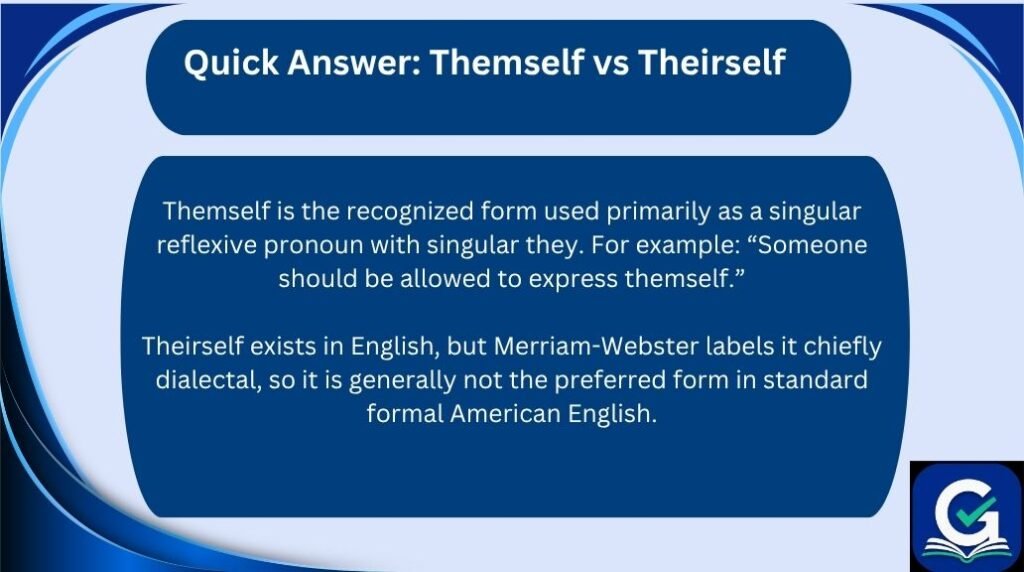
Themself is the recognized form used primarily as a singular reflexive pronoun with singular they. For example: “Someone should be allowed to express themself.”
Theirself exists in English, but Merriam-Webster labels it chiefly dialectal, so it is generally not the preferred form in standard formal American English.
For most standard writing, remember:
Singular they → themself or themselves, depending on style and context
Theirself → generally avoid in standard formal writing
There is also an important point: themselves remains extremely common and is widely accepted with singular they. Merriam-Webster specifically records themselves with singular indefinite antecedents as well as its traditional plural use.
Understanding the Basics of Themself vs Theirself
To understand themself vs theirself, you first need to understand what a reflexive pronoun is.
A reflexive pronoun refers back to the subject of a sentence. Common examples include:
- I → myself
- You → yourself
- He → himself
- She → herself
- It → itself
- We → ourselves
- They → themselves
- Singular they → themself in some usage
For example:
Jordan reminded themself to bring the documents.
The subject is Jordan, and themself refers back to Jordan.
Merriam-Webster defines a reflexive pronoun as a pronoun that refers to the subject of the sentence, clause, or verbal phrase.
Comparison Table
| Form | Type | Meaning | Example | Correct/Incorrect |
|---|---|---|---|---|
| themself | Reflexive pronoun | One person referred to with singular they | “Alex reminded themself to call.” | ✅ Recognized |
| themselves | Reflexive pronoun | Multiple people, and also commonly singular they | “They prepared themselves.” | ✅ Standard |
| theirself | Reflexive pronoun | Dialectal variant of themself | “They did it theirself.” | ⚠️ Dialectal |
| theirselves | Reflexive pronoun | Nonstandard/dialectal form | “They did it theirselves.” | ❌ Avoid in standard writing |
The key issue in themself vs theirself is that themself follows the object-pronoun form them, while theirself is based on the possessive determiner their.
What Does “Themself” Mean?
Themself is a reflexive pronoun used with singular they.
It can refer to one person whose gender is unknown, unspecified, or intentionally not identified. It can also refer to a person who uses they/them pronouns.
For example:
Someone should be able to make decisions for themself.
Here, someone is singular, and themself refers back to that person.
Another example:
Taylor wants to be themself at work.
Here, themself refers to Taylor.
Merriam-Webster describes themself as a gender-neutral reflexive form of they used chiefly when referring to a single person indefinitely or to a nonbinary person.
Cambridge also records themself for situations where singular they is used, although Cambridge currently labels the form “not standard.”
This difference between dictionaries is important: themself is recognized and increasingly used, but not every style guide or authority treats it as equally standard.
How “Themself” Works in a Sentence
Consider:
The employee reminded themself to submit the report.
Let’s break it down:
- The employee = subject
- reminded = verb
- themself = reflexive pronoun
- to submit the report = infinitive phrase
The word themself points back to the employee.
Another example:
If anyone wants to challenge themself, they should start small.
Here:
- anyone is grammatically singular.
- they is used as singular gender-neutral pronoun.
- themself functions as the reflexive form.
This is one of the situations in which themself has become increasingly useful.
What Does “Theirself” Mean?
Theirself is a much less standard form.
Merriam-Webster lists theirself as a pronoun meaning themself but labels it chiefly dialectal. It also records its first known use in the 14th century.
That means theirself is not simply an invented word. It has a historical presence in English. However, its existence does not mean it is the best choice for standard professional or academic writing.
For example:
They completed the project theirself.
You may encounter this sentence in regional or informal speech, but in standard American English, a better choice would usually be:
They completed the project themself.
Or, depending on the context:
They completed the project themselves.
This distinction is crucial when discussing themself vs theirself. One is recognized as a singular reflexive form; the other is chiefly dialectal.
Why Is “Theirself” So Tempting?
The confusion makes sense.
English reflexive pronouns do not always look completely predictable:
- my → myself
- your → yourself
- our → ourselves
- their → ?
Because people see their + self, it may seem logical that the reflexive form should be theirself.
But English does not form every reflexive pronoun by simply adding -self to the possessive form.
Consider:
- him → himself, not hisself
- them → themselves, not theirselves
- them → themself, not theirself
The object form them is the important starting point.
This is why theirself can feel logical while still being nonstandard in most formal contexts.
Themself vs Theirself: The Core Grammar Rule
The easiest rule is:
Use “themself” when you need a singular reflexive form of “they” in a context where that form is appropriate. Avoid “theirself” in standard formal writing.
For example:
✅ Someone should be free to express themself.
⚠️ Someone should be free to express theirself.
The first follows the established singular-they pattern.
The second uses the dialectal form theirself.
However, there is another option:
✅ Someone should be free to express themselves.
This is especially important because themselves is widely accepted with singular they. Merriam-Webster explicitly records singular uses of themselves, including examples with indefinite singular antecedents.
So, depending on your audience and style guide, you may encounter:
Someone should be able to express themself.
and:
Someone should be able to express themselves.
Both can occur in modern English, although different authorities have different preferences.
Themself vs Themselves
Before choosing between themself vs theirself, it helps to understand the more important comparison: themself vs themselves.
“Themselves” for plural they
When they refers to multiple people, themselves is the standard reflexive pronoun.
The students prepared themselves for the exam.
Here, the students is plural.
Another example:
The employees introduced themselves.
Again, several employees are involved.
“Themselves” with singular they
Modern English also frequently uses themselves when they refers to one person.
Someone should be proud of themselves.
This usage is widely established.
Merriam-Webster gives themselves a singular use with indefinite third-person antecedents.
“Themself” for singular they
Themself makes the singular meaning more visible:
Someone should be proud of themself.
This makes the singular reference explicit.
Merriam-Webster recognizes this usage, particularly with singular indefinite they and nonbinary individuals.
Correct Meanings and Uses
1. Use “Themself” for a Singular Person
One common use of themself is when they refers to one person.
Example:
Every student should give themself enough time to finish.
Here, every student refers to one student at a time.
The structure is:
Every student → they → themself
The reflexive pronoun points back to the singular subject.
2. Use “Themself” With a Nonbinary Person Who Uses They/Them Pronouns
If a person uses they/them pronouns and prefers themself, the form can be appropriate.
Example:
Morgan introduced themself to the new team.
Here, themself refers directly back to Morgan.
The person’s pronouns and preferences should guide the choice when known.
3. Use “Themselves” for Multiple People
When they refers to several people, use themselves.
The players congratulated themselves after the victory.
The subject is plural, so themselves is the natural standard form.
4. Use “Themselves” for Singular They When Preferred by Your Style
If your style guide or publication prefers themselves for singular they, use it consistently.
For example:
If anyone needs help, they can ask themselves whether the plan is practical.
A more natural example would be:
Anyone can remind themselves to slow down.
This form is common in modern standard English.
Test Tip: Try the “He/She” Test
When you are unsure about themself vs theirself, replace the gender-neutral pronoun with himself or herself.
For example:
Alex reminded themself to stay calm.
Imagine:
Alex reminded himself to stay calm.
or:
Alex reminded herself to stay calm.
Because himself/herself are reflexive pronouns, the corresponding gender-neutral option can be themself.
Now try:
Alex reminded theirself to stay calm.
That construction does not follow the same standard reflexive pattern.
Easy memory trick:
them → themself
Not:
their → theirself
This one substitution can help you remember the difference.
Case Study: A Workplace Example
Imagine an employee named Jordan is preparing a presentation.
Jordan uses they/them pronouns.
A manager writes:
Jordan prepared theirself for the presentation.
The sentence may be understandable, but theirself is dialectal and would not normally be the preferred form in polished professional writing.
A better version is:
Jordan prepared themself for the presentation.
Another acceptable modern option, depending on the organization’s style, is:
Jordan prepared themselves for the presentation.
Why does this matter?
In a workplace, word choice affects how polished and intentional a message sounds.
Compare:
❌ Jordan prepared theirself for the presentation.
✅ Jordan prepared themself for the presentation.
✅ Jordan prepared themselves for the presentation.
The second and third versions are much more suitable for professional communication.
Grammar Rules Behind the Difference
The basic structure of English pronouns helps explain themself vs theirself.
Consider the pronoun set:
| Subject | Object | Possessive | Reflexive |
|---|---|---|---|
| I | me | my/mine | myself |
| you | you | your/yours | yourself |
| he | him | his | himself |
| she | her | her/hers | herself |
| it | it | its | itself |
| we | us | our/ours | ourselves |
| they | them | their/theirs | themselves |
| singular they | them | their/theirs | themself/themselves |
Notice the distinction:
them is the object form.
their is the possessive form.
That is why themself has a stronger grammatical basis than theirself when creating a singular reflexive form of they.
Merriam-Webster specifically recognizes themself, while its entry for theirself labels the latter chiefly dialectal.
Is “Themself” Actually a Real Word?
Yes.
This is one of the most common questions about the topic.
Themself is a real English word. Merriam-Webster has a dictionary entry for it and explains its use with singular they.
It is also not a completely new invention.
Merriam-Webster notes historical uses of themself, including examples from earlier periods of English. Its usage became less common as themselves became established.
Today, the word has gained renewed attention because singular they is widely used.
So if your spell-checker marks themself as unusual, that does not automatically mean the word is wrong.
Is “Theirself” a Real Word?
Yes, but there is an important qualification.
Theirself is a dictionary-recognized word, but it is chiefly dialectal. Merriam-Webster gives it the definition “themself” and labels it chiefly dialectal.
Therefore, it is better to distinguish:
- Real word? Yes.
- Standard choice in formal American English? Generally no.
- Can it occur in dialect or informal speech? Yes.
- Best choice for professional writing? Usually not.
This is a good example of why the terms correct and standard are not always identical.
A form can exist in English without being the preferred form in formal standard English.
Common Mistakes With Themself and Theirself
Why do people confuse these forms?
Several factors can contribute.
1. Fast Typing
When people type quickly, they often choose the form that feels intuitive.
Because their is familiar, theirself can appear naturally.
2. Autocorrect
Phones and word processors may recognize themselves but flag themself. This can encourage writers to replace a less familiar word with something that appears more familiar.
Merriam-Webster has even discussed how autocorrect can react to themself.
3. Lack of Familiarity
Many people learned traditional pronouns such as:
- himself
- herself
- themselves
They may never have been taught about themself.
4. The Possessive Trap
Writers sometimes assume:
their + self = theirself
But English reflexive forms are not always created that way.
That assumption can also produce forms such as theirselves.
Similar Grammar Confusions
The confusion surrounding themself vs theirself belongs to a larger family of commonly confused English forms.
| Confusion | Correct Forms | Common Mistake |
|---|---|---|
| its vs it’s | its / it’s | ❌ using it’s for possession |
| your vs you’re | your / you’re | ❌ mixing possession and contraction |
| their vs they’re | their / they’re | ❌ confusing possession and contraction |
| affect vs effect | affect / effect | ❌ treating them as interchangeable |
| then vs than | then / than | ❌ confusing time and comparison |
| themselves vs themself | depends on number/style | ❌ assuming only one form can ever occur |
| themself vs theirself | themself / themselves generally preferred | ❌ using dialectal theirself in formal writing |
The common pattern is simple: English words that sound or look similar are not necessarily grammatically interchangeable.
Usage in Different Contexts
Everyday Conversation
Informal conversation is flexible.
You may hear:
They did it theirself.
This can occur in certain dialects and regional varieties.
However, if you are speaking standard American English, themself or themselves is generally a better choice.
For example:
They decided to handle it themself.
or:
They decided to handle it themselves.
Professional Writing
Professional writing requires greater consistency.
For emails, reports, resumes, business documents, and workplace communication, avoid theirself.
Prefer:
The employee should give themself time to review the document.
Or:
The employee should give themselves time to review the document.
Which one you choose may depend on your organization’s style guide and your intended treatment of singular they.
Academic Writing
Academic writing benefits from precise and consistent pronoun usage.
If your institution or style guide permits themself, you can use it when appropriate.
However, because authorities differ in how strongly they endorse the form, themselves may be the safer choice for some formal academic contexts.
The important point is to follow the relevant style guide consistently.
Creative Writing
Creative writing gives you more flexibility.
If you are writing dialogue for a character who speaks a particular dialect, theirself may be appropriate because it can help represent authentic speech.
For example:
“I did it theirself,” the character said.
In this case, the unusual form may be intentional characterization.
However, narration should follow your chosen standard unless you have a deliberate stylistic reason to do otherwise.
Social Media and Texting
Social media is less formal.
You may see all kinds of forms, including:
- themself
- themselves
- theirself
- theirselves
That does not mean all four are equally standard.
If you want your post to look polished, themself or themselves is generally preferable to theirself.
Why This Difference Matters
At first, themself vs theirself may seem like a tiny grammatical detail.
But small details can affect communication.
Clarity
Standard forms make your meaning easier for readers to process.
Professionalism
In workplace communication, unusual dialectal forms may distract readers from your message.
Accuracy
Using established grammatical forms demonstrates control over language.
Digital Communication
Emails, websites, applications, and social media posts are often read quickly. Familiar forms reduce unnecessary confusion.
A useful principle is:
Choose the form that makes your meaning clear and matches your audience.
That principle is especially valuable because language changes over time. Singular they is now widely used, and the reflexive form themself is becoming more visible. Merriam-Webster notes that themself has gained traction alongside the broader acceptance of singular they.
A Short Quote to Remember
“Choose clarity over confusion.”
When two forms are possible, choose the one your audience will understand most naturally and that fits the style of writing you are producing.
Special Exception: Dialect and Historical Usage
There is an important exception when discussing theirself.
You should not assume that every occurrence of theirself is simply a spelling mistake.
Merriam-Webster identifies theirself as chiefly dialectal and records historical use dating back centuries.
That means it can legitimately appear in:
- Regional speech
- Dialect writing
- Character dialogue
- Historical texts
- Informal language
For example, an author writing realistic dialogue may intentionally use theirself to reflect a character’s speech.
The same principle applies to many dialectal forms. A word can be nonstandard in formal writing while still being meaningful and authentic within a particular speech community.
So the better rule is not:
“Theirself is not a word.”
Instead, say:
“Theirself is a chiefly dialectal form and is generally not the preferred choice in standard formal writing.”
That is more accurate.
Themself vs Theirself: Quick Recap Checklist
Use this checklist whenever you are unsure.
| Question | If Yes → Use |
|---|---|
| Does they refer to multiple people? | themselves |
| Does they refer to one person? | themself or themselves, depending on style/context |
| Are you writing formal American English? | Prefer themself/themselves, not theirself |
| Are you intentionally representing a dialect? | theirself may be appropriate |
| Does your style guide prefer themselves with singular they? | themselves |
| Are you unsure whether theirself is standard? | Choose themself or themselves |
Practice Example 1
Everyone should be able to express ___.
Answer: themself or themselves, depending on your style.
Practice Example 2
The children prepared ___ for the trip.
Answer: themselves
Because children is plural.
Practice Example 3
Taylor completed the assignment ___.
If Taylor uses singular they:
Answer: themself or themselves, depending on the preferred style.
Not theirself in standard formal writing.
A Simple Way to Remember the Rule
If you remember only one thing about themself vs theirself, remember this:
Think “them,” not “their.”
The standard object pronoun is:
them
The corresponding reflexive form is:
themself / themselves
Not:
❌ theirself
You can also remember the traditional pattern:
him → himself
her → herself
them → themself/themselves
That makes the distinction much easier.
FAQs About Themself vs Theirself
1. Is “themself” grammatically correct?
Yes. Themself is a recognized English reflexive pronoun, especially when singular they refers to one person. Merriam-Webster specifically records it in this sense.
However, some authorities treat themself as less standard than themselves, so the preferred form can depend on the style guide.
2. Is “theirself” correct?
Theirself exists, but it is chiefly dialectal. Merriam-Webster lists it as a dialectal form of themself.
For standard professional or academic writing, it is generally better to use themself or themselves.
3. Should I use “themself” or “themselves” for one person?
Both forms can occur with singular they.
Themself emphasizes the singular construction:
Someone should be able to decide for themself.
Themselves is also widely accepted:
Someone should be able to decide for themselves.
Merriam-Webster recognizes singular uses of themselves, while also recognizing themself.
4. Is “theirself” the same as “themself”?
They can communicate the same basic idea, but they do not have the same standard status.
Themself is recognized as a singular reflexive form of they.
Theirself is chiefly dialectal.
Therefore, they should not be treated as interchangeable in formal writing.
5. Why do people say “theirself”?
The form likely feels logical because English speakers see the possessive their and may naturally combine it with -self.
Dialect, regional speech, historical usage, and informal language also contribute to its continued use.
Its existence is documented in dictionaries, but its use is generally more limited than themself or themselves.
6. Is “themselves” acceptable for singular “they”?
Yes. Singular they can take themselves, and this usage is widely established.
For example:
If anyone wants to improve, they should challenge themselves.
Merriam-Webster explicitly includes singular indefinite uses of themselves.
Conclusion
The difference between themself vs theirself becomes much easier once you understand how English reflexive pronouns work. Themself is a recognized singular reflexive form associated with singular they, particularly when referring to one person. Themselves is also widely accepted and remains the standard reflexive form for plural they and a common choice for singular they.
Theirself, meanwhile, is a real historical and dialectal form, but it is generally not the best choice for standard formal American English. Merriam-Webster labels it chiefly dialectal.
So when you’re writing an email, article, school assignment, or professional document, remember the simple rule: choose themself or themselves, not theirself, unless you have a specific dialectal or creative reason to use it.
When in doubt, think “them → themself,” and your grammar will stay on the right track. ✍️

I’m Clara Bennett, a vocabulary and language specialist at Gramfino, where I write about word meanings and proper usage.
I love helping readers choose the right words and build stronger English vocabulary with confidence.
[…] to use each one, common mistakes to avoid, and the easiest way to remember the correct spelling. Themself vs Theirself | Counselor vs Councilor | Shears vs […]