Have you ever wondered about the difference between fourth vs forth while writing an email, school assignment, or everyday message? 🤔 These two words sound almost identical when spoken, but they have completely different meanings and uses. That small spelling difference can change the meaning of an entire sentence.
The confusion is understandable because both words are commonly heard in English. However, fourth is connected to the number four and is used for position, order, or one of four equal parts. Forth, on the other hand, generally means forward, onward, or outward. For example, you might say, “She finished fourth in the race,” but “The explorers moved forth into the unknown.” The first sentence describes a position, while the second describes movement.
Understanding fourth vs forth can help students, professionals, writers, and English learners avoid common spelling and grammar mistakes. Once you learn the simple rule behind these words, choosing the correct one becomes much easier. Cue vs Queue | Aberrant vs Abberant | Across vs Accros
Quick Answer: Fourth vs Forth
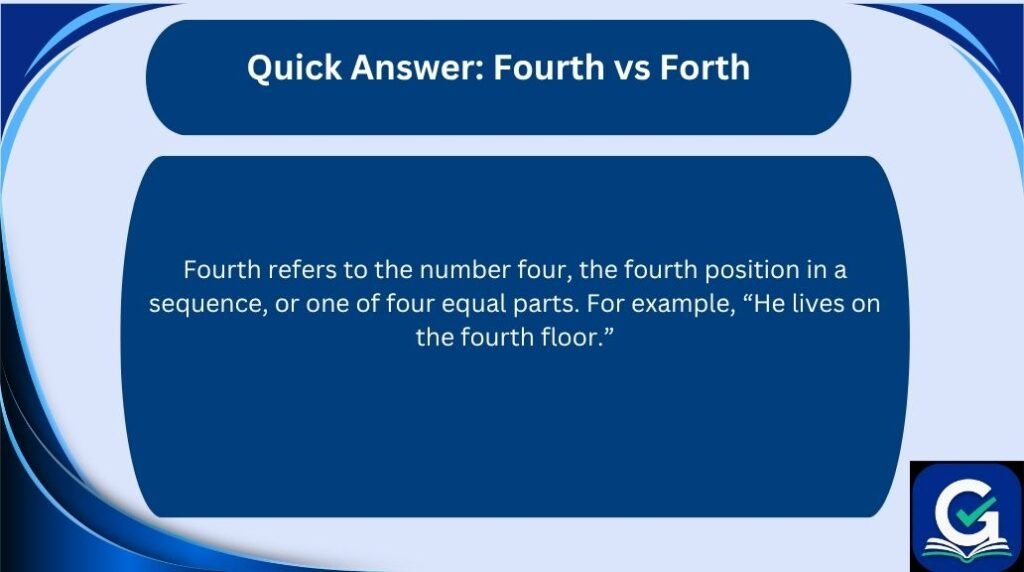
Fourth refers to the number four, the fourth position in a sequence, or one of four equal parts. For example, “He lives on the fourth floor.”
Forth is an adverb that generally means forward, onward, or outward. For example, “The explorers moved forth into the unknown.” Merriam-Webster defines forth with meanings related to moving onward or forward and coming out into notice or view.
Easy rule:
👉 Fourth = four or 4th
👉 Forth = forward or onward
Understanding the Basics: Fourth vs Forth
The easiest way to understand these words is to connect each spelling with its meaning.
Fourth contains the word four. This gives you a useful memory clue. Whenever you are talking about the number four, the fourth position, or something divided into four equal parts, fourth is generally the correct choice.
Forth has no connection to the number four. It is primarily used to describe movement forward or outward, progression, or something becoming visible.
Fourth vs Forth Comparison Table
| Form | Type | Meaning | Example | Correct/Incorrect |
|---|---|---|---|---|
| fourth | Adjective | Coming after third | She won fourth place. | Correct |
| fourth | Noun | One of four equal parts or the fourth item | I ate a fourth of the cake. | Correct |
| fourth | Adverb | In fourth position | He finished fourth. | Correct |
| forth | Adverb | Forward or onward | The soldiers marched forth. | Correct |
| forth | Adverb | Out into view | New evidence came forth. | Correct |
| forth | Adverb | In established phrases | We talked back and forth. | Correct |
| forth | — | Meaning 4th in a sequence | She finished forth. | Incorrect |
The important point is that both words are correct English words. The mistake occurs when one is used in place of the other.
What Does “Fourth” Mean?
Fourth Means Number Four in a Sequence
The most common use of fourth is to describe something that comes immediately after the third item.
Consider this sequence:
- First
- Second
- Third
- Fourth
If something occupies position number four, use fourth.
Examples:
- She came in fourth place.
- Today is my fourth day at work.
- This is the fourth chapter of the book.
- He finished in fourth position.
- We are meeting on the fourth floor.
In each sentence, fourth identifies a position in an order or sequence.
Fourth Can Describe One of Four Equal Parts
Fourth can also refer to one of four equal portions.
For example:
- She ate a fourth of the pizza.
- One fourth of the students were absent.
- Divide the cake into four equal parts and take one fourth.
- A fourth of the budget was spent on equipment.
Here, fourth does not mean “position number four.” Instead, it means one out of four equal parts, or 1/4.
Fourth as a Noun
The word can function as a noun when it identifies the fourth person, thing, position, or portion.
Examples:
The fourth was the most difficult question.
He finished fourth in the competition.
I only ate a fourth of the sandwich.
The exact grammatical role depends on the sentence, but the connection to four remains.
Fourth in Dates and Holidays
You may also see fourth in expressions involving dates and holidays.
For example:
- The Fourth of July
- The fourth day of the month
- The fourth week of the year
- The fourth quarter
In the Fourth of July, the word identifies July 4, a specific date associated with Independence Day in the United States.
Fourth in Sports
Sports writing frequently uses fourth because rankings and positions matter.
Examples include:
- fourth place
- fourth quarter
- fourth inning
- fourth down
- fourth round
- fourth seed
For example:
The team scored twice in the fourth quarter.
Here, fourth tells us which quarter is being discussed.
What Does “Forth” Mean?
Unlike fourth, the word forth is not associated with the number four.
Merriam-Webster defines forth as an adverb meaning onward or forward in time, place, or order. It can also describe something coming out into notice or view.
Forth Means Forward or Onward
One of the clearest meanings of forth is forward or onward.
Examples:
- The travelers moved forth.
- The soldiers marched forth.
- She stepped forth to speak.
- The explorers went forth into the wilderness.
- From that day forth, everything changed.
The word often has a formal, literary, or dramatic tone. In ordinary conversation, people are more likely to use forward, ahead, or onward.
For example:
The explorers moved forth.
This is grammatically correct, but:
The explorers moved forward.
sounds more natural in everyday American English.
Forth Can Mean Outward or Into View
Forth can also describe something becoming visible or emerging.
Examples:
- New evidence came forth.
- The flowers sprang forth after the rain.
- The speaker brought forth an interesting idea.
- The truth eventually came forth.
- The volcano burst forth with lava.
The idea is that something moves from a hidden, inactive, or contained state into a visible or noticeable one.
Forth in “Back and Forth”
One of the most familiar expressions containing forth is back and forth.
It means moving repeatedly between two directions, places, people, or ideas.
Examples:
- The children ran back and forth.
- We went back and forth about the decision.
- They exchanged emails back and forth.
- The argument continued back and forth for hours.
Notice that forth is not related to “four” in this expression.
Forth in “And So Forth”
Another common phrase is and so forth.
It means and so on or indicates that a list continues.
Example:
We discussed the schedule, budget, deadlines, and so forth.
This expression is still common in formal and everyday writing.
Forth in “Set Forth”
The phrase set forth has several uses.
It can mean to begin a journey:
The travelers set forth before sunrise.
It can also mean to explain, state, or present something:
The report sets forth several important recommendations.
Merriam-Webster lists set forth as meaning to give an account or statement and also to start out on a journey.
Fourth vs Forth: The Simple Memory Trick
If you constantly confuse these words, use this simple trick:
Think “Four” → Fourth
If the sentence involves:
- 4
- 4th
- position
- order
- ranking
- four equal parts
- a sequence
use fourth.
For example:
This is my fourth attempt.
There are four attempts, and this one comes after the first three.
Think “Forward” → Forth
If the sentence involves:
- movement
- going onward
- moving outward
- emerging
- progressing
use forth.
For example:
The group marched forth.
They moved forward.
The One-Second Test
Ask yourself:
Can I replace the word with “4th”?
If yes, use fourth.
Can I replace it with “forward” or “onward”?
If yes, use forth.
Compare:
She finished fourth.
Can you say “She finished 4th”? Yes. ✅
She stepped forth.
Can you say “She stepped forward”? Yes. ✅
This test works in many everyday situations.
Correct Meanings & Uses
Fourth for Position
Use fourth when identifying something after the first three items.
Example:
Maya finished fourth in the spelling competition.
Breakdown:
- Maya = subject
- finished = verb
- fourth = position
The word tells us Maya ranked number four.
Fourth for a Fraction
Use fourth when referring to one of four equal parts.
Example:
He drank a fourth of the bottle.
Breakdown:
- He = subject
- drank = verb
- a fourth = one of four equal parts
- of the bottle = what was divided
Forth for Forward Movement
Use forth when something moves forward or onward.
Example:
The hikers continued forth despite the rain.
Here, forth communicates movement onward.
Forth for Emerging Information
Use forth when something becomes known, visible, or available.
Example:
More details came forth during the investigation.
The details became known or emerged.
Test Tip
When you see a blank in a sentence, don’t focus only on pronunciation.
Instead, ask:
Is this about four? → fourth
Is this about forward movement or emergence? → forth
That meaning-based test is more reliable than trying to hear the spelling.
Case Study: A Workplace Example
Imagine an employee is writing an email about a quarterly meeting.
Here is an incorrect version:
“The meeting will take place on the forth floor at 10 a.m.”
The sentence contains a spelling mistake because the writer is talking about floor number four.
The correct version is:
“The meeting will take place on the fourth floor at 10 a.m.”
Why?
Because the word describes the floor’s position in a numbered sequence.
Now consider another sentence:
“After the meeting, the team set forth several recommendations.”
Here, forth is correct because it appears in the expression set forth, meaning the team presented or stated recommendations.
This example shows why context matters. Both words may appear in professional writing, but they perform completely different jobs.
Grammar Rules for Fourth vs Forth
The core grammar rule is based on meaning, not pronunciation.
Fourth is the ordinal form associated with the number four. It identifies position in a sequence or can refer to one of four equal parts. Standard American English dictionaries recognize these uses.
Forth is primarily an adverb. It communicates ideas such as forward, onward, outward, or into view. Merriam-Webster specifically lists meanings involving movement onward in time or place and movement out into notice or view.
Therefore:
She finished fourth.
is correct because she finished in position 4.
But:
She finished forth.
is incorrect if the intended meaning is “in fourth place.”
Similarly:
The travelers went forth.
is correct because they moved onward.
But:
The travelers went fourth.
would normally be incorrect if the intended meaning is movement.
Why Are They So Easy to Confuse?
The words are homophones or near-homophones in many varieties of English. They sound the same or extremely similar when spoken.
That means listeners may understand the intended word from context even when they cannot see the spelling.
Writing is different.
When you type the wrong form, readers see the mistake immediately.
Common Mistakes With Fourth and Forth
People commonly confuse these words for several reasons.
1. Fast Typing
When people type quickly, they may write the first spelling that comes to mind.
For example:
“I finished forth in the race.”
The writer probably knows the meaning but types the shorter-looking word by mistake.
2. Autocorrect
Autocorrect can sometimes reinforce a mistake rather than fix it. Since both fourth and forth are legitimate English words, a spell-checker may not always recognize that the wrong word was selected.
This is an important point: spell-checking a sentence is not the same as checking its meaning.
3. Lack of Knowledge
Some learners simply have not learned the distinction.
Because the words sound similar, it is easy to assume they are interchangeable.
They are not.
Similar Grammar Confusions
| Confused Words | Correct Difference |
|---|---|
| it’s / its | It’s = it is; its = possessive |
| your / you’re | Your = possession; you’re = you are |
| their / there / they’re | Possession / place / they are |
| to / too / two | Direction / also / number |
| then / than | Time or sequence / comparison |
| affect / effect | Usually verb / usually noun |
| accept / except | Receive or agree / excluding |
| advice / advise | Noun / verb |
| fourth / forth | Number or position / forward or onward |
Learning these distinctions improves both accuracy and confidence.
Fourth vs Forth in Different Contexts
Everyday Conversation
In ordinary conversation, fourth is common when discussing rankings, floors, days, attempts, or sequences.
Examples:
- “This is my fourth cup of coffee.”
- “She lives on the fourth floor.”
- “That was his fourth attempt.”
Forth is less common in casual speech but appears in familiar phrases.
Examples:
- “We went back and forth.”
- “And so forth.”
- “From this day forth.”
Professional Writing
Professional writing requires precise word choice.
Use fourth for:
- fourth quarter
- fourth stage
- fourth floor
- fourth meeting
- fourth position
Use forth in established phrases such as:
- set forth
- put forth
- bring forth
- go forth
- from this point forth
For example:
The proposal sets forth the company’s objectives for the coming year.
Creative Writing
Writers may use forth more frequently in literary or dramatic language.
Examples:
The knight rode forth beneath the morning sun.
A new generation stepped forth to lead the community.
The word creates a sense of movement or progression.
By contrast:
The fourth knight entered the hall.
Here, fourth identifies position in a sequence.
Social Media and Texting
Texting often encourages shortcuts, but the distinction still matters.
For example:
“I got fourth place!”
is clear and correct.
Writing:
“I got forth place!”
can make the writer appear careless because forth does not mean “number four in a ranking.”
Even informal writing benefits from choosing the correct word.
Why Fourth vs Forth Matters
You may wonder whether this small spelling difference is really important.
It is.
Clarity in Communication
Correct word choice helps readers understand your exact meaning.
Compare:
She came fourth.
with:
She came forth.
The first means she ranked number four. The second suggests she came forward or emerged.
Those are very different ideas.
Professionalism
Spelling and word-choice mistakes can affect how readers perceive your writing.
A mistake in a casual text may not matter much. However, the same mistake in a resume, business email, academic assignment, report, or presentation can reduce confidence in the writer.
Accuracy in Digital Communication
Digital writing moves quickly. Emails, messages, social posts, reports, and online content are often written under time pressure.
That makes homophone confusion especially common.
A useful habit is to pause whenever two words sound alike but have different spellings.
A Simple Reminder
“Four means fourth; forward means forth.”
Keep that sentence in mind, and this confusion becomes much easier to avoid.
Special Exceptions and Edge Cases
There is an important distinction between ordinary forth and Forth as a proper noun.
Forth can refer to the Firth of Forth, an estuary in Scotland. It is also the name of the River Forth. Merriam-Webster lists Forth as a geographical name associated with a river and the Firth of Forth.
This is completely different from the ordinary word forth.
For example:
The River Forth is in Scotland.
Here, Forth is capitalized because it is a proper name.
There are also established phrases such as and so forth, back and forth, set forth, put forth, and bring forth.
These expressions should be learned as complete phrases rather than interpreted as references to the number four.
Fourth vs Forth: Quick Recap Checklist
Use this checklist whenever you are unsure.
| Question | If Yes → Use |
|---|---|
| Does it refer to number 4? | fourth |
| Does it mean 4th in a sequence? | fourth |
| Does it describe one of four equal parts? | fourth |
| Does it mean forward? | forth |
| Does it mean onward? | forth |
| Does it describe something coming into view? | forth |
| Is it part of “back and forth”? | forth |
| Is it part of “and so forth”? | forth |
| Is it part of “set forth”? | forth |
Practice Examples
1. She finished ___ in the competition.
Answer: fourth ✅
Why? She finished in position number four.
2. The travelers moved ___ before sunrise.
Answer: forth ✅
Why? They moved onward.
3. He ate a ___ of the pie.
Answer: fourth ✅
Why? He ate one of four equal parts.
4. The two friends argued back and ___.
Answer: forth ✅
Why? The expression is back and forth.
5. This is the ___ time I have visited the museum.
Answer: fourth ✅
Why? The visit is number four in the sequence.
FAQs
1. What is the difference between fourth and forth?
Fourth relates to the number four, the fourth position, or one of four equal parts. Forth generally means forward, onward, or outward. For example, “She finished fourth” refers to position, while “They marched forth” describes movement.
2. Is it fourth place or forth place?
The correct phrase is fourth place. A ranking of number four uses fourth because it is an ordinal number.
Correct:
She won fourth place.
Incorrect:
She won forth place.
3. Does forth mean forward?
Yes. Forth can mean forward or onward, especially in formal, literary, or established expressions. For example, “The travelers went forth” means they moved onward.
4. Is “back and fourth” correct?
No. The correct expression is back and forth.
Example:
We walked back and forth across the room.
Here, forth refers to movement in the opposite direction from “back.”
5. Is “fourth” related to the number four?
Yes. Fourth is the ordinal form associated with the number four. It indicates something that comes after the first, second, and third.
For example:
This is the fourth chapter.
6. How can I remember fourth vs forth?
Use the memory trick “four = fourth.” If the sentence refers to number four, position four, or a quarter of something, choose fourth. If the sentence means forward, onward, or outward, choose forth.
Conclusion
Understanding fourth vs forth becomes simple once you connect each word with its core meaning. Fourth is related to the number four. Use it for the fourth position in a sequence, rankings, dates, quarters, or one of four equal parts. For example, “She finished fourth,” and “I ate a fourth of the cake.”
Forth, by contrast, generally means forward, onward, or outward. It appears in expressions such as “go forth,” “back and forth,” “set forth,” and “and so forth.” It can also describe something emerging or coming into view.
The best way to remember the difference is short and powerful: four means fourth; forward means forth. When you pause to consider the meaning instead of relying only on sound, you can choose the correct spelling with confidence.
In English, one letter can change the meaning. Know the meaning, and the spelling becomes clear.

I’m Mason Reed, a grammar researcher at Gramfino, where I explore grammar rules and common English mistakes.
I turn my research into clear explanations and practical examples that readers can easily follow.
[…] news is that the difference is easy to remember once you connect each word with its main purpose. Fourth vs Forth | Cue vs Queue | Aberrant vs […]