Have you ever typed a sentence and suddenly wondered whether the correct word is censored vs sensored? You are not alone. These two spellings look surprisingly similar, especially when you are writing quickly, using autocorrect, or thinking about words related to “sensors.” However, they do not have the same status in standard English.
One is a common and correct English word, while the other is generally not the word you want when you mean that something has been removed, blocked, hidden, or suppressed.
I know this confusion can be frustrating because censored and sensored look as though they could both be forms of ordinary verbs. The key is to connect the spelling with the meaning. Censored comes from the verb censor, which means to examine something and remove or suppress material considered objectionable, sensitive, or inappropriate. Standard dictionaries recognize censored as the past tense and past participle of censor.
Once you understand where each form comes from, the choice becomes much easier. Sheath vs Sheathe | Complaint vs Complain | Canvas vs Canvass
Quick Answer: Censored vs Sensored
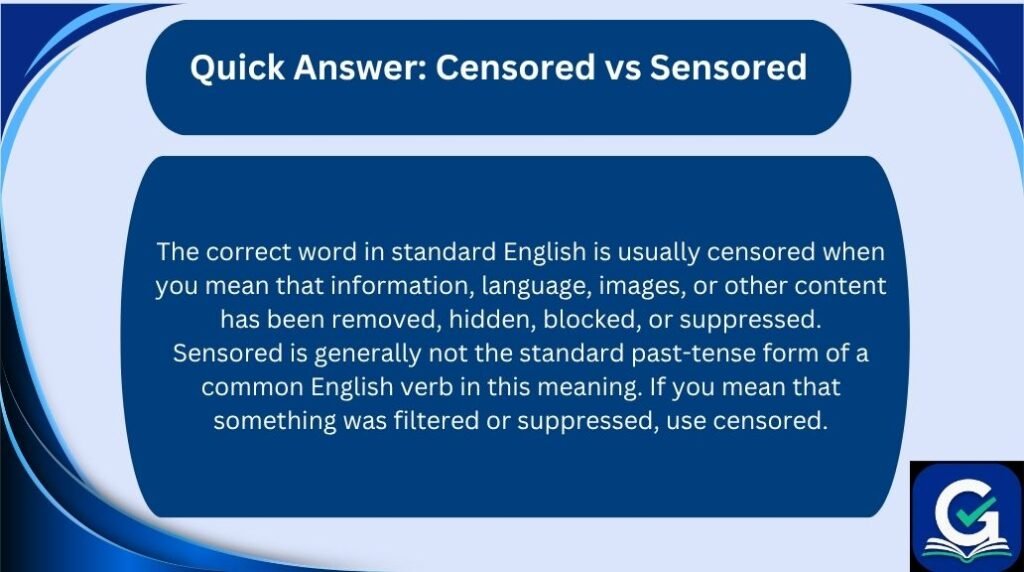
The correct word in standard English is usually censored when you mean that information, language, images, or other content has been removed, hidden, blocked, or suppressed.
Sensored is generally not the standard past-tense form of a common English verb in this meaning. If you mean that something was filtered or suppressed, use censored.
Example:
- Correct: The offensive language was censored from the movie.
- Incorrect in this meaning: The offensive language was sensored from the movie.
A useful memory trick is simple:
Censor → censored
Sensor → sensor-based technology
Understanding the Basics
To understand censored vs sensored, start with the words behind them.
What Does “Censored” Mean?
Censored is the past tense and past participle of censor.
Merriam-Webster defines censor as a verb meaning to examine something in order to suppress or delete material considered objectionable. It can apply to books, movies, news reports, communications, websites, speech, and other forms of content.
For example:
- The movie was censored before it was released.
- Several lines were censored from the interview.
- The newspaper published a censored version of the report.
In each sentence, something has been removed, blocked, altered, or suppressed.
What About “Sensored”?
Sensored is often produced because people associate the word with sensor.
A sensor is a device that detects or measures something, such as temperature, movement, light, pressure, or sound. The word sensor is real, but that does not automatically make sensored the correct verb for describing content that has been removed.
If you are talking about censorship, the correct word is censored.
Comparison Table
| Form | Type | Meaning | Example | Correct/Incorrect |
|---|---|---|---|---|
| censored | Past tense/past participle | Removed, suppressed, or blocked objectionable material | The scene was censored. | ✅ Correct |
| censor | Verb | To remove or suppress objectionable content | They censor offensive language. | ✅ Correct |
| censoring | Present participle | Removing or suppressing content | The network is censoring the program. | ✅ Correct |
| sensor | Noun | A device that detects or measures something | The motion sensor detected movement. | ✅ Correct |
| sensored | Nonstandard/incorrect in ordinary censorship usage | Often mistakenly used instead of censored | The scene was sensored. | ❌ Incorrect in this meaning |
The most important distinction is this:
Censor is connected to controlling or suppressing information.
Sensor is connected to detecting or measuring something.
What Does “Censored” Mean?
The word censored can be used in several closely related situations.
Censored Content
Something is censored when material has been removed or hidden because it is considered inappropriate, offensive, sensitive, dangerous, secret, or otherwise unsuitable for publication or distribution.
For example:
The television station aired a censored version of the movie.
The word censored tells us that the original content was changed by removing or hiding certain material.
Censored Language
You may also see the word when offensive or inappropriate language is removed.
For example:
The comedian’s strongest language was censored during the broadcast.
Here, the network has removed or covered certain words.
Common methods include:
- Bleeping a word
- Replacing a word
- Removing a sentence
- Muting audio
- Blurring an image
- Blocking part of a video
- Redacting sensitive information
All of these can be described using censored when the action is censorship.
Censored Documents
The term also appears in professional, legal, governmental, and journalistic contexts.
For example:
The agency released a censored copy of the report.
This could mean that sensitive information was removed before the document was made public.
The related noun censorship refers to the practice or process of restricting or suppressing material. Cambridge Dictionary similarly defines censored as the past form of censor and describes censorship as preventing all or part of communication from being publicly available for various reasons.
Why “Sensored” Looks Correct to Many People
The confusion between censored vs sensored makes sense when you look at their spelling.
The word sensor is extremely common in modern English.
We use sensors in:
- Smartphones
- Cars
- Security systems
- Thermostats
- Cameras
- Medical equipment
- Industrial machines
- Smart-home devices
Because sensor is familiar, people may naturally assume that sensored is its past-tense form.
That assumption can lead to sentences such as:
The video was sensored.
But if the writer means that inappropriate material was removed, the intended word is censored.
The spelling difference is only one letter, but the meanings are completely different.
Censor vs Sensor
Understanding censor and sensor makes the difference much easier to remember.
Censor
A censor is a person, organization, authority, or system that examines material and decides whether certain content should be removed or restricted.
As a verb, censor means to remove or suppress objectionable material.
Examples:
- The network censored the interview.
- Officials censored sensitive information.
- The editor censored several passages.
Sensor
A sensor is a device or mechanism that detects something.
Examples:
- The motion sensor turned on the lights.
- The temperature sensor is broken.
- The car uses sensors to detect nearby objects.
A sensor does not mean a person or organization that removes offensive content.
That distinction provides one of the easiest ways to remember the spelling.
Correct Meanings and Uses
Use “Censored” for Removed or Suppressed Content
Use censored when something has been deliberately removed, hidden, blocked, or altered.
Examples:
The newspaper published a censored version of the article.
Breakdown:
- The newspaper = subject
- published = verb
- a censored version = object
- of the article = explains what was changed
The word censored describes the version that had some content removed or suppressed.
Use “Censored” for Movies and Television
Entertainment is one of the most common contexts.
Examples:
The movie was censored for television.
The broadcast included a censored version of the song.
Several scenes were censored before the film aired.
Here, censored indicates that some original material was altered or removed.
Use “Censored” for Online Content
The word is also common when discussing internet content.
Examples:
The platform censored the post.
The video was censored because it violated the site’s rules.
Some users complained that their comments had been censored.
The exact reason for censorship can vary. The important point is that the content was restricted, removed, hidden, or altered.
Use “Censored” for Sensitive Information
You can also use the word for documents and information.
The public received a heavily censored report.
Sensitive names were censored from the document.
The released files contained several censored sections.
In formal contexts, redacted may sometimes be more precise when specific confidential information has been blacked out or removed from a document. However, censored is appropriate when the broader idea is suppression or restriction of content.
Test Tip: How to Choose the Correct Word
When you are unsure about censored vs sensored, ask yourself one question:
“Was something removed, hidden, blocked, or suppressed?”
If the answer is yes, use:
CENSORED
For example:
Was the offensive word removed?
Yes → The word was censored.
If you are talking about a device that detects something, use sensor instead.
For example:
Does the device detect movement?
Yes → It has a motion sensor.
This simple meaning-based test is much more reliable than trying to remember the spelling alone.
Censored vs Sensored in Real-Life Situations
Let’s look at practical situations where the confusion commonly occurs.
Example 1: Television
Incorrect:
The TV station sensored the violent scene.
Correct:
The TV station censored the violent scene.
Why?
The station removed or altered content. That is censorship.
Example 2: Social Media
Incorrect:
My post was sensored because of the language.
Correct:
My post was censored because of the language.
Why?
The platform restricted or removed content. The correct word is censored.
Example 3: Technology
Correct:
The motion sensor detected someone at the door.
Notice that we use sensor, not censor, because the device detects movement.
Example 4: Sensitive Documents
Correct:
The agency released a censored copy of the document.
The word censored works because portions of the document were withheld or removed.
Example 5: Audio
Correct:
The radio station censored the offensive word.
Again, the action involves removing or suppressing content.
Case Study: A Workplace Email
Imagine that an employee is preparing an email about a report.
The employee writes:
“The final report contains a sensored section.”
The manager may understand the intended meaning, but the sentence contains a word-choice problem.
A better version is:
“The final report contains a censored section.”
Why is this better?
The writer is saying that part of the report has been deliberately removed or hidden.
Now consider a different situation:
“The security system has a sensor near the entrance.”
This is completely different.
The sensor detects something. It does not censor information.
Workplace Lesson
Professional writing requires accurate word choice because small spelling differences can change meaning.
Using censored instead of sensored communicates the intended idea immediately and avoids distracting the reader.
Grammar Rules: Why “Censored” Is Correct
The grammatical reason is straightforward.
The verb is:
censor
Its standard forms include:
- Base form: censor
- Third-person singular: censors
- Present participle: censoring
- Past tense: censored
- Past participle: censored
Merriam-Webster explicitly lists censored as the past-tense form of censor and defines censor as examining material to suppress or delete objectionable content.
So:
They censor the content.
becomes:
They censored the content.
And:
The content has been censored.
These follow ordinary English verb formation.
Why “Sensored” Does Not Work Here
The noun sensor is a different word.
It refers to something that detects or measures.
For example:
The sensor detected heat.
It would be a mistake to replace censored with sensored simply because the words look similar.
The important rule is:
Censor → censored
Sensor → a detecting device
Do not choose a word based only on spelling. Choose it based on meaning and word origin.
A Note About Merriam-Webster
Merriam-Webster recognizes censor as both a noun and a verb. As a verb, it means to examine something and suppress or delete material considered objectionable. Its listed forms include censored and censoring.
Merriam-Webster also distinguishes censor from the related but different word censure. Censor involves suppressing or removing content, while censure means to criticize or reprimand.
That distinction is useful because English has several visually similar words:
- censor
- censored
- censorship
- censure
- censured
- sensor
They may look related, but they do not all have the same meaning.
Common Mistakes With “Censored vs Sensored”
Why do people write sensored when they mean censored?
Several factors contribute to the mistake.
1. Fast Typing
When people type quickly, they often write the first spelling that feels familiar.
Because sensor is a common modern word, sensored may seem natural.
2. Autocorrect
Autocorrect can sometimes reinforce an incorrect spelling, especially when the software interprets the sentence differently from the writer.
Always check the complete sentence rather than blindly accepting a suggested correction.
3. Lack of Knowledge
Some writers simply have not learned the difference.
That is understandable because the two forms are visually similar.
The best solution is to connect each word with its meaning.
4. Pronunciation
In ordinary speech, censor and sensor can sound very similar. This can make the spelling distinction difficult for language learners.
When two words sound alike or nearly alike, context becomes especially important.
Similar Grammar Confusions
The censored vs sensored confusion is part of a much larger group of English word-choice problems.
| Confusing Words | Correct Distinction |
|---|---|
| its / it’s | Its shows possession; it’s means it is or it has. |
| your / you’re | Your shows possession; you’re means you are. |
| their / they’re / there | Possession / they are / location or existence. |
| affect / effect | Usually verb / usually noun, though both have additional uses. |
| accept / except | Receive or agree / excluding. |
| advice / advise | Noun / verb. |
| than / then | Comparison / time or sequence. |
| principal / principle | Person or main item / rule or belief. |
| censor / sensor | Suppress content / detect or measure something. |
These mistakes are common because English contains many words that sound similar or look similar.
Usage in Different Contexts
Everyday Conversation
In casual conversation, people may say:
“They censored that part.”
This is natural and clear.
You generally do not need a complicated phrase. Censored is the ordinary word when content has been removed or restricted.
Professional Writing
Professional writing requires extra care.
Instead of:
“The document was sensored.”
Write:
“The document was censored.”
If you need to be more specific, you can say:
“The document was partially censored to remove confidential information.”
This sounds precise and professional.
Creative Writing
Authors can use censored to describe characters, media, or fictional governments.
For example:
The mysterious government had censored every reference to the event.
Creative writing may also use the word metaphorically:
She censored herself before revealing what she really thought.
This usage is connected to the idea of deliberately holding back speech or expression.
Social Media and Texting
On social media, you might see:
- “My comment was censored.”
- “The platform censored the video.”
- “The word was censored automatically.”
These are all natural uses.
In informal online writing, you may also encounter sensored. However, seeing a spelling online does not automatically make it standard English.
Censored, Redacted, Filtered, and Bleeped
These words are related, but they are not always interchangeable.
Censored
Means content has been suppressed, removed, or restricted.
The broadcast was censored.
Redacted
Usually refers to specific information removed or obscured from a document.
The names were redacted from the report.
Filtered
Often refers to software or systems automatically screening content.
The platform filtered offensive comments.
Bleeped
Usually refers specifically to offensive language being covered by a sound.
The television broadcast bleeped the swear word.
Understanding these distinctions can make your writing more precise.
Why This Difference Matters
At first glance, censored vs sensored may seem like a tiny spelling issue.
It is more important than it appears.
Clarity in Communication
Correct word choice helps readers understand your meaning immediately.
Compare:
The video was sensored.
with:
The video was censored.
The second sentence clearly communicates that content was suppressed.
Professionalism
Spelling and word-choice mistakes can make professional writing look careless.
A report, email, article, or presentation should use standard vocabulary whenever possible.
Digital Communication
The internet has made written communication faster than ever.
People write:
- Emails
- Comments
- Captions
- Messages
- Reports
- Reviews
- Posts
Because so much communication happens through text, accurate word choice matters.
A Short Reminder
Clear words create clear communication.
Choosing censored when you mean suppressed content is a small decision that makes your writing more accurate.
Special Exception: Is “Sensored” Ever Used?
This is where a little nuance is helpful.
Sensored can occasionally appear in informal, technical, commercial, or nonstandard contexts as an attempt to create a verb from sensor. You may encounter such usage in online writing, product descriptions, or specialized discussions.
However, that does not mean it should replace censored when you are discussing censorship.
If your sentence means:
“Someone removed or blocked this content.”
Use:
censored
If your sentence concerns:
“A device detecting or measuring something.”
Use:
sensor or an appropriate technical verb such as detected, measured, or sensed, depending on the intended meaning.
For standard US English, writers should not use sensored as a substitute for censored.
Censored vs Sensored: Easy Memory Tricks
Here are several ways to remember the difference.
Memory Trick 1: C = Content Control
Think:
C = Censor = Control content
If content is blocked or removed, choose censored.
Memory Trick 2: S = Sensor = Sensing
Think:
S = Sensor = Senses something
A sensor detects movement, heat, light, sound, pressure, or another physical property.
Memory Trick 3: Ask What Happened
If something was removed, it was:
censored
If something was detected, a:
sensor
may have detected it.
Memory Trick 4: Follow the Original Verb
The word censored comes directly from censor.
So:
censor → censored
Not:
sensor → sensored
when the meaning involves censorship.
Quick Recap Checklist
Use this checklist whenever you are unsure.
| Question | If Yes → Use |
|---|---|
| Was offensive language removed? | censored |
| Was part of a movie removed? | censored |
| Was information hidden from the public? | censored |
| Was a document partially suppressed? | censored |
| Did a device detect movement? | sensor |
| Did a device measure temperature? | sensor |
| Are you talking about a detecting device? | sensor |
| Are you describing content being suppressed? | censored |
Practice Example 1
The television station ______ the offensive scene.
Answer: censored
Practice Example 2
The motion ______ detected movement near the door.
Answer: sensor
Practice Example 3
Several names were ______ from the publicly released document.
Answer: censored or, depending on the exact document context, redacted.
More Example Sentences
Seeing the word in context is one of the best ways to remember it.
Correct Uses of “Censored”
- The film was censored before it reached theaters.
- The broadcaster censored the offensive language.
- The article contained several censored passages.
- The government released a censored version of the report.
- The video was censored for television.
- The platform censored the post after reviewing it.
- The actor’s comments were censored during the broadcast.
- The book was heavily censored when it was first published.
- The documentary included both censored and uncensored footage.
- The journalist criticized the decision to censor the story.
Merriam-Webster lists censored as the past-tense form of censor, while Cambridge likewise identifies it as the past simple and past participle of censor.
Correct Uses of “Sensor”
- The sensor detected movement.
- The temperature sensor stopped working.
- The car has a sensor that detects nearby objects.
- The camera uses a light sensor.
- The security system contains several motion sensors.
Notice how different the contexts are.
Censored vs Uncensored
Another useful pair to know is:
censored vs uncensored
Merriam-Webster defines uncensored as something that has not been censored, including a version in which material has not been deleted or suppressed.
Examples:
The streaming service offers both censored and uncensored versions.
I watched the uncensored interview.
The uncensored version contains language that was removed from the television broadcast.
This pair reinforces the spelling of censored.
If the opposite is uncensored, then the base word is clearly censor.
Censored vs Censure
There is another word that sometimes causes confusion: censure.
Although censor and censure look and sound similar, they have different meanings.
Censor
To remove or suppress objectionable content.
The network censored the scene.
Censure
To criticize or formally reprimand someone.
The committee censured the official for misconduct.
Merriam-Webster specifically distinguishes the two: censor involves suppressing or deleting content, while censure means finding fault with and criticizing someone.
So there are actually several similar-looking words worth remembering:
- censor = suppress content
- censored = content was suppressed
- censorship = the practice of suppressing content
- censure = criticize or reprimand
- sensor = detecting device
Keeping these meanings separate will prevent many spelling mistakes.
How to Improve Your Word Choice
If you frequently confuse similar words, try these strategies.
Read the Whole Sentence
Do not choose a word based on spelling alone.
Ask what the sentence is actually describing.
Identify the Root Word
For censored, the root is censor.
For a detecting device, the word is sensor.
Use a Dictionary
When you are unsure, check a reputable dictionary rather than relying on autocorrect.
Merriam-Webster and Cambridge both provide clear definitions and examples for censor and censored.
Create Your Own Examples
Write two sentences:
The network censored the program.
The motion sensor detected movement.
The contrast makes the difference easier to remember.
Frequently Asked Questions About Censored vs Sensored
1. Is “sensored” a correct word?
Sensored is generally not the standard word to use when you mean that content was removed, hidden, or suppressed. In that context, the correct word is censored, the past tense and past participle of censor.
2. Is it “censored” or “sensored”?
Use censored when something has been suppressed, removed, blocked, or altered because of its content.
For example:
The offensive scene was censored.
Use sensor when referring to a device that detects or measures something.
3. What does “censored” mean?
Censored means that something has been examined and had material removed, suppressed, blocked, or otherwise restricted. It is the past tense and past participle of censor.
4. What is the difference between censor and sensor?
A censor suppresses or removes objectionable content, while a sensor is a device that detects or measures something.
For example:
The editor censored the article.
The sensor detected smoke.
5. Can I use “sensored” in formal writing?
It is best to avoid sensored in formal standard US English when you mean censorship. Use censored instead.
If you are discussing technology, describe what the sensor actually did, such as detected, measured, or sensed, depending on the context.
6. Is “censored” the opposite of “uncensored”?
Yes. Censored describes content that has been suppressed or altered, while uncensored describes content that has not been censored. Merriam-Webster gives uncensored the meaning “not censored,” including material that has not been deleted or suppressed.
Conclusion
The difference between censored vs sensored becomes easy once you focus on meaning instead of spelling. Censored is the standard word when content has been removed, suppressed, blocked, hidden, or altered. It comes from the verb censor, whose standard past-tense and past-participle form is censored. Merriam-Webster and Cambridge both support this usage.
By contrast, sensor refers to a device that detects or measures something. While you may occasionally see sensored used informally or nonstandardly, it should not be used as a replacement for censored in ordinary standard English.
The easiest memory trick is to connect the first letter with the meaning: C for Censor and Content Control; S for Sensor and Sensing.
So, whenever something has been removed or suppressed, remember:
It was censored—not sensored. ✅

I’m Ethan Carter, a grammar writer at Gramfino, where I explain English grammar in a simple and practical way.
I enjoy helping readers understand sentence structure, grammar rules, and common writing mistakes.
[…] you connect each word with its main meaning, choosing the correct one becomes much easier. Censored vs Sensored | Sheath vs Sheathe | Complaint vs […]