Have you ever typed a simple word and suddenly wondered whether you spelled it correctly? Truly vs truely is a common English spelling confusion because the word true appears to suggest that adding -ly should produce truely. At first glance, that spelling seems logical, but standard English follows a different pattern.
The correct spelling is truly, while truely is considered a misspelling in standard English. The word truly is an adverb that can mean genuinely, sincerely, really, or in a truthful way. You might use it in a sentence such as, “I truly appreciate your help.”
Understanding truly vs truely is especially useful for students, professionals, bloggers, job seekers, and anyone who wants polished English writing. A small spelling mistake may not change the meaning of a sentence, but it can affect how accurate and professional the writing appears.
The good news is that this confusion is easy to solve. Once you remember the spelling pattern true → truly, you will know which form to choose whenever this question comes up. Elses vs Elses | Skill Set vs Skillset | Dwarfs vs Dwarves
Quick Answer: Truly vs Truely
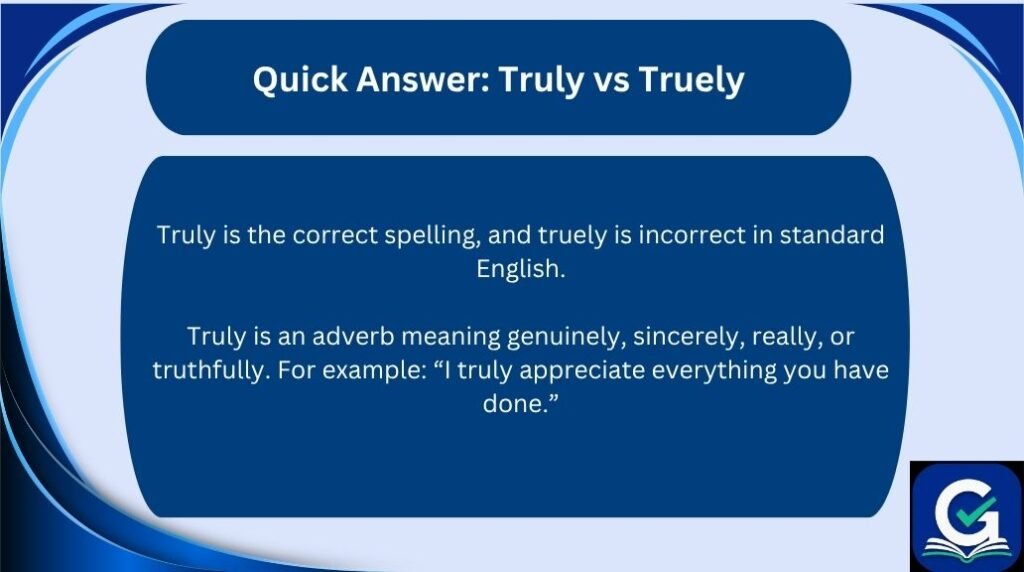
Truly is the correct spelling, and truely is incorrect in standard English.
Truly is an adverb meaning genuinely, sincerely, really, or truthfully. For example: “I truly appreciate everything you have done.”
The easiest rule to remember is:
True → truly, not truely.
Understanding Truly vs Truely
The basic difference between truly vs truely is spelling and standard usage. Truly is the accepted English form, while truely is a common spelling error.
The confusion happens because true ends in e. When writers try to form an adverb by adding -ly, they may assume that the original spelling should remain unchanged. However, the final e is dropped in truly.
Truly vs Truely Comparison Table
| Form | Type | Meaning | Example | Correct/Incorrect |
|---|---|---|---|---|
| truly | Adverb | Genuinely, sincerely, really | I truly value your advice. | ✅ Correct |
| truely | Misspelling | Intended to mean genuinely or sincerely | I truely value your advice. | ❌ Incorrect |
So, whenever you are deciding between truly vs truely, choose truly.
Truly vs Truely: What Does Truly Mean?
Truly is an adverb associated with the adjective true. It can express sincerity, truth, reality, or strong emphasis.
Its exact meaning depends on the sentence.
For example:
I truly believe you.
Here, truly means sincerely or genuinely.
Another example is:
This is truly impressive.
Here, truly adds emphasis to the adjective impressive.
You can also use it to describe genuine feelings:
She truly cares about her family.
In this sentence, truly emphasizes that her feelings are sincere.
Understanding these meanings makes it easier to recognize why truly is the correct word in different contexts.
Truly vs Truely: Why Is Truly Correct?
The spelling truly may seem unusual because the base adjective is true. However, English spelling sometimes changes when suffixes are added.
In this case:
true → truly
The final e is removed before -ly.
Writing:
true + ly = truely
may seem logical, but it does not produce the standard spelling.
Instead, standard English uses:
truly
This is why the following sentence is correct:
I truly understand your concern.
And this version is incorrect:
I truely understand your concern.
The spelling difference is small, but the correct form is important in formal and polished writing.
Truly vs Truely: Correct Meanings and Uses
The word truly can communicate several related ideas. Learning these meanings helps you use it naturally instead of simply memorizing the spelling.
Truly Means “Genuinely”
One common meaning of truly is genuinely.
She truly enjoys her work.
This sentence tells us that her enjoyment is genuine.
Another example:
He truly cares about his friends.
The word truly emphasizes that his concern is sincere.
Truly Means “Sincerely”
Truly can also communicate sincerity.
I truly appreciate your support.
The speaker is not simply saying “thank you.” The word emphasizes genuine appreciation.
Truly Means “Really”
In some sentences, truly can mean really or actually.
That was truly an amazing experience.
Here, truly strengthens the adjective amazing.
Truly Means “Truthfully”
The word can also emphasize that something is true.
I can truly say that this experience changed my life.
The speaker is emphasizing honesty and sincerity.
Truly vs Truely in Sentence Examples
Seeing truly vs truely in complete sentences can make the difference easier to remember.
Correct Examples
- I truly appreciate your kindness.
- She truly believes in herself.
- We truly enjoyed the event.
- He is truly talented.
- I am truly grateful for your help.
- This is truly remarkable.
- They truly understand the situation.
- You have truly made a difference.
Incorrect Examples
The following sentences contain the common spelling mistake:
- I truely appreciate your kindness.
- She truely believes in herself.
- We truely enjoyed the event.
- He is truely talented.
- I am truely grateful.
Replace truely with truly in every case.
Truly vs Truely: How to Use Truly With Verbs
Because truly is an adverb, it commonly appears near verbs.
For example:
I truly appreciate your help.
Here:
- I is the subject.
- truly is the adverb.
- appreciate is the verb.
- your help is the object.
Another example:
She truly understands the problem.
Here, truly modifies the verb understands and emphasizes the sincerity or completeness of the understanding.
Other examples include:
I truly believe this is the right decision.
We truly value your feedback.
He truly deserves the opportunity.
They truly understand what happened.
In all of these sentences, truly is the correct form.
Truly vs Truely: How to Use Truly With Adjectives
You can also use truly before an adjective to add emphasis.
Examples:
She is truly amazing.
The movie was truly entertaining.
This is truly important.
He is truly remarkable.
The landscape was truly beautiful.
In these examples, truly strengthens the adjective that follows it.
For example, in:
The view was truly beautiful.
Beautiful already describes the view, while truly adds emphasis.
This makes truly useful in both everyday and formal writing.
Truly vs Truely in Everyday Conversation
In everyday conversation, truly is often used when someone wants to sound sincere or emphasize a feeling.
For example:
“Thank you for helping me.”
“I truly appreciate it.”
Another example:
“Did you enjoy the trip?”
“Yes, I truly enjoyed it.”
Although really is often more common in casual speech, truly is perfectly natural.
Common conversational examples include:
- I truly understand how you feel.
- You truly made my day.
- I truly hope everything works out.
- She truly deserves this.
- That was truly amazing.
- I truly enjoyed meeting you.
The spelling does not change simply because the conversation is informal.
Truly vs Truely in Professional Writing
Correct spelling is particularly important in professional communication.
Imagine sending this email:
I truely appreciate your assistance.
Although the reader can understand the intended meaning, the spelling mistake makes the sentence look less polished.
The professional version is:
I truly appreciate your assistance.
You can use truly in:
- Business emails
- Reports
- Cover letters
- Resumes
- Proposals
- Workplace messages
- Customer service communication
For example:
We truly appreciate your continued support.
This sentence sounds professional, sincere, and grammatically correct.
Truly vs Truely in Academic Writing
Academic writing requires careful spelling and grammar. Therefore, truly should always be used instead of truely.
For example:
The findings truly demonstrate the importance of regular practice.
However, academic writers should use truly only when it contributes meaning. It should not be added to every sentence simply to increase word count.
Compare:
The results truly demonstrate the importance of accurate data.
with:
The results demonstrate the importance of accurate data.
Both can be grammatically correct. The first emphasizes the claim, while the second is more direct.
Good academic writing uses truly when the emphasis is meaningful.
Truly vs Truely in Creative Writing
Creative writing often uses truly to add emotion or emphasis.
For example:
For the first time, she felt truly free.
The word truly gives extra emotional weight to free.
Another example:
He truly believed that the old house contained a secret.
Here, truly helps readers understand that the character’s belief was genuine.
You may see truly in:
- Fiction
- Poetry
- Personal essays
- Memoirs
- Speeches
- Inspirational writing
The spelling remains the same in every genre.
Truly vs Truely in Social Media and Texting
People often type quickly on social media, which makes spelling mistakes more common.
Someone might write:
I truely love this picture!
The intended meaning is obvious, but the spelling is incorrect.
The correct version is:
I truly love this picture!
Even in informal digital communication, truly is the standard spelling.
If you are creating public content, captions, website copy, or professional posts, using the correct form helps your writing look more credible.
Truly vs Truely: Grammar Rules Explained
The central grammar and spelling rule behind truly vs truely is straightforward.
The adjective is:
true
The standard adverb is:
truly
The final e is removed before the suffix -ly.
This produces:
true → truly
not:
true → truely
Standard dictionaries such as Merriam-Webster list truly as the accepted English adverb.
The word can function as an adverb modifying verbs and adjectives, depending on the sentence.
For example:
I truly appreciate your help.
Here, truly modifies appreciate.
And:
She is truly talented.
Here, truly modifies talented.
Truly vs Truely: Common Mistakes
Many people write truely because the spelling appears logical.
Fast Typing
When people type quickly, they may spell words based on habit rather than carefully checking each letter.
Autocorrect
Autocorrect does not always prevent spelling errors. If the wrong form is not corrected, users may become accustomed to it.
Lack of Knowledge
Some writers simply have never learned the spelling pattern.
Visual Influence
Because true contains the letters t-r-u-e, it is natural to assume that the entire word remains intact when -ly is added.
However, standard spelling requires:
true → truly
Truly vs Truely and Other Common Confusions
The truly vs truely confusion is similar to many other English spelling and grammar problems.
| Confusion | Correct Forms | Main Difference |
|---|---|---|
| truly vs truely | truly | Standard spelling vs misspelling |
| its vs it’s | its / it’s | Possessive vs contraction |
| your vs you’re | your / you’re | Possessive vs contraction |
| their vs they’re | their / they’re | Possessive vs contraction |
| affect vs effect | affect / effect | Verb and noun uses |
| then vs than | then / than | Time/order vs comparison |
| definitely vs definately | definitely | Correct spelling vs misspelling |
| separate vs seperate | separate | Correct spelling vs misspelling |
These examples show why English learners should not always rely on what looks logical. Standard usage must guide the spelling.
Truly vs Truely: A Real-Life Workplace Example
Imagine an employee writing to a manager after receiving assistance on an important project.
Incorrect
Hi Mark,
I truely appreciate your help with the presentation. Your feedback made the final version much stronger.
The message is understandable, but truely is misspelled.
Correct
Hi Mark,
I truly appreciate your help with the presentation. Your feedback made the final version much stronger.
The second version is more polished and professional.
This example shows that a tiny spelling difference can influence the overall quality of written communication.
Truly vs Truely: A Simple Memory Trick
One of the easiest ways to remember truly vs truely is to memorize this transformation:
TRUE → TRULY
Think of it as:
True loses the E before LY.
Whenever you are about to type truely, stop and check whether the extra e is necessary.
It is not.
Write:
✅ truly
Instead of:
❌ truely
This simple memory trick can prevent the mistake in emails, essays, blog posts, and everyday writing.
Truly vs Truely: Test Tip
Here is a quick test you can use.
Question 1
Do you mean genuinely?
If yes → use truly.
Question 2
Do you mean sincerely?
If yes → use truly.
Question 3
Do you mean really?
If yes → use truly.
Question 4
Are you describing something as genuine or truthful?
If yes → use truly.
There is no standard English situation in which you need truely as the normal spelling of this adverb.
Truly vs Truely: Truly or Really?
The words truly and really can overlap in meaning, but they may create slightly different tones.
Really is extremely common in everyday speech.
I really appreciate your help.
Truly can sound more sincere or emphatic.
I truly appreciate your help.
Both sentences are correct. The choice depends on tone and context.
If you want to express heartfelt appreciation, truly can work particularly well.
Truly vs Truely: Is Truly an Adverb?
Yes. Truly is an adverb.
An adverb can modify a verb, adjective, or another part of a sentence.
For example:
I truly understand.
Here, truly modifies the verb understand.
Another example:
She is truly wonderful.
Here, truly modifies the adjective wonderful.
The grammatical function explains why the word is often placed before a verb or adjective.
Truly vs Truely: Common Expressions
The word truly appears in many common English expressions.
Some examples include:
- truly appreciate
- truly believe
- truly understand
- truly grateful
- truly amazing
- truly remarkable
- truly unique
- truly important
- truly happy
- truly sorry
Example sentences:
I truly appreciate your patience.
She is truly grateful for the opportunity.
This is a truly remarkable achievement.
He was truly sorry about the mistake.
These phrases are common in everyday, professional, and formal English.
Truly vs Truely: Does Pronunciation Cause Confusion?
Pronunciation can contribute to spelling uncertainty because the spoken word does not clearly tell you why the final e disappears.
The standard pronunciation of truly is approximately TROO-lee.
When spoken aloud, there is no obvious sound that tells you whether the written word should contain an e before ly.
That is why memorizing the standard spelling is useful.
English contains many words whose spelling cannot be predicted perfectly from pronunciation alone.
Truly vs Truely: Special Exception
There is no standard grammatical exception that makes truely an acceptable spelling of the adverb truly.
However, Truely could theoretically appear as a deliberately chosen name, username, product name, fictional name, or brand.
For example, a business might intentionally use Truely as part of its branding.
In that situation, the spelling functions as a proper name rather than standard English vocabulary.
If you are writing a normal English sentence, however, use:
truly
Do not use truely simply because you want to preserve the spelling of true.
Truly vs Truely: Why Correct Spelling Matters
A single spelling error may seem insignificant, but accuracy matters in written communication.
Clarity
Correct spelling helps readers understand your message without distraction.
Professionalism
A polished message demonstrates attention to detail.
Credibility
Readers may judge the quality of an article, email, or document partly by its spelling and grammar.
Digital Communication
Online content is often public. A small mistake can remain visible in posts, websites, profiles, or documents.
Using truly instead of truely is a simple way to keep your writing accurate.
Truly vs Truely: Quick Recap Checklist
Use this checklist whenever you need to choose between the two forms.
| Question | If Yes → Use |
|---|---|
| Do you mean “genuinely”? | truly |
| Do you mean “sincerely”? | truly |
| Do you mean “really”? | truly |
| Are you expressing genuine emotion? | truly |
| Are you modifying a verb or adjective? | truly |
| Are you tempted to write “truely”? | Change it to truly |
| Are you using the standard English adverb from “true”? | truly |
Practice Examples
1. I ______ appreciate your kindness.
Answer: truly
2. She ______ believes that hard work matters.
Answer: truly
3. That was ______ an unforgettable experience.
Answer: truly
Final Spelling Check
Remember:
TRUE → TRULY
Never:
TRUE → TRUELY
FAQs
1. Is truly or truely correct?
Truly is correct. Truely is a misspelling in standard English.
2. Why is truely wrong?
The standard adverb formed from true is truly. The final e is removed before -ly, producing truly rather than truely.
3. What does truly mean?
Truly can mean genuinely, sincerely, really, or truthfully. Its exact meaning depends on the context.
4. Is truly an adverb?
Yes. Truly is an adverb. It can modify a verb, adjective, or statement to express sincerity, truth, or emphasis.
5. How do I remember the spelling of truly?
Remember the simple pattern true → truly. Think: “True loses its E before LY.”
6. Can truely ever be used?
As a normal English word, truely is incorrect. It might appear intentionally as a brand, username, title, or other proper name, but standard English uses truly.
Conclusion
The difference between truly vs truely is easy to understand once you remember the correct spelling pattern. Truly is the standard English spelling, while truely is an incorrect spelling when you intend to use the adverb related to true.
The word truly can mean genuinely, sincerely, really, or truthfully. It can modify verbs, adjectives, and statements, making it useful in everyday conversation, professional writing, academic work, creative writing, and digital communication.
The main spelling rule is simple:
True → truly
The final e is removed before -ly. Therefore, always write truly, not truely, in standard English.
Whether you are writing an email, preparing an essay, publishing an article, or sending a message, choosing the correct spelling keeps your communication clear and professional.
When you are stuck between truly vs truely, remember one simple line: True loses its E, and truly becomes the correct choice.

I’m Clara Bennett, a vocabulary and language specialist at Gramfino, where I write about word meanings and proper usage.
I love helping readers choose the right words and build stronger English vocabulary with confidence.
[…] professional document, knowing the correct form will help you communicate clearly and confidently. Truly vs Truely | Elses vs Elses | Skill Set vs […]
[…] behind the spelling, and provide simple tips for remembering which form to use. Trek vs Treck | Truly vs Truely | Elses vs […]