Have you ever written the word savior and wondered whether you should add a u and write saviour instead? You are not alone. The difference between savior vs saviour often confuses English learners, writers, students, and even experienced speakers because both spellings refer to the same basic word. The meaning does not change when the spelling changes.
Instead, the main difference comes from regional spelling conventions. Savior is the standard spelling in American English, while saviour is primarily associated with British English and several other varieties of English. This small spelling difference can matter when you are writing for a specific audience.
If your readers are in the United States, choosing the American spelling will generally make your writing look more natural and consistent.
In this guide, I will explain the difference between savior vs saviour, show you when to use each form, discuss common mistakes, and provide simple examples so you can remember the rule easily. Noisy vs Noisey | Premier vs. Premiere | Fourth vs Forth
Quick Answer: Savior vs Saviour
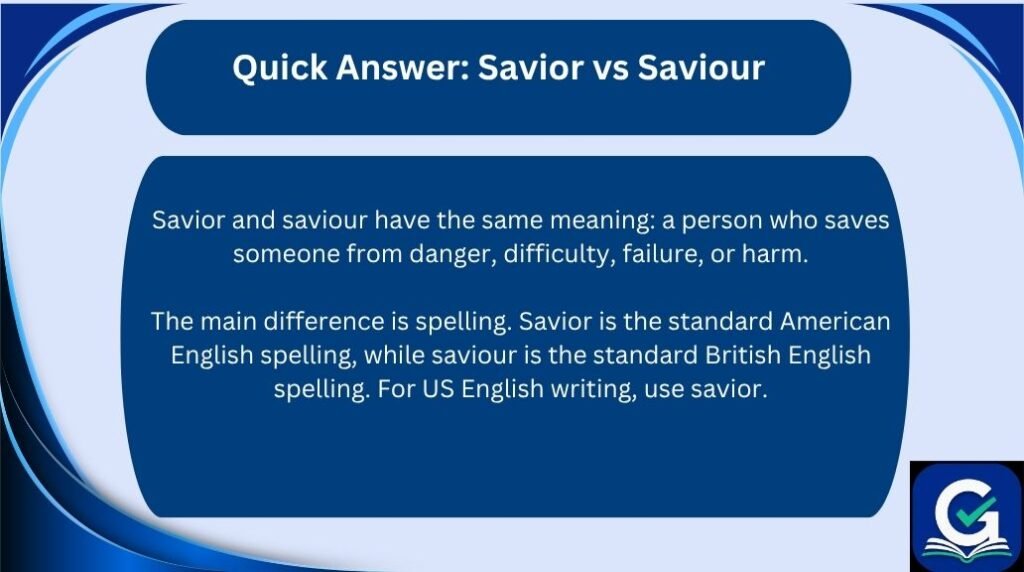
Savior and saviour have the same meaning: a person who saves someone from danger, difficulty, failure, or harm.
The main difference is spelling. Savior is the standard American English spelling, while saviour is the standard British English spelling. For US English writing, use savior.
Understanding the Basics: Savior vs Saviour
The easiest way to understand savior vs saviour is to think about regional English.
Both words are nouns. They describe someone or something that saves another person or group from danger, trouble, failure, or a difficult situation.
The only major difference is the spelling:
- Savior → American English
- Saviour → British English and some other varieties of English
For a US-based article, school assignment, business document, email, or website, savior is normally the better choice.
Comparison Table
| Form | Type | Meaning | Example | Correct/Incorrect |
|---|---|---|---|---|
| Savior | Noun | A person or thing that saves someone | The firefighter became a hero and a savior to the family. | Correct in US English |
| Saviour | Noun | A person or thing that saves someone | The firefighter became a hero and a saviour to the family. | Correct in British English |
| Savior | Religious noun | A title for Jesus Christ | Christians believe Jesus is the Savior. | Correct in US English |
| Saviour | Religious noun | A title for Jesus Christ | Christians believe Jesus is the Saviour. | Correct in British English |
So, neither spelling is inherently wrong. The correct choice depends largely on the variety of English you are using.
What Does Savior Mean?
Savior means a person who saves someone from danger, harm, failure, or a serious problem.
It can describe an ordinary person who helps someone in a difficult situation. It can also have a religious meaning, especially when referring to Jesus Christ.
For example:
The lifeguard was the savior of the drowning swimmer.
Here, savior refers to someone who rescued another person.
The word can also be used figuratively:
The new software was a savior for our struggling business.
In this sentence, the software did not literally rescue someone. Instead, it helped solve a serious problem.
Savior in Religious Contexts
The word Savior is also commonly used as a religious title.
In Christianity, Savior can refer to Jesus Christ, who is viewed by Christians as the Savior of humanity.
For example:
Christians believe Jesus Christ is the Savior.
When the word is used as a religious title or name, capitalization may be appropriate depending on the sentence and the style guide being followed.
What Does Saviour Mean?
Saviour has the same meaning as savior.
The difference is simply the spelling.
British English commonly uses saviour, while American English generally removes the u and uses savior.
For example:
The doctor was hailed as a saviour after successfully treating the patient.
This spelling is natural in British English.
In American English, the same sentence would normally be written:
The doctor was hailed as a savior after successfully treating the patient.
The pronunciation and basic meaning remain the same.
Why Does Savior Have No “U” in American English?
This spelling difference is part of a larger pattern in English.
American English often uses shorter spellings in words that traditionally contain -our in British English.
Consider these examples:
- color → colour
- honor → honour
- favor → favour
- labor → labour
- neighbor → neighbour
- Savior → Saviour
American English commonly uses -or, while British English frequently uses -our in these words.
This does not mean American English is missing a letter by mistake. It is an established spelling convention.
Savior vs Saviour in American English
If you are writing for readers in the United States, savior is the standard choice.
This applies to many common forms of writing:
- School papers
- Business documents
- Blog posts
- News-style content
- Emails
- Website copy
- Marketing content
- Social media posts
- Academic writing
For example:
The emergency worker was called a savior after rescuing the children.
For a US audience, this spelling looks natural and follows American spelling conventions.
Is Saviour Wrong in American English?
Not necessarily.
Saviour can still appear in American writing, particularly in religious, historical, literary, or quoted material. However, if you are writing ordinary US English prose, savior is generally the preferred spelling.
The key is consistency.
If your article follows American English conventions, avoid switching randomly between savior and saviour.
Savior vs Saviour in British English
British English generally prefers saviour.
For example:
The villagers considered the young man their saviour.
A British publication may therefore use saviour throughout an article.
The same sentence in American English would usually become:
The villagers considered the young man their savior.
Neither sentence changes the underlying meaning.
The spelling simply reflects the intended variety of English.
Savior as a Common Noun
A savior can be an ordinary person who rescues or helps someone.
For example:
The stranger became a savior when he helped the injured driver.
The word does not necessarily have to describe a heroic person in a dramatic situation. It can also be used casually or figuratively.
Examples include:
- That extra payment was a savior during a difficult month.
- My assistant was a savior when the deadline changed.
- The backup generator became a savior during the power outage.
- Her advice was a real savior when I felt lost.
In each sentence, the word describes someone or something that provides important help.
Savior as a Figurative Expression
English speakers often use savior metaphorically.
A person, product, idea, or solution can be described as a savior if it solves a major problem.
For example:
This shortcut was a savior when we were running late.
The shortcut did not literally rescue anyone. Instead, it helped solve the problem of being late.
Another example:
The new marketing strategy became the company’s savior.
Here, savior describes a strategy that helped the company recover.
This figurative use is common in conversational and creative writing.
Savior in Religious Writing
The religious use of Savior is especially important because the word can function as a title.
In Christian writing, Savior commonly refers to Jesus Christ.
Examples include:
Christians worship Jesus as their Savior.
The hymn praises the Savior.
Capitalization can depend on the religious tradition, publication, and style guide. If you are writing religious content, consistency is more important than randomly changing capitalization.
In American English, the spelling is generally Savior.
In British English, you may see Saviour.
Test Tip: How to Choose the Right Spelling
Here is an easy test:
Ask yourself: “Who is my audience?”
If your audience primarily uses American English:
Use savior.
If your audience primarily uses British English:
Use saviour.
You can also remember the broader pattern:
American -or → British -our
For example:
- favor → favour
- honor → honour
- color → colour
- savior → saviour
This simple pattern makes the spelling easier to remember.
Case Study: Workplace Email
Imagine an American company has completed a difficult project.
An employee writes:
Our IT team was a real saviour when the system failed.
The sentence is understandable, but saviour does not match the company’s American English style.
A better US English version would be:
Our IT team was a real savior when the system failed.
Now imagine the same message is being written for a British company. In that context, saviour would be perfectly appropriate.
What This Case Study Shows
The important point is that the word itself is not changing.
The audience is changing.
That audience determines the preferred spelling.
This is especially important for companies that publish content internationally. A brand should decide which English variety it follows and maintain that choice throughout its content.
Grammar Rules for Savior vs Saviour
The difference between savior and saviour is primarily a spelling and regional-usage issue rather than a grammatical one.
Both forms function as nouns.
They can refer to:
- A person who rescues someone.
- A person who helps solve a serious problem.
- Something that provides an important solution.
- A religious figure, especially Jesus Christ in Christian contexts.
Merriam-Webster is a major American dictionary authority, and American English spelling conventions generally favor forms such as savior.
The important rule is therefore:
Use the spelling that matches the English variety of your writing.
US English
The firefighter became a savior to the trapped family.
British English
The firefighter became a saviour to the trapped family.
Both sentences are grammatically sound.
Why American English Uses “Savior”
The difference reflects broader historical developments in English spelling.
American spelling conventions often prefer simplified forms that end in -or instead of -our.
This pattern is not limited to savior.
Compare:
| American English | British English |
|---|---|
| color | colour |
| favor | favour |
| honor | honour |
| labor | labour |
| neighbor | neighbour |
| Savior | Saviour |
These differences are normal variations between major English varieties.
They do not mean one variety is more correct than the other.
Common Mistakes With Savior and Saviour
People commonly make mistakes with these words because English has several spelling systems.
Mistake 1: Mixing Regional Spellings
A writer may use color, favor, and saviour in the same American English article.
This creates an inconsistent spelling style.
A better approach is to choose one regional standard and follow it consistently.
For US English:
- color
- favor
- honor
- savior
For British English:
- colour
- favour
- honour
- saviour
Mistake 2: Assuming Saviour Is Always Wrong
This is another common mistake.
Saviour is not an incorrect word.
It is a standard spelling in British English and other varieties that follow British spelling conventions.
Calling it “wrong” without considering regional English is inaccurate.
Mistake 3: Assuming Savior Is Always Wrong
The opposite mistake also happens.
Some writers learn British English first and assume that savior is misspelled.
For American English, however, savior is the normal spelling.
Mistake 4: Relying on Autocorrect
Autocorrect can create confusion when your device uses a different regional dictionary from your intended audience.
For example, an American writer may type saviour because a British English dictionary is active.
Always check the language setting of your writing software if spelling differences repeatedly appear.
Similar Grammar and Spelling Confusions
The savior vs saviour issue is similar to many other English spelling and usage differences.
| Confusion | Correct Form | Explanation |
|---|---|---|
| it’s / its | Both | “It’s” = it is; “its” = possessive |
| your / you’re | Both | “Your” = possession; “you’re” = you are |
| their / they’re | Both | “Their” = possession; “they’re” = they are |
| color / colour | Both | Regional spelling |
| favor / favour | Both | Regional spelling |
| center / centre | Both | Regional spelling |
| license / licence | Depends on variety and usage | US and UK conventions differ |
| savior / saviour | Both | Regional spelling |
Why Do These Mistakes Happen?
Several factors can cause spelling errors:
- Fast typing: Writers may type without checking regional spelling.
- Autocorrect: Software may automatically change a word.
- Lack of knowledge: Writers may not know that both forms are accepted.
- Mixed-language exposure: Online content often combines US and UK English.
- School background: A person may have learned one English variety and later write for another audience.
The solution is simple: identify your audience and choose a consistent style.
Savior vs Saviour in Everyday Conversation
In spoken English, the difference is almost invisible because both spellings generally have the same pronunciation.
For example, when someone says:
“He was our savior.”
A listener cannot normally determine whether the speaker would spell the word savior or saviour.
The distinction becomes important when the word is written.
That means this is mainly a written-English issue rather than a pronunciation issue.
Savior vs Saviour in Professional Writing
Professional writing benefits from consistency.
If you are writing a US business article, report, presentation, or email, savior is usually the appropriate choice.
For example:
The emergency response team became a savior for the organization during the crisis.
If you are writing for a British organization, saviour may be preferred:
The emergency response team became a saviour for the organization during the crisis.
Neither version is grammatically inferior.
The choice depends on the style of English being used.
Savior vs Saviour in Creative Writing
Creative writers have more flexibility.
An author may deliberately choose saviour even when writing for American readers if the spelling supports a particular character, setting, historical period, or stylistic voice.
For example, a novel set in London may naturally use British spelling throughout the dialogue and narration.
A fantasy writer might also choose a particular spelling for world-building purposes.
Creative writing therefore allows intentional variation, but the choice should usually be deliberate rather than accidental.
Savior vs Saviour in Social Media and Texting
On social media, both forms can appear.
People may write:
You are my savior!
or:
You are my saviour!
Social media is informal, so readers are unlikely to misunderstand either form.
However, if you are creating professional social media content for a US-based brand, savior is usually the cleaner choice.
For casual personal messages, either spelling may be understood easily.
Why the Difference Matters
At first glance, one extra letter may seem unimportant. However, spelling choices can affect how polished and consistent your writing appears.
1. Clarity
Using the expected spelling helps readers immediately recognize your intended English variety.
2. Professionalism
Consistent spelling makes business writing, website content, and academic work look more carefully edited.
3. Digital Communication
Search engines, content platforms, and readers encounter multiple English varieties online. A consistent spelling style helps establish the intended audience.
4. Reader Expectations
A US reader generally expects savior, while a British reader may naturally expect saviour.
A short spelling choice can therefore signal the variety of English being used.
Good writing is not only about correct words; it is also about using the right form for the right audience.
Special Exception: Names, Titles, and Official Wording
There can be exceptions when Savior or Saviour appears as part of an official name, title, quotation, organization name, artwork, book title, or religious expression.
In these situations, do not automatically change the spelling simply to match your normal regional style.
For example, if an official title uses Saviour, preserve that spelling when reproducing the title accurately.
The same principle applies to quotations. If you are quoting a source, its original spelling should generally remain unchanged.
This is an important distinction between writing your own sentence and reproducing an established name or quotation.
Is Savior or Saviour More Common in the US?
For standard American English, savior is the preferred spelling.
American spelling generally favors the -or ending in this group of words.
Therefore, if your target audience is American, use:
Savior
rather than:
Saviour
This is particularly useful for US-focused SEO content because consistent American spelling helps maintain the expected language style throughout the page.
Is Savior or Saviour More Common in the UK?
British English generally uses:
Saviour
The extra u follows the broader British spelling pattern found in words such as colour, favour, and honour.
Therefore:
- US English → savior
- UK English → saviour
The meaning remains the same.
How to Remember the Difference
A simple memory trick can make this distinction almost automatic.
Think:
American = shorter
So:
savior
British spelling adds the u:
saviour
You can connect it with other examples:
US: color, favor, honor, savior
UK: colour, favour, honour, saviour
Once you recognize the pattern, remembering the spelling becomes much easier.
Quick Recap Checklist
Use this checklist whenever you are unsure about savior vs saviour.
| Question | If Yes → Use |
|---|---|
| Am I writing standard American English? | Savior |
| Am I writing standard British English? | Saviour |
| Am I writing for a US website or company? | Savior |
| Am I following British spelling throughout my article? | Saviour |
| Is the word part of an official title or name? | Preserve the official spelling |
| Am I quoting a source? | Preserve the source’s original spelling |
Practice Examples
1. US English:
The firefighter became a savior to the family.
2. British English:
The firefighter became a saviour to the family.
3. Religious context in US English:
Many Christians refer to Jesus as the Savior.
The spelling changes according to the English variety, but the underlying meaning stays the same.
FAQs
1. Is “savior” or “saviour” correct?
Both are correct. Savior is the standard American English spelling, while saviour is commonly used in British English and other varieties that follow British spelling.
2. Is “saviour” wrong in American English?
No. It is not inherently wrong, but it is less typical of standard American English. For a US audience, savior is generally the preferred spelling.
3. What is the difference between savior and saviour?
There is no significant difference in meaning. The primary difference is regional spelling: savior is American English, and saviour is British English.
4. Should I use “Savior” in US English?
Yes. If you are following standard American English, savior is normally the best choice.
5. Does savior always refer to Jesus?
No. Savior can refer to any person or thing that rescues, helps, or provides relief. It can also be used as a religious title for Jesus Christ.
6. Are savior and saviour pronounced differently?
Generally, no. The two spellings normally have the same pronunciation. The difference is primarily written rather than spoken.
Conclusion
Understanding savior vs saviour is much easier once you recognize that the difference is mainly regional. Both words describe someone or something that saves, rescues, or provides important help. Savior is the standard spelling for American English, while saviour is commonly used in British English.
Neither spelling is universally “wrong.” The most important rule is to match your spelling to your intended audience and remain consistent throughout your writing. If you are creating content for readers in the United States, choose savior.
If your content follows British English conventions, choose saviour. Also remember that official names, titles, and quotations may preserve their original spelling. When in doubt, think about your audience first. Choose the spelling that matches your English variety, and your writing will stay clear, polished, and accurate.

I’m Ethan Carter, a grammar writer at Gramfino, where I explain English grammar in a simple and practical way.
I enjoy helping readers understand sentence structure, grammar rules, and common writing mistakes.
[…] media post, or a professional article, this guide will help you make the right choice. ✍️ Savior vs Saviour | Noisy vs Noisey | Premier vs. […]
[…] and give you practical examples so you can choose the best form confidently. Dwarfs vs Dwarves | Savior vs Saviour | Noisy vs […]
[…] Understanding this small distinction can prevent awkward wording and punctuation mistakes in emails, school assignments, professional documents, and everyday messages. Skill Set vs Skillset | Dwarfs vs Dwarves | Savior vs Saviour […]