Have you ever stopped while writing and wondered whether you should use premier vs. premiere? You are not alone. These two words look almost identical, sound similar in many varieties of English, and both are connected to the idea of being “first.” However, they do not always perform the same grammatical job.
Premier can describe something that is first in rank, importance, or quality, and it can also refer to a government leader. Premiere, on the other hand, is most commonly associated with the first public showing or performance of a movie, play, television program, or other work.
It can also function as a verb meaning to present something publicly for the first time.Understanding premier vs. premiere is useful for students, professionals, bloggers, journalists, and anyone who wants accurate US English.
A single extra e can change the meaning of a sentence. The good news is that the difference is easy to remember once you connect each word with its main purpose. Fourth vs Forth | Cue vs Queue | Aberrant vs Abberant
Quick Answer: Premier vs. Premiere
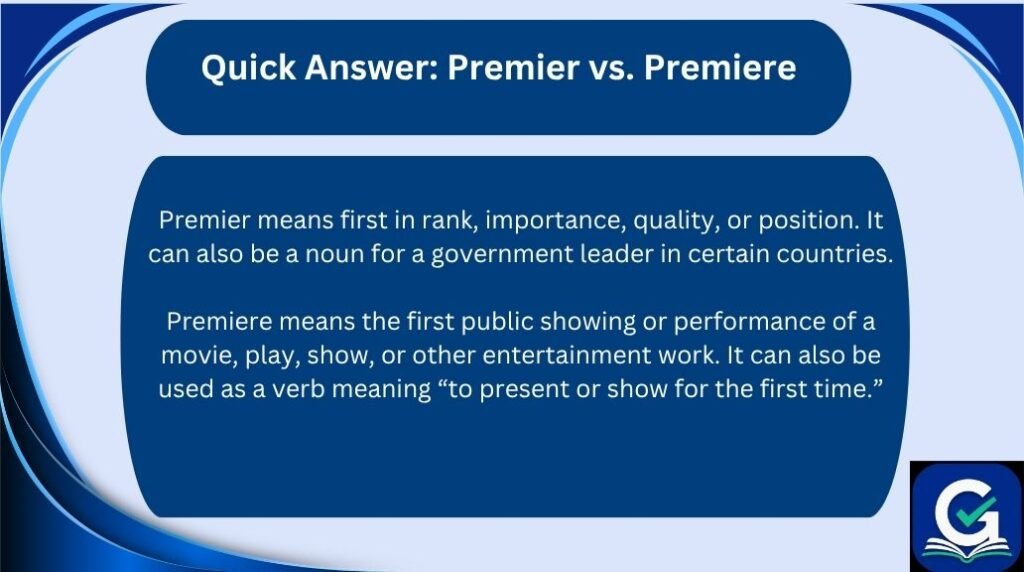
Premier means first in rank, importance, quality, or position. It can also be a noun for a government leader in certain countries.
Premiere means the first public showing or performance of a movie, play, show, or other entertainment work. It can also be used as a verb meaning “to present or show for the first time.”
Easy rule:
- Premier = top, leading, or highest-ranking
- Premiere = first showing or debut
For example:
- The restaurant is a premier dining destination.
- The movie’s premiere is Friday night.
Understanding the Basics: Premier vs. Premiere
The simplest way to understand these words is to focus on what you are describing.
Premier generally describes status or rank. If something is considered one of the best, most important, or most prestigious examples of its kind, premier is usually the right choice. It can also describe something that happened first or earliest.
Premiere generally describes a first public presentation. It is commonly used for movies, television shows, plays, operas, concerts, and other forms of entertainment.
Comparison Table
| Form | Type | Meaning | Example | Correct/Incorrect |
|---|---|---|---|---|
| premier | Adjective | Best, leading, or highest in rank | She is a premier surgeon. | ✅ Correct |
| premier | Noun | A government leader in certain countries | The premier addressed the legislature. | ✅ Correct |
| premier | Adjective | First or earliest | It was his premier novel. | ✅ Correct, though “first novel” is often clearer |
| premiere | Noun | First public showing or performance | We attended the movie premiere. | ✅ Correct |
| premiere | Verb | To show or present for the first time | The series will premiere tonight. | ✅ Correct |
| premier | Noun for movie debut | First public showing | The movie had its premier. | ❌ Incorrect in standard usage |
| premiere | Adjective meaning “best” | Highest-ranking or leading | She is the premiere doctor in town. | ⚠️ Usually incorrect for this meaning; use premier |
The distinction becomes much easier when you ask yourself one question:
Am I talking about being the best, or am I talking about a first showing?
If you mean best or leading, choose premier.
If you mean first public showing, choose premiere.
What Does “Premier” Mean?
Premier has several related meanings, but its most common modern use as an adjective is best, leading, or most important.
For example:
The university is a premier research institution.
Here, premier tells readers that the university is considered highly important or highly regarded.
Another example:
She works for one of the country’s premier law firms.
The word does not mean that the law firm is appearing publicly for the first time. Instead, it emphasizes the firm’s high standing or reputation.
Cambridge Dictionary defines premier as meaning “best or most important,” while dictionaries also recognize meanings related to being first in time or rank.
Premier as an Adjective
As an adjective, premier can describe:
- A leading company
- A highly respected institution
- A top restaurant
- A major resort
- A leading expert
- A high-ranking service
- Something first or earliest in certain contexts
Examples:
- The city has several premier hotels.
- She is a premier medical researcher.
- This is one of the state’s premier attractions.
- The company is known as a premier technology provider.
In each sentence, premier describes status, quality, importance, or rank.
Premier as a Noun
Premier can also be a noun. In political contexts, it can refer to a government leader or prime minister in certain countries or regions.
For example:
The Canadian premier announced a new policy.
Here, premier is a person, not an adjective.
This meaning is less common in everyday American conversation, but it remains an established dictionary meaning.
What Does “Premiere” Mean?
Premiere is most strongly associated with a first public showing or performance.
For example:
The movie’s premiere attracted hundreds of fans.
The movie had its first public showing, so premiere is correct.
The word can describe the first public presentation of:
- A movie
- A television show
- A play
- An opera
- A musical performance
- A concert piece
- A documentary
- Other entertainment or artistic works
Cambridge Dictionary defines premiere as the first public performance of a play or another type of entertainment.
Premiere as a Noun
When premiere is a noun, it refers to the event itself.
Examples:
- We attended the film premiere.
- The show’s premiere attracted millions of viewers.
- The play will have its premiere next month.
- Tickets for the world premiere sold out quickly.
Think of the noun premiere as an event.
Premiere as a Verb
This is one of the most important differences in premier vs. premiere.
Premiere can be a verb meaning to present or show something publicly for the first time.
Examples:
The network will premiere the new series tonight.
The director premiered her documentary at the festival.
The band will premiere its new song during the concert.
The word remains premiere even though it is being used as a verb.
Premier vs. Premiere in Simple Examples
Let’s make the difference even clearer.
Example 1: A Top Restaurant
The city has a premier seafood restaurant.
Why?
Because the restaurant is being described as one of the best or most important.
Example 2: A New Movie
The film’s premiere takes place Saturday.
Why?
Because the sentence refers to the movie’s first public showing.
Example 3: A Television Debut
The new season will premiere in October.
Why?
Because the show will be presented to the public for the first time.
Example 4: A Leading Expert
Dr. Lee is a premier expert in environmental science.
Why?
Because the word describes professional standing or excellence.
Example 5: A Government Leader
The premier spoke to reporters after the meeting.
Why?
Because premier can refer to a government leader in certain political systems.
Correct Meanings & Uses
Using “Premier” for Rank or Quality
Use premier when you want to emphasize that something is among the best or most important.
The museum is a premier cultural attraction.
Breakdown:
- The museum = subject
- is = linking verb
- a premier = adjective phrase describing status
- cultural attraction = noun
The meaning is that the museum is a leading or highly regarded cultural attraction.
Using “Premiere” for a First Showing
Use premiere when referring to the first public presentation.
The film’s premiere was held in Los Angeles.
Breakdown:
- The film’s premiere = noun phrase
- was held = verb phrase
- in Los Angeles = location
The sentence refers to the event where the film was shown publicly for the first time.
Using “Premiere” as a Verb
Use premiere when something is being shown or performed publicly for the first time.
The documentary will premiere on Friday.
Here, premiere is the verb.
It does not mean “be the best.” It means “make its first public appearance.”
Test Tip: How Can You Tell Which Word Is Correct?
Try replacing the word with one of these alternatives.
If best, leading, or top works, choose premier.
She is a premier athlete.
Test:
She is a top athlete.
The meaning still works. ✅
If first showing, debut, or first performance works, choose premiere.
The movie had its premiere.
Test:
The movie had its first showing.
The meaning works. ✅
The One-Second Test
Ask:
“Is this about status or a debut?”
- Status → premier
- Debut → premiere
That simple distinction will solve most usage questions.
Premier vs. Premiere in a Real-Life Workplace Example
Imagine that a marketing manager sends an email to a team about a new promotional video.
An employee writes:
“Our company’s premier video will be shown to clients next Friday.”
The sentence could technically be interpreted as saying the video is a leading or top-quality video, but it does not clearly communicate that Friday is its first public showing.
A clearer version would be:
“Our company’s new video will have its premiere next Friday.”
Now the meaning is precise. The team understands that Friday marks the video’s first public presentation.
Consider another workplace sentence:
“We hired a premier marketing agency to handle the campaign.”
Here, premier is correct because the writer is describing the agency as a leading or highly respected company.
The Practical Lesson
In professional writing, choosing the right word prevents readers from having to guess what you mean.
Grammar Rules for Premier vs. Premiere
The grammar behind these words is straightforward once their roles are separated.
Rule 1: Use “Premier” for Rank or Importance
When premier functions as an adjective, it commonly means:
- Leading
- Best
- Most important
- Highest in rank
- First in some contexts
For example:
This is a premier educational institution.
The institution is being described by its status.
Rule 2: Use “Premiere” for a First Performance
When you mean the first public showing of an entertainment work, use premiere.
The film’s premiere was sold out.
The word functions as a noun.
Rule 3: “Premiere” Can Be a Verb
This is an especially useful rule.
The network will premiere the documentary next week.
The verb means the documentary will receive its first public showing.
Rule 4: Do Not Automatically Choose “Premiere” Because It Means “First”
There is an interesting overlap. Premier can also mean first or earliest, and premiere has historically been connected with the idea of “first.” Dictionary sources recognize overlapping meanings in certain contexts.
However, modern everyday usage usually makes the distinction clear:
Premier → rank, importance, leadership
Premiere → first public showing or debut
What Merriam-Webster and Other Dictionaries Say
Major dictionaries support the distinction between these words.
Merriam-Webster’s definition of premier includes the meanings “first in position, rank, or importance” and “first in time.”
Dictionary sources also identify premiere as a noun referring to a first performance or exhibition and as a verb meaning to give or have a first public performance.
This confirms that premier vs. premiere is not simply a spelling preference. The words have distinct grammatical functions and meanings, even though their origins and pronunciations are closely related.
Common Mistakes With Premier and Premiere
Why do people confuse these words?
The main reason is simple: they look and sound extremely similar.
The final e is easy to overlook, especially when someone is typing quickly.
Mistake 1: “The Movie’s Premier”
❌ The movie’s premier was last night.
✅ The movie’s premiere was last night.
A movie has a premiere because the word refers to its first public showing.
Mistake 2: “A Premiere Restaurant”
❌ We ate at the city’s premiere restaurant.
✅ We ate at the city’s premier restaurant.
Here, the intended meaning is “leading” or “best,” so premier is the better choice.
Mistake 3: Confusing the Verb
❌ The show will premier next Tuesday.
✅ The show will premiere next Tuesday.
When you mean “will be shown for the first time,” the verb is premiere.
Why These Errors Happen
Common causes include:
- Fast typing: Writers often leave out a final letter.
- Autocorrect: Software may not recognize the intended context.
- Similar pronunciation: The words can sound very similar.
- Lack of knowledge: Writers may never have learned the distinction.
- Visual familiarity: People may recognize the words without knowing their meanings.
Similar Grammar Confusions
Premier vs. premiere is one example of a much larger group of easily confused English words.
| Confusing Words | Correct Difference |
|---|---|
| its / it’s | Its shows possession; it’s means “it is” or “it has.” |
| your / you’re | Your shows possession; you’re means “you are.” |
| their / there / they’re | Their shows possession; there refers to a place; they’re means “they are.” |
| affect / effect | Affect is usually a verb; effect is usually a noun. |
| then / than | Then relates to time; than is used for comparisons. |
| accept / except | Accept means receive or agree; except means excluding. |
| principal / principle | Principal can mean a person in authority or something important; principle means a rule or belief. |
| premier / premiere | Premier relates to rank or importance; premiere relates to a first public showing. |
Learning these distinctions improves both grammar and overall writing accuracy.
Premier vs. Premiere in Different Contexts
The right word can depend on what you are discussing.
Everyday Conversation
In casual conversation, you may hear:
Did you watch the show’s premiere?
This is a natural use of premiere.
You might also say:
That’s one of the city’s premier restaurants.
Here, premier describes the restaurant’s high status.
Professional Writing
Professional writing benefits from precise word choice.
Examples:
The company partnered with a premier consulting firm.
The product demonstration will premiere at the annual conference.
Both sentences use the words correctly because they communicate different ideas.
Creative Writing
Writers can use both words effectively.
The city’s premier theater hosted the premiere of a new play.
Notice how both words appear in one sentence.
- premier theater = leading theater
- premiere = first performance
Social Media and Texting
Informal digital communication often contains spelling shortcuts.
Someone might write:
Movie premier tonight!
But if they mean the first showing, the standard spelling is:
Movie premiere tonight! 🎬
Even in casual posts, the correct form helps readers understand the intended meaning.
Why Premier vs. Premiere Matters
At first glance, adding or removing one letter may seem unimportant. However, small spelling differences can change the grammatical function and meaning of a word.
Clarity in Communication
Clear writing helps readers understand your message immediately.
Compare:
The movie’s premier is Friday.
with:
The movie’s premiere is Friday.
The second sentence clearly identifies Friday as the movie’s first public showing.
Professionalism
Correct word choice matters in:
- Emails
- Resumes
- Reports
- Marketing copy
- News articles
- Business websites
- Academic assignments
A small spelling error can make otherwise polished writing look less careful.
Digital Communication
Online writing is often read quickly. Readers may scan headlines, social posts, product pages, and emails without much context.
Using premier and premiere correctly makes your meaning easier to recognize at a glance.
“Precision is the difference between saying something and saying exactly what you mean.”
That principle applies especially well to commonly confused words.
A Special Exception: “Premiere” Can Have a Broader Adjectival Use
There is a useful edge case worth knowing.
Although premiere is most commonly encountered as a noun or verb for a first showing, dictionary sources also record an adjectival use meaning first, initial, or principal.
For example, a dictionary may recognize expressions such as:
a premiere showing
However, this does not mean premiere and premier are interchangeable in every sentence.
When you want to say something is top-ranked, leading, or highly important, premier is the standard choice:
She is a premier designer.
When you mean the first public showing, use premiere:
The designer’s new collection had its premiere at the event.
What About “Première”?
You may also see première, with an accent mark. This reflects the French form and may appear in English, especially in specialized or stylistic contexts. Modern American English commonly uses the unaccented spelling premiere.
How to Remember the Difference
Here are several easy memory tricks.
Think “E” for Entertainment
Premiere has an extra e.
Think:
E = Entertainment
Movies, shows, plays, and performances have premieres.
Think “Premier = Prime”
Both words connect to the idea of being first or important.
Premier → prime, top, leading
Think “Premiere = Debut”
If something is making its first public appearance, it is having a premiere.
Use This Formula
Premier = status
Premiere = showing
That is probably the shortest useful rule to remember.
Quick Recap Checklist
Use this checklist whenever you are unsure about premier vs. premiere.
| Question | If Yes → Use |
|---|---|
| Am I describing something as leading or highly important? | Premier |
| Am I describing something as one of the best? | Premier |
| Am I referring to a government leader in a relevant political system? | Premier |
| Am I talking about the first public showing of a movie? | Premiere |
| Am I talking about the first performance of a play? | Premiere |
| Am I saying that a show will be shown for the first time? | Premiere |
| Can I replace the word with “top” or “leading”? | Premier |
| Can I replace it with “debut” or “first showing”? | Premiere |
Practice Examples
1. The documentary will ______ at the film festival.
Answer: premiere
2. The university is one of the country’s ______ research institutions.
Answer: premier
3. Thousands of fans attended the show’s ______.
Answer: premiere
FAQs
1. What is the difference between premier and premiere?
Premier usually means first in rank, importance, or quality and can also refer to a government leader. Premiere usually means the first public showing or performance of a movie, play, television show, or other entertainment work.
2. Is it “movie premier” or “movie premiere”?
The correct phrase for a movie’s first public showing is movie premiere.
Correct: The movie premiere is Friday.
Incorrect: The movie premier is Friday.
3. Is “premiere” a verb?
Yes. Premiere can function as a verb meaning to present or show something publicly for the first time.
Example:
The series will premiere next month.
4. Is “premier” an adjective?
Yes. Premier is commonly used as an adjective meaning leading, best, most important, or highest in rank.
Example:
She is a premier scientist in her field.
5. Can premier and premiere mean the same thing?
Sometimes their meanings overlap around the idea of being first. However, they are not generally interchangeable. Premier is normally associated with rank, importance, or leadership, while premiere is strongly associated with a first public showing or performance.
6. How can I remember premier vs. premiere?
Remember “E for entertainment.” If you are talking about the first public showing of a movie, show, play, or performance, use premiere. If you mean something is top-ranked or leading, use premier.
Conclusion
Understanding premier vs. premiere becomes easy once you focus on the meaning rather than the spelling. Premier is generally used when something is first in rank, importance, quality, or position.
It can also be a noun for a government leader in certain countries or regions. Premiere, with the extra e, is primarily used for the first public showing or performance of a movie, television program, play, opera, or other entertainment work. It can also function as a verb when something is presented publicly for the first time.
When you are unsure, ask yourself whether you mean “top” or “first showing.” If you mean top or leading, choose premier. If you mean a debut or first public presentation, choose premiere.
Premier describes status; premiere announces a debut. Remember that simple distinction, and you will rarely confuse these two words again.

I’m Amelia Parker, an English language writer at Gramfino, focused on making difficult language topics easier to understand.
I write about grammar, vocabulary, word usage, and everyday English to help readers communicate clearly.
[…] end, you will have a simple memory trick that makes this common spelling confusion easy to avoid. Premier vs. Premiere | Fourth vs Forth | Cue vs […]