Have you ever written a sentence and suddenly wondered If you should use cue or queue? These two words sound exactly alike in standard English, but they have completely different meanings. That makes cue vs queue a common spelling and vocabulary confusion, especially when writing quickly, texting, or relying on memory instead of context.
The good news is that the difference is easy to understand once you connect each word with its main purpose.
Cue usually refers to a signal, prompt, or indication that tells someone what to do next. It can also mean a long, tapered stick used to play games such as pool or billiards.
Queue, on the other hand, usually refers to a line or sequence of people or things waiting for their turn.
If you are unsure which spelling belongs in your sentence, do not rely on pronunciation because both words sound alike. Instead, look at the meaning you want to express.
This simple strategy makes cue vs queue much easier to remember and helps you write with confidence. Aberrant vs Abberant | Across vs Accros | Smoky vs Smokey
Quick Answer: Cue vs Queue
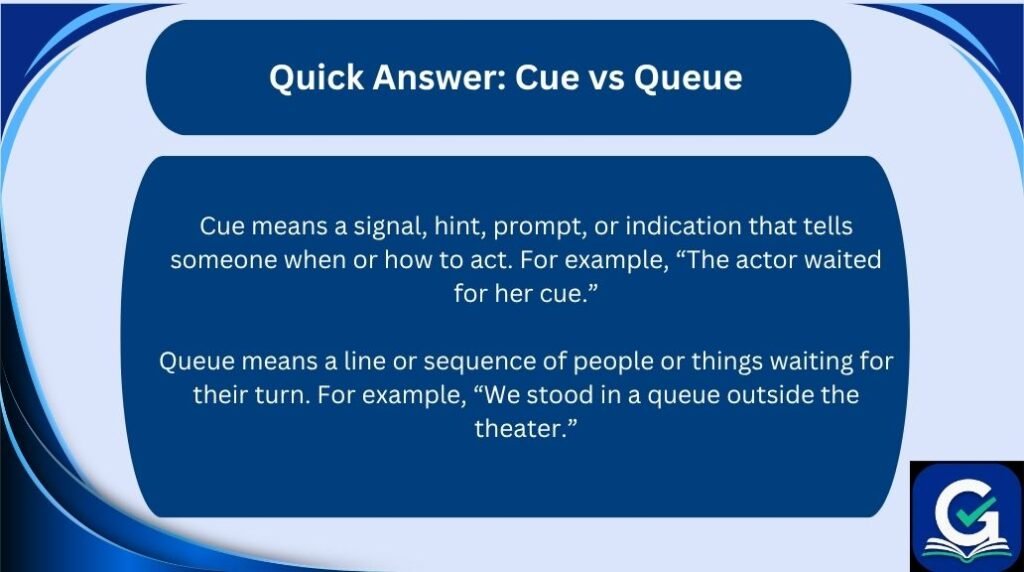
Cue means a signal, hint, prompt, or indication that tells someone when or how to act. For example, “The actor waited for her cue.”
Queue means a line or sequence of people or things waiting for their turn. For example, “We stood in a queue outside the theater.”
The easiest rule to remember:
- Cue = signal or prompt 🎬
- Queue = line or waiting sequence 🚶
Although cue and queue have the same pronunciation, their meanings and spellings are different.
Understanding the Basics: Cue vs Queue
The most important difference between these words is their meaning.
Cue is connected with a signal, instruction, or prompt. If someone gives you a cue, they are giving you information about when to do something or what to do next.
Queue is connected with waiting. If people form a queue, they arrange themselves in a line and wait for service, entry, or their turn.
Here is a quick comparison:
| Form | Type | Meaning | Example | Correct/Incorrect |
|---|---|---|---|---|
| Cue | Noun | A signal or prompt | “That was my cue to leave.” | Correct |
| Cue | Verb | To give a signal or prepare something | “Cue the music.” | Correct |
| Queue | Noun | A line or waiting sequence | “We joined the queue.” | Correct |
| Queue | Verb | To form or place something in a line | “The files were queued for processing.” | Correct |
| Queue | Noun | A signal or prompt | “That was my queue.” | Incorrect |
| Cue | Noun | A line of waiting people | “The cue was very long.” | Incorrect |
The key is not pronunciation. The key is meaning.
If you mean a signal, choose cue. If you mean a waiting line or sequence, choose queue.
What Does Cue Mean?
Cue has several related meanings, but they all involve the idea of a signal, prompt, or indication.
Cue as a Signal
A cue can tell someone that it is time to act.
For example:
“The director gave the actor a cue.”
In this sentence, the cue is a signal telling the actor when to begin.
Other examples include:
- “The music was my cue to start dancing.”
- “When she nodded, I knew it was my cue to speak.”
- “The flashing light served as a cue to begin.”
- “The teacher gave the students a cue to start writing.”
In each sentence, cue refers to something that provides information about what should happen next.
Cue as a Prompt
A cue can also be a reminder or prompt that helps someone remember what to say or do.
For example:
“The speaker glanced at her notes for a cue.”
Here, the notes provide a prompt.
This meaning is common in public speaking, acting, teaching, and everyday conversations.
Cue as a Billiards Stick
There is another meaning of cue that is unrelated to signals.
A cue can be a long, slender stick used to strike balls in games such as pool or billiards.
For example:
“He picked up the cue and prepared for his shot.”
In this case, cue does not mean a signal. It refers to the piece of equipment used in the game.
This is one reason context matters when interpreting the word.
What Does Queue Mean?
A queue is a line or sequence in which people or things wait for their turn.
For example:
“We waited in the queue for twenty minutes.”
The people are arranged in an order, and each person waits until their turn arrives.
Queue for People
The most familiar use of queue describes people waiting.
Examples include:
- “There was a long queue at the ticket counter.”
- “Please join the queue.”
- “The queue moved slowly.”
- “We waited in the queue outside the store.”
The word is especially common in British English, although American English speakers also understand and use it in certain contexts.
In everyday American English, line is often more common:
“We stood in line.”
However, queue is perfectly valid English and is widely used for organized waiting systems, computing, and technical contexts.
Queue for Things
A queue does not have to contain people.
Things can also be placed in a sequence.
For example:
“The printer has five documents in its queue.”
The documents are waiting to be processed.
Other examples include:
- “Your request is in the processing queue.”
- “The songs are in the playback queue.”
- “Several tasks are waiting in the queue.”
- “The emails were added to the outgoing queue.”
In these examples, queue means an ordered sequence waiting for processing or action.
Cue vs Queue in Simple Sentences
One of the easiest ways to understand the difference is to compare the words side by side.
Cue
“The actor received her cue.”
Meaning: The actor received a signal telling her when to act.
Queue
“The actor joined the queue.”
Meaning: The actor joined a line of people waiting.
Notice that changing one letter combination completely changes the meaning.
More Comparisons
Cue:
“That song was my cue to leave.”
The song was a signal.
Queue:
“I waited in the queue for coffee.”
The queue was a line of waiting customers.
Cue:
“The director gave him a cue.”
The director gave him a signal.
Queue:
“The application entered the queue.”
The application entered a waiting sequence.
Cue vs Queue: How to Remember the Difference
A useful memory trick can make this distinction almost automatic.
Think “Cue = Cue Card”
Actors and speakers often use cue cards to remind themselves what to say or do.
So remember:
Cue → signal → prompt → cue card
Think “Queue = Waiting Line”
A queue is a line in which people or things wait.
So remember:
Queue → waiting → line → sequence
You can also remember that queue has several letters after the first one that seem to wait around before the final sound is heard. While this is not a grammatical rule, it can be a fun spelling trick.
Correct Meanings and Uses
Understanding the different grammatical uses of each word will help you avoid mistakes.
Cue as a Noun
As a noun, cue can mean a signal, prompt, or indication.
Example:
“The applause was his cue to return to the stage.”
The applause acted as a signal.
Another example:
“She missed her cue.”
This means she failed to respond at the correct moment.
Cue as a Verb
Cue can also function as a verb.
It can mean to give someone a signal.
Example:
“Cue the music.”
This means to start the music at the appropriate moment.
Another example:
“The technician cued the video.”
The technician prepared or started the video at the appropriate time.
Queue as a Noun
As a noun, queue means a line or ordered sequence.
Example:
“There was a long queue outside the restaurant.”
Here, the queue consists of people waiting.
Queue as a Verb
Queue can also be used as a verb.
It means to place something in a waiting line or sequence.
Example:
“The files were queued for printing.”
The files were placed in an ordered group waiting to be printed.
Test Tip: How to Choose the Right Word
When you are unsure about cue vs queue, ask yourself one simple question:
Am I talking about a signal or a waiting line?
- If the answer is signal, use cue.
- If the answer is waiting line or sequence, use queue.
Test 1
“The director gave me a ___ to enter.”
The missing word means a signal.
✅ Cue
Test 2
“We waited in the ___ for tickets.”
The missing word means a line.
✅ Queue
Test 3
“The printer has several documents in the ___.”
The documents are waiting to be processed.
✅ Queue
Test 4
“That was my ___ to start talking.”
The phrase means a signal.
✅ Cue
This test works because the two words have different meanings even though they sound alike.
A Real-Life Case Study
Imagine a manager is preparing employees for a company presentation.
During rehearsal, the manager tells one employee:
“When the slide changes, that is your cue to begin.”
Here, cue is correct because the slide change acts as a signal.
Now imagine the same company uses a customer-support system. Customers are assigned to representatives in an ordered waiting system.
The manager might say:
“Your request has been added to the support queue.”
Here, queue is correct because the request is waiting for processing.
Workplace Lesson
The two words can appear in the same professional environment, but they describe different ideas.
Cue = signal to act.
Queue = waiting sequence.
This distinction is particularly important in workplaces where instructions, software systems, presentations, and customer-service processes are discussed.
Cue vs Queue in Professional Writing
Accuracy matters in professional communication because a spelling error can change the meaning of a sentence.
Consider these examples:
❌ “Your request is in the cue.”
If you mean that the request is waiting to be processed, this is incorrect.
✅ “Your request is in the queue.”
Now the meaning is clear.
Another example:
❌ “Please watch for your queue to begin.”
If you mean a signal telling someone to begin, this should be:
✅ “Please watch for your cue to begin.”
Professional writing benefits from choosing the word based on meaning rather than sound.
Grammar Rules Explanation
The words cue and queue are both standard English words, but they are not interchangeable.
Cue can function as a noun or verb. As a noun, it commonly means a signal or prompt. As a verb, it can mean to give a signal or prepare something for use at the appropriate time.
Queue can also function as a noun or verb. As a noun, it refers to a line or ordered sequence. As a verb, it means to place something into such a sequence or wait in one.
Standard dictionaries such as Merriam-Webster distinguish these words by meaning and usage. Merriam-Webster’s pronunciation guide also represents cue with the pronunciation “kyü,” illustrating why its pronunciation can overlap with queue in ordinary speech.
The important point is that pronunciation does not determine spelling.
English contains many homophones: words that sound alike but have different spellings and meanings. Cue and queue are one such pair.
Why Are Cue and Queue So Easy to Confuse?
The biggest reason is simple: they sound the same.
When people speak, they hear the pronunciation rather than the spelling. If they later write the word from memory, they may choose the wrong spelling.
Several factors contribute to the confusion.
Fast Typing
When typing quickly, people often focus on getting their thoughts onto the screen rather than checking every word.
For example, someone may type:
“Your request is in the cue.”
They may actually mean:
“Your request is in the queue.”
Autocorrect
Autocorrect can sometimes make spelling decisions based on the surrounding text. If the wrong word is accepted or manually selected, the error can remain unnoticed.
Lack of Knowledge
Some writers may know that both words exist but may not remember the difference.
Learning the meaning of each word is more useful than simply memorizing the spelling.
Sound-Based Writing
Because cue and queue sound alike, someone may spell the word according to how it sounds.
This is especially common among learners who are still developing English spelling skills.
Common Mistakes with Cue vs Queue
Here are some common mistakes and their corrections.
Mistake 1: Using Cue for a Waiting Line
❌ “There was a long cue outside the theater.”
If you mean a line of people, the correct sentence is:
✅ “There was a long queue outside the theater.”
In American English, you could also write:
✅ “There was a long line outside the theater.”
Mistake 2: Using Queue for a Signal
❌ “That was my queue to leave.”
Correct:
✅ “That was my cue to leave.”
The phrase “my cue” means “my signal.”
Mistake 3: Confusing a Queue with a Cue Card
❌ “The speaker checked her queue card.”
Correct:
✅ “The speaker checked her cue card.”
A cue card provides a prompt or reminder.
Similar Grammar Confusions
The confusion between cue and queue is part of a larger group of commonly confused English words.
| Confusing Words | Correct Meaning |
|---|---|
| Cue / Queue | Signal / Waiting line |
| It’s / Its | It is / Possessive form |
| Your / You’re | Possessive / You are |
| Their / There / They’re | Possession / Place / They are |
| To / Too / Two | Direction / Also / Number |
| Affect / Effect | Usually influence / Result |
| Then / Than | Time or sequence / Comparison |
| They’re / Their | They are / Possessive |
| Hear / Here | Receive sound / Place |
| Weather / Whether | Atmospheric conditions / Choice or possibility |
The common pattern is that pronunciation, appearance, or quick typing can cause writers to choose the wrong form.
Usage in Different Contexts
The difference between these words becomes even clearer when you see how they work in different forms of communication.
Everyday Conversation
In casual conversation, cue often refers to a signal.
“When she looked at me, I knew it was my cue.”
Queue can describe a waiting line.
“We had to stand in a queue for an hour.”
In American everyday speech, line is usually more natural than queue for a group of people waiting.
Professional Writing
Both words can appear frequently in professional communication.
Examples:
“Please wait until you receive your cue.”
and:
“Your request has been placed in the queue.”
The first refers to a signal. The second refers to a waiting process.
Creative Writing
Writers can use cue to describe subtle signals.
“The sudden silence was her cue to leave.”
Queue can help describe crowded locations or organized systems.
“A long queue stretched around the corner.”
Social Media and Texting
In texting, people often write quickly, which can increase homophone errors.
Someone might type:
“Is that my cue?”
This means, “Is that my signal?”
Or:
“I’m still in the queue.”
This means the person is still waiting.
Although social media is informal, using the correct word still makes your meaning clearer.
Cue vs Queue in Technology
The word queue has an especially important role in technology.
A computer system may process tasks one at a time or according to a specific order. These tasks can be placed in a queue.
For example:
- Print queue
- Email queue
- Processing queue
- Job queue
- Message queue
- Download queue
Consider this sentence:
“The files are waiting in the print queue.”
The files are waiting to be processed.
Using cue here would change the meaning and would normally be incorrect.
By contrast, cue can appear in technology when a system uses a signal or prompt.
For example:
“The notification was a cue for the user to continue.”
So even in technical writing, the same basic distinction remains:
Cue = signal.
Queue = waiting sequence.
Why It Matters
Knowing the difference between cue and queue may seem like a small detail, but accurate word choice has a real effect on communication.
Clarity in Communication
The correct word immediately tells readers what you mean.
Compare:
“Wait for your cue.”
with:
“Wait in the queue.”
The first tells someone to wait for a signal.
The second tells someone to wait in a line.
One spelling changes the entire idea.
Professionalism
Correct spelling shows attention to detail. In emails, reports, applications, instructions, and business documents, small errors can make writing appear less polished.
Digital Communication
People often communicate through messages, emails, workplace platforms, and online systems. Because these formats rely heavily on written language, choosing the correct word helps prevent misunderstandings.
A Simple Reminder
“Sound can be the same while meaning is completely different.”
That is exactly what happens with cue and queue.
Special Exception and Edge Cases
There is no common grammatical situation in which cue and queue can simply be swapped because they sound alike. Each word has its own established meanings.
However, queue has some specialized uses beyond a physical line.
For example, computing systems use the term queue for an ordered collection of tasks or data waiting to be processed.
Similarly, cue has specialized uses in theater, broadcasting, music, sports, and billiards.
For example:
- A stage cue tells a performer when to act.
- A production cue can signal when sound or lighting should change.
- A cue stick is used in billiards.
- A queue can contain people waiting for service.
- A software queue can contain tasks waiting for processing.
The context may change, but the basic meanings remain stable.
Quick Recap Checklist
Use this checklist whenever you are uncertain about cue vs queue.
| Question | If Yes → Use |
|---|---|
| Does the word mean a signal? | Cue |
| Does it mean a prompt or indication? | Cue |
| Does it refer to a billiards stick? | Cue |
| Does it mean a line of people? | Queue |
| Does it mean an ordered waiting sequence? | Queue |
| Does it describe tasks waiting to be processed? | Queue |
| Does it mean “give a signal”? | Cue |
| Does it mean “place in a waiting sequence”? | Queue |
Practice Examples
1. “The director gave the actor a ___.”
Answer: cue
2. “We waited in the ___ for our tickets.”
Answer: queue
3. “The documents are currently in the print ___.”
Answer: queue
4. “The music was my ___ to begin.”
Answer: cue
Quick Memory Formula
Cue = Signal
Queue = Line
If you remember only these two words, you can solve most cue vs queue questions correctly.
FAQs
1. What is the difference between cue and queue?
Cue means a signal, prompt, or indication that tells someone when or how to act. Queue means a line or ordered sequence of people or things waiting for their turn or to be processed.
2. Is it “cue” or “queue” for a line?
Use queue when you mean a line or waiting sequence. For example, “We stood in the queue for tickets.” In American English, line is often more common for a physical line of people.
3. Is it “my cue” or “my queue”?
Use my cue when you mean “my signal” or “my indication to act.”
For example:
“That was my cue to leave.”
“My queue” would normally refer to something belonging to or associated with a queue, such as “my queue of tasks.”
4. Do cue and queue sound the same?
Yes. In standard English pronunciation, cue and queue are pronounced alike. Their different spellings and meanings are therefore easy to confuse.
5. Can queue be used as a verb?
Yes. Queue can be used as a verb meaning to place something in a waiting sequence or to wait in such a sequence.
Example:
“The files were queued for printing.”
6. Can cue be used as a verb?
Yes. Cue can be used as a verb meaning to give someone a signal or prompt, or to prepare something for a particular point in a performance or process.
Example:
“Cue the music.”
Conclusion
Understanding cue vs queue becomes simple when you focus on meaning instead of pronunciation. Although both words sound alike, they serve completely different purposes in English.
Use cue when you mean a signal, prompt, indication, or even the stick used in billiards. For example, “The director gave the actor a cue.” Use queue when you mean a line or an ordered sequence of people or things waiting for their turn. For example, “We waited in the queue.”
The easiest memory trick is straightforward: cue means a signal, while queue means a waiting line or sequence. In American English, “line” is often more common than “queue” for people waiting, but queue remains a correct English word and is especially common in technical contexts.
Whenever you hesitate, ask yourself what the word represents. Is it telling someone when to act, or is something waiting its turn? That one question will usually give you the answer.
Remember: A cue tells you when to act; a queue tells you where to wait.

I’m Jordan Hayes, a proofreading and editing writer at Gramfino, focused on clear and accurate English.
I enjoy finding common writing mistakes and sharing simple ways to make sentences stronger and easier to read.
[…] Once you learn the simple rule behind these words, choosing the correct one becomes much easier. Cue vs Queue | Aberrant vs Abberant | Across vs […]
[…] difference is easy to remember once you connect each word with its main purpose. Fourth vs Forth | Cue vs Queue | Aberrant vs […]