Have you ever typed a sentence such as “People worshiped the ancient gods” and then wondered whether you should have written “worshipped” instead? You are not alone. The difference between worshiped vs worshipped confuses many English learners and even native speakers because both spellings look natural and both appear in reputable dictionaries.
The good news is that this is not a case where one spelling is simply “right” and the other is “wrong.” Both worshiped and worshipped are accepted spellings of the past tense and past participle of worship. The main difference is regional spelling preference.
In American English, worshiped is generally preferred, while worshipped is especially common in British English and other varieties that follow British spelling conventions. Merriam-Webster lists both forms as standard variants. Combating vs Combatting | En Route vs In Route | Through vs Thru
Quick Answer: Worshiped vs Worshipped
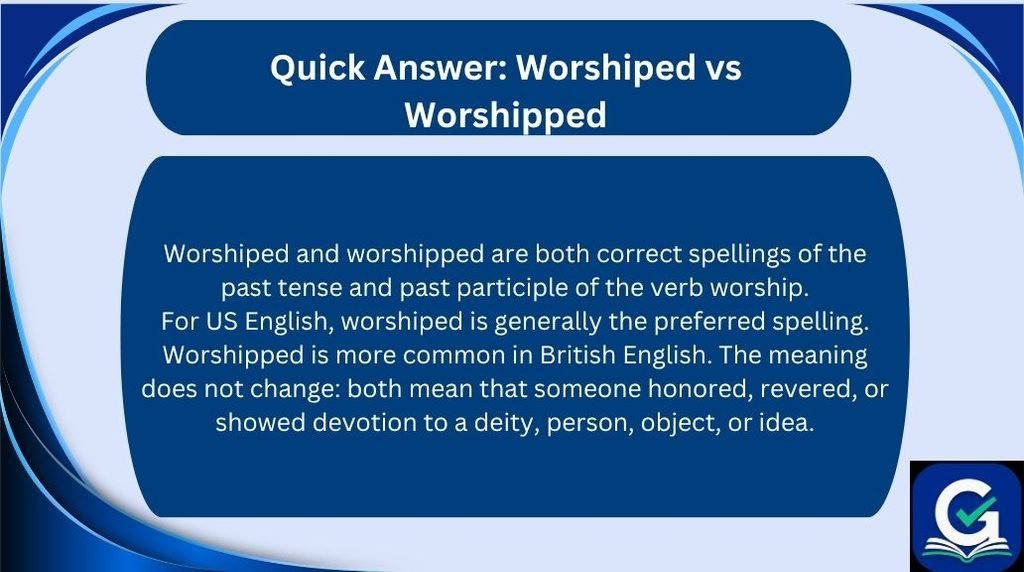
Worshiped and worshipped are both correct spellings of the past tense and past participle of the verb worship.
For US English, worshiped is generally the preferred spelling. Worshipped is more common in British English. The meaning does not change: both mean that someone honored, revered, or showed devotion to a deity, person, object, or idea.
Example:
- US English: Ancient people worshiped many different gods.
- British English: Ancient people worshipped many different gods.
Both sentences are grammatically correct.
Understanding the Basics of Worshiped vs Worshipped
The easiest way to understand worshiped vs worshipped is to remember that the difference is primarily spelling, not meaning.
The base verb is worship. When we form its past tense or past participle, English allows two spellings:
- worshiped
- worshipped
Merriam-Webster specifically lists “worshipped also worshiped” and also recognizes worshipping and worshiping as variants.
Comparison Table
| Form | Type | Meaning | Example | Correct/Incorrect |
|---|---|---|---|---|
| worship | Base verb | To honor, revere, or show devotion | They worship God. | Correct |
| worshiped | Past tense/past participle | Honored or revered | They worshiped the deity. | Correct |
| worshipped | Past tense/past participle | Honored or revered | They worshipped the deity. | Correct |
| worshiping | Present participle | Currently honoring or revering | They are worshiping together. | Correct |
| worshipping | Present participle | Currently honoring or revering | They are worshipping together. | Correct |
So, if you see worshiped or worshipped, do not assume that one is a spelling mistake.
The important question is often which style of English you are writing in.
What Does “Worship” Mean?
Before comparing the two spellings, it helps to understand the word itself.
As a verb, worship can mean to honor or show reverence toward a divine being or supernatural power. It can also describe showing extremely strong admiration, respect, or devotion toward someone or something. Merriam-Webster gives both religious and broader meanings for the verb.
For example:
The community worships at the temple every Sunday.
Here, worships refers to religious practice.
But worship does not always have a strictly religious meaning:
Fans worshiped the famous singer.
Here, worshiped means that the fans admired the singer intensely.
Religious Use
The word is frequently used when discussing:
- God
- gods and goddesses
- religious figures
- sacred objects
- religious traditions
- temples and churches
- ceremonies
- prayer and devotion
Example:
The ancient Egyptians worshiped many gods.
Figurative Use
The word can also describe extreme admiration.
Example:
The public worshiped the champion after his historic victory.
This does not necessarily mean the public literally treated the champion as a deity. It can simply emphasize extraordinary admiration.
Why Are There Two Spellings?
The difference comes from spelling conventions used in different varieties of English.
American English often uses a simpler pattern when forming the past tense of certain verbs ending in -p.
That gives us:
worship → worshiped
British English commonly doubles the final consonant in this type of word before adding -ed:
worship → worshipped
This is similar to other differences between American and British spelling.
For example:
- US English: traveled
- British English: travelled
And:
- US English: canceled
- British English: cancelled
Likewise:
- US English: worshiped
- British English: worshipped
The spelling changes, but the meaning remains the same.
Is “Worshiped” Correct in American English?
Yes. Worshiped is correct in American English.
If you are writing an article, essay, website page, school assignment, business document, or other content specifically for a US audience, worshiped is generally the better choice for consistency.
Examples include:
- The ancient people worshiped the sun.
- She worshiped the singer as a child.
- The villagers worshiped at the old temple.
- Many cultures worshiped different deities.
- The fans worshiped their favorite athlete.
None of these sentences requires the double p.
Why US Writers Usually Prefer “Worshiped”
American spelling tends to favor worshiped rather than worshipped.
That does not make worshipped grammatically incorrect. It simply makes worshiped a more natural choice when following standard US spelling conventions.
If your website targets readers in the United States, choosing worshiped throughout the article can help maintain a consistent American-English style.
Is “Worshipped” Correct?
Yes. Worshipped is also correct.
It is especially common in British English and other forms of English influenced by British spelling.
Examples:
- The people worshipped the goddess.
- They worshipped at the ancient shrine.
- Many generations worshipped there.
- The king was worshipped as a divine ruler.
Merriam-Webster explicitly recognizes worshipped as a standard variant of worshiped.
Therefore, correcting every occurrence of worshipped to worshiped would be unnecessary unless you are deliberately converting the writing to US English.
Worshiped vs Worshipped in American and British English
The simplest distinction is geographical.
| Variety of English | Preferred Form | Example |
|---|---|---|
| American English | worshiped | They worshiped the ancient gods. |
| British English | worshipped | They worshipped the ancient gods. |
| Canadian English | Either may appear | Usage can vary by style. |
| Australian English | worshipped is common | They worshipped at the shrine. |
| General international English | Both are understood | Either form may be acceptable depending on style. |
Language varieties are not always completely uniform, so this table should be viewed as a general writing guideline rather than an absolute rule.
For a US English grammar article, however, worshiped is the safest default.
Correct Meanings and Uses
1. Worshiped as a Past-Tense Verb
When you are talking about something that happened in the past, use worshiped or worshipped.
Example:
The ancient civilization worshiped several gods.
The action happened in the past.
Sentence breakdown:
- The ancient civilization = subject
- worshiped = past-tense verb
- several gods = object
British spelling:
The ancient civilization worshipped several gods.
Same meaning. Different spelling convention.
2. Worshiped as a Past Participle
The word can also function as a past participle.
For example:
The goddess was worshiped by thousands of people.
Here, was worshiped forms a passive construction.
The same sentence can be written:
The goddess was worshipped by thousands of people.
Again, both forms are correct.
The choice depends mainly on the variety of English being used.
3. Worshiped for Exceptional Talent
Worship does not have to refer to literal religious devotion.
Consider:
The athlete was worshiped by his fans.
This can mean that the fans admired him intensely.
A similar use appears in Merriam-Webster’s definition, which includes regarding someone or something with “great or extravagant respect, honor, or devotion.”
For example:
The actress was worshiped by her followers.
The sentence emphasizes extreme admiration.
4. Worshiped in Historical Writing
Historical writing frequently uses the word when describing ancient cultures and religious practices.
Examples:
The Greeks worshiped many gods and goddesses.
Ancient communities worshiped nature and celestial bodies.
The people worshiped at the temple for generations.
When writing for a US audience, worshiped is a natural choice.
5. Worshiped in Literary Writing
Creative writers can also use the word figuratively.
For example:
She worshiped the memory of her mother.
This means she held that memory in extremely high regard.
Another example:
The villagers worshiped the mountain as sacred.
The exact meaning depends on context.
Test Tip: How Can You Check the Correct Form?
When you are unsure about worshiped vs worshipped, ask yourself two questions:
Question 1: Am I talking about the past?
If yes, you need the past form:
- worshiped
- worshipped
Question 2: What type of English am I writing?
If the answer is US English, choose:
worshiped
If the answer is British English, worshipped is generally the more natural choice.
Easy Memory Trick
Think:
US = worshiped
British = worshipped
This is not a perfect rule for every English-speaking country, but it is a useful shortcut when writing specifically for an American audience.
Case Study: A Workplace Example
Imagine you are preparing a company newsletter about an ancient-art exhibition.
You write:
The exhibition explores how ancient civilizations worshipped different gods.
Your editor is based in the United States and asks you to follow American spelling.
You can revise it to:
The exhibition explores how ancient civilizations worshiped different gods.
What changed?
Only the spelling.
The meaning, grammar, tense, and sentence structure remain exactly the same.
Another Example: Email
Imagine an employee writes:
The report explains how ancient cultures worshipped the sun.
If the company uses British English, there is no problem.
If the company uses US English, an editor may prefer:
The report explains how ancient cultures worshiped the sun.
Neither sentence communicates a different idea.
The important principle is consistency.
Grammar Rules Behind “Worshiped” and “Worshipped”
The spelling difference can look complicated because English has several rules for adding -ed to verbs.
Usually, English spelling does not double the final consonant of every verb.
However, some verbs double the final consonant before adding a suffix.
For example:
- stop → stopped
- plan → planned
- admit → admitted
That may lead writers to assume:
worship → worshipped
And that spelling is indeed accepted.
However, American English also uses:
worship → worshiped
The important point is that worship has established variant spellings rather than one universally mandatory spelling.
Merriam-Webster lists:
worshipped also worshiped
and similarly lists:
worshipping also worshiping.
This confirms that both forms have dictionary recognition.
Is One Grammatically More Correct?
No.
Worshiped and worshipped are both grammatically correct.
The difference is primarily one of spelling convention and regional style.
That is why a US editor may prefer worshiped, while a British editor may prefer worshipped.
Common Mistakes With Worshiped vs Worshipped
The most common mistake is not actually using the “wrong” form. The bigger problem is mixing spelling conventions throughout the same piece.
For example:
The people worshipped the gods and traveled across the country.
This sentence mixes:
- worshipped — British-style spelling
- traveled — American-style spelling
The sentence is understandable, but a carefully edited document may choose one spelling system and use it consistently.
Mistake 1: Assuming “Worshipped” Is Always Wrong
Some American writers see the double p and assume it is a spelling error.
It is not.
Worshipped is a recognized spelling. Merriam-Webster lists it as a variant.
Mistake 2: Assuming “Worshiped” Is a Typo
British English readers may be more accustomed to worshipped, but worshiped is also a legitimate form.
Mistake 3: Mixing Regional Styles
If you are writing for an American audience, try to maintain American spelling throughout your document.
For example:
- worshiped
- traveled
- canceled
- center
- color
A British-style document might instead use:
- worshipped
- travelled
- cancelled
- centre
- colour
Consistency makes writing look more polished.
Similar Grammar and Spelling Confusions
Worshiped vs worshipped belongs to a larger group of English words that confuse writers because small spelling changes can cause uncertainty.
| Confusion | Correct Forms | Main Difference |
|---|---|---|
| worshiped vs worshipped | Both correct | Regional spelling preference |
| traveled vs travelled | Both correct | US vs British spelling |
| canceled vs cancelled | Both correct | US vs British spelling |
| color vs colour | Both correct | US vs British spelling |
| center vs centre | Both correct | US vs British spelling |
| it’s vs its | Both correct | Contraction vs possessive |
| your vs you’re | Both correct | Possessive vs contraction |
| they’re vs their | Both correct | Contraction vs possessive |
| affect vs effect | Both correct | Different grammatical meanings |
These examples show why context and writing style matter.
Why Do People Make These Mistakes?
Fast Typing
When people type quickly, they often do not stop to consider regional spelling conventions.
You might write:
The followers worshipped the leader.
even if your entire article otherwise follows US English.
That is a normal editing issue.
Autocorrect
Autocorrect can also influence spelling.
Depending on your device, keyboard, browser, or language settings, your software may recognize one version more readily than the other.
Lack of Knowledge
Many writers simply do not know that both spellings are accepted.
They may learn one version in school and assume it is the only possible form.
Exposure to Different English Varieties
The internet has made English highly international.
An American reader can easily encounter British websites, Australian publications, Canadian content, and international academic writing.
As a result, writers naturally absorb multiple spelling conventions.
Usage in Different Contexts
Everyday Conversation
In casual speech, the spelling difference does not matter because the words sound essentially the same.
You might say:
People worshiped the deity for centuries.
A listener cannot determine whether you would spell the word with one p or two.
The distinction appears in writing.
Professional Writing
For professional writing, consistency is important.
If your organization follows US English, use:
worshiped
If your organization follows British English, use:
worshipped
The key is to follow your organization’s established style guide.
Academic Writing
Academic writing should prioritize consistency and the style requirements of the institution or publication.
If you are writing an American research paper, worshiped may fit the expected spelling conventions.
If you are submitting to a British publication, worshipped may be preferred.
Always check the required style guide when one is provided.
Creative Writing
Creative writers have more flexibility.
A novelist writing in an American setting may naturally use:
The villagers worshiped the old gods.
A British author may write:
The villagers worshipped the old gods.
Neither spelling changes the story.
Social Media and Texting
On social media, both forms are easily understood.
For casual communication, the distinction is rarely important.
However, if you are managing a professional brand account, consistency still matters.
A polished brand should generally select one English variety and stick with it.
Why the Difference Matters
At first, worshiped vs worshipped may seem like a tiny spelling issue. In reality, understanding these differences can improve the quality of your writing.
1. Clarity in Communication
Consistent spelling helps readers understand that your writing follows a deliberate style.
2. Professionalism
A consistent editorial style makes websites, reports, articles, and business documents look more carefully prepared.
3. Accuracy in Digital Communication
Online readers come from many countries. Understanding regional spelling prevents unnecessary confusion.
4. Better Editing
Knowing that both forms are correct prevents you from “correcting” something that was never actually wrong.
A Simple Reminder
Good writing is not only about choosing correct words; it is also about using them consistently.
Special Exception: What About “Worshipper” and “Worshiper”?
The same spelling variation appears in the noun referring to a person who worships.
You may encounter:
- worshiper
- worshipper
Merriam-Webster lists worshipper as the noun and notes worshiper as a less common variant.
Examples:
The worshipers gathered before sunrise.
The worshippers gathered before sunrise.
Both can be found in English writing.
This is useful because it shows that the single-versus-double-consonant pattern extends beyond the past-tense form.
What About “Worshiping” vs “Worshipping”?
You may also encounter another variation:
- worshiping
- worshipping
Both are recognized forms. Merriam-Webster lists both variants.
Examples:
They are worshiping at the temple.
They are worshipping at the temple.
Again, the spelling does not change the meaning.
For a US English article, worshiping is generally the natural choice.
Worshiped vs Worshipped in SEO Writing
If you are writing online content, spelling consistency can be particularly important.
Suppose your target audience is primarily American.
Your article could consistently use:
- worshiped
- worshiping
- worshiper
If your audience is primarily British, you may prefer:
- worshipped
- worshipping
- worshipper
Should You Use Both Keywords for SEO?
You do not need to force both forms repeatedly into an article.
Search engines are generally capable of understanding spelling variants and related forms.
Instead, focus on answering the reader’s question naturally.
For example, an article targeting the query worshiped vs worshipped can explain both forms clearly without repeating the exact phrase in every heading or paragraph.
Natural language is more important than excessive repetition.
Quick Recap Checklist
Use this checklist when deciding between worshiped and worshipped.
| Question | If Yes → Use |
|---|---|
| Are you writing standard US English? | worshiped |
| Are you following British English spelling? | worshipped |
| Are you writing for a US website or audience? | worshiped |
| Does your publication’s style guide require British spelling? | worshipped |
| Are you quoting a source that uses “worshipped”? | Keep the original spelling |
| Are you editing an existing document? | Follow its established spelling style |
| Are you asking whether one is grammatically wrong? | Neither is inherently wrong |
Practice Example 1
Question:
Ancient people ______ several gods.
For US English:
Answer: worshiped
Ancient people worshiped several gods.
Practice Example 2
Question:
The followers ______ at the temple every morning.
For British English:
Answer: worshipped
The followers worshipped at the temple every morning.
Practice Example 3
Question:
The singer was ______ by millions of fans.
Both are correct:
The singer was worshiped by millions of fans.
or
The singer was worshipped by millions of fans.
Choose the version that matches your overall spelling style.
FAQs
1. Is “worshiped” or “worshipped” correct?
Both worshiped and worshipped are correct spellings of the past tense and past participle of worship. Worshiped is generally preferred in US English, while worshipped is especially common in British English. Merriam-Webster recognizes both forms.
2. Which spelling should I use in American English?
Use worshiped when following standard American English spelling conventions.
For example:
Ancient civilizations worshiped many different gods.
3. Is “worshipped” wrong in American English?
No. Worshipped is not inherently incorrect in American English. It is an accepted spelling variant. However, worshiped is generally the better choice if you want your writing to follow typical US spelling conventions.
4. Why does “worshipped” have two p’s?
The double p reflects a spelling convention commonly used in British English and related varieties. English spelling has different regional conventions for doubling final consonants before suffixes. In the case of worship, both worshipped and worshiped are established forms.
5. Do “worshiped” and “worshipped” have different meanings?
No. They have the same meaning. Both are past-tense or past-participle forms of worship. The difference is primarily regional spelling preference.
6. Is “worshiping” or “worshipping” correct?
Both forms are accepted. Worshiping is generally more suitable for US English, while worshipping is common in British English. Merriam-Webster recognizes both variants.
Conclusion
The debate over worshiped vs worshipped becomes much easier once you know the key rule: both spellings are correct. They are simply different spelling variants of the same past-tense and past-participle form of worship.
For US English, choose worshiped:
The ancient people worshiped their gods.
For British English, worshipped is generally preferred:
The ancient people worshipped their gods.
Neither version changes the meaning, grammar, or pronunciation in any important way. Merriam-Webster confirms that both forms are recognized, so there is no reason to treat one as a simple spelling error.
The most important lesson is consistency. If you are writing for an American audience, use worshiped throughout your article. If your audience follows British spelling, use worshipped. Once you understand that distinction, this common English confusion becomes easy to handle.
When in doubt, remember: US English → worshiped; British English → worshipped. ✨

I’m Amelia Parker, an English language writer at Gramfino, focused on making difficult language topics easier to understand.
I write about grammar, vocabulary, word usage, and everyday English to help readers communicate clearly.
[…] The real question is which spelling is more appropriate for your audience and writing situation. Worshiped vs Worshipped | Combating vs Combatting | En Route vs In […]