Have you ever written an email and suddenly wondered whether you should say, “I want to complaint” or “I want to complain”? If so, you are not alone. The confusion between complaint vs complain is common because both words are closely related and describe dissatisfaction with something. However, they do not serve the same grammatical purpose.
I know how easy it is to mix them up, especially when you are writing quickly, texting someone, or trying to sound professional in an email. The good news is that the difference is actually simple once you understand what each word does in a sentence. Complaint is a noun, while complain is a verb. One refers to the problem, statement, or expression of dissatisfaction itself; the other describes the action of expressing dissatisfaction.
In this guide, we will examine complaint vs complain in detail, including their meanings, grammar rules, examples, common mistakes, professional usage, everyday conversations, and practical tips. By the end, you will know exactly when to use each word. ✍️ Canvas vs Canvass | Lefty vs Leftie | Authorization vs Authorisation
Quick Answer: Complaint vs Complain
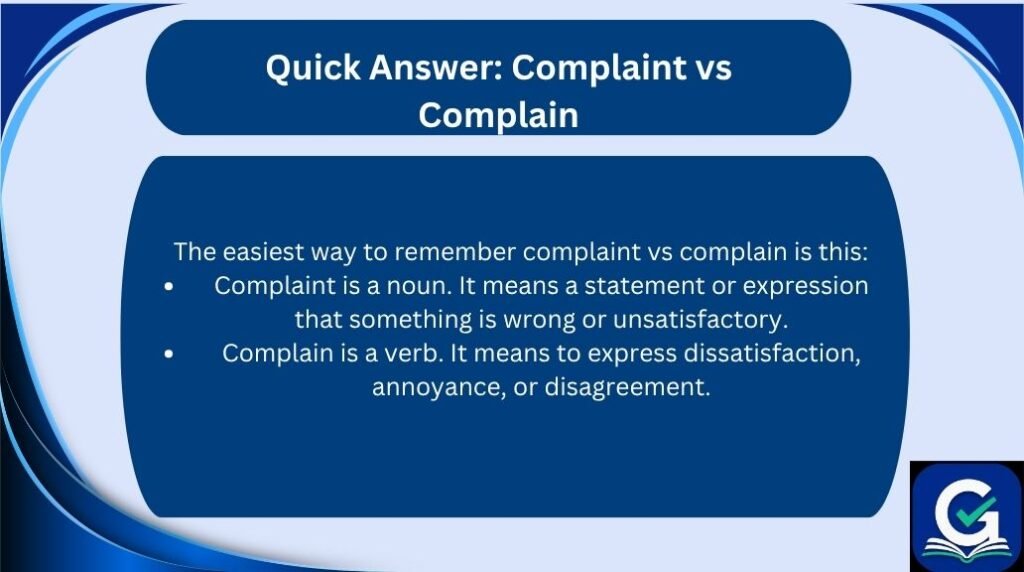
The easiest way to remember complaint vs complain is this:
- Complaint is a noun. It means a statement or expression that something is wrong or unsatisfactory.
- Complain is a verb. It means to express dissatisfaction, annoyance, or disagreement.
For example:
I made a complaint about the service.
Here, “complaint” is the thing that was made.
I complained about the service.
Here, “complained” describes the action of expressing dissatisfaction.
So, if you need a thing or statement, use complaint. If you need an action, use complain.
Understanding the Basics of Complaint vs Complain
The core difference becomes much easier when you look at the grammatical role of each word.
| Form | Type | Meaning | Example | Correct/Incorrect |
|---|---|---|---|---|
| Complaint | Noun | An expression of dissatisfaction | I filed a complaint. | ✅ Correct |
| Complain | Verb | To express dissatisfaction | I want to complain. | ✅ Correct |
| Complaint | Verb | Not the standard verb form | I want to complaint. | ❌ Incorrect |
| Complain | Noun | Not normally used as a noun | I submitted a complain. | ❌ Incorrect |
The words are related, but they cannot normally replace each other.
Complaint Is a Noun
A complaint names an issue, objection, or expression of dissatisfaction.
Examples:
- The customer filed a complaint.
- We received several complaints.
- Her complaint was taken seriously.
- I have a complaint about my order.
- The manager reviewed the complaint.
In each sentence, “complaint” refers to a thing or matter.
You can often place words such as a, the, my, your, or several before it:
- a complaint
- the complaint
- my complaint
- your complaint
- several complaints
That is a strong clue that you are dealing with a noun.
Complain Is a Verb
Complain describes the action of expressing dissatisfaction.
Examples:
- I want to complain.
- She complained about the noise.
- They complain too much.
- He complained to the manager.
- Customers often complain about long wait times.
Because “complain” is a verb, it can change according to tense:
- complain
- complains
- complained
- complaining
For example:
I complain about the service.
She complains about the service.
He complained about the service yesterday.
They are complaining about the service now.
This difference is one of the most important points in understanding complaint vs complain.
Correct Meanings and Uses
What Does “Complaint” Mean?
A complaint is an expression of dissatisfaction or an objection to something that a person considers wrong, inconvenient, unfair, poor-quality, or unpleasant.
It can refer to a formal or informal expression.
For example:
The customer made a complaint about the damaged product.
The word “complaint” refers to the customer’s expression of dissatisfaction.
Another example:
Your complaint has been forwarded to the appropriate department.
Here, the complaint is treated as a specific matter that can be reviewed or handled.
A complaint can be:
- formal
- informal
- written
- verbal
- personal
- professional
- legal
- customer-related
What Does “Complain” Mean?
Complain means to express dissatisfaction, annoyance, or unhappiness about something.
For example:
The customer complained about the damaged product.
The word “complained” tells us what the customer did.
Another example:
Please contact customer service if you want to complain about the product.
Here, “complain” describes the action.
Complaint vs Complain in Simple Sentences
Compare these examples:
I have a complaint.
I want to complain.
The first sentence identifies a matter of dissatisfaction.
The second sentence describes an action.
Another pair:
She made a complaint about the noise.
She complained about the noise.
Both sentences are grammatically correct, but their structures are different.
How to Know Which Word to Use
One of the easiest ways to choose between these words is to ask yourself:
Am I naming something, or am I describing an action?
If you are naming an issue, use complaint.
I submitted a complaint.
If you are describing the act of expressing dissatisfaction, use complain.
I complained to the supervisor.
You can also use a quick substitution test.
If you can replace the word with issue, statement, or grievance, you probably need complaint.
I submitted a complaint.
→ I submitted an issue/grievance.
If you can replace the word with express dissatisfaction, you probably need complain.
I complained about the service.
→ I expressed dissatisfaction about the service.
Test Tip
Remember:
Complaint = thing
Complain = action
This simple rule will help you avoid most mistakes.
Complaint and Complain in Different Tenses
Because complain is a verb, it can be used in different tenses.
Present Tense
I complain about the noise.
She complains about everything.
Notice that “complain” becomes “complains” with he, she, or it.
Past Tense
The past form is complained.
I complained to the manager yesterday.
She complained about the food.
Do not write:
I complaint to the manager yesterday. ❌
Instead:
I complained to the manager yesterday. ✅
Present Continuous
The -ing form is complaining.
They are complaining about the weather.
He is complaining about his workload.
Present Perfect
You can also use:
I have complained several times.
She has complained about the problem before.
These forms demonstrate why complain belongs to the verb category.
Common Sentence Patterns
Understanding common sentence structures makes the difference even easier.
“Make a Complaint”
The phrase make a complaint is correct.
I would like to make a complaint.
She made a complaint about the service.
The customer made a formal complaint.
Because “complaint” is a noun, it works naturally after the verb “make.”
“File a Complaint”
Another common expression is:
I filed a complaint with the company.
This is especially common in professional, customer-service, administrative, and legal contexts.
“Lodge a Complaint”
In some varieties of English, particularly British English, lodge a complaint is also common.
The customer lodged a complaint against the company.
In American English, file a complaint and make a complaint are often more natural depending on context.
“Complain About Something”
Use complain about when identifying the thing that causes dissatisfaction.
She complained about the noise.
He complained about the delay.
They complained about the price.
“Complain To Someone”
Use complain to when identifying the person or organization receiving the complaint.
I complained to the manager.
She complained to customer service.
They complained to the landlord.
You can combine both:
I complained to the manager about the poor service.
This sentence is completely natural.
Complaint vs Complain: A Real-Life Workplace Example
Imagine an employee has a problem with excessive noise in an office.
The employee might say:
“I want to complain about the noise.”
Here, complain is correct because the employee is describing an action.
The employee could then write:
“I would like to make a formal complaint about the noise in the office.”
Here, complaint is correct because the employee is referring to a formal expression of dissatisfaction.
A manager might respond:
“We received your complaint and will investigate the issue.”
Notice how naturally the noun works in this context.
The employee could later say:
“I complained to my supervisor last week.”
Again, complained is a verb.
This example shows that the same situation can involve both words. The choice depends on how the sentence is constructed.
Grammar Rules Behind Complaint vs Complain
The fundamental grammar rule is simple:
Complaint is a noun, while complain is a verb.
This distinction explains why the words cannot simply be substituted for each other.
Standard dictionaries, including Merriam-Webster, distinguish words according to their grammatical categories and meanings. That distinction is important here because complain functions as a verb and complaint functions primarily as a noun.
Consider:
I want to complain.
The word after “want to” should be a base-form verb. Therefore, complain is correct.
Now consider:
I have a complaint.
The article “a” is followed by a noun. Therefore, complaint is correct.
Compare these structures:
want to + verb
want to complain ✅
a + noun
a complaint ✅
This is one of the easiest grammar patterns to memorize.
Why “I Want to Complaint” Is Incorrect
A very common error is:
I want to complaint. ❌
Why is it wrong?
Because want to is followed by the base form of a verb.
Examples:
- I want to eat.
- I want to leave.
- I want to speak.
- I want to complain.
“Complaint” is a noun, so it cannot normally follow “want to” in this structure.
Correct:
I want to complain about my order. ✅
Incorrect:
I want to complaint about my order. ❌
If you want to use complaint, change the sentence structure:
I want to make a complaint about my order. ✅
Why “I Submitted a Complain” Is Incorrect
Another frequent mistake is:
I submitted a complain. ❌
The problem is that “a” normally introduces a singular countable noun here, and complain is not the noun you need.
Use:
I submitted a complaint. ✅
Or:
I complained about the issue. ✅
The choice depends on whether you are naming the complaint or describing the action.
Common Mistakes With Complaint vs Complain
Why do people confuse these words?
There are several reasons.
Fast Typing
When people type quickly, they may know the difference but still choose the wrong word.
For example:
I want to complaint about this.
The writer may simply have typed the noun because it looks similar.
Autocorrect
Autocorrect can sometimes change a correctly typed word or fail to suggest the form you actually need.
This is especially common when typing quickly on phones.
Lack of Grammar Knowledge
Some learners memorize related words without learning their grammatical categories.
Because complaint and complain have similar meanings, it is easy to assume they are interchangeable.
Pronunciation Confusion
The words also sound related, which can make the distinction harder for English learners.
Learning the noun-versus-verb difference is more reliable than trying to choose based only on pronunciation.
Similar Grammar Confusions
The complaint vs complain issue belongs to a larger group of commonly confused English words.
| Confusing Words | Correct Difference | Example |
|---|---|---|
| Complaint / complain | Noun vs. verb | I filed a complaint. / I complained. |
| Advice / advise | Noun vs. verb | She gave advice. / She advised me. |
| Affect / effect | Usually verb vs. noun | It affected me. / The effect was clear. |
| Choice / choose | Noun vs. verb | Make a choice. / Choose one. |
| Practice / practise | Noun vs. verb in some varieties | Daily practice helps. |
| Its / it’s | Possessive vs. contraction | The dog wagged its tail. / It’s cold. |
| Your / you’re | Possessive vs. contraction | Your book. / You’re right. |
| Their / they’re | Possessive vs. contraction | Their house. / They’re here. |
The best strategy is to learn the function of each word rather than memorizing isolated spellings.
Usage in Different Contexts
Everyday Conversation
In casual speech, complain is extremely common.
Stop complaining about the weather.
He always complains about traffic.
I need to complain about this bill.
Complaint is also common:
I have a complaint.
She made a complaint about the restaurant.
In everyday conversation, the difference is usually easy to understand from context.
Professional Writing
Professional communication often requires greater precision.
Instead of:
I want to complaint about this issue.
Write:
I would like to make a formal complaint about this issue.
Or:
I would like to complain about this issue.
The first sounds more formal because it treats the complaint as an official matter.
Creative Writing
Creative writers can use both forms depending on the character and narrative style.
For example:
Maria complained about the cold wind as she walked home.
Or:
His only complaint was that the journey had taken too long.
The choice depends entirely on grammatical structure.
Social Media and Texting
Informal digital communication often contains shortened or grammatically loose sentences.
You might see:
I need to complain 😤
Or:
Another complaint about the service today!
Both can be correct because they use the words according to their grammatical roles.
However, informal writing does not make incorrect grammar correct in professional communication.
Complaint vs Complain in Customer Service
Customer service is one area where both words appear frequently.
Consider these examples:
I want to complain about my order.
I would like to make a complaint about my order.
We received your complaint.
Several customers complained about the delivery time.
Please submit your complaint through our online form.
Customers can complain directly to the support team.
Each sentence uses the correct form.
A useful distinction is:
Customer action: complain
Customer issue/document: complaint
For example:
The customer complained about the refund.
But:
The company received a complaint about the refund.
Complaint vs Complain in Emails
Professional emails require careful word choice.
Informal Email
Hi, I want to complain about the service I received yesterday.
This is grammatically correct but somewhat direct.
More Professional Version
Dear Customer Service Team,
I am writing to make a formal complaint regarding the service I received yesterday.
The second version is more formal and appropriate for a business setting.
You can also write:
I am writing to complain about the service I received yesterday.
This is also grammatically correct.
The choice between the two depends on tone and context.
Why the Difference Matters
At first glance, confusing complaint vs complain may seem like a small mistake. However, correct word choice matters because language is built around precise grammatical relationships.
Clarity in Communication
Correct grammar helps readers understand exactly what you mean.
Compare:
I want to complaint.
with:
I want to complain.
The second sentence immediately communicates the intended action.
Professionalism
Grammar mistakes can affect how your writing is perceived.
A customer-service representative, employer, teacher, or business partner may notice incorrect word choices.
Using the correct form demonstrates attention to detail.
Digital Communication
Emails, online forms, social media posts, and workplace messages are often read quickly.
Clear language makes your message easier to understand.
A Simple Reminder
“Clear words make clear messages.”
You do not need complicated vocabulary to sound professional. You need accurate vocabulary used in the right grammatical position.
Special Exception and Edge Cases
There is no major standard-English exception in which complaint normally functions as the verb meaning “to express dissatisfaction.” In ordinary US English, use complain as the verb and complaint as the noun.
You may encounter unusual uses in names, titles, trademarks, historical texts, or creative language. A brand or organization could theoretically use either word as part of a name. Such a proper name does not change the standard grammar rule.
For ordinary writing, remember:
complain = verb
complaint = noun
There is also a related verb form, complained, and an -ing form, complaining.
Examples:
- complain
- complains
- complained
- complaining
The noun has its own plural:
- complaint
- complaints
How to Remember the Difference Easily
Here is a simple memory trick:
Think “Action = Complain”
If someone is doing something, use the verb.
I complain.
She complained.
They are complaining.
Think “Thing = Complaint”
If you are talking about the thing, issue, or statement, use the noun.
I have a complaint.
She filed a complaint.
We received three complaints.
Another useful trick is to look for common words nearby.
Words Often Followed by “Complaint”
- a complaint
- the complaint
- my complaint
- your complaint
- formal complaint
- customer complaint
- written complaint
- serious complaint
Words Often Used With “Complain”
- complain about
- complain to
- complain that
- complain repeatedly
- complain loudly
- complain constantly
These patterns can help you recognize the correct word almost instantly.
Practical Examples You Can Copy
Here are several correct examples:
- I want to complain about the poor service.
- I have a complaint about my order.
- She complained to the manager.
- The manager received a complaint.
- Several customers complained about the delay.
- We received several complaints yesterday.
- He is always complaining about work.
- Please submit your complaint in writing.
- I would like to complain about this charge.
- Her main complaint was the long waiting time.
Notice how both words can appear in the same situation without having the same grammatical function.
Quick Recap Checklist
Use this checklist whenever you are unsure.
| Question | If Yes → Use |
|---|---|
| Am I describing an action? | Complain |
| Am I naming an issue or expression of dissatisfaction? | Complaint |
| Does the sentence use “want to”? | Complain |
| Does the sentence use “a” before the word? | Complaint |
| Am I talking about someone expressing dissatisfaction? | Complain |
| Am I talking about a formal or written issue? | Complaint |
Practice Example 1
I want to ______ about the service.
Answer: complain
Correct sentence:
I want to complain about the service.
Practice Example 2
I submitted a ______ yesterday.
Answer: complaint
Correct sentence:
I submitted a complaint yesterday.
Practice Example 3
She ______ to the manager about the delay.
Answer: complained
Correct sentence:
She complained to the manager about the delay.
A Simple Decision Rule for Writers
When deciding between complaint vs complain, stop and identify the grammar role first.
Ask:
Is this word acting as a noun?
If yes, choose complaint.
The complaint was serious.
Ask:
Is this word acting as a verb?
If yes, choose complain.
The customer complained.
This method is much more reliable than trying to remember which word “sounds right.”
If you are writing a formal document, read the entire sentence aloud after choosing the word. Then check what comes before and after it.
For example:
I would like to complain about the issue.
The phrase “would like to” requires a verb, so complain is correct.
Now:
I would like to submit a complaint.
The word “submit” can take a noun as its object, so complaint is correct.
FAQs
1. What is the main difference between complaint and complain?
The main difference is grammatical. Complaint is a noun that refers to an expression or statement of dissatisfaction, while complain is a verb meaning to express dissatisfaction.
For example:
I filed a complaint.
I complained about the service.
2. Is it correct to say “I want to complaint”?
No. The correct sentence is:
I want to complain.
The phrase “want to” is followed by the base form of a verb, and complain is the verb.
You can also say:
I want to make a complaint.
Here, complaint is correct because it functions as a noun.
3. Is “I have a complain” correct?
No. In standard English, the correct sentence is:
I have a complaint.
Because a is followed by a singular noun, and complaint is the noun form.
4. Should I say “complain about” or “complaint about”?
Usually, use complain about when describing the action.
She complained about the noise.
If you are using the noun, you can say:
She made a complaint about the noise.
Both are correct, but their grammatical structures are different.
5. Can complaint be used as a verb?
In standard modern US English, complaint is normally used as a noun, not as the ordinary verb meaning “to express dissatisfaction.” Use complain as the verb.
Correct:
I complained about the service.
Incorrect in standard usage:
I complaint about the service.
6. What is an easy trick for remembering complaint vs complain?
Remember:
Complain = action
Complaint = thing
If someone does it, use complain.
If someone has, makes, files, or submits it, use complaint.
Conclusion
Understanding complaint vs complain is much easier when you focus on grammar instead of simply memorizing the spellings. The key rule is straightforward: complain is a verb, while complaint is a noun. You complain about something, but you make, file, submit, or have a complaint.
For example, you can say, “I want to complain about the service,” or “I want to make a complaint about the service.” Both are correct because each sentence uses the appropriate grammatical form.
Whenever you are uncertain, remember the simplest test: action = complain; thing or issue = complaint. This rule works in everyday conversations, workplace emails, customer-service messages, academic writing, and professional communication.
Once this distinction becomes familiar, the confusion disappears. The next time you face complaint vs complain, pause for a second, identify whether you need a noun or a verb, and choose accordingly.
When in doubt, remember: You complain, but you make a complaint. ✅

I’m Amelia Parker, an English language writer at Gramfino, focused on making difficult language topics easier to understand.
I write about grammar, vocabulary, word usage, and everyday English to help readers communicate clearly.
[…] common mistakes, and practical uses so you can confidently choose the right word every time. Complaint vs Complain | Canvas vs Canvass | Lefty vs […]
[…] you understand where each form comes from, the choice becomes much easier. Sheath vs Sheathe | Complaint vs Complain | Canvas vs […]