Have you ever stopped while writing and wondered whether lefty vs leftie is the correct spelling? It is an easy question to have because both words look almost identical, sound the same, and are commonly used to describe someone who is left-handed.
I know how confusing it can be when one spelling feels familiar but another version appears in dictionaries, conversations, or online posts. The good news is that this is not a simple case of one word being correct and the other being wrong.
Lefty and leftie are both recognized informal forms, although they can differ in popularity, regional preference, and style.
For most US English readers, “lefty” is usually the more familiar choice, while “leftie” is an accepted alternative. In formal writing, however, “left-handed person” is often the clearest option.
In this complete guide, we will explore lefty vs leftie, their meanings, differences, examples, common mistakes, and the best choice for different writing situations. ✍️ Authorization vs Authorisation Treat vs Treet | Phoenix vs Pheonix
Quick Answer: Lefty vs Leftie
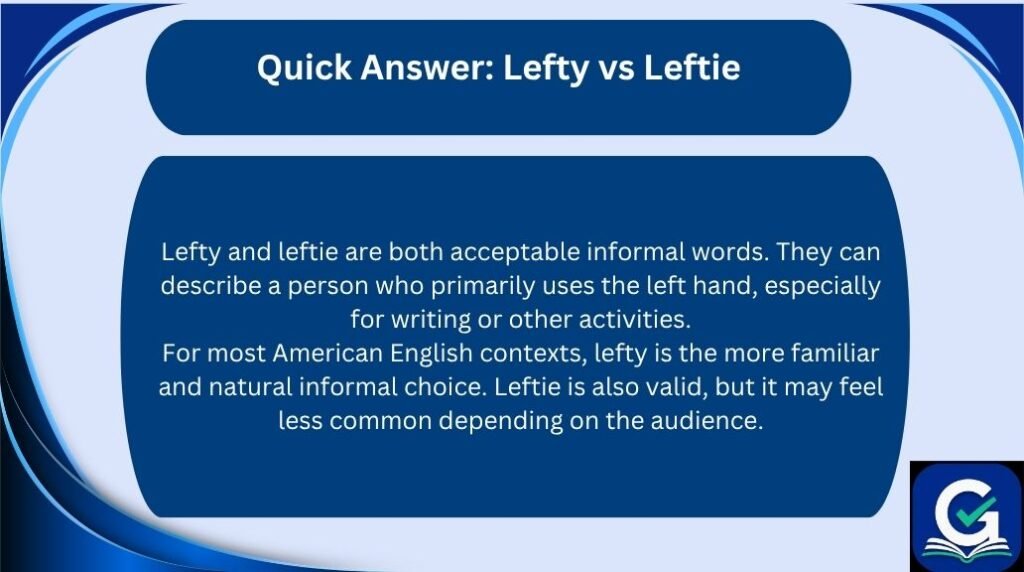
Lefty and leftie are both acceptable informal words. They can describe a person who primarily uses the left hand, especially for writing or other activities.
For most American English contexts, lefty is the more familiar and natural informal choice. Leftie is also valid, but it may feel less common depending on the audience.
If you need a formal or neutral expression, use left-handed or left-handed person.
In short:
- Lefty = common informal form
- Leftie = alternative informal form
- Left-handed = neutral and more formal
- Neither “lefty” nor “leftie” is automatically incorrect
Understanding the Basics of Lefty vs Leftie
The main difference between lefty and leftie is spelling, not basic meaning.
Both words can function as informal nouns referring to people who are left-handed. The choice between them often depends on personal preference, regional usage, and the tone of the sentence.
For example:
“My brother is a lefty.”
and:
“My brother is a leftie.”
Both sentences communicate essentially the same idea.
The adjective left-handed, however, is more formal and direct:
“My brother is left-handed.”
This third option is often preferable in professional, academic, medical, educational, or technical writing.
Comparison Table
| Form | Type | Meaning | Example | Correct/Incorrect |
|---|---|---|---|---|
| lefty | Informal noun | A left-handed person | “My sister is a lefty.” | Correct |
| leftie | Informal noun | A left-handed person | “My sister is a leftie.” | Correct |
| left-handed | Adjective | Using the left hand as the dominant hand | “My sister is left-handed.” | Correct |
| left-handed person | Noun phrase | A person who is left-handed | “She is a left-handed person.” | Correct |
| leftee | Nonstandard/rare | Usually intended to mean left-handed person | “He is a leftee.” | Generally avoid |
The most important lesson is simple: do not treat leftie as a straightforward misspelling of lefty.
What Does “Lefty” Mean?
The word lefty is an informal noun.
Its most common meaning is a person who is left-handed.
For example:
“I’m a lefty.”
This means:
“I am left-handed.”
Another example is:
“My daughter is a lefty.”
The word “lefty” replaces the longer expression “left-handed person.”
Because “lefty” is informal, it works especially well in casual conversations.
Examples of Lefty in Sentences
- “My dad is a lefty.”
- “She’s been a lefty since childhood.”
- “Are you a lefty too?”
- “The coach recruited another lefty.”
- “Being a lefty can make some desks uncomfortable.”
- “My friend is a talented lefty.”
All of these sentences use lefty as an informal noun.
Why Do People Say “Lefty”?
English speakers often shorten longer expressions in casual communication.
Instead of saying:
“a person who is left-handed”
they may simply say:
“a lefty.”
This makes conversation faster and more natural.
That is one reason why informal words like “lefty” are common in everyday speech.
What Does “Leftie” Mean?
Leftie is an alternative informal spelling of lefty.
It can also refer to someone who is left-handed.
For example:
“My son is a leftie.”
The meaning is essentially:
“My son is left-handed.”
The spelling with -ie may look unusual to some American readers, but it is not automatically a spelling mistake.
Cambridge Dictionary recognizes leftie as an alternative spelling of lefty, which supports its use as a legitimate informal form.
Examples of Leftie
Here are some natural examples:
- “I’m a leftie.”
- “My brother is a leftie.”
- “She’s the only leftie in her family.”
- “That leftie has an interesting throwing style.”
- “Are there any other lefties here?”
The important point is that the context determines whether “leftie” sounds natural for your particular audience.
Is Leftie a Correct Word?
Yes. Leftie is a recognized informal variant of lefty.
This is an important distinction because people sometimes assume that a word ending in -ie must be a typo when they are accustomed to seeing the -y spelling.
However, English contains many words with alternative spellings and informal forms.
The existence of an alternative spelling does not mean that one version is automatically wrong.
For example:
“She is a leftie.”
can be acceptable informal English.
However, if you are writing an academic report, you may want:
“She is left-handed.”
The second sentence is more neutral.
Lefty vs Leftie in US English
If your audience is American, lefty will usually be the easiest choice.
For example:
“He’s a lefty.”
sounds very natural in casual US English.
The word is also common in sports, particularly baseball.
“Leftie” is understandable, but some US readers may encounter it less frequently.
This does not make “leftie” incorrect. It simply means that familiarity matters.
When writing for a broad American audience, your safest informal choice is generally:
Use “lefty.”
When you need formal or highly precise language:
Use “left-handed.”
When discussing spelling alternatives or a particular style:
“Leftie” can be appropriate.
When Should You Use “Lefty”?
There are several situations where “lefty” works especially well.
Casual Conversations
If you are talking to friends or family, “lefty” sounds natural.
“My brother is a lefty.”
There is no need to use the longer phrase “left-handed person” unless you want to be more formal.
Sports
“Lefty” is frequently used in sports conversations.
For example:
“The manager brought in a lefty.”
The exact meaning depends on the sport and context.
In baseball, “lefty” commonly refers to someone who throws left-handed.
Social Media
Short informal language works well on social platforms.
For example:
“Any other lefties out there? 🙋♂️”
This sounds friendly and conversational.
Personal Stories
“Lefty” can make a personal story feel more natural.
“I realized I was a lefty when I started school.”
The informal word fits the conversational tone.
When Should You Use “Leftie”?
Use leftie when the informal spelling fits your audience or personal writing style.
For example:
“All the lefties in my family learned to adapt to right-handed tools.”
This is understandable and grammatically fine.
You might also see “leftie” in informal online discussions, personal writing, or regional varieties of English.
The key is consistency.
If you choose “leftie” for a casual article, you do not need to constantly switch between “leftie” and “lefty” without a reason.
When Should You Avoid Both Words?
There are situations where neither informal term is ideal.
If you are writing a:
- research paper
- formal report
- business document
- medical document
- school assignment
- technical guide
- official communication
then left-handed is usually the better choice.
Compare:
“The experiment included ten lefties.”
with:
“The experiment included ten left-handed participants.”
The second sentence is more professional and precise.
Similarly:
“The employee is a lefty.”
can become:
“The employee is left-handed.”
The second version is cleaner for formal communication.
Lefty as a Sports Term
One of the most interesting uses of lefty occurs in sports.
A coach might say:
“We need another lefty.”
The listener may understand that the team needs a left-handed player.
In baseball, the term is particularly familiar.
For example:
“The manager brought in a lefty to face the next batter.”
Here, “lefty” is shorthand for a left-handed pitcher.
Why Context Is Important
Imagine someone says:
“He is a lefty.”
Without context, you probably assume the person is left-handed.
But if the conversation is about politics, the meaning could be different.
If the conversation is about baseball, “lefty” could refer to a left-handed pitcher.
Therefore:
The same word can have different meanings depending on context.
Lefty Can Have a Political Meaning
There is another meaning of lefty that writers should know.
In some contexts, particularly British English, “lefty” can refer informally to someone associated with or supportive of the political left.
For example:
“The columnist was criticized for being a lefty.”
Here, the word is not talking about handedness.
This meaning can sometimes create ambiguity.
Consider:
“John is a lefty.”
If you know John is a baseball player, you may interpret the sentence as referring to his throwing hand.
If the conversation is political, you may interpret it as a political description.
How to Avoid Ambiguity
If you mean handedness, use:
“John is left-handed.”
If you mean politics, use:
“John supports the political left.”
This makes the intended meaning immediately clear.
Lefty vs Leftie: Grammar Rules
From a grammatical perspective, lefty and leftie can both function as nouns.
For example:
“She is a lefty.”
The word “lefty” is a noun functioning as a subject complement after the linking verb “is.”
The same structure works with “leftie”:
“She is a leftie.”
The grammar has not changed.
Only the spelling of the informal noun has changed.
Adjective vs Noun
There is an important distinction between left-handed and lefty.
“Left-handed” is an adjective:
“She is left-handed.”
“Lefty” is a noun:
“She is a lefty.”
You can also use “left-handed” inside a noun phrase:
“She is a left-handed student.”
Understanding this distinction helps you choose the correct grammatical structure.
Sentence Breakdown
Consider:
“Tom is a lefty.”
Here is the structure:
- Tom = subject
- is = linking verb
- a = article
- lefty = noun functioning as a subject complement
Now consider:
“Tom is left-handed.”
The structure is:
- Tom = subject
- is = linking verb
- left-handed = adjective
Both sentences are grammatical.
They simply use different forms.
Test Tip: How to Choose the Right Form
When you are unsure about lefty vs leftie, try replacing the word with left-handed.
For example:
“My sister is a lefty.”
Replace “a lefty” with “left-handed.”
“My sister is left-handed.”
The meaning remains clear.
Now ask whether the context is formal.
If yes, keep left-handed.
If the context is casual, lefty or leftie may be perfectly appropriate.
Easy Test
Ask yourself:
“Would I say this in a formal report?”
If the answer is no, an informal word may be fine.
If the answer is yes, left-handed is often the safer choice.
Real-Life Workplace Case Study
Imagine that an employee is explaining why a standard workstation is uncomfortable.
Informal Message
“Hi Sarah, I’m a lefty, so the current desk setup is a little difficult for me.”
This sounds natural in a casual workplace message.
More Professional Version
“Hi Sarah, I’m left-handed, so the current desk setup is a little difficult for me.”
The second version is better for a formal email because it is clear and neutral.
What If You Used “Leftie”?
You could write:
“Hi Sarah, I’m a leftie, so the current desk setup is a little difficult for me.”
The sentence is understandable, but “left-handed” may be more appropriate in a professional environment.
This case study demonstrates an important principle:
A word can be correct while still being less suitable for a particular context.
Common Mistakes With Lefty and Leftie
Mistake 1: Calling Leftie Always Incorrect
Some writers see “leftie” and immediately assume it is a typo.
That is not accurate.
“Leftie” is an established alternative informal form.
Mistake 2: Assuming Lefty Is Always Formal
“Lefty” is informal.
It should not automatically replace “left-handed” in academic or professional writing.
Mistake 3: Ignoring Context
“Lefty” can have more than one meaning.
Always consider the surrounding sentence.
Mistake 4: Inventing “Leftee”
The spelling leftee is not the standard alternative you should use when referring to a left-handed person.
If you want the informal noun, choose lefty or leftie.
Mistake 5: Overthinking Casual Writing
If you are texting a friend, there is usually no need to worry excessively about whether “lefty” or “leftie” is the perfect choice.
Both can communicate the intended meaning.
Why Do People Confuse These Spellings?
Several factors can cause confusion.
Fast Typing
When people type quickly, they often write the first spelling that comes to mind.
That can lead to inconsistent usage.
Autocorrect
Autocorrect can make one spelling appear more familiar because the keyboard recognizes it more easily.
However, autocorrect is not a complete grammar authority.
Regional Differences
People encounter different forms depending on where they live and what they read.
A spelling that feels unusual to one reader may be completely familiar to another.
Limited Vocabulary Exposure
If someone has only ever seen “lefty,” they may assume “leftie” is wrong.
The opposite can also happen.
Learning both forms eliminates much of the confusion.
Similar English Confusions
The lefty vs leftie question is different from pairs where the words have completely different grammatical functions.
Here are some useful comparisons:
| Pair | Difference |
|---|---|
| lefty / leftie | Alternative informal spellings |
| it’s / its | Contraction vs. possessive determiner |
| your / you’re | Possessive determiner vs. contraction |
| there / their / they’re | Different meanings and functions |
| than / then | Comparison vs. sequence |
| affect / effect | Different grammatical and semantic uses |
| advice / advise | Noun vs. verb |
| everyday / every day | Adjective vs. time expression |
The lesson is important:
Not every confusing word pair has one correct word and one incorrect word.
Sometimes both forms are legitimate.
Usage in Everyday Conversation
Everyday conversation is probably the easiest environment for lefty.
Examples include:
“Are you a lefty?”
“Yep, I’ve always been a lefty.”
“My dad is a lefty too.”
These sentences are relaxed and natural.
You can also use “leftie”:
“Are you a leftie?”
“Yep, I’ve always been a leftie.”
Again, the difference is mainly stylistic.
Usage in Professional Writing
Professional writing usually benefits from direct language.
Instead of:
“Our new employee is a lefty.”
consider:
“Our new employee is left-handed.”
The second sentence is more neutral.
If you are discussing equipment, you can be even more specific:
“The employee requires equipment designed for left-handed users.”
This gives the reader useful information rather than relying on an informal label.
Usage in Academic Writing
Academic writing should generally avoid unnecessary slang and informal labels.
Instead of:
“The researchers interviewed 20 lefties.”
write:
“The researchers interviewed 20 left-handed participants.”
This sounds more objective.
The same principle applies to school assignments.
If your assignment asks you to discuss language itself, however, lefty and leftie are completely appropriate because the words themselves are the topic.
Usage in Creative Writing
Creative writing is different.
Authors often use informal language to make dialogue sound authentic.
For example:
“I’m a lefty,” Jake said, laughing. “Give me five minutes and I’ll figure out this desk.”
The informal word helps the dialogue sound natural.
An author might choose “leftie” instead if that spelling fits the character’s voice.
Creative writing gives you more freedom because the goal is not always formal precision.
Usage in Texting and Social Media
Texting and social media favor short, casual vocabulary.
Examples:
“Lefty problems 😂”
“Any other lefties here?”
“Leftie life! ✍️”
Either informal form can work.
The important thing is that the audience understands your meaning.
Social media also allows playful language, so “lefty” can easily become part of captions, jokes, hashtags, and casual discussions.
Why Accurate Word Choice Matters
You may wonder why such a small difference deserves attention.
The answer is that clear writing depends on many small choices.
Clarity
Choosing “left-handed” instead of “lefty” can remove ambiguity.
For example:
“She is left-handed.”
is immediately clear.
Professionalism
Formal vocabulary makes business and academic writing sound more polished.
Reader Expectations
Different audiences expect different levels of formality.
A social media post can be relaxed.
A research paper should be precise.
Digital Communication
Online readers often scan content quickly.
Clear wording makes it easier for them to understand your meaning without stopping to interpret informal language.
As a useful writing principle:
Good word choice makes your meaning easier to understand.
Lefty vs Leftie: Which Is Better for SEO Content?
If you are writing an SEO article targeting a US audience, lefty is usually a practical primary term because it is concise and familiar.
However, an article targeting the search query lefty vs leftie should discuss both forms naturally.
Good SEO writing should answer the reader’s actual question rather than repeating the keyword unnecessarily.
Useful related terms include:
- lefty meaning
- leftie meaning
- lefty or leftie
- is leftie a word
- lefty spelling
- leftie spelling
- left-handed meaning
- left-handed person
- lefty definition
- leftie definition
These variations help search engines understand the broader topic.
The goal should be natural topical coverage, not keyword stuffing.
Special Exception: Context Can Change the Meaning
One special point deserves attention: lefty can have meanings beyond handedness.
For example, a political discussion may use “lefty” as an informal label for someone associated with the political left.
A sports conversation may use “lefty” for a left-handed player.
A conversation about writing may use “lefty” to mean a person who writes with the left hand.
Therefore, do not interpret the word in isolation.
Context Examples
Handedness:
“Sarah is a lefty, so she uses her left hand to write.”
Sports:
“The coach selected a lefty for the next game.”
Politics:
“The commentator called him a lefty.”
These sentences demonstrate why context is essential.
Quick Recap Checklist
Use this checklist to make the right choice quickly.
| Question | If Yes → Use |
|---|---|
| Is the sentence casual? | lefty or leftie |
| Are you writing for a US audience? | lefty is usually the easiest choice |
| Do you want a neutral expression? | left-handed |
| Is the writing academic? | left-handed |
| Is it a professional email? | left-handed |
| Are you writing a social media post? | lefty or leftie |
| Are you discussing a spelling variation? | lefty and leftie |
| Could “lefty” be politically misunderstood? | Use left-handed |
| Are you discussing baseball? | lefty may be useful |
| Are you unsure whether leftie is real? | Yes, it is an accepted informal form |
Practice Examples
Example 1
“My sister is a lefty.”
Correct. This is a natural informal sentence.
Example 2
“My sister is a leftie.”
Correct. This is also an accepted informal form.
Example 3
“My sister is left-handed.”
Correct. This is the most neutral option.
Example 4
“The research included 40 lefties.”
Informal. In academic writing, “40 left-handed participants” would be preferable.
Example 5
“The team signed a talented lefty.”
Correct in an appropriate sports context.
Easy Memory Trick for Lefty vs Leftie
Do not memorize the pair as:
lefty = correct
leftie = incorrect
That would give you the wrong rule.
Instead, remember:
Lefty and leftie are both informal alternatives.
Then remember the formal option:
Left-handed = neutral and precise.
A simple three-step memory trick is:
Casual → lefty
Alternative casual → leftie
Formal → left-handed
That is all you really need to remember.
FAQs
1. Is “lefty” or “leftie” correct?
Both lefty and leftie are accepted informal forms. They can describe a person who is left-handed. For many US readers, “lefty” is the more familiar option.
2. Is “leftie” a misspelling of “lefty”?
No. Leftie is recognized as an alternative informal spelling of “lefty.” It should not automatically be marked as a spelling error.
3. Which is more common in American English, lefty or leftie?
Lefty is generally the more familiar choice for many American English readers. However, “leftie” is also understandable and accepted as an informal variant.
4. Should I use “lefty” in formal writing?
Usually, it is better to use left-handed or left-handed person in formal writing. These expressions are clearer and more neutral.
5. Can “lefty” mean something other than a left-handed person?
Yes. In some contexts, especially British political usage, “lefty” can refer to someone associated with the political left. In sports, it can also refer to a left-handed player.
6. What is the safest word to use instead of lefty or leftie?
If you want maximum clarity and neutrality, use left-handed.
For example:
“She is left-handed.”
This works well in everyday, professional, educational, and academic contexts.
Conclusion
The question of lefty vs leftie becomes much easier once you understand that both words can be correct. Lefty is a common informal term for a left-handed person, while leftie is an accepted alternative informal spelling.
For many US English readers, “lefty” will feel more familiar, especially in everyday conversation and sports.
However, “leftie” should not automatically be treated as a spelling mistake. When your writing needs to sound formal, professional, academic, or completely neutral, left-handed or left-handed person is usually the better choice.
The biggest lesson is to choose based on context, audience, and tone rather than assuming one spelling is always right. If you are writing casually, either informal form can work. If clarity and professionalism matter most, simply choose “left-handed.”
Remember: lefty and leftie can both be right—the best choice depends on how and where you use them. ✨

I’m Jordan Hayes, a proofreading and editing writer at Gramfino, focused on clear and accurate English.
I enjoy finding common writing mistakes and sharing simple ways to make sentences stronger and easier to read.
[…] mistakes, memory tricks, and practical uses so you can confidently use both words in your writing. Lefty vs Leftie | Authorization vs Authorisation | Treat vs […]