Have you ever twisted your ankle, pulled a muscle, or felt sudden pain after exercising and wondered whether you had a sprain vs strain? You are not alone. These two words are often used interchangeably in everyday conversation, but they describe different types of injuries. The confusion is understandable because both can cause pain, swelling, tenderness, and difficulty moving the affected area.
The key difference is the type of tissue that gets injured. A sprain affects a ligament, while a strain affects a muscle or tendon. Knowing this distinction can make it easier to describe an injury accurately and understand basic treatment and recovery information.
In this guide, I’ll explain the difference between a sprain and a strain in simple language, show you practical examples, discuss common mistakes, and answer frequently asked questions. Whether you are writing about an injury, talking to a doctor, or simply trying to understand what happened after a workout, this guide will help you tell these two terms apart. 🩹 Parties vs Partys | Passed Away vs Past Away | Pray vs Prey
Quick Answer: Sprain vs Strain
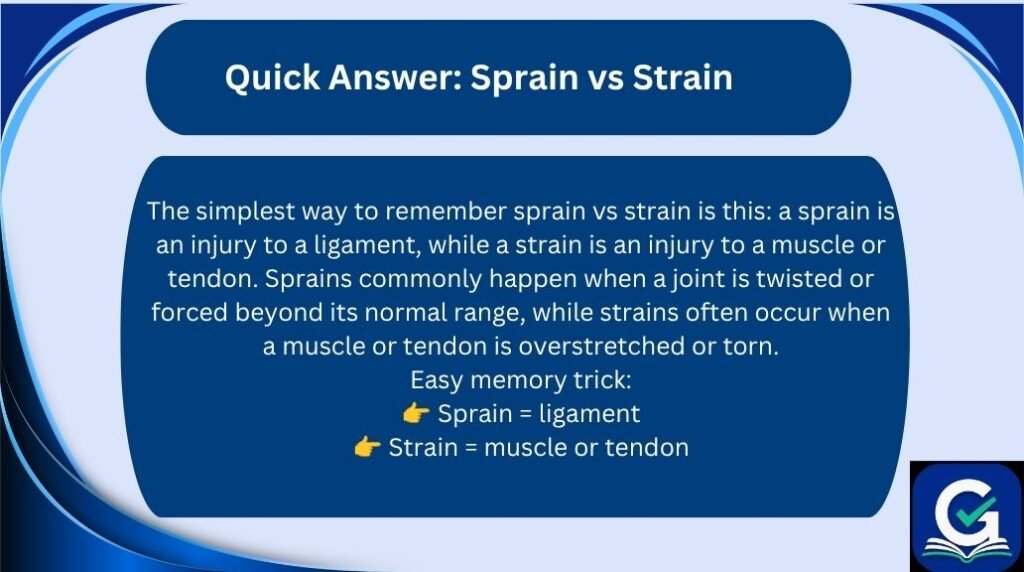
The simplest way to remember sprain vs strain is this: a sprain is an injury to a ligament, while a strain is an injury to a muscle or tendon. Sprains commonly happen when a joint is twisted or forced beyond its normal range, while strains often occur when a muscle or tendon is overstretched or torn.
Easy memory trick:
👉 Sprain = ligament
👉 Strain = muscle or tendon
For example, an ankle ligament injured after a sudden twist is generally called a sprain. A pulled hamstring or injured tendon is generally called a strain.
Understanding the Basics of Sprain vs Strain
Although sprains and strains are different injuries, their symptoms can look very similar. Both may result from sudden movements, falls, sports activities, overuse, or accidents.
The main difference is what tissue has been injured.
What Is a Sprain?
A sprain occurs when a ligament is stretched beyond its normal limits or torn.
Ligaments are strong bands of connective tissue that connect bone to bone. They help stabilize joints and keep them from moving too far in directions they are not designed to move.
Common locations for sprains include:
- Ankles
- Knees
- Wrists
- Thumbs
- Fingers
An ankle sprain, for example, can happen when you step awkwardly and the ankle suddenly rolls or twists.
What Is a Strain?
A strain occurs when a muscle or tendon is stretched too far or torn.
Tendons are strong connective tissues that attach muscles to bones. A strain can therefore involve the muscle itself, the tendon, or the connection between them.
Common locations for strains include:
- Hamstrings
- Lower back
- Neck
- Shoulders
- Calves
- Groin
A person might strain a hamstring while sprinting or strain a back muscle while lifting something incorrectly.
Sprain vs Strain Comparison Table
| Form | Type | Meaning | Example | Correct/Incorrect |
|---|---|---|---|---|
| Sprain | Noun/verb | Injury involving a ligament | I sprained my ankle. | Correct |
| Strain | Noun/verb | Injury involving a muscle or tendon | I strained my back. | Correct |
| Sprained | Adjective/verb form | Describes a ligament injury | She has a sprained wrist. | Correct |
| Strained | Adjective/verb form | Describes a muscle or tendon injury | He has a strained muscle. | Correct |
| “Muscle sprain” | Common mistaken usage | Usually confuses a sprain with a strain | I have a muscle sprain. | Usually incorrect |
| “Ligament strain” | Common mistaken usage | Usually confuses a strain with a sprain | I strained my ankle ligament. | Usually incorrect |
The most important distinction is not spelling or pronunciation. It is anatomical.
Correct Meanings and Uses
Understanding sprain vs strain becomes easier when you look at how each word functions in real sentences.
Sprain as a Noun
As a noun, sprain refers to the injury itself.
Example:
I went to the doctor because I have an ankle sprain.
Here, “sprain” is a noun because it names the injury.
Sentence breakdown:
- I = subject
- went = verb
- to the doctor = destination
- because = conjunction
- I have = verb phrase
- an ankle sprain = noun phrase naming the injury
Another example:
The athlete suffered a severe knee sprain.
“Sprain” identifies the type of injury.
Sprain as a Verb
Sprain can also function as a verb.
Example:
I sprained my ankle while playing basketball.
Here, “sprained” is the past tense of the verb sprain.
Other examples include:
- She sprained her wrist.
- He sprained his knee during practice.
- I think I sprained my thumb.
- They sprained an ankle during the hike.
Strain as a Noun
As a noun, strain can refer to an injury involving a muscle or tendon.
Example:
The runner suffered a hamstring strain.
Here, “strain” names the injury.
Another example:
The doctor diagnosed him with a lower-back strain.
The phrase identifies the type of injury and the affected area.
Strain as a Verb
Strain can also be used as a verb.
Example:
I strained my back while lifting a heavy box.
Here, “strained” is the past tense of strain.
Other examples include:
- She strained a muscle in her leg.
- He strained his shoulder during training.
- I strained my neck while sleeping awkwardly.
- The player strained his hamstring during the game.
How to Remember the Difference
If you frequently confuse these words, try connecting each term to the tissue it describes.
Sprain → Ligament
Think:
Sprain = Joint + Ligament
A sprain generally happens around a joint because ligaments stabilize joints.
Examples:
- Ankle sprain
- Knee sprain
- Wrist sprain
- Thumb sprain
Strain → Muscle or Tendon
Think:
Strain = Muscle + Tendon
Strains commonly affect areas that contain muscles and tendons.
Examples:
- Hamstring strain
- Back strain
- Neck strain
- Calf strain
A Simple Memory Sentence
You sprain a ligament and strain a muscle.
That sentence is not a complete medical rule for every possible injury description, but it is a useful everyday memory aid.
Test Tip: How Can You Check Which Word to Use?
When you are unsure about sprain vs strain, ask yourself one question:
What tissue was injured?
If the answer is ligament, use sprain.
If the answer is muscle or tendon, use strain.
For example:
Question: The ligament in my ankle was injured.
Answer: I have an ankle sprain.
Question: The muscle in my back was injured.
Answer: I have a back strain.
This test works better than trying to remember which word “sounds right.”
Sprain vs Strain in Real-Life Situations
The distinction becomes especially useful when describing an injury to another person.
Example 1: At the Gym
Imagine you are lifting weights and suddenly feel pain in your lower back.
You might say:
“I think I strained my back.”
That is appropriate when the injury involves a muscle or tendon.
Now imagine you step sideways, your ankle rolls, and you feel pain around the joint.
You might say:
“I think I sprained my ankle.”
The two situations may feel similar, but the injured structures are different.
Example 2: During a Soccer Game
A soccer player suddenly changes direction and twists a knee.
If a ligament is injured, the injury may be described as a knee sprain.
If the player overstretches a thigh muscle while sprinting, the injury may be described as a muscle strain.
Example 3: Everyday Conversation
Person A: Why aren’t you going to work today?
Person B: I strained my back yesterday while moving furniture.
Later, Person A might say:
“I hope your back strain gets better soon.”
That is natural and grammatically correct.
Case Study: Using the Words Correctly at Work
Imagine an employee sends this message to a supervisor:
“I twisted my ankle while walking downstairs yesterday. The doctor said I have an ankle sprain, so I may need to rest for a few days.”
The wording is clear because sprain describes the ligament injury.
Now consider a different situation:
“I lifted a heavy box yesterday and strained a muscle in my lower back. I may need to avoid lifting for a few days.”
Here, strained correctly describes the muscle-related injury.
Why This Matters
Using the correct term makes communication more precise.
Compare:
“I hurt my leg.”
with:
“I strained a muscle in my leg.”
The first sentence is broad. The second gives more specific information.
However, it is important not to diagnose yourself based solely on symptoms. Similar symptoms can occur with different injuries, and some injuries require professional evaluation.
Grammar Rules Behind Sprain vs Strain
Unlike spelling pairs such as its/it’s or your/you’re, sprain vs strain is not primarily a grammar confusion.
Both words are standard English words.
Both can be used as nouns and verbs.
The difference is mainly one of meaning and usage.
Sprain
As a verb:
She sprained her ankle.
As a noun:
She has an ankle sprain.
Strain
As a verb:
He strained his hamstring.
As a noun:
He has a hamstring strain.
Standard dictionaries, including Merriam-Webster, recognize sprain as an injury involving a ligament and strain as an injury involving excessive stretching or injury to a muscle or tendon.
Therefore, neither word is grammatically “better” than the other. The correct choice depends on what you mean.
Important Grammar Point
You should not assume that every sentence containing “ankle” requires sprain or every sentence containing “muscle” requires strain.
The surrounding meaning matters.
For example:
My ankle hurts.
This sentence does not identify the injury at all.
You cannot automatically change it to:
My ankle sprain hurts.
unless you know that a sprain is the actual condition being described.
Similarly:
My back hurts.
does not automatically mean:
I have a back strain.
The second statement makes a specific claim about the injury.
Common Mistakes With These Words
Why do people confuse sprain vs strain?
Several everyday factors contribute to the problem.
1. The Words Sound Similar
Both words are short and begin with “s.”
They are also commonly used when talking about injuries, which makes them easy to mix up.
2. Their Symptoms Can Overlap
Pain, swelling, tenderness, bruising, weakness, and limited movement can occur with both sprains and strains.
Because the symptoms can be similar, people may use the terms interchangeably.
3. Fast Typing
When people type quickly, they may choose the first similar-looking word that comes to mind.
This is especially common in:
- Text messages
- Social media posts
- Online chats
- Informal emails
4. Autocorrect
Autocorrect can sometimes reinforce mistakes instead of fixing them. If a person repeatedly uses the wrong word, they may become accustomed to seeing it.
5. Lack of Knowledge
Many people simply have never learned the anatomical difference between ligaments, muscles, and tendons.
That does not make the mistake unusual. It just means the distinction needs to be learned.
Similar Grammar and Word Confusions
The sprain vs strain confusion is different from traditional grammar pairs, but comparing it with other commonly confused words can help illustrate how word choice affects meaning.
| Confusing Words | Correct Use | Common Mistake |
|---|---|---|
| Its / It’s | “The dog wagged its tail.” | Using “it’s” to show possession |
| Your / You’re | “You’re doing well.” | Writing “your” for “you are” |
| Their / There / They’re | “They’re over there with their bags.” | Mixing the three forms |
| Affect / Effect | “The injury affected his training.” | Using the wrong noun/verb form |
| Then / Than | “She is faster than me.” | Using “then” for comparison |
| Sprain / Strain | “I sprained my ankle.” | Using “strain” for a ligament injury |
The key lesson is simple: similar words can have very different meanings.
Usage in Different Contexts
Everyday Conversation
In casual conversation, people often use broad language.
You might hear:
“I hurt my ankle.”
That is completely natural when you do not know the exact injury.
If you know it is a ligament injury, you can be more specific:
“I sprained my ankle.”
For a muscle-related injury:
“I strained my calf.”
Professional Writing
Professional communication benefits from precise wording.
For example:
“I am experiencing pain after a suspected ankle sprain.”
is more specific than:
“My leg got hurt.”
In workplace communication, however, you should avoid presenting an unconfirmed diagnosis as a fact.
A safer statement might be:
“I injured my ankle and am having it evaluated.”
Creative Writing
Writers can use either term depending on the scene.
For example:
He stumbled down the trail, grabbing his ankle after the sudden twist.
The writer does not need to identify the injury immediately.
Later:
The doctor confirmed that he had suffered a sprain.
Creative writing often benefits from showing symptoms before naming the condition.
Social Media and Texting
Informal posts frequently use abbreviated language:
“Sprained my ankle at the game 😭”
or:
“I think I strained my back at the gym.”
These are understandable and natural in casual communication.
For formal writing, complete sentences are generally preferable.
Why the Difference Matters
Knowing sprain vs strain matters for more than vocabulary.
Clarity in Communication
Precise language helps people understand what you mean.
Compare:
“I pulled something.”
with:
“I strained a muscle in my thigh.”
The second sentence communicates more information.
Professionalism
Correct terminology can make workplace messages, school assignments, articles, and health-related communication clearer and more polished.
Digital Communication
Online communication moves quickly. A single incorrect word can change the meaning of a message or make it less precise.
This is especially important when discussing injuries with coaches, teachers, employers, or healthcare professionals.
A Useful Reminder
Clear words create clear communication.
When you choose the right term, readers do not have to guess what you mean.
Symptoms of Sprains and Strains
Although this article focuses on word usage, understanding the basic medical distinction can make the vocabulary easier to remember.
Possible Symptoms of a Sprain
A sprain may involve:
- Pain around a joint
- Swelling
- Bruising
- Tenderness
- Reduced range of motion
- Difficulty putting weight on the affected area
Possible Symptoms of a Strain
A strain may involve:
- Muscle pain
- Tenderness
- Swelling
- Bruising
- Muscle weakness
- Muscle spasms or cramping
- Difficulty moving the affected area
These symptoms can overlap, so symptoms alone do not always tell you exactly which tissue has been injured.
Severity Can Vary
Both sprains and strains can range from mild to severe.
A mild injury may involve stretching or minor tissue damage. A more serious injury can involve a partial or complete tear.
Because severity varies, the words sprain and strain do not automatically tell you how serious an injury is.
For example:
“I have a sprain.”
does not necessarily mean the injury is minor.
Likewise:
“I have a strain.”
does not necessarily mean the injury is severe.
Medical professionals may use additional classifications to describe the extent of tissue damage.
When Should an Injury Be Evaluated?
Not every minor injury requires immediate medical attention, but certain symptoms warrant professional evaluation.
Consider seeking medical care if:
- Pain is severe or worsening.
- You cannot put weight on or use the affected body part.
- There is significant swelling or bruising.
- The joint appears deformed.
- You experience numbness or unusual weakness.
- You heard a popping sound when the injury occurred and have significant pain or loss of function.
- Symptoms do not improve as expected.
- You are unsure whether the injury is a sprain, strain, fracture, or another condition.
If an injury is severe or you are concerned about it, a qualified healthcare professional can assess it properly.
Special Exception: “Strain” Has Other Meanings
There is an important language exception.
The word strain has meanings that have nothing to do with physical injuries.
For example:
The long hours put a strain on her eyes.
Here, “strain” refers to stress or excessive demand.
Another example:
The disagreement put a strain on their friendship.
In this sentence, strain means pressure or tension in a relationship.
The word can also refer to a particular variety or genetic line in certain scientific contexts.
Therefore, strain is a broader word than the injury-related meaning alone.
The meaning depends on context.
What About “Sprain”?
Sprain is much more closely associated with an injury involving a ligament.
That makes it easier to identify in most ordinary contexts.
Quick Recap Checklist
Use this checklist whenever you are uncertain about sprain vs strain.
| Question | If Yes → Use |
|---|---|
| Is a ligament injured? | Sprain |
| Is a muscle injured? | Strain |
| Is a tendon injured? | Strain |
| Did you twist a joint and injure a ligament? | Sprain |
| Did you overstretch or tear a muscle or tendon? | Strain |
| Are you simply describing pain without knowing the injury? | Use a general term such as injury |
Practice Example 1
Situation: You roll your ankle and injure a ligament.
Correct:
I sprained my ankle.
Practice Example 2
Situation: You overstretch a hamstring while running.
Correct:
I strained my hamstring.
Practice Example 3
Situation: You do not know what caused your pain.
Better:
I injured my leg.
This avoids making an unsupported diagnosis.
Sprain vs Strain: Common Sentence Examples
Here are additional examples to reinforce the distinction.
Sprain Examples
- I sprained my ankle during the hike.
- She suffered a wrist sprain.
- The doctor diagnosed a knee sprain.
- He has a badly sprained ankle.
- The player returned after recovering from an ankle sprain.
Strain Examples
- I strained my back while moving the table.
- She strained her hamstring during practice.
- The runner suffered a calf strain.
- He has a strained shoulder muscle.
- The athlete is recovering from a muscle strain.
Incorrect or Misleading Examples
Instead of:
I strained my ankle ligament.
when you mean that you injured the ligament, say:
I sprained my ankle.
Instead of:
I sprained my hamstring.
when you mean that you injured the muscle, say:
I strained my hamstring.
The important point is the injured structure, not simply the body part.
How Writers Can Avoid Confusion
If you write health, fitness, sports, or workplace content, precision is especially important.
Before using either word, ask:
- What tissue am I describing?
- Do I know the injury has actually been diagnosed?
- Am I describing a confirmed injury or simply a symptom?
- Is the sentence intended for casual or professional communication?
If you do not know the exact injury, use neutral wording.
For example:
She injured her ankle during the game.
This sentence is accurate without claiming that the injury is definitely a sprain.
If the diagnosis is known:
She suffered an ankle sprain during the game.
This is more specific.
FAQs
1. What is the main difference between a sprain and a strain?
A sprain is an injury to a ligament, which connects bone to bone. A strain affects a muscle or tendon, which connects muscle to bone. Both injuries can involve stretching or tearing of tissue.
2. Is a sprain worse than a strain?
Not necessarily. Both sprains and strains can range from mild to severe. The seriousness depends on factors such as the extent of tissue damage, location, symptoms, and loss of function.
3. Is a pulled muscle a strain or a sprain?
A pulled muscle is generally called a strain. The term “pulled muscle” commonly describes an overstretched or torn muscle or related tendon.
4. Is a twisted ankle a sprain or a strain?
A twisted ankle can result in an ankle sprain when the twisting injures one or more ankle ligaments. However, other structures can also be injured, so a twisted ankle should not automatically be assumed to be a sprain.
5. Can you strain a ligament?
In standard everyday medical terminology, a ligament injury is generally described as a sprain, while a muscle or tendon injury is described as a strain. This distinction is the easiest way to remember the terms.
6. What is the easiest way to remember sprain vs strain?
Remember:
Sprain = ligament.
Strain = muscle or tendon.
Think of a sprain as something that commonly happens around a joint and a strain as something involving a muscle or tendon.
Final Comparison: Sprain vs Strain
| Feature | Sprain | Strain |
|---|---|---|
| Main tissue | Ligament | Muscle or tendon |
| Common location | Ankle, knee, wrist, thumb | Back, hamstring, calf, neck |
| Common cause | Twisting or forcing a joint | Overstretching or overloading muscle/tendon |
| Can involve a tear? | Yes | Yes |
| Can cause swelling? | Yes | Yes |
| Can cause bruising? | Yes | Yes |
| Can cause pain? | Yes | Yes |
| Example | Sprained ankle | Strained hamstring |
The table highlights why the two words are often confused: their symptoms and causes can overlap even though the injured tissues are different.
Conclusion
Understanding sprain vs strain is much easier once you focus on the tissue involved. A sprain affects a ligament, while a strain affects a muscle or tendon. A twisted ankle that injures a ligament is commonly called an ankle sprain, while an overstretched hamstring or injured back muscle is generally described as a strain.
Both words can function as nouns and verbs, so the issue is not really grammar; it is choosing the word that accurately communicates the meaning. If you are unsure about an injury, avoid guessing and use a general term such as “injury” until it has been properly evaluated.
For everyday writing, professional communication, and conversations about sports or fitness, remembering one simple rule can prevent most mistakes: sprain means ligament, strain means muscle or tendon. Get the tissue right, and you’ll get the word right. 🩹

I’m Mason Reed, a grammar researcher at Gramfino, where I explore grammar rules and common English mistakes.
I turn my research into clear explanations and practical examples that readers can easily follow.


[…] when to use each form, point out common mistakes, and give you practical examples you can remember. Sprain vs Strain | Parties vs Partys | Passed Away vs Past […]
[…] and memory tricks so you never have to second-guess this spelling again. 🧠✨ Life vs Lives | Sprain vs Strain | Parties vs […]