Have you ever stopped while writing and wondered whether parties vs partys is the correct spelling? You are not alone—this is a common English spelling confusion, especially when you need to write about multiple celebrations, groups, or organizations.
At first glance, “party” seems like a word that should simply become “partys” when plural, but standard English follows a different rule. The correct plural form is parties, while partys is incorrect in ordinary English usage.
In this guide, I’ll explain the difference between parties vs partys, show you why “parties” is correct, and give you simple examples that make the rule easy to remember. Whether you are writing an email, school assignment, business document, social media post, or everyday message, understanding this small spelling rule can help you write with greater confidence and accuracy. 😊 Passed Away vs Past Away | Pray vs Prey | Licensed vs Licenced
Quick Answer: Parties vs Partys
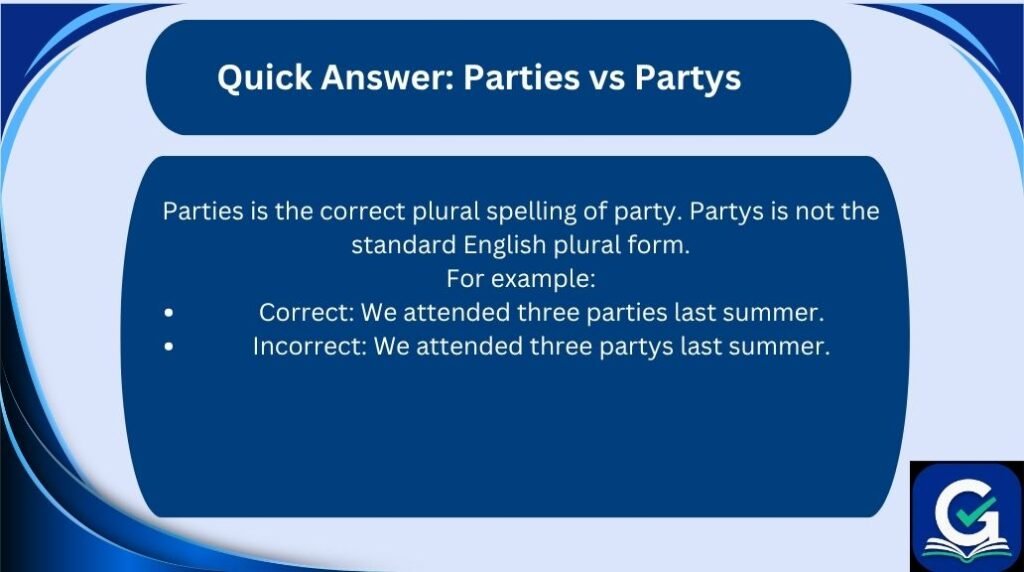
Parties is the correct plural spelling of party. Partys is not the standard English plural form.
For example:
- Correct: We attended three parties last summer.
- Incorrect: We attended three partys last summer.
The spelling changes from party → parties because the word ends in a consonant followed by y. To form the plural, the y changes to i and -es is added.
Understanding the Basics of Parties vs Partys
The easiest way to understand parties vs partys is to look at the final letters of the singular word party.
The singular form is:
party
When you need to talk about more than one party, you do not simply add -s. Instead, you change the final y to i and add -es:
party → parties
This is a standard pluralization pattern in English.
Parties vs Partys Comparison Table
| Form | Type | Meaning | Example | Correct/Incorrect |
|---|---|---|---|---|
| party | Singular noun | One party | I went to a party. | ✅ Correct |
| parties | Plural noun | More than one party | We attended two parties. | ✅ Correct |
| partys | Intended plural noun | Supposed to mean more than one party | We attended two partys. | ❌ Incorrect |
The key point is simple: parties is the standard plural form of party. The spelling partys should not be used as the ordinary plural.
What Does “Party” Mean?
Before examining the plural, it helps to understand the word party itself.
The noun party can have several meanings depending on context.
Party as a Social Event
A party can be a social gathering where people meet, celebrate, eat, drink, dance, or spend time together.
Examples:
- We are having a birthday party tonight.
- Sarah invited me to her graduation party.
- The children enjoyed the Halloween party.
When there is more than one social event, use parties.
- We attended several birthday parties this year.
- The hotel hosts holiday parties every December.
Party as a Group of People
Party can also refer to a group of people involved in an agreement, legal matter, business transaction, or negotiation.
For example:
- Both parties agreed to the contract.
- The two parties reached a settlement.
- Each party must sign the document.
Here, parties means multiple groups or sides.
Party as a Political Organization
In politics, a party can mean an organized group with shared political goals or beliefs.
Examples include:
- The political party announced its new policy.
- Several political parties participated in the election.
- The two major parties debated the proposal.
Again, the plural is parties, not partys.
Why Is “Parties” Correct?
The spelling rule behind party → parties is one of the most useful English plural rules to learn.
When a noun ends in a consonant + y, the usual plural form changes the y to i and adds -es.
The pattern looks like this:
consonant + y → i + es
So:
- party → parties
- city → cities
- baby → babies
- country → countries
- story → stories
- family → families
- company → companies
The same principle applies to party.
Step-by-Step Breakdown
Start with:
party
Remove the final y:
part
Actually, when applying the spelling rule, think of it as changing the final y to i:
parti
Then add -es:
parties
Therefore:
party → parties
The result is parties.
When Do Words Ending in “Y” Take Only “-S”?
This is where many learners become confused.
Not every noun ending in y changes to -ies.
If the letter immediately before y is a vowel, the plural normally keeps the y and simply adds -s.
For example:
- boy → boys
- toy → toys
- key → keys
- day → days
- monkey → monkeys
- holiday → holidays
Compare these with words ending in a consonant + y:
- party → parties
- city → cities
- baby → babies
- country → countries
- library → libraries
The Easy Rule
Remember:
Consonant + y → change y to i and add -es
Vowel + y → keep y and add -s
Examples:
| Singular | Letter Before Y | Plural |
|---|---|---|
| party | t = consonant | parties |
| city | t = consonant | cities |
| baby | b = consonant | babies |
| boy | o = vowel | boys |
| toy | o = vowel | toys |
| key | e = vowel | keys |
This rule makes parties vs partys much easier to remember.
Correct Meanings and Uses of “Parties”
The word parties is not limited to birthday celebrations. It can appear in several types of writing.
1. Parties as Social Gatherings
This is probably the meaning most people think of first.
Example:
We went to three parties during the holiday season.
Sentence Breakdown
- We = subject
- went = verb
- to = preposition
- three parties = object of the preposition
- three tells us there is more than one party.
Because the sentence refers to three separate events, parties is required.
2. Parties in Business Writing
The word parties is common in contracts and formal business communication.
Example:
Both parties must approve the agreement.
Here, parties refers to two sides involved in the agreement.
Another example:
The parties agreed to resolve the dispute privately.
In this context, replacing parties with partys would be a spelling error.
3. Parties in Legal Writing
Legal documents frequently use party and parties.
For example:
The parties involved in the case appeared in court.
Here, parties refers to multiple individuals or organizations involved in a legal matter.
You may also see phrases such as:
- interested parties
- third parties
- opposing parties
- contracting parties
- affected parties
All of these use parties.
4. Parties in Political Writing
Political writing also uses the plural form regularly.
Example:
Several parties competed in the election.
The sentence refers to more than one political organization.
Another example:
The parties presented different proposals.
Again, parties is the correct spelling.
Test Tip: How to Choose “Parties” vs “Partys”
If you are unsure, use this quick test:
Ask yourself:
Am I talking about more than one party?
If the answer is yes, use:
parties
Never use partys as the standard plural.
You can also look at the word before the final y.
In party, the letter before y is t, which is a consonant.
Therefore:
party → parties
Memory Trick 🧠
Think:
Party loses Y and gains IES.
PARTY → PARTIES
You can remember the phrase:
“A party becomes parties.”
That small sentence can help you recall the spelling whenever you hesitate.
Parties vs Partys in Real-Life Writing
Let’s imagine you are writing an email to your coworkers.
Incorrect Email Sentence
We have several company partys scheduled this month.
The plural spelling is incorrect.
Correct Version
We have several company parties scheduled this month.
The correction is simply:
partys ❌ → parties ✅
Now imagine a workplace contract:
Incorrect
Both partys must sign the agreement.
Correct
Both parties must sign the agreement.
The second version is grammatically and orthographically correct.
Case Study: A Workplace Example
Imagine a manager sends an email about an upcoming company event.
First Draft
Hi everyone,
We have two holiday partys planned for December. Please let me know which one you would like to attend.
There is one spelling problem: partys.
The corrected version is:
Hi everyone,
We have two holiday parties planned for December. Please let me know which one you would like to attend.
Why?
Because two tells us the noun is plural. The plural of party is parties.
Another Workplace Example
Suppose a manager writes:
Both partys need to review the contract before Friday.
The correct sentence is:
Both parties need to review the contract before Friday.
Here, parties refers to two sides in a business agreement rather than social gatherings.
This example shows why understanding meaning is useful, but the spelling rule remains the same.
Grammar Rules Behind “Parties”
Standard English spelling rules determine why parties is correct.
According to established English usage, nouns ending in a consonant followed by y generally form their plural by changing y to i and adding -es.
The same pattern appears in many common nouns:
- party → parties
- puppy → puppies
- hobby → hobbies
- enemy → enemies
- activity → activities
- opportunity → opportunities
Major dictionaries such as Merriam-Webster list parties as the plural of party and recognize party as a noun with several meanings, including a social gathering and a group of people.
The important lesson is that partys is not the standard plural spelling.
Why Do People Write “Partys”?
If parties is correct, why does partys appear so often?
There are several common reasons.
1. Fast Typing
People often type quickly, especially when using phones or messaging apps.
Someone may think:
party + s = partys
This happens because adding -s is the most common way to form regular plurals.
However, English has many spelling patterns that require more than simply adding s.
2. Autocorrect
Autocorrect can sometimes create confusion rather than solve it.
A person might type quickly and fail to notice that the word has been changed incorrectly—or that the incorrect form was never corrected.
Always proofread important writing instead of depending completely on automatic corrections.
3. Lack of Knowledge of the Rule
Someone who has not learned the consonant + y plural rule may reasonably assume that every noun becomes plural by adding s.
That assumption works for many words:
- book → books
- car → cars
- house → houses
But it does not work for party.
Similar Grammar and Spelling Confusions
The parties vs partys confusion belongs to a larger group of common English mistakes.
| Common Confusion | Correct Form | Basic Rule |
|---|---|---|
| parties vs partys | parties | consonant + y → ies |
| cities vs citys | cities | consonant + y → ies |
| babies vs babys | babies | consonant + y → ies |
| stories vs storys | stories | consonant + y → ies |
| boys vs boies | boys | vowel + y → s |
| it’s vs its | depends on meaning | contraction vs possessive |
| you’re vs your | depends on meaning | contraction vs possessive |
| they’re vs their | depends on meaning | contraction vs possessive |
These examples show an important truth about English:
Spelling often depends on the structure and function of a word, not simply on adding letters mechanically.
Parties vs Partys in Different Contexts
Understanding where the correct form belongs can make your writing more natural.
Everyday Conversation
In casual conversation, parties is used when talking about multiple social events.
Examples:
- We went to two parties last weekend.
- Her birthday parties are always fun.
- I have three parties to attend this month.
- The neighborhood hosts summer parties every year.
Although conversation is informal, the standard spelling remains parties when you write it down.
Professional Writing
Accuracy becomes especially important in professional communication.
Use parties in:
- emails
- reports
- contracts
- proposals
- meeting notes
- business documents
- legal correspondence
Examples:
The two parties signed the agreement.
All interested parties will receive an update.
The company organized several employee parties throughout the year.
Using partys in professional writing can make the document look careless.
Creative Writing
Authors may use parties when describing multiple events or groups.
For example:
The town hosted several parties during the festival.
Or:
The two parties stood on opposite sides of the room.
Creative writing allows unusual vocabulary and stylistic choices, but standard spelling still matters unless a deliberate fictional spelling is being used.
Social Media and Texting
Social media and texting are much more relaxed.
Someone might type:
going to 2 partys tonight 😂
People may understand the intended meaning, but partys is still not the standard plural spelling.
For polished social media captions, professional posts, or public-facing content, use:
going to two parties tonight 😂
Informal communication may tolerate mistakes, but correct spelling improves readability.
Why Correct Spelling Matters
Clarity in Communication
Correct spelling helps readers understand your message quickly.
When someone sees parties, the meaning is immediately clear.
Incorrect spelling can cause the reader to pause, even when the intended meaning is obvious.
Good writing should make communication easy, not make readers decode avoidable mistakes.
Professionalism
Spelling matters especially in:
- resumes
- cover letters
- business emails
- academic papers
- websites
- marketing materials
- official documents
A small spelling mistake may not change the meaning of a sentence, but repeated errors can affect how carefully your writing is perceived.
Digital Communication
Today, people communicate through:
- text messages
- emails
- social media
- online forms
- websites
- workplace platforms
Because so much communication is written, spelling accuracy has become an important part of clear digital communication.
As a simple principle:
Clear writing builds confidence in the message.
Special Exception: When Could “Partys” Appear?
In standard English, partys is not the normal plural of party.
However, there could theoretically be unusual situations where a form resembling Partys appears as part of a proper name, username, fictional spelling, product name, brand, title, or other intentionally stylized wording.
For example, a fictional business might deliberately choose an unusual spelling for branding.
That does not change the standard grammar rule.
If you are simply trying to write the plural of party, use:
parties
So unless Partys is intentionally part of a specific name or stylized expression, it should not replace parties.
Common Sentences: Parties vs Partys
Here are several examples to reinforce the difference.
Correct Examples
- We attended three parties last month.
- The two parties reached an agreement.
- Several political parties participated in the election.
- She loves hosting birthday parties.
- The interested parties received an email.
- Both parties signed the contract.
- There will be several holiday parties this year.
- The children enjoyed their school parties.
- The legal parties appeared before the judge.
- Different parties offered competing solutions.
Incorrect Examples
- We attended three partys.
- Both partys signed the contract.
- Several political partys participated.
- She organizes birthday partys.
In every ordinary case above, parties is the correct spelling.
Singular and Plural Forms You Should Know
Understanding the singular and plural together can prevent mistakes.
| Singular | Plural |
|---|---|
| party | parties |
| city | cities |
| baby | babies |
| family | families |
| company | companies |
| country | countries |
| story | stories |
| hobby | hobbies |
| activity | activities |
| opportunity | opportunities |
Notice the consistent pattern.
The singular word ends in consonant + y, so the plural changes the y to i and adds -es.
A Simple Way to Remember the Rule
If you want a quick memory formula, use this:
Consonant + Y
Change Y to I + add ES
Examples:
party → parties
baby → babies
city → cities
Vowel + Y
Keep Y + add S
Examples:
boy → boys
toy → toys
key → keys
So when you see party, check the letter immediately before y.
It is t, a consonant.
Therefore:
party → parties
Not:
party → partys
Quick Recap Checklist
Use this checklist whenever you are unsure.
| Question | If Yes → Use |
|---|---|
| Am I talking about more than one party? | parties |
| Does the singular noun end in consonant + y? | Usually change y → ies |
| Am I writing the standard plural of party? | parties |
| Am I referring to multiple social gatherings? | parties |
| Am I referring to multiple groups or sides? | parties |
| Is “partys” simply intended as the plural of party? | ❌ Don’t use it |
Practice Example 1
We attended three birthday ______.
Answer: parties
Practice Example 2
Both ______ agreed to the terms.
Answer: parties
Practice Example 3
Several political ______ joined the discussion.
Answer: parties
Parties vs Partys: Quick Grammar Test
Try completing these sentences without looking at the answers.
Question 1
My friends are planning two summer ______.
Answer: parties ✅
Question 2
The two ______ signed the contract.
Answer: parties ✅
Question 3
She hosted several birthday ______ this year.
Answer: parties ✅
Question 4
Which spelling is standard?
A. Partys
B. Parties
Answer: B. Parties ✅
FAQs
1. Is “parties” or “partys” correct?
Parties is correct. The plural of party is parties, not partys. The spelling changes from y to i and adds -es.
2. Why is the plural of party “parties”?
Because party ends in a consonant followed by y. In standard English, nouns with this pattern generally change y to i and add -es to form the plural.
3. Is “partys” ever correct?
Not as the standard plural of party. It might appear as part of an intentionally unusual proper name, brand, username, or fictional spelling, but ordinary English requires parties.
4. What is the singular of “parties”?
The singular form is party.
One party → two parties
5. Does the rule apply to other words ending in consonant + y?
Yes. Many nouns follow the same pattern:
- city → cities
- baby → babies
- country → countries
- story → stories
- family → families
6. How can I remember “parties” vs “partys”?
Remember this simple rule: consonant + y changes to -ies. Since party has t + y, it becomes parties.
Conclusion
When comparing parties vs partys, the correct choice is clear: parties is the standard plural form of party. Whether you are talking about several social gatherings, multiple political organizations, or two sides in a business or legal agreement, the spelling remains parties.
The reason is the familiar English spelling rule for nouns ending in a consonant followed by y: change the y to i and add -es. That gives us party → parties. The form partys is incorrect when it is intended as the ordinary plural.
Once you remember the consonant + y rule, this spelling becomes much easier to recognize. So the next time you hesitate, skip the extra guesswork and remember: one party, two parties—never two partys. ✨

I’m Jordan Hayes, a proofreading and editing writer at Gramfino, focused on clear and accurate English.
I enjoy finding common writing mistakes and sharing simple ways to make sentences stronger and easier to read.
[…] understand what happened after a workout, this guide will help you tell these two terms apart. 🩹 Parties vs Partys | Passed Away vs Past Away | Pray vs […]
[…] point out common mistakes, and give you practical examples you can remember. Sprain vs Strain | Parties vs Partys | Passed Away vs Past […]