Have you ever written a sentence and suddenly stopped because you could not decide between licensed vs licenced? You are not alone. These two spellings look almost identical, sound the same, and carry the same basic idea, so the confusion is understandable. The important point is that English spelling can change depending on regional conventions and dictionary preferences. For writers using standard US English, licensed is the preferred spelling.
You will see it in phrases such as “licensed driver,” “licensed professional,” and “licensed contractor.” The spelling licenced can also be found as a variant, but it is much less common and is not the usual choice for American writing.
In this guide, I’ll explain the difference between licensed vs licenced, show you how each form works, discuss American and British usage, and give you simple examples and memory tricks so you can choose the right spelling with confidence. referred vs refered | Savvy vs Savy | Tires vs Tyres
Quick Answer: Licensed vs Licenced
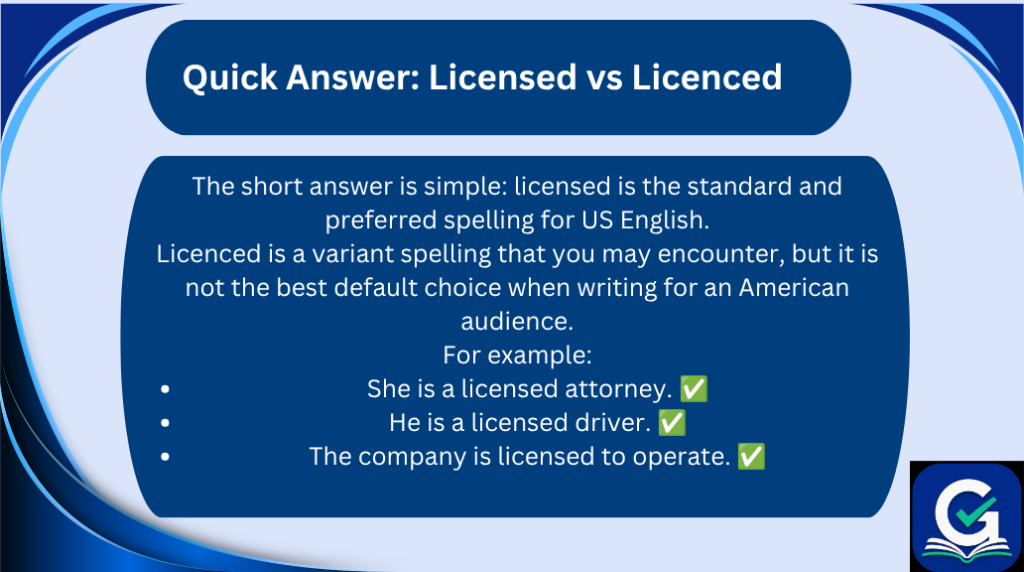
The short answer is simple: licensed is the standard and preferred spelling for US English.
Licenced is a variant spelling that you may encounter, but it is not the best default choice when writing for an American audience.
For example:
- She is a licensed attorney. ✅
- He is a licensed driver. ✅
- The company is licensed to operate. ✅
If you are writing in standard US English, remember:
Use “licensed” rather than “licenced.”
Understanding the Basics
The easiest way to understand licensed vs licenced is to look at the word they come from.
The base verb is license.
When you form the past tense or past participle, the standard spelling is:
license → licensed
The word licensed can also work as an adjective.
For example:
The doctor is a licensed professional.
Here, licensed describes the doctor.
You can also use it as a verb:
The state licensed the business.
Here, licensed describes an action that happened in the past.
Comparison Table
| Form | Type | Meaning | Example | Correct/Incorrect |
|---|---|---|---|---|
| licensed | Adjective | Officially authorized | She is a licensed nurse. | ✅ Standard |
| licensed | Past-tense verb | Officially authorized someone or something | The state licensed the company. | ✅ Standard |
| licensed | Past participle | Having received authorization | The facility is fully licensed. | ✅ Standard |
| licenced | Variant spelling | Same general meaning | The company was licenced. | ⚠️ Variant |
| license | Noun/verb | Official permission / to authorize | He has a license. | ✅ US English |
| licence | Noun | Official permission | She has a driving licence. | ✅ British English |
For American readers, licensed is the safest and most natural choice.
What Does Licensed Mean?
Licensed means officially authorized, permitted, or approved to do something.
The authorization is usually provided by a government agency, professional organization, company, or other recognized authority.
For example:
She is a licensed therapist.
This means she has the required authorization to practice as a therapist.
Another example is:
The restaurant is licensed to sell alcoholic beverages.
Here, licensed means the restaurant has official permission to perform that activity.
Common Uses of Licensed
The word appears in many everyday and professional expressions, including:
- licensed driver
- licensed doctor
- licensed lawyer
- licensed attorney
- licensed contractor
- licensed electrician
- licensed therapist
- licensed nurse
- licensed architect
- licensed business
- licensed manufacturer
- licensed distributor
- licensed professional
The meaning remains connected to official authorization.
Licensed as an Adjective
One of the most common uses of licensed is as an adjective.
An adjective describes or modifies a noun.
Consider:
James is a licensed electrician.
The word licensed tells us something about James’s professional status.
Sentence Breakdown
- James = subject
- is = linking verb
- a = article
- licensed = adjective
- electrician = noun
The sentence means that James has the required authorization to work as an electrician.
Here are more examples:
We hired a licensed contractor.
Licensed describes contractor.
She works at a licensed clinic.
Licensed describes clinic.
The company employs licensed professionals.
Licensed describes professionals.
This adjective form is especially common in professional and legal contexts.
Licensed as a Verb
Licensed can also be the past tense and past participle of the verb license.
For example:
The government licensed the company last year.
Here, licensed is a verb because it tells us what the government did.
Compare these forms:
- The agency licenses businesses.
- The agency licensed the business.
- The agency has licensed the business.
- The agency is licensing new businesses.
The spelling of the past form is licensed.
More Examples
The state licensed the facility in June.
The board licensed the new practitioner.
The organization has licensed several professionals.
The agency officially licensed the company.
In all these examples, licensed communicates authorization.
What Does Licenced Mean?
When examining licensed vs licenced, it is important not to assume that licenced is simply a random spelling mistake.
Licenced is a variant spelling that can be found in English-language usage. However, it is much less common than licensed, particularly in standard American English.
The two forms generally communicate the same meaning.
For example:
The company is licensed to operate.
and:
The company is licenced to operate.
The intended meaning is essentially the same.
However, if you are writing for a US audience, the first sentence is the better choice.
Why Licensed Is Better for US English
American English normally uses:
license → licensed
This pattern is familiar to American readers and appears in dictionaries, professional documents, websites, forms, and official communication.
Therefore, if your goal is clear and standard US English, choose licensed.
Why the Confusion Exists
The confusion surrounding licensed vs licenced partly comes from another spelling difference:
license vs licence
American English generally uses license as both a noun and a verb.
For example:
I have a driver’s license.
The state will license the company.
British English traditionally distinguishes between the noun and verb:
licence = noun
license = verb
For example:
She has a driving licence.
The government will license the business.
This distinction can make the past form confusing.
Some writers see licence and assume the past form must be licenced.
But the verb is license, and its standard past form is licensed.
License vs Licence: The Important Difference
To understand licensed vs licenced, it helps to understand license vs licence.
American English
In US English, license can be both a noun and a verb.
Examples:
I renewed my driver’s license.
The state will license the company.
The company was licensed last year.
British English
Traditional British English uses licence as the noun and license as the verb.
Examples:
I renewed my driving licence.
The authority will license the business.
The business was licensed last year.
So the key point is:
British “licence” does not automatically mean “licenced.”
That is one of the most common misunderstandings in this area.
Correct Meanings and Uses
Official Authorization
The most common meaning is having official permission.
The company is licensed to provide financial services.
The company has been officially authorized.
Professional Qualification
The word can describe someone who is legally or professionally authorized to work.
She is a licensed psychologist.
The sentence indicates that she has the required professional authorization.
Business Authorization
A business may also be licensed.
The store is licensed by the local authority.
This means the relevant authority has granted permission for the business to operate.
Product or Brand Authorization
The word can also describe something produced under an official agreement.
The company sells licensed merchandise.
Here, licensed indicates that the merchandise has been authorized by the relevant rights holder.
Driving Permission
A very familiar example is:
He is a licensed driver.
This means he has the necessary driving authorization.
Test Tip: How to Choose the Correct Form
When you are unsure about licensed vs licenced, use this quick test:
Ask yourself:
Am I writing standard US English?
If yes, use:
✅ licensed
For example:
She is a licensed nurse.
He is a licensed contractor.
The company is licensed to operate.
This test works in most everyday American English situations.
Another Memory Trick
Remember:
license + d = licensed
The standard spelling keeps the s:
license → licensed
This is an easy way to avoid accidentally changing the spelling to licenced.
A Real-Life Workplace Case Study
Imagine that you work in the human resources department of an American company.
Your manager asks you to write an email confirming that a new employee has the necessary professional credentials.
You might write:
Subject: Professional Credential Verification
Sarah has provided documentation confirming that she is a licensed professional. Her current license has been verified, and all required documents have been submitted.
This version is clear, natural, and appropriate for professional US English.
Now imagine writing:
Sarah has provided documentation confirming that she is a licenced professional.
Most readers would understand the sentence, but licensed is the better standard choice for American professional writing.
What This Example Teaches
The example also shows the relationship between:
- licensed = adjective
- license = noun
You can say:
She is licensed.
and:
Her license is current.
Both words are correct in US English, but they serve different grammatical roles.
Grammar Rules Explained
The grammar behind licensed vs licenced becomes much easier when you start with the base verb.
The verb is:
license
Its common forms are:
| Verb Form | Example |
|---|---|
| Base form | The state will license the company. |
| Third-person singular | The state licenses the company. |
| Past tense | The state licensed the company. |
| Past participle | The company has been licensed. |
| Present participle | The state is licensing companies. |
The important form for this article is:
licensed
Standard dictionaries recognize licensed as the normal past and past-participle form of license. Variant spellings may also be recorded, but they are not equally common or equally appropriate for every audience.
Why Licensed Is the Best US Choice
American English generally favors license and licensed.
Therefore:
The company is licensed. ✅
is the natural US English form.
The spelling:
The company is licenced.
may be understood, but it is not the preferred standard choice for American writing.
Is Licenced Wrong?
This question deserves a careful answer.
If you are asking whether licenced can ever be found in English, the answer is no, it is not simply nonexistent. It appears as a variant spelling in some dictionaries and sources.
However, if the question is:
“Which spelling should I use in standard US English?”
the answer is:
licensed
This distinction is important because English contains many spelling variants. A word can exist as a variant without being the best choice for every audience.
For SEO content targeting American readers, professional documents, school assignments, resumes, and business communication, licensed is the stronger choice.
Common Mistakes With Licensed and Licenced
Mistake 1: Using Licenced in US English
❌ She is a licenced attorney.
✅ She is a licensed attorney.
Mistake 2: Assuming Licence Requires Licenced
❌ The company was licenced because British English uses “licence.”
✅ The company was licensed.
The noun licence and the verb license have different roles in traditional British English.
Mistake 3: Mixing Regional Styles
❌ She renewed her driver’s licence and is now a licensed driver for an entirely US-focused document.
This is not necessarily grammatically wrong, but it mixes regional conventions.
For consistent US English, write:
She renewed her driver’s license and is now a licensed driver.
Mistake 4: Changing the Base Verb
Some writers incorrectly reason:
licence → licenced
But when the verb is license, the standard past form is:
licensed
Why Do These Mistakes Happen?
There are several common reasons.
Fast Typing
When people type quickly, they often write the spelling that first comes to mind.
A one-letter difference is easy to miss.
Autocorrect
Autocorrect and spelling tools may be configured for different English varieties.
A writer who normally uses American English may encounter British spelling suggestions, or vice versa.
Lack of Knowledge
Many people learn English without formally studying regional spelling differences.
They may know what a word means but never learn why it has different forms in different varieties of English.
Exposure to British and American English
The internet has made regional English boundaries less obvious.
A US writer may read British websites, while a British writer may regularly read American content.
As a result, both spelling systems can appear in the same person’s vocabulary.
Similar Grammar Confusions
The licensed vs licenced question is part of a much larger pattern of English words that look or sound similar.
| Confusing Pair | Main Difference |
|---|---|
| its / it’s | its is possessive; it’s means “it is” or “it has” |
| your / you’re | your shows possession; you’re means “you are” |
| their / they’re | their shows possession; they’re means “they are” |
| there / their | there refers to a place; their shows possession |
| affect / effect | Usually affect is a verb and effect is a noun |
| advice / advise | advice is a noun; advise is a verb |
| practice / practise | Regional spelling and grammatical distinction |
| license / licence | US English favors license; British English uses licence as a noun |
| licensed / licenced | licensed is the standard preferred form in US English |
Learning these patterns can make your writing more accurate overall.
Usage in Different Contexts
Everyday Conversation
In conversation, licensed and licenced usually sound the same.
You might say:
Are you a licensed driver?
The listener is unlikely to notice any spelling difference because the word is spoken.
However, when the same sentence is written, spelling matters.
Professional Writing
Professional writing should normally use licensed for an American audience.
Examples:
We only hire licensed contractors.
The facility employs licensed professionals.
All licensed providers must meet the required standards.
These sentences sound polished and natural.
Academic Writing
Academic writing should prioritize consistency and standard usage.
If your paper follows US English conventions, choose:
licensed
Avoid unnecessary variant spellings unless you are discussing the spelling itself.
Creative Writing
Creative writing offers more flexibility.
An author may intentionally reproduce a particular regional or historical spelling.
However, ordinary narrative prose should remain consistent with the style of the publication.
Social Media and Texting
Casual communication is more flexible.
Someone might write licenced in a quick message and still be understood.
But if you are posting professional content, educational material, or branded content, licensed is the better choice for US English.
Why the Difference Matters
At first, licensed vs licenced may seem like a very small spelling issue.
After all, the difference is only one letter.
But small details matter in polished writing.
Clarity
Standard spelling makes your writing easier to understand.
Professionalism
Correct spelling helps business documents, resumes, emails, and websites look more polished.
Consistency
Using one spelling system throughout a document prevents unnecessary distractions.
Digital Communication
Readers often scan online content quickly. Familiar spelling allows them to focus on your message rather than stopping over unusual word forms.
Credibility
Accurate language can make educational and professional content appear more trustworthy.
A useful principle is:
Choose the spelling that matches your audience and stay consistent.
For standard American English, that means choosing licensed.
Special Exception: Variant and Historical Usage
There is an important exception to any simple spelling rule: writers sometimes need to preserve the original wording of a source.
You may encounter licenced in:
- older documents,
- historical texts,
- regional publications,
- quotations,
- archived material,
- sources that intentionally use a particular spelling convention.
If you are quoting a source exactly, you should not automatically change its spelling.
Likewise, a company or organization may have its own established editorial style.
In those situations, follow the required style.
For ordinary original writing, however, licensed remains the best choice for US English.
Licensed vs Licenced in SEO Writing
If you are writing an article targeting the keyword licensed vs licenced, natural keyword placement is important.
The exact phrase should appear in strategic locations such as:
- the title,
- introduction,
- quick answer,
- relevant body sections,
- one or more subheadings,
- FAQ content,
- conclusion.
However, repeating the exact phrase in every heading can make an article sound unnatural.
A strong SEO article should use related terms naturally, including:
- licensed meaning
- licenced meaning
- license vs licence
- American English spelling
- British English spelling
- correct spelling of licensed
- licensed definition
- licensed professional
- licensed driver
- spelling differences
- English grammar
- regional spelling
This approach helps search engines understand the topic without making the article feel repetitive.
Featured Snippet Answer
Which is correct: licensed or licenced?
Licensed is the preferred spelling in standard US English. It is the past tense and past participle of the verb license and can also function as an adjective. Licenced is a less common variant spelling that may appear in some sources, but American writers should generally use licensed.
Quick Recap Checklist
Use this checklist whenever you are unsure about licensed vs licenced.
| Question | If Yes → Use |
|---|---|
| Are you writing standard US English? | licensed |
| Are you describing an officially authorized person? | licensed |
| Are you describing an authorized business? | licensed |
| Are you using the past tense of “license”? | licensed |
| Are you using the past participle of “license”? | licensed |
| Are you writing a professional document for Americans? | licensed |
| Are you using the American noun? | license |
| Are you using the traditional British noun? | licence |
| Are you preserving an original quotation? | Keep the source’s spelling |
Practice Example 1
Choose the correct word:
She is a _______ real estate agent.
Answer: licensed
Correct sentence:
She is a licensed real estate agent.
Practice Example 2
The government _______ the company last year.
Answer: licensed
Correct sentence:
The government licensed the company last year.
Practice Example 3
He renewed his driver’s _______.
For US English:
He renewed his driver’s license.
For British English:
He renewed his driving licence.
Easy Memory Trick
Here is the simplest way to remember the rule:
Think of the verb
license → licensed
The letter s stays in the standard spelling.
So remember:
License with S → Licensed with S
If you are writing for an American audience, this quick trick will help you avoid licenced when you actually need licensed.
FAQs
1. Is licensed or licenced correct?
Licensed is the preferred standard spelling in US English. Licenced exists as a less common variant, but American writers should normally choose licensed.
2. Is licenced a British spelling?
Licenced can be found in British-related and variant usage, but it is not accurate to say that standard British English always requires licenced. Traditional British English uses licence as the noun and license as the verb, with licensed as the normal past form of the verb.
3. Should I use licensed in American English?
Yes. Licensed is the standard choice in American English. Write “licensed driver,” “licensed professional,” and “licensed contractor” when describing people or organizations that have official authorization.
4. Is licensed a verb or an adjective?
It can be both. In “The state licensed the company,” licensed is a past-tense verb. In “She is a licensed nurse,” licensed functions as an adjective describing nurse.
5. What is the difference between license and licence?
In US English, license is used for both the noun and verb. Traditional British English uses licence as the noun and license as the verb. For example, Americans say “driver’s license,” while British English commonly uses “driving licence.”
6. How do I remember licensed vs licenced?
Remember the base verb license. Its standard past form is licensed. A simple memory trick is: license with S becomes licensed with S.
Conclusion
The licensed vs licenced question becomes much easier once you understand the spelling and regional conventions behind these words. For standard US English, licensed is the preferred spelling.
It can function as an adjective, as in “a licensed professional,” or as the past tense and past participle of the verb license, as in “the state licensed the company.” The spelling licenced may appear as a variant, but it should not normally be your first choice when writing for an American audience.
It is also important not to confuse the issue with license vs licence. American English generally uses license for both the noun and verb, while traditional British English uses licence as the noun. When in doubt, remember the simplest pattern: license → licensed.
Choose the form your audience expects, use it consistently, and your writing will stay clear, professional, and accurate.

I’m Amelia Parker, an English language writer at Gramfino, focused on making difficult language topics easier to understand.
I write about grammar, vocabulary, word usage, and everyday English to help readers communicate clearly.
[…] end, you will know exactly which word to choose whenever these two homophones cause confusion. 😊 Licensed vs Licenced | referred vs refered | Savvy vs […]
[…] By the end, you will know exactly which expression to use with confidence. ✅ Pray vs Prey | Licensed vs Licenced | referred vs […]
[…] In this guide, I’ll explain the difference between parties vs partys, show you why “parties” is correct, and give you simple examples that make the rule easy to remember. Whether you are writing an email, school assignment, business document, social media post, or everyday message, understanding this small spelling rule can help you write with greater confidence and accuracy. 😊 Passed Away vs Past Away | Pray vs Prey | Licensed vs Licenced […]