Have you ever typed a sentence and suddenly wondered whether the right word is shears vs sheers? You are not alone. These two words sound almost identical when spoken, and their spellings differ by only one letter. That makes them easy to confuse, especially when you are writing quickly. However, shears and sheers have completely different meanings and grammatical uses.
The word shears is mainly associated with cutting tools, especially large scissors or specialized cutting instruments. Sheers, on the other hand, is connected to the word sheer and can refer to lightweight curtains or fabrics in some contexts. It can also be the third-person singular form of the verb sheer, meaning to swerve or change direction.Understanding shears vs sheers becomes much easier once you connect each spelling with its meaning.
In this guide, we will examine their definitions, grammar, examples, common mistakes, practical uses, and a few easy memory tricks. By the end, you will know exactly when to use each word. ✂️ Imbalance vs Inbalance | Roster vs Roaster | Appendixes vs Appendices
Quick Answer: Shears vs Sheers
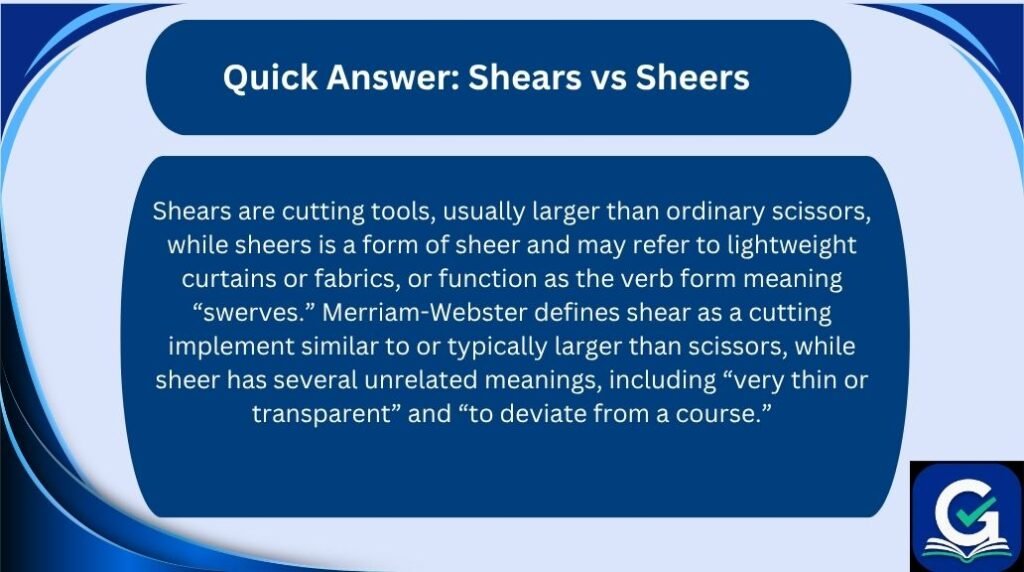
Shears are cutting tools, usually larger than ordinary scissors, while sheers is a form of sheer and may refer to lightweight curtains or fabrics, or function as the verb form meaning “swerves.” Merriam-Webster defines shear as a cutting implement similar to or typically larger than scissors, while sheer has several unrelated meanings, including “very thin or transparent” and “to deviate from a course.”
Easy rule:
- ✂️ Shears = cutting tools
- 🪟 Sheers = lightweight curtains or fabrics
- 🚢 Sheers = third-person singular form of “sheer,” meaning swerves
So, if you are talking about something used for cutting hair, wool, fabric, plants, or other materials, shears is the word you want.
Understanding the Basics of Shears vs Sheers
The biggest difference between shears vs sheers is their origin and meaning.
Shears comes from the noun shear, which refers to a cutting instrument. The word is commonly used in the plural because the tool consists of two blades working together. Merriam-Webster describes a shear as a cutting implement similar or identical to scissors but typically larger.
Sheers comes from sheer. The word sheer has several meanings. It can describe something thin or transparent, something complete or absolute, or something extremely steep. As a verb, sheer means to deviate or swerve from a course.
Here is a quick comparison:
| Form | Type | Meaning | Example | Correct/Incorrect |
|---|---|---|---|---|
| shears | Noun | A cutting tool | She used shears to trim the hedge. | ✅ Correct |
| shears | Verb | Cuts or trims | The machine shears the wool. | ✅ Correct |
| sheers | Noun | Lightweight curtains/fabrics in some usage | We bought new sheers for the windows. | ✅ Correct |
| sheers | Verb | Third-person singular of sheer | The car sheers away from the obstacle. | ✅ Correct |
| sheers | Noun meaning cutting tool | A tool for cutting | She used sheers to cut the fabric. | ❌ Incorrect for this meaning |
| shears | Adjective meaning transparent | Thin or see-through | She wore a shears dress. | ❌ Incorrect |
The key point is that neither spelling is universally “wrong.” The correct choice depends on what you mean.
What Does “Shears” Mean?
The word shears most commonly refers to a cutting instrument.
Unlike ordinary scissors, shears are often larger, heavier, or designed for a particular job. They may be used for gardening, tailoring, sheep shearing, hair cutting, cooking, or industrial work.
Merriam-Webster lists shear as a noun meaning a cutting implement similar to or typically larger than scissors and notes that the noun is usually used in the plural.
Shears as a Cutting Tool
Here are some common examples:
- The gardener used shears to trim the bushes.
- The tailor reached for her fabric shears.
- The farmer cleaned his sheep shears after the job.
- Please use kitchen shears to cut the herbs.
- The stylist sharpened her professional shears.
In each sentence, shears refers to something that cuts.
Why Is “Shears” Usually Plural?
This is an interesting grammar feature.
The word shears generally refers to a tool made of two connected blades. Like scissors, it is commonly treated as a plural noun.
For example:
These shears are very sharp.
We normally say are, not is, when treating shears as the plural name of the tool.
You can also say:
This pair of shears is very sharp.
Here, the subject is pair, which is singular.
Therefore:
- These shears are sharp. ✅
- This pair of shears is sharp. ✅
- These shears is sharp. ❌
Shears as a Verb
Shears can also be a verb.
It is the third-person singular present form of shear.
For example:
The farmer shears the sheep every spring.
Here, shears means cuts the wool from the sheep.
Merriam-Webster defines shear as cutting or clipping hair, wool, or similar material and also as cutting or trimming with shears or a similar instrument.
Compare:
- I shear the sheep.
- You shear the sheep.
- They shear the sheep.
- He shears the sheep.
This grammatical use is completely different from the noun shears.
What Does “Sheers” Mean?
The word sheers belongs to the word sheer.
Unlike shears, it is not the normal spelling for a pair of cutting tools.
The word sheer has several meanings, including “very thin or transparent,” “complete or absolute,” and “very steep.”
Sheers as Lightweight Curtains
In everyday American English, sheers can be used as a plural noun for lightweight, translucent curtains.
For example:
We installed white sheers in the living room.
Here, sheers refers to lightweight curtains that allow some light to pass through.
You may also see:
- sheer curtains
- window sheers
- decorative sheers
- white sheers
- linen sheers
This meaning is connected to the adjective sheer, which Merriam-Webster defines in one sense as describing a very thin or transparent texture.
Sheers as a Verb
Sheers can also be the third-person singular present form of the verb sheer.
As a verb, sheer means to deviate from a course or swerve. Merriam-Webster gives examples involving a ship or vehicle changing direction.
For example:
The boat sheers away from the rocks.
In this sentence, sheers means swerves or moves away from its course.
This use is less common in ordinary conversation than the noun shears, but it is grammatically valid.
Shears vs Sheers in Everyday Sentences
Seeing the words in context is one of the fastest ways to understand the difference.
Examples with “Shears”
Maria bought new garden shears.
Meaning: A cutting tool.
The barber cleaned his shears after the haircut.
Meaning: Professional cutting scissors.
The machine shears the wool quickly.
Meaning: Cuts the wool.
Examples with “Sheers”
We need new sheers for the bedroom windows.
Meaning: Lightweight curtains.
The curtains are made from a sheer material.
Meaning: Thin or transparent.
The boat sheers toward the left.
Meaning: Swerves or changes direction.
These examples show why context matters when choosing between shears vs sheers.
The Main Difference in One Sentence
If you need a simple rule, remember this:
Shears are for cutting; sheers are related to “sheer,” including lightweight curtains and the verb meaning “swerves.”
That one sentence will solve most shears vs sheers questions.
Test Tip: Use the Meaning Test
Here is a simple test you can use whenever you are unsure.
Step 1: Ask what you are talking about.
Is it a cutting tool?
If yes, use shears.
I need garden shears.
Is it a lightweight curtain or transparent fabric?
If yes, sheers may be correct.
The new sheers brighten the room.
Are you describing something that swerves?
If yes, use sheers as the verb.
The vehicle sheers away from the barrier.
Step 2: Replace the word.
If you can replace it with scissors or cutting tool, choose shears.
If you can replace it with light curtains, choose sheers.
If you can replace it with swerves, choose sheers.
This is an easy way to distinguish the two spellings without memorizing complicated grammar rules.
Case Study: A Workplace Example
Imagine that an employee sends an email to a landscaping team.
They want to request a tool for trimming shrubs.
The employee writes:
Please bring the garden sheers tomorrow.
The reader may understand the intended meaning, but the spelling is wrong for the cutting tool.
The corrected version is:
Please bring the garden shears tomorrow.
Why?
Because the employee is talking about a tool used for cutting plants.
Now consider a different workplace:
Please install the new window sheers in the conference room.
Here, sheers is appropriate because the writer is talking about lightweight curtains.
The meaning determines the spelling.
This is an important lesson in English vocabulary: words that sound alike do not necessarily have the same meaning or spelling.
Grammar Rules Behind Shears vs Sheers
The confusion between shears vs sheers comes partly from pronunciation.
In many varieties of American English, shears and sheers sound the same or extremely similar. They are therefore examples of words that can create spelling confusion in writing.
However, their grammatical origins are different.
Shears Comes From “Shear”
The noun shears comes from shear, a word associated with cutting.
The verb shear can mean to cut hair, wool, or other material. Its third-person singular form is also shears.
Examples:
- The farmer shears the sheep.
- The tool is a pair of shears.
- These shears are sharp.
Sheers Comes From “Sheer”
The word sheers comes from sheer.
As a verb, sheer means to deviate from a course. Its third-person singular form is sheers.
Example:
The ship sheers away from the rocks.
The noun sheers can also be used for lightweight curtains in common usage.
Therefore, saying that sheers is always incorrect would be inaccurate. It is a legitimate word. It is simply not the correct word when you mean cutting tools.
Why People Confuse These Words
There are several reasons people mix up shears vs sheers.
1. They Sound Alike
When two words have nearly identical pronunciation, people often rely on sound instead of spelling.
If someone hears:
“Bring the shears.”
They may not know whether the speaker means shears or sheers until they see the context.
2. Fast Typing
When people type quickly, they often choose the spelling that looks familiar.
This is particularly common when writing emails, messages, or notes on a phone.
3. Autocorrect
Autocorrect can sometimes make vocabulary confusion worse.
A keyboard may recognize both forms as valid words and therefore fail to identify the intended meaning.
4. Lack of Vocabulary Knowledge
Someone who has never encountered the word shears in writing may assume the word is spelled sheers because the pronunciation sounds like it.
Reading widely is one of the best ways to build vocabulary and avoid these mistakes.
Common Grammar Confusions Similar to Shears vs Sheers
The confusion here is similar to many other English word pairs.
| Confusing Words | Correct Difference | Example |
|---|---|---|
| shears / sheers | Cutting tools / forms of sheer | Use garden shears. |
| its / it’s | Possessive / it is | The dog wagged its tail. |
| your / you’re | Possessive / you are | You’re holding your bag. |
| there / their / they’re | Place / possession / they are | They’re over there with their friends. |
| to / too / two | Direction/infinitive / also / number | I want to go too. |
| then / than | Time/result / comparison | She arrived then; she is taller than me. |
| affect / effect | Usually verb / usually noun | The weather may affect the effect. |
| principal / principle | Person or main / rule or belief | The principal explained the school principle. |
The general lesson is simple: pronunciation alone cannot tell you which spelling is correct. Context and meaning matter.
Shears vs Sheers in Different Contexts
The correct word can become much easier to identify when you consider the situation.
Everyday Conversation
In everyday conversation, shears is common when discussing cutting tools.
Examples:
Where are the garden shears?
I need my fabric shears.
These shears are getting dull.
Sheers may appear when discussing curtains:
The new sheers look beautiful.
However, many people simply say sheer curtains instead of using the noun sheers.
Professional Writing
Professional writing requires extra precision.
If you are writing instructions for a gardener, tailor, barber, farmer, or craft worker, use shears when referring to cutting equipment.
For example:
Employees must clean and disinfect their shears after each use.
Using sheers in this context would create a spelling error and could reduce the professionalism of the document.
Creative Writing
Creative writing gives you more opportunities to use both words.
For example:
She lifted the silver shears and carefully trimmed the fabric.
Here, shears creates a clear image of a cutting tool.
You might also write:
Sunlight filtered through the delicate sheers.
Here, sheers refers to lightweight curtains.
A writer could even use sheers as a verb:
The boat sheers away from the dark rocks.
The surrounding context makes the meaning clear.
Social Media and Texting
In casual communication, people often type quickly and overlook spelling differences.
You might see:
Need new garden sheers 😂
The intended meaning is probably garden shears.
Even though social media is informal, the correct spelling is still shears when referring to a cutting tool.
Shears vs Sheers in Gardening
Gardening is one of the contexts where the distinction matters most.
Gardeners use various cutting tools, including:
- pruning shears
- hedge shears
- grass shears
- hand pruners
- loppers
All of these cutting-tool uses belong to shears, not sheers.
Examples:
I bought a new pair of pruning shears.
These hedge shears need sharpening.
She used grass shears to trim the edges.
Writing pruning sheers would normally be incorrect because the intended word is the cutting-tool noun shears.
Shears vs Sheers in Fashion and Textiles
The word sheers can appear naturally when discussing fabrics and window treatments.
For example:
The designer chose a sheer white fabric.
Here, sheer means thin or transparent.
You may also encounter:
The room has white sheers over the windows.
The noun sheers refers to lightweight curtains.
By contrast, if a tailor is talking about the tool used to cut that fabric, the correct word is:
The tailor used fabric shears.
Notice the difference:
- sheer fabric = transparent or lightweight material
- sheers = lightweight curtains
- fabric shears = cutting tool
The words are related in sound but not interchangeable.
Shears vs Sheers in Technical and Specialized Writing
In specialized writing, precision becomes even more important.
A manufacturing document might say:
The machine shears the metal sheet.
Here, shears is the verb meaning cuts.
A technical document might also use shear in physics or engineering. Merriam-Webster defines shear as an internal force acting tangentially to a section and also describes an action or stress that causes adjacent parts to slide relative to each other.
This is another reason shear has a much broader technical vocabulary than sheer.
For example:
- shear force
- shear stress
- shear strength
- shear wall
- shearing force
These technical terms are spelled with shear, not sheer.
Why Correct Spelling Matters
At first glance, confusing shears vs sheers may seem like a tiny spelling issue. In reality, choosing the right word helps readers understand exactly what you mean.
Clarity in Communication
Imagine an instruction manual that says:
Use the sheers to cut the wire.
A reader could wonder whether sheers is a specialized tool or simply a spelling mistake.
Writing:
Use the shears to cut the wire.
makes the meaning immediately clear.
Professionalism
Correct vocabulary creates a stronger impression in:
- business emails
- instruction manuals
- academic writing
- product descriptions
- workplace documents
- websites
- educational materials
Small spelling errors can make otherwise strong writing look careless.
Digital Communication
Search engines, spell-checkers, and AI systems can often interpret context, but writers should not rely on technology to fix every mistake.
Accurate word choice makes digital content easier for both humans and machines to understand.
As a useful writing principle:
Clear words create clear communication.
That is especially true for words that sound alike.
Special Exceptions and Edge Cases
There is an important exception to remember: sheers is not an incorrect word.
It is simply not a substitute for shears when you mean cutting tools.
Merriam-Webster recognizes sheers as the third-person singular form of the verb sheer. The verb means to deviate from a course or swerve.
For example:
The car sheers to the right.
In addition, sheers is used as a noun for lightweight curtains or fabrics in common English.
So the rule is not:
“Always use shears.”
Instead, the accurate rule is:
Use shears for cutting tools; use sheers when the meaning comes from sheer, such as lightweight curtains or the verb meaning “swerves.”
This distinction is important because treating sheers as universally wrong would oversimplify English grammar.
A Simple Memory Trick
Need an easy way to remember shears vs sheers?
Think of the A in shears as standing for action with a blade.
Shears → A → action → cutting
For sheers, think of the E in sheer as connected to elegant, light curtains.
Sheers → E → sheer fabric → lightweight curtains
It is not a formal grammar rule, but it is a useful memory aid.
Another simple trick:
Shears cut. Sheers come from sheer.
That is enough to solve most spelling questions.
Quick Recap Checklist
Use this checklist whenever you are unsure about shears vs sheers.
| Question | If Yes → Use |
|---|---|
| Are you talking about a cutting tool? | shears |
| Are you talking about garden cutting equipment? | shears |
| Are you talking about fabric-cutting scissors? | shears |
| Does the word mean “cuts” in a sentence? | shears |
| Are you talking about lightweight curtains? | sheers |
| Are you describing transparent or thin fabric? | sheer |
| Does the word mean “swerves” or “deviates”? | sheers |
| Are you referring to the verb sheer? | sheers for third-person singular |
Practice Example 1
Sentence:
The gardener used the ___ to trim the hedge.
Answer: shears
Why? The word refers to a cutting tool.
Practice Example 2
Sentence:
The new white ___ let sunlight into the bedroom.
Answer: sheers
Why? The word refers to lightweight curtains.
Practice Example 3
Sentence:
The boat ___ away from the rocks.
Answer: sheers
Why? Here, sheers is the third-person singular form of sheer, meaning swerves or changes direction.
FAQs
1. What is the difference between shears and sheers?
Shears are cutting tools, usually similar to scissors but often larger or designed for specialized cutting. Sheers is related to sheer and can refer to lightweight curtains or serve as the third-person singular form of the verb sheer, meaning “swerves.”
2. Is “garden sheers” correct?
No, not when you mean gardening tools. The standard spelling is garden shears because shears refers to a cutting tool.
Correct: I bought new garden shears.
Incorrect for this meaning: I bought new garden sheers.
3. Are shears and scissors the same thing?
They are closely related cutting tools, but shears are often larger or more specialized than ordinary scissors. Merriam-Webster defines a shear as a cutting implement similar or identical to scissors but typically larger.
4. Can “sheers” be a correct English word?
Yes. Sheers is a legitimate word. It can refer to lightweight curtains, and it is also the third-person singular form of the verb sheer. Therefore, sheers is not simply a misspelling of shears.
5. Should I say “a shears” or “a pair of shears”?
Usually, say a pair of shears when referring to one cutting tool.
For example:
I bought a pair of shears.
You can also use shears directly:
These shears are sharp.
6. Why do shears and sheers sound the same?
They are pronounced similarly in many varieties of English. Because their sounds are so close, writers can confuse them when spelling from memory. Their meanings and origins, however, are different.
Conclusion
The difference between shears vs sheers becomes simple once you focus on meaning rather than sound. Shears is the correct word for cutting tools, including garden shears, fabric shears, hedge shears, and other specialized cutting instruments. It can also be the third-person singular form of the verb shear, meaning “cuts” or “trims.” Merriam-Webster supports these uses of shear.
Sheers, meanwhile, comes from sheer. It can describe lightweight curtains when used as a noun, and it can function as the verb form meaning “swerves” or “deviates from a course.”
The easiest rule to remember is this: shears cut, while sheers are connected to sheer. When you know what the sentence means, the spelling becomes much easier to choose.
So the next time you face the shears vs sheers dilemma, ask yourself one simple question: Am I talking about cutting? If the answer is yes, reach for shears. ✂️

I’m Mason Reed, a grammar researcher at Gramfino, where I explore grammar rules and common English mistakes.
I turn my research into clear explanations and practical examples that readers can easily follow.
[…] you remember counsel = advice and council = governing group, the spelling becomes much easier. 😊 Shears vs Sheers | Imbalance vs Inbalance | Roster vs […]