Have you ever typed favor vs favour into a search bar because you were unsure which spelling to use? You are not alone. English has many spelling differences between American and British English, and favor vs favour is one of the most common examples. Both forms refer to the same word and carry the same meanings, but the spelling depends mainly on the variety of English you are using.
If you write for an American audience, the answer is simple: favor is the standard US spelling. If you are writing in British English, favour is the standard form. Neither spelling is inherently wrong; the important thing is to use the spelling that matches your chosen variety of English and remain consistent throughout your writing.
In this guide, I will explain favor vs favour in simple terms, show you how each form works as a noun and verb, compare examples, discuss common mistakes, and give you an easy trick for remembering which spelling to choose. Themselves vs Theirselves | Leaped vs Leapt | There vs Their vs Theyre
Quick Answer: Favor vs Favour
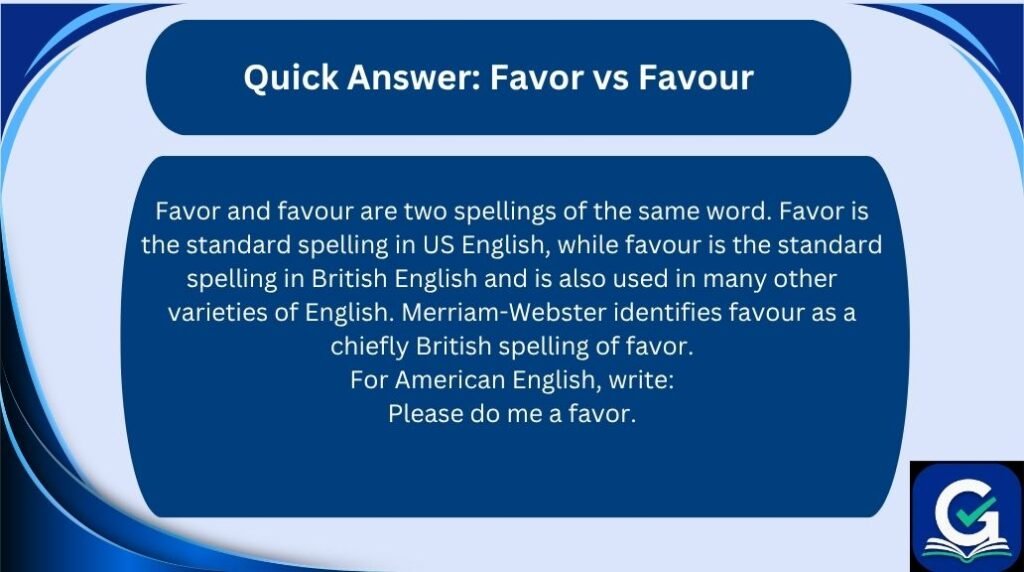
Favor and favour are two spellings of the same word. Favor is the standard spelling in US English, while favour is the standard spelling in British English and is also used in many other varieties of English. Merriam-Webster identifies favour as a chiefly British spelling of favor.
For American English, write:
Please do me a favor.
For British English, write:
Please do me a favour.
The meaning does not change because of the spelling.
Understanding the Basics of Favor vs Favour
The main difference between favor vs favour is not meaning, pronunciation, or grammatical function. It is regional spelling.
American English generally removes the u from words such as favor, color, honor, and behavior. British English generally retains the u, producing favour, colour, honour, and behaviour.
Merriam-Webster lists favor as a noun and verb and defines meanings that include an act of kindness, approval, preference, support, and treating someone or something favorably.
Favor vs Favour Comparison Table
| Form | Type | Meaning | Example | Correct/Incorrect |
|---|---|---|---|---|
| favor | Noun | An act of kindness or help | Can you do me a favor? | Correct in US English |
| favour | Noun | An act of kindness or help | Can you do me a favour? | Correct in UK English |
| favor | Verb | To prefer, support, or treat positively | Many voters favor the proposal. | Correct in US English |
| favour | Verb | To prefer, support, or treat positively | Many voters favour the proposal. | Correct in UK English |
| favor | US spelling | Same word and meaning | She asked for a favor. | Correct |
| favour | UK spelling | Same word and meaning | She asked for a favour. | Correct |
| favor | In a British document | US spelling | She asked for a favor. | Usually inconsistent |
| favour | In a US document | UK spelling | She asked for a favour. | Usually inconsistent |
So, when comparing favor vs favour, remember:
US English → favor
UK English → favour
What Does “Favor” Mean?
The word favor has several meanings. It can function as both a noun and a verb.
Favor as a Noun
As a noun, favor can describe an act of kindness, help, approval, support, preference, or a special benefit.
For example:
Could you do me a favor?
Here, favor means a helpful action performed for someone.
Another example is:
She asked her brother for a favor.
The word favor refers to something helpful that the brother is being asked to do.
Merriam-Webster includes “an act of such kindness” among the noun meanings of favor. It also lists meanings involving approval, partiality, popularity, privileges, and small gifts.
Favor as a Verb
As a verb, favor can mean to prefer, support, approve of, or treat positively.
For example:
Most employees favor the new schedule.
In this sentence, favor means that most employees support or prefer the new schedule.
Another example:
The evidence favors the defendant.
Here, favors means that the evidence supports the defendant’s position.
The verb can also mean to resemble someone:
The child favors her mother.
In this context, favors means “looks like” or “resembles.”
These meanings are recognized in standard dictionary usage.
What Does “Favour” Mean?
Favour has the same meanings as favor. The difference is spelling rather than definition.
In British English, you may see sentences such as:
Could you do me a favour?
Or:
Most customers favour the new design.
In American English, these would normally be written:
Could you do me a favor?
Most customers favor the new design.
Merriam-Webster specifically describes favour as a chiefly British spelling of favor.
Therefore, if you see favour in a British article, book, email, or website, it is not a different word. It is simply the British spelling.
Why Does American English Use “Favor”?
The spelling difference has a long history.
English spelling was not always standardized. Different spellings existed for many words, and regional varieties gradually developed their own conventions.
In the United States, spelling reformer Noah Webster played an important role in promoting simpler spellings. His dictionaries helped establish American forms such as favor instead of favour, along with color instead of colour and honor instead of honour. Merriam-Webster explains that Webster promoted these simplified spellings as part of the development of distinct American English conventions.
The u in favour has historical connections to French influence on English. Over time, British English retained the -our spelling, while American English increasingly preferred -or.
This explains why the difference between favor vs favour is similar to other spelling pairs:
- favor / favour
- color / colour
- honor / honour
- behavior / behaviour
- flavor / flavour
- neighbor / neighbour
The American versions generally use -or, while British versions generally use -our.
Correct Meanings and Uses
Understanding how favor vs favour works in actual sentences makes the distinction much easier.
1. Asking Someone for Help
One of the most common uses is when asking someone to do something helpful.
American English
Could you do me a favor?
British English
Could you do me a favour?
The grammatical structure is identical. Only the spelling changes.
Sentence Breakdown
Could you → polite request
do → verb
me → indirect object
a favor/favour → noun referring to an act of kindness
The meaning is essentially:
Could you help me by doing something?
2. Showing Support
The word can also describe support for an idea, person, plan, or decision.
US English
The committee favors the new proposal.
UK English
The committee favours the new proposal.
In both sentences, the verb means that the committee supports or prefers the proposal.
Merriam-Webster lists “to show partiality toward” and “to prefer” among the meanings of the verb favor.
3. Being in Favor of Something
The phrase in favor of is very common in American English.
I am in favor of the new policy.
It means:
I support the new policy.
British English normally writes:
I am in favour of the new policy.
Again, the meaning does not change.
4. Acting in Someone’s Favor
Another common expression is:
The decision was in her favor.
This means the decision benefited or supported her.
British English uses:
The decision was in her favour.
Both forms are grammatically correct within their respective varieties of English.
5. Losing Favor
Favor can also refer to popularity or approval.
For example:
The politician has lost favor with voters.
This means the politician is no longer as popular or well regarded.
In British English:
The politician has lost favour with voters.
Merriam-Webster includes popularity and approval among the meanings of favor.
Test Tip: How Can You Check Your Spelling?
When deciding between favor vs favour, ask yourself one simple question:
Am I writing in American English or British English?
If your answer is American English, use:
favor
If your answer is British English, use:
favour
Do not try to determine the correct spelling by pronunciation. Both words are pronounced essentially the same way.
The issue is regional spelling, not grammar.
Favor vs Favour in a Real-Life Workplace Example
Imagine that an employee is writing an email to a manager.
American workplace email
Hi Sarah,
Could you do me a favor and review the attached report before Friday? I would really appreciate your feedback.
Thanks,
Daniel
This is perfectly natural in US English.
Now imagine the same message written for a British workplace:
Hi Sarah,
Could you do me a favour and review the attached report before Friday? I would really appreciate your feedback.
Thanks,
Daniel
The meaning, sentence structure, and tone remain the same.
Only the regional spelling changes.
Why Consistency Matters
Suppose an American company’s official documents normally use:
favor, color, behavior, honor
Suddenly writing:
favour, colour, behaviour, honour
may make the document look inconsistent.
The British spelling itself is not grammatically wrong. It simply does not match the established US spelling style.
For professional writing, choose one variety of English and follow it consistently.
Grammar Rules for Favor vs Favour
The most important grammar rule is surprisingly simple:
Favor and favour are variant spellings of the same noun and verb.
There is no grammatical rule saying that one is always correct and the other is always incorrect.
Instead, the correct choice depends on the variety of English.
American English
Use:
- favor
- favored
- favoring
- favorable
- favoritism
British English
Use:
- favour
- favoured
- favouring
- favourable
- favouritism
The spelling differences continue into related words.
For example:
The proposal is favorable.
is standard American English.
British English generally uses:
The proposal is favourable.
Merriam-Webster’s dictionary entry for favor gives the US forms favored and favoring, while its entry for favour identifies the latter as the chiefly British spelling.
Favor vs Favour and Related Words
Once you understand the main spelling difference, several related forms become easier.
| American English | British English |
|---|---|
| favor | favour |
| favored | favoured |
| favoring | favouring |
| favorable | favourable |
| favoritism | favouritism |
| favorite | favourite |
For example:
American English
She is my favorite author.
British English
She is my favourite author.
Merriam-Webster explains that favorite and favourite are variant spellings of the same word, with favorite used in the United States and favourite generally used elsewhere in the English-speaking world.
This is useful because it reveals a broader spelling pattern. If you are writing consistently in US English, you will generally use the shorter -or forms.
Common Mistakes With Favor vs Favour
Why do people make mistakes with these spellings?
Usually, the problem is not a lack of intelligence or grammar knowledge. English contains many regional spelling systems, and modern technology makes switching between them very easy.
Here are three common causes.
1. Fast Typing
When people type quickly, they often write the version they have seen most frequently.
Someone who regularly reads British websites may automatically type favour, even while writing for an American audience.
Likewise, an American writer may use favor while preparing a document that follows British English conventions.
2. Autocorrect
Autocorrect can sometimes create confusion.
Your keyboard or word processor may be configured for a particular regional variety of English. As a result, it may recognize favour as standard even if you are writing for an American audience.
Always check your language settings when regional spelling matters.
3. Lack of Knowledge
Some writers assume that one spelling must be wrong.
That is not the case.
Favor and favour are both legitimate spellings.
The key is knowing where each spelling belongs.
Similar Grammar and Spelling Confusions
The confusion surrounding favor vs favour is similar to other English word pairs.
| Confusing Forms | Correct Use |
|---|---|
| it’s / its | It’s = it is; its = possessive |
| your / you’re | Your = possessive; you’re = you are |
| they’re / their / there | Different meanings and functions |
| color / colour | US / UK spelling |
| honor / honour | US / UK spelling |
| behavior / behaviour | US / UK spelling |
| favorite / favourite | US / UK spelling |
| center / centre | US / UK spelling |
| theater / theatre | Often US / UK preference, with some variation |
| traveled / travelled | US / UK spelling convention |
There is an important distinction, however.
Pairs such as it’s/its have different meanings and grammatical functions.
But favor/favour have the same meaning. Their difference is primarily regional spelling.
Favor vs Favour in Different Contexts
The correct choice can depend on the audience and style guide.
Everyday Conversation
In American English, you will commonly hear and see:
Can you do me a favor?
In British English, you will commonly encounter:
Can you do me a favour?
Both sound natural to speakers of the relevant variety.
Professional Writing
Professional writers should consider their audience.
If you are preparing an American business report, use:
The findings favor the proposed solution.
If you are preparing a British business report, use:
The findings favour the proposed solution.
Consistency is especially important in:
- reports
- academic papers
- business emails
- websites
- resumes
- presentations
- marketing materials
- company policies
Creative Writing
Creative writers have more flexibility.
If your story is set in London and your characters use British English, favour may be more appropriate.
If your story is set in New York and your characters use American English, favor will usually fit better.
Regional spelling can help establish setting and voice.
For example:
“Could you do me a favor?”
may feel more natural for an American character.
Meanwhile:
“Could you do me a favour?”
may fit a British character.
Social Media and Texting
On social media, both spellings appear frequently.
American users may write:
Do me a favor 😂
British users may write:
Do me a favour 😂
Informal digital communication is generally forgiving about regional spelling. Still, if you are representing a business or professional brand, consistency remains important.
Why Favor vs Favour Matters
At first, the difference may seem tiny. After all, it is only one letter.
But spelling consistency matters for several reasons.
1. Clarity in Communication
Consistent spelling helps readers understand which variety of English you are using.
This is especially useful for international audiences.
2. Professionalism
A document that consistently follows one style looks carefully edited.
For example, a US company using favor, color, behavior, and honor creates a consistent American-English style.
3. Accuracy in Digital Communication
Search engines, spell-checkers, writing tools, and publishing systems can recognize regional spelling differences, but writers still need to choose the appropriate variety.
Your goal should not simply be to write a word that is technically recognizable. Your goal should be to match the expectations of your audience.
4. Consistent Brand Voice
Companies that publish content internationally often establish specific language guidelines.
A US-focused website may choose American spelling throughout its content.
A UK-focused website may choose British spelling.
That consistency creates a more polished reading experience.
A Simple Reminder
Good writing is not only about being correct; it is also about being consistent.
Special Exceptions and Edge Cases
There is no major grammatical exception that changes the basic rule for favor vs favour. However, there are some situations worth knowing about.
Brand Names and Official Names
A company, organization, product, publication, or title may intentionally use a particular spelling.
If an official name contains favour, do not change it to favor simply because you are writing in American English.
Proper names should generally be preserved as officially written.
Quoting Someone
If you quote a source directly, keep the original spelling.
For example, if a British source says:
“Could you do me a favour?”
an American writer should not silently change the quotation to favor if the exact wording matters.
Mixed International Audiences
Sometimes a publication serves both American and British readers.
In that case, the organization may establish a house style.
The important thing is to follow the publication’s chosen style rather than randomly switching between spellings.
Quick Recap Checklist
Use this checklist whenever you are unsure about favor vs favour.
| Question | If Yes → Use |
|---|---|
| Am I writing standard US English? | favor |
| Am I writing standard UK English? | favour |
| Am I writing for a US business audience? | favor |
| Am I writing for a British audience? | favour |
| Am I following an American style guide? | favor |
| Am I following a British style guide? | favour |
| Am I copying an official name that uses “favour”? | Keep favour |
| Am I quoting British English directly? | Keep favour |
Practice Example 1
Choose the correct US-English spelling:
Could you do me a ___?
Answer: favor
Correct sentence:
Could you do me a favor?
Practice Example 2
Choose the correct British-English spelling:
The committee is in ___ of the proposal.
Answer: favour
Correct sentence:
The committee is in favour of the proposal.
Practice Example 3
Choose the correct US-English spelling:
Most voters ___ the new policy.
Answer: favor
Correct sentence:
Most voters favor the new policy.
FAQs
1. Is “favor” or “favour” correct?
Both are correct spellings. Favor is the standard US English spelling, while favour is the standard British English spelling and is also used in many other English varieties.
2. Is “favour” wrong in American English?
It is not an incorrect word, but favor is the standard spelling preferred in US English. If you are writing specifically for an American audience, use favor for consistency.
3. Is “favor” British or American?
Favor is the standard American spelling. British English normally uses favour.
4. Do favor and favour have different meanings?
No. Favor and favour have the same basic meanings and grammatical functions. The difference is primarily regional spelling. They can both be nouns or verbs.
5. Should I use “favor” in an American essay?
Yes. If your essay follows standard US English, favor is the appropriate spelling.
For example:
The evidence favors the proposed explanation.
6. Why does British English have the extra “u”?
The -our spelling has historical roots in French influence on English. American spelling later developed conventions that often removed the u from words ending in -our. Noah Webster was an important influence on the adoption of simplified American spellings.
Conclusion
The difference between favor vs favour is easy once you know the rule. The two words have the same meaning, pronunciation, and grammatical functions. The main distinction is regional spelling.
If you are writing in US English, choose favor:
Can you do me a favor?
If you are writing in British English, choose favour:
Can you do me a favour?
The same pattern appears in related words such as color/colour, honor/honour, behavior/behaviour, and favorite/favourite.
The most important lesson is not that one spelling is “right” and the other is “wrong.” Instead, choose the spelling that matches your audience, region, or style guide, and use it consistently.
So the next time you hesitate over favor vs favour, remember one simple rule:
US English favors “favor”; British English favors “favour.” 🇺🇸🇬🇧
Once that rule becomes familiar, this common spelling question becomes a quick and effortless choice.

I’m Amelia Parker, an English language writer at Gramfino, focused on making difficult language topics easier to understand.
I write about grammar, vocabulary, word usage, and everyday English to help readers communicate clearly.
[…] for your audience. By the end, this seemingly tricky grammar question should feel much easier. 📚 Favor vs Favour | Themselves vs Theirselves | Leaped vs […]