Have you ever typed a sentence like “I lended my friend some money” and then paused because it did not sound quite right? If you have searched for lent vs lended, you are not alone. This is a common English grammar confusion because many past-tense verbs are formed by adding -ed.
We say “walked,” “helped,” “cleaned,” and “opened,” so it seems reasonable to assume that “lend” should become “lended.” However, English has many irregular verbs that do not follow this pattern. The correct past tense of lend is lent, not “lended.” The same word, lent, is also used as the past participle.
In this complete guide, I’ll explain the lent vs lended difference in simple US English, show you how to use each form correctly, explain why “lended” is a common mistake, and provide examples for conversations, professional writing, texting, and more. By the end, you will have an easy rule to remember and practical examples that make the distinction clear. 📚 Tomorrow vs Tommorow | Guidance vs Guidence
Quick Answer: Lent vs Lended
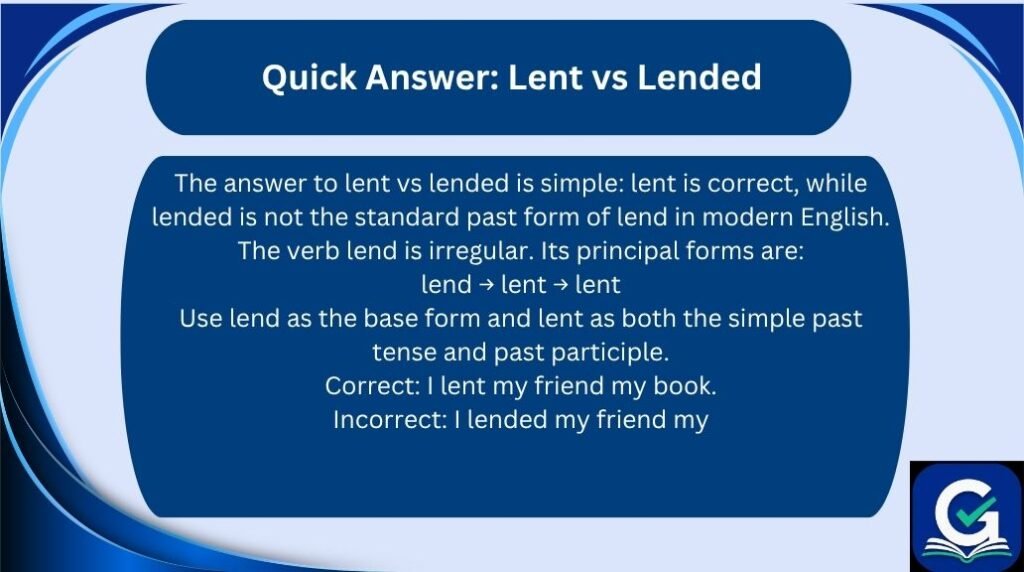
The answer to lent vs lended is simple: lent is correct, while lended is not the standard past form of lend in modern English.
The verb lend is irregular. Its principal forms are:
lend → lent → lent
Use lend as the base form and lent as both the simple past tense and past participle.
Correct: I lent my friend my book.
Incorrect: I lended my friend my book.
If you are unsure about lent vs lended, remember that “lend” does not take the regular -ed ending when it changes to the past tense.
Understanding the Basic Difference
The best way to understand lent vs lended is to start with the verb lend.
To lend something means to give it to another person temporarily, usually with the expectation that it will be returned.
For example:
Can you lend me your charger?
This sentence uses lend because the speaker is asking for the action to happen.
Now compare:
She lent me her charger yesterday.
Here, the action happened in the past, so lent is required.
Comparison Table
| Form | Type | Meaning | Example | Correct/Incorrect |
|---|---|---|---|---|
| lend | Base form | Give something temporarily | I can lend you my book. | ✅ Correct |
| lends | Present tense | Gives something temporarily | She lends books to students. | ✅ Correct |
| lent | Simple past | Gave something temporarily | He lent me his car. | ✅ Correct |
| lent | Past participle | Used with have, has, or had | She has lent me her notes. | ✅ Correct |
| lended | Nonstandard form | Intended as the past of lend | He lended me his phone. | ❌ Incorrect |
The most important rule is:
Lend → lent, not lended.
What Does “Lend” Mean?
Lend means to allow someone to use something temporarily.
The thing being lent can be almost anything that can reasonably be returned.
For example, you can lend:
- Money
- Books
- Pens
- Clothes
- Cars
- Phones
- Laptops
- Tools
- Equipment
- Notes
Here are some examples:
I can lend you my calculator.
My sister will lend me her car.
Can you lend me your pen?
We often lend books to our classmates.
These examples all use lend because the verb is in its base or present/future form.
Understanding this basic meaning makes the lent vs lended distinction much easier because the spelling changes according to the tense, not the meaning.
When to Use “Lent”
Use lent when the act of lending happened in the past.
For example:
I lent him my jacket yesterday.
The word “yesterday” shows that the action is complete.
More examples include:
Sarah lent me her notes last night.
My uncle lent me his car last weekend.
They lent us some chairs for the party.
My teacher lent me a dictionary.
I lent my neighbor a ladder.
All of these sentences describe completed actions.
Past-Time Clues
Words that often indicate past actions include:
- yesterday
- last night
- last week
- last month
- earlier
- previously
- two days ago
- last year
For example:
I lent my friend some money two days ago.
If you see a past-time expression, lent will often be the correct form.
Using “Lent” as a Past Participle
One reason this verb can confuse learners is that lent has two grammatical functions.
It is:
- The simple past tense
- The past participle
The past participle appears with helping verbs such as have, has, and had.
With “Have”
I have lent him my book.
With “Has”
She has lent me her notes.
With “Had”
They had lent us their equipment.
The form does not change to “lended.”
Incorrect:
She has lended me her notes. ❌
Correct:
She has lent me her notes. ✅
Therefore, one of the most useful things to memorize when studying lent vs lended is:
lend – lent – lent
When to Use “Lend”
Use lend when the sentence requires the base form.
Present Tense
I usually lend my books to my friends.
Future Tense
I will lend you my notes tomorrow.
After “Can”
Can you lend me your charger?
After “Should”
You should lend him your calculator.
After “Would”
Would you lend me your umbrella?
Modal verbs such as can, should, would, and will are followed by the base form.
So:
Can you lend me your phone? ✅
Not:
Can you lent me your phone? ❌
The Important “Did + Lend” Rule
Another useful point in the lent vs lended discussion is what happens after did.
When you use did, the main verb stays in its base form.
Correct:
Did you lend him your car?
Incorrect:
Did you lent him your car? ❌
Why?
Because did already carries the past tense.
The same applies to negative sentences:
I did not lend him my laptop.
Not:
I did not lent him my laptop. ❌
This rule is worth remembering because learners sometimes think that every past sentence needs the past form of the main verb.
Why “Lended” Sounds Logical
If “lended” is incorrect, why does it sound reasonable to so many people?
The answer is simple: regular verbs normally use -ed in the past tense.
For example:
- work → worked
- talk → talked
- help → helped
- play → played
- clean → cleaned
- watch → watched
A learner may therefore reason:
lend + ed = lended
That reasoning is understandable but incorrect because lend is an irregular verb.
Irregular verbs do not follow the regular -ed pattern.
For example:
- go → went
- buy → bought
- take → took
- teach → taught
- keep → kept
- send → sent
- lend → lent
So, when considering lent vs lended, remember that English grammar does not allow us to apply the regular -ed rule to every verb.
A Simple Memory Trick
A good memory trick is:
I lend today, but I lent yesterday.
This sentence connects the present and past forms.
For example:
Present:
I lend my books to my friends.
Past:
I lent my book to my friend yesterday.
You can also memorize:
lend → lent → lent
Another helpful association is:
send → sent
spend → spent
lend → lent
These verbs have similar spelling patterns, which can make them easier to remember.
If you regularly confuse lent vs lended, writing this three-form pattern a few times can help turn it into a natural habit.
Test Tip: How to Choose the Correct Form
When you are uncertain, use this quick test.
Question 1: Did the action happen in the past?
If yes, use lent.
I ___ him my book yesterday.
Answer:
I lent him my book yesterday. ✅
Question 2: Does the sentence use “have,” “has,” or “had”?
If yes, use lent.
She has ___ me her notes.
Answer:
She has lent me her notes. ✅
Question 3: Does the sentence use “can,” “will,” “should,” “would,” or “did”?
If yes, use lend.
Can you lend me your pen?
Did you lend him your car?
This test can help you solve most lent vs lended questions quickly.
Real-Life Workplace Case Study
Imagine that Sarah works in an office. Her colleague needs a laptop for a presentation.
Sarah gave the laptop to him yesterday.
A coworker asks:
Where is the extra laptop?
Sarah responds:
I lent it to James yesterday.
That sentence is correct.
Now imagine Sarah writes:
I lended the laptop to James yesterday.
The meaning is understandable, but the verb form is incorrect.
The professional version is:
I lent the laptop to James yesterday.
Why the Difference Matters
Workplace communication often needs to be clear and polished.
Correct grammar can make:
- Emails easier to understand
- Reports more professional
- Business messages more credible
- Instructions clearer
- Written communication more trustworthy
A small error may not prevent understanding, but consistently using standard grammar improves the quality of your writing.
Grammar Rule Behind the Difference
The central rule behind lent vs lended is that lend is an irregular verb.
Regular verbs form the simple past by adding -ed:
walk → walked
call → called
finish → finished
Irregular verbs use different forms:
go → went
write → wrote
buy → bought
teach → taught
lend → lent
Standard English dictionaries, including Merriam-Webster, identify lent as the past and past participle form of lend. Therefore, lent is the appropriate form for standard modern US English.
The important lesson is that verb patterns must sometimes be memorized individually. You cannot assume that every English verb becomes past tense simply by adding -ed.
Common Mistakes to Avoid
Here are some frequent errors involving this verb.
Mistake 1: Using “Lended”
Incorrect:
I lended him some money.
Correct:
I lent him some money.
Mistake 2: Using “Lent” After “Did”
Incorrect:
Did you lent me your book?
Correct:
Did you lend me your book?
Mistake 3: Using “Lend” With a Past-Time Expression
Incorrect:
I lend him my car yesterday.
Correct:
I lent him my car yesterday.
Mistake 4: Using “Lended” After “Has”
Incorrect:
She has lended me her laptop.
Correct:
She has lent me her laptop.
Mistake 5: Confusing Lend and Borrow
Incorrect:
I borrowed my friend my laptop.
Correct:
I lent my friend my laptop.
Or:
I borrowed my friend’s laptop.
These examples show why understanding both the verb form and sentence structure is important.
Similar Grammar Confusions
The question of lent vs lended belongs to a larger group of English grammar and vocabulary problems.
| Confusing Forms | Difference | Example |
|---|---|---|
| it’s / its | “It’s” means “it is”; “its” shows possession | It’s cold. / The dog wagged its tail. |
| your / you’re | “Your” shows possession; “you’re” means “you are” | Your book is here. / You’re early. |
| their / they’re | “Their” shows possession; “they’re” means “they are” | Their car is new. / They’re outside. |
| then / than | “Then” relates to time; “than” is used for comparison | Eat first, then leave. / Taller than me. |
| affect / effect | Usually influence / result | It affected me. / The effect was clear. |
| lend / borrow | Give temporarily / receive temporarily | I lent him money. / I borrowed money. |
| lend / lended | Correct irregular past / nonstandard form | I lend books. / I lent books. |
Recognizing these patterns can make your overall English more accurate.
Why Do People Write “Lended”?
There are several reasons this mistake appears.
Fast Typing
When people type quickly, they may automatically add -ed to a verb when talking about the past.
Autocorrect
Predictive text may sometimes suggest unexpected forms, particularly when a sentence is typed quickly.
Lack of Familiarity
A person who has not encountered lent may reasonably assume that “lended” is the correct past form.
Overgeneralizing a Grammar Rule
Learners often remember:
Past tense = verb + ed
That is a useful rule for regular verbs, but it does not apply to every English verb.
The solution is to memorize common irregular verbs and use them in complete sentences.
Everyday Conversation Examples
In casual conversations, both lend and lent are common.
For example:
Can you lend me your charger?
A possible response is:
Sure. I lent it to Mike yesterday, but I’ll ask him for it.
Another conversation might be:
Did Sarah lend you her notes?
Yes, she lent them to me this morning.
These examples show that the correct form depends on the tense and sentence structure.
If you are speaking naturally, lent will sound much more familiar and correct than “lended.”
Professional Writing Examples
Standard grammar is especially important in professional writing.
I lent the conference equipment to the events team yesterday.
Report
The department lent additional equipment to the research group.
Business Message
We have lent the requested materials to the client for temporary use.
Workplace Question
Did you lend the projector to the marketing team?
These examples demonstrate how lend and lent work in formal communication.
Creative Writing Examples
Creative writing does not change the grammatical rule.
For example:
Daniel lent her his coat as the rain began to fall.
Another example:
She remembered that her grandfather had lent her the book years earlier.
The style may be creative, but the past form remains lent.
Even when writing fiction, poems, stories, or personal essays, choosing the standard form keeps your sentences grammatically sound.
Social Media and Texting
Informal digital communication often uses abbreviations, slang, emojis, and casual expressions.
For example:
Can u lend me your charger? 😭
Or:
I lent him my hoodie and still haven’t got it back 😂
Although texting can be informal, the standard verb form remains the same.
If you want your messages to be grammatically polished, use lend for the base form and lent for the past.
Lend vs Borrow: An Important Distinction
Another common source of confusion is the difference between lend and borrow.
These words describe the same temporary exchange from opposite perspectives.
If I give you my book temporarily, I lend it to you.
I lent you my book.
From your perspective, you borrowed the book.
I borrowed your book.
So remember:
The giver lends.
The receiver borrows.
For example:
I lent Sarah $50.
Sarah can say:
I borrowed $50 from Sarah? ❌
If Sarah received the money from you, she should say:
I borrowed $50 from you. ✅
Understanding this distinction prevents another common set of mistakes.
Using the Verb With Different Subjects
One helpful feature of lent is that it does not change according to the subject in the simple past.
You can say:
I lent him my book.
You lent him your book.
She lent him her book.
He lent me his book.
We lent them our books.
They lent us their books.
The form remains lent.
In the present tense, however, the third-person singular form is lends:
I lend books.
She lends books.
This is another reason to study the complete verb pattern rather than one form in isolation.
Examples Across Different Tenses
Here is the verb used in several grammatical structures.
Simple Present
I lend books to my classmates.
Present, Third Person
She lends her notes to other students.
Simple Past
I lent him my book yesterday.
Future
I will lend you my calculator tomorrow.
Present Perfect
I have lent her my notes before.
Past Perfect
I had lent him the money already.
Question With “Did”
Did you lend him your car?
These examples show that choosing between lend and lent depends on the grammatical structure.
Why Correct Grammar Matters
You might wonder whether using “lended” really matters if people understand what you mean.
In casual speech, listeners may understand the intended meaning. However, standard grammar is still valuable.
Clarity
Correct verb forms make sentences easier to process.
Professionalism
Accurate grammar helps your emails, reports, applications, and business communication look polished.
Credibility
Careful writing can create a stronger impression of attention to detail.
Digital Communication
Your written words may appear in emails, websites, social media posts, messages, and online documents. Correct grammar helps your communication represent you well.
A useful principle is:
Good grammar removes distractions from your message.
You do not need complicated vocabulary to communicate effectively. Simple, accurate English is often the strongest choice.
Special Exception: Capitalized “Lent”
There is another word spelled Lent that has a completely different meaning.
With a capital L, Lent refers to a Christian season traditionally observed before Easter.
For example:
Lent is observed by many Christians before Easter.
This is unrelated to the verb lend.
Compare:
I lent my friend a book.
Here, lent is the past tense of “lend.”
But:
Lent is an important religious season for many Christians.
Here, Lent is a proper noun.
The meaning is determined by context and capitalization.
Quick Recap Checklist
Use this checklist whenever you are unsure about the correct form.
| Question | If Yes → Use |
|---|---|
| Do you need the base form? | lend |
| Are you talking about a present habit? | lend/lends |
| Are you talking about the future? | lend |
| Did the lending happen in the past? | lent |
| Is it after have? | lent |
| Is it after has? | lent |
| Is it after had? | lent |
| Is it after can? | lend |
| Is it after will? | lend |
| Is it after did? | lend |
| Are you considering “lended” as the past form? | ❌ Use lent |
Practice Examples
1. Yesterday, I ___ my friend my calculator.
Answer: lent
Yesterday, I lent my friend my calculator. ✅
2. Can you ___ me your notebook?
Answer: lend
Can you lend me your notebook? ✅
3. She has ___ me her notes.
Answer: lent
She has lent me her notes. ✅
4. Did you ___ him your car?
Answer: lend
Did you lend him your car? ✅
Five Rules to Memorize
If you want a short lesson you can remember easily, focus on these five rules:
- Lend is the base form.
- Lent is the simple past.
- Lent is also the past participle.
- Lended is not the standard form.
- After did, use lend, not lent.
The complete pattern is:
lend → lent → lent
Whenever the lent vs lended question comes up, return to this pattern.
Frequently Asked Questions
1. Is “lent” or “lended” correct?
Lent is correct. “Lended” is not the standard past tense or past participle of lend in modern US English.
Correct:
I lent him my book.
Incorrect:
I lended him my book.
2. What is the past tense of “lend”?
The past tense of lend is lent.
For example:
I lent my friend some money yesterday.
The complete pattern is:
lend → lent → lent
3. Is “lent” also a past participle?
Yes. Lent functions as both the simple past tense and past participle.
Examples:
She lent me her notes.
She has lent me her notes.
She had lent me her notes.
4. Why is “lended” incorrect?
“Lended” is incorrect in standard English because lend is an irregular verb. Its past form is lent, rather than a regular -ed form.
5. Can “lended” be used in formal writing?
No. In standard US English, use lent instead.
Correct:
The company lent us the equipment.
Avoid:
The company lended us the equipment.
Final Examples to Remember
| Situation | Correct Sentence |
|---|---|
| Present | I lend books to my friends. |
| Present, third person | She lends books to students. |
| Past | I lent him my laptop. |
| Future | I will lend you my charger. |
| Present perfect | I have lent her my notes. |
| Past perfect | I had lent him the money. |
| Question | Can you lend me your pen? |
| Past question | Did you lend him your car? |
| Negative past | I did not lend him my laptop. |
The final example is particularly useful:
I did not lend him my laptop. ✅
Not:
I did not lent him my laptop. ❌
The word did already expresses the past, so the main verb stays in its base form.
Conclusion
The answer to lent vs lended is clear: lent is the correct form, while “lended” is not the standard past tense or past participle of lend in modern US English. The verb is irregular, so its basic forms are lend → lent → lent. Use lend as the base form, for present and future constructions, and after modal or auxiliary verbs such as can, will, should, would, and did. Use lent when describing a completed action in the past or when it follows have, has, or had.
For example, say, “I lent my friend my car yesterday,” rather than “I lended my friend my car.” Once you understand the pattern, this common mistake becomes easy to avoid. If you ever hesitate, remember the simplest rule: lend today, lent yesterday. Master that pattern, and you can use this irregular verb confidently in conversations, professional writing, academic work, and digital communication. ✅

I’m Ethan Carter, a grammar writer at Gramfino, where I explain English grammar in a simple and practical way.
I enjoy helping readers understand sentence structure, grammar rules, and common writing mistakes.
[…] experiance, show you how to use the correct spelling, and give you simple ways to remember it. 😊 Lent vs Lended | Tomorrow vs Tommorow | Guidance vs […]