Have you ever typed a professional email, written a resume, or prepared an assignment and suddenly wondered whether business vs bussiness is the correct spelling? You are not alone. This is a common spelling confusion because the word business does not sound exactly the way it looks.
When people hear it pronounced quickly, they may naturally assume that it contains an extra s, resulting in the incorrect form bussiness. The good news is that the difference is easy to understand. Business is the correct spelling in standard US English, while bussiness is a misspelling.
The word business can refer to a company, commercial activity, work, professional affairs, or a field of study. Understanding business vs bussiness can help you write more accurately in emails, resumes, reports, assignments, websites, and everyday communication. Eighteen vs Eiteen | Molding vs Moulding | Segue vs Segway
Quick Answer: Business vs Bussiness
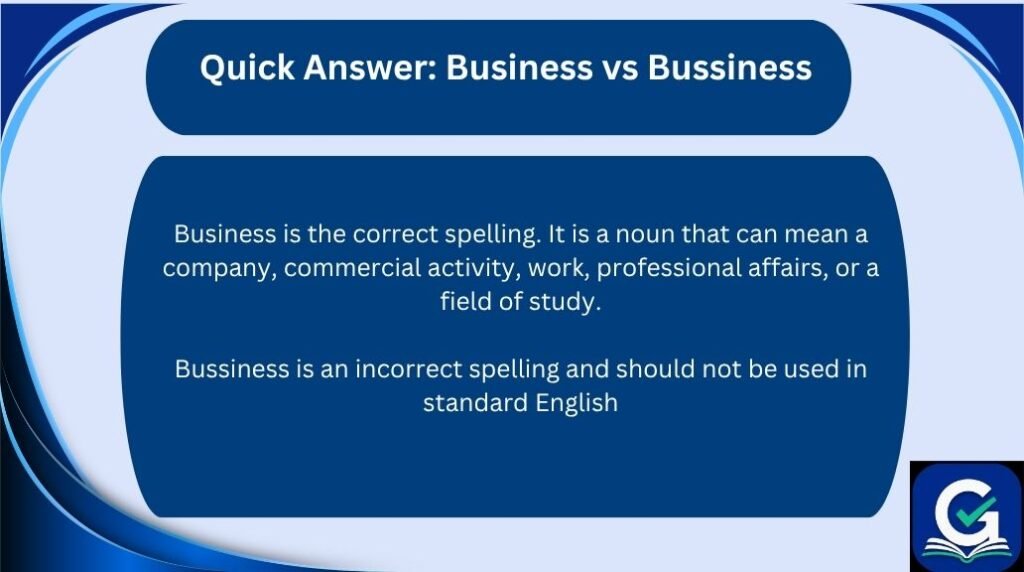
Business is the correct spelling. It is a noun that can mean a company, commercial activity, work, professional affairs, or a field of study.
Bussiness is an incorrect spelling and should not be used in standard English.
Correct: She owns a successful business. ✅
Incorrect: She owns a successful bussiness. ❌
Understanding the Basics of Business vs Bussiness
The main difference between these two forms is spelling.
The correct word is:
Business
The incorrect form is:
Bussiness
The common mistake occurs when an extra s is inserted after the first s.
The correct spelling is:
B-U-S-I-N-E-S-S
The incorrect spelling is:
B-U-S-S-I-N-E-S-S
Notice that business has only one s after bu. The word does have two s letters at the end.
Business vs Bussiness Comparison Table
| Feature | Business | Bussiness |
|---|---|---|
| Form | Business | Bussiness |
| Type | Noun | Misspelling |
| Meaning | Company, commercial activity, work, or affairs | No standard English meaning |
| Example | She started a business. | She started a bussiness. ❌ |
| Correct/Incorrect | Correct ✅ | Incorrect ❌ |
The safest rule is simple:
Always use “business” in standard English writing.
What Does Business Mean?
The word business has several meanings. Its meaning depends on how it is used in a sentence.
Business as a Company
One of the most common meanings of business is a company or organization that sells products or services.
Example:
My brother owns a small business.
Here, business refers to the company or commercial operation owned by the speaker’s brother.
Another example is:
The business has hired five new employees.
In this sentence, business refers to the company that employs the workers.
Business as Commercial Activity
Business can also refer to commercial activity in general.
Example:
International business connects companies across different countries.
Here, the word does not refer to one specific company. Instead, it describes commercial activity between businesses or countries.
Another example:
Online business has grown rapidly.
In this sentence, business refers to commercial activity conducted online.
Business as Work
The word can also mean work, duties, or matters that need attention.
Example:
I have some business to take care of today.
Here, business means tasks or matters that the speaker needs to handle.
Similarly:
She went downtown to take care of some business.
The word refers to work or personal matters rather than a particular company.
Business as Personal Affairs
Sometimes business refers to someone’s personal concerns or affairs.
Example:
That is none of your business.
Here, business means something that concerns another person and is not your responsibility.
This is one of the most familiar uses of the word in everyday English.
Business as a Field of Study
Business can also describe an academic or professional field.
Example:
She studied business at college.
Here, business refers to a field involving areas such as management, finance, marketing, entrepreneurship, and commerce.
Why Is “Bussiness” Incorrect?
The form bussiness is incorrect because standard English spelling does not include the extra s after the initial s.
Many people make this mistake because the pronunciation of business is not a perfect reflection of its spelling.
The word is commonly pronounced approximately like:
BIZ-niss
Because some letters are not pronounced exactly as a learner might expect, people sometimes spell the word according to its sound.
This creates forms such as:
bussiness ❌
However, English spelling often contains patterns that cannot be predicted entirely from pronunciation.
For that reason, the correct spelling should be memorized as a complete word:
business ✅
How to Remember the Correct Spelling
A simple memory trick can make this spelling much easier.
Think of the word as:
BUS + INESS = BUSINESS
The first part is spelled like bus.
Then add:
iness
Together:
business
Another helpful reminder is:
Business has one “s” after “bu” and two “s” letters at the end.
So remember:
BUSINESS ✅
Not:
BUSSINESS ❌
Business Pronunciation and Spelling
The pronunciation of business is one of the major reasons people misspell it.
The written form is:
business
But the pronunciation is commonly close to:
BIZ-niss
The pronunciation does not clearly represent every letter in the spelling.
This is a common feature of English. Some English words have spellings that cannot be predicted simply by listening to them.
For example:
- business
- Wednesday
- enough
- knowledge
- answer
Therefore, when learning difficult English words, it is useful to learn both their pronunciation and their written form.
Correct Meanings and Uses of Business
Learning how business functions in different sentences can make the correct spelling easier to remember.
1. A Company
Example:
They opened a new business last year.
Sentence breakdown:
- They = subject
- opened = verb
- a new business = object
- last year = time expression
Here, business means a company or commercial operation.
2. Commercial Activity
Example:
Business between the two countries has increased.
Here, business refers to trade or commercial activity.
3. Work or Responsibilities
Example:
I have important business to finish.
In this context, business means work or responsibilities.
4. Personal Affairs
Example:
Please stay out of my business.
Here, business means personal affairs.
5. A Professional Field
Example:
He wants to study business in college.
Here, business refers to an academic subject or professional field.
Test Tip: How to Check the Spelling
If you are confused about business vs bussiness, try this simple test.
Ask yourself:
Am I talking about a company, commercial activity, work, or someone’s affairs?
If the answer is yes, the correct spelling is:
business
You can also write the word slowly:
B-U-S-I-N-E-S-S
If you see B-U-S-S-I…, you have added an unnecessary s.
For important documents, checking a trusted dictionary is another reliable way to confirm spelling.
Business vs Bussiness in Real-Life Communication
Imagine that an employee is sending an email to a potential client.
The employee writes:
We would like to discuss your bussiness requirements.
The meaning is understandable, but the spelling is incorrect.
The corrected sentence is:
We would like to discuss your business requirements.
The second version is more appropriate for professional communication.
Why Does This Matter?
A spelling error does not always make a sentence impossible to understand. However, professional communication should demonstrate accuracy and attention to detail.
This is particularly important in:
- job applications
- resumes
- cover letters
- client emails
- business proposals
- company reports
- presentations
- websites
- marketing materials
A writer who consistently uses correct spelling creates a stronger professional impression.
Grammar Rules for Business
Business is primarily used as a noun.
A noun names a person, place, thing, idea, or concept. The word business can name a company, activity, occupation, matter, or field.
Singular Form
Use business when referring to one company or one general concept.
Examples:
She owns a business.
The business is growing.
Our business needs more customers.
Plural Form
The plural of business is:
businesses
Example:
Many businesses are moving online.
Do not write:
bussinesses ❌
The correct plural remains based on the correct spelling:
businesses ✅
Possessive Form
For one business, the possessive form is:
business’s
Example:
The business’s reputation is important.
For multiple businesses, use:
businesses’
Example:
The businesses’ owners attended the conference.
Although the apostrophe changes depending on number, the base word remains business.
What Does Merriam-Webster Say?
Merriam-Webster is a major American dictionary and language reference. Its dictionary resources recognize business as the standard English word and provide definitions and pronunciation information for it.
The important point is that business is the established standard spelling.
Therefore, when deciding between business vs bussiness, choose:
business ✅
The spelling bussiness should be treated as an error in standard English writing.
Common Mistakes With Business
Several factors can lead writers to spell business incorrectly.
Fast Typing
Typing quickly can cause accidental repeated letters.
For example:
business → bussiness
A writer may press the s key twice without noticing.
Autocorrect
Autocorrect and spell-checking tools can be helpful, but they are not perfect.
Writers should still proofread important documents rather than depending entirely on automated correction.
Lack of Knowledge
English learners may not know the established spelling.
If they have mostly heard the word in conversation, they may try to spell it based on pronunciation.
Pronunciation-Based Spelling
The pronunciation of business does not make every letter obvious.
Someone unfamiliar with the word may therefore create a spelling that looks more logical based on the sound.
The solution is simple: memorize the standard written form.
Similar English Spelling Confusions
The business vs bussiness problem is similar to many other common English spelling mistakes.
| Correct Form | Common Incorrect Form | Why It Causes Confusion |
|---|---|---|
| business | bussiness | Extra “s” |
| separate | seperate | Incorrect vowel |
| definitely | definately | Pronunciation influence |
| necessary | neccessary | Incorrect doubled consonant |
| receive | recieve | Vowel-order confusion |
| tomorrow | tommorow | Extra “m” |
| occurrence | occurence | Missing “r” |
| accommodation | accomodation | Incorrect consonant pattern |
These mistakes are common, but regular reading and proofreading can help you recognize the correct forms.
Usage in Different Contexts
The spelling business does not change according to context. Whether you use the word in conversation, professional writing, creative writing, or social media, the standard spelling remains business.
Everyday Conversation
You might hear:
What kind of business are you in?
Or:
I need to take care of some business.
Even though conversation is informal, the written form is still business.
Professional Writing
Professional communication requires accuracy.
Correct:
Our business provides services to small companies.
Incorrect:
Our bussiness provides services to small companies.
The first version should always be preferred.
Creative Writing
Authors may intentionally use incorrect spelling in dialogue to represent a character’s speech, personality, education, or texting style.
However, an intentionally misspelled word in creative writing does not make that spelling standard.
In normal narration, use:
business
Social Media and Texting
Social media and text messages are often informal. People may make spelling mistakes because they type quickly.
Still, if you are using the word in a professional social media post, advertisement, profile, or company description, use the standard spelling:
business
Business in Professional Communication
The word business is extremely common in workplace English.
Here are some examples:
I am writing to discuss our business partnership.
The business meeting starts at 9 a.m.
Please review the business proposal.
Our business strategy needs improvement.
She works in business development.
The company is expanding its business operations.
In all these examples, the spelling is exactly the same:
business
Why Correct Spelling Matters
Correct spelling may seem like a small detail, but it has an important role in effective communication.
Clarity in Communication
Correct spelling makes writing easier to read.
A reader can usually understand bussiness, but seeing an obvious spelling mistake can interrupt the reading experience.
Professionalism
Professional documents should be polished and accurate.
A correctly spelled word shows that the writer has taken time to review the message.
Writing Accuracy
Spelling is one part of overall writing quality.
Good spelling works together with grammar, punctuation, sentence structure, and word choice.
Digital Communication
Modern communication is heavily text-based.
People communicate through:
- emails
- websites
- online forms
- messaging apps
- social media
- digital reports
- professional platforms
Because written communication is so common, spelling accuracy remains important.
Clear writing creates clearer communication.
Special Exception: Can “Bussiness” Ever Be Used?
In standard English, bussiness is not the correct spelling of business.
However, unusual spellings can sometimes appear as intentional names.
For example, a fictional company, username, character, or creative brand might intentionally use Bussiness as a stylized name.
If it is deliberately used as a proper name, that does not make it the standard English spelling.
In ordinary writing, always use:
business ✅
Not:
bussiness ❌
Common Expressions With Business
Learning common expressions can reinforce the correct spelling.
Mind Your Own Business
You should mind your own business.
This means that someone should avoid interfering in another person’s private matters.
Business as Usual
After the holiday, it was business as usual.
This means that normal activities continued.
Go Out of Business
The store went out of business.
This means that the company stopped operating.
Business Hours
The office is open during regular business hours.
This refers to the normal hours when an organization operates.
Business Partner
She is my business partner.
This refers to someone who shares ownership or professional responsibilities in a business.
Business Opportunity
This could be a valuable business opportunity.
This refers to a chance to start, improve, or expand commercial activity.
How to Avoid the Mistake Permanently
You can reduce spelling mistakes with a few simple habits.
Memorize the Word
Learn the visual pattern:
BUSINESS
Instead of trying to construct the spelling from pronunciation, memorize the complete word.
Practice Short Sentences
Write:
I own a business.
The business is successful.
She studies business.
Repeated exposure makes the correct spelling more familiar.
Read Regularly
Reading well-edited English exposes you to the correct spelling in different contexts.
Proofread Important Documents
After finishing a professional document, read it again specifically for spelling errors.
Use a Dictionary
When you are uncertain about a word, consult a reliable dictionary instead of guessing.
Quick Recap Checklist
| Question | If Yes → Use |
|---|---|
| Are you referring to a company? | business |
| Are you talking about commercial activity? | business |
| Are you referring to work or duties? | business |
| Are you discussing personal affairs? | business |
| Are you writing a professional document? | business |
| Does your spelling contain an extra “s” after “bus”? | Remove it → business |
Practice Examples
Choose the correct form:
- She wants to start a new business / bussiness.
- The business / bussiness is hiring employees.
- We discussed the business / bussiness proposal.
Answers:
- business ✅
- business ✅
- business ✅
Business vs Bussiness: Easy Memory Rule
If you remember only one rule, remember this:
BUSINESS is correct. BUSSINESS is incorrect.
Think of the spelling in two parts:
BUS + INESS = BUSINESS
Do not insert another s between bus and iness.
The correct pattern is:
BUSINESS
The incorrect pattern is:
BUSSINESS
This simple visual trick can help you avoid the mistake whenever you write the word.
FAQs
Is “business” or “bussiness” correct?
Business is correct. Bussiness is a misspelling and is not the standard English form.
Why do people spell business as bussiness?
The mistake often happens because the pronunciation of business does not clearly reveal its spelling. Fast typing, unfamiliarity, and pronunciation-based spelling can also cause the error.
Is “bussiness” a real English word?
No. Bussiness is not the standard spelling of the English noun. The correct form is business.
What is the plural of business?
The plural form is businesses.
Example: Several businesses operate in the area.
How do you spell business correctly?
The correct spelling is:
B-U-S-I-N-E-S-S
A useful memory trick is BUS + INESS = BUSINESS.
Is business a noun?
Yes. Business is primarily a noun. It can refer to a company, commercial activity, work, affairs, or an academic and professional field.
Conclusion
The difference between business vs bussiness is straightforward once you learn the correct spelling. Business is the standard English word, while bussiness is a misspelling. The word business can describe a company, commercial activity, work, personal affairs, or the broader field of commerce.
It is widely used in everyday conversations, professional emails, resumes, reports, websites, academic writing, and social media.
The easiest way to remember the spelling is to focus on the beginning of the word. Write BUSINESS with only one s after bu. The word ends with ss, but there is no extra s between bus and iness.
Whenever you are unsure, choose business. With a little practice, this common spelling confusion will become easy to avoid.
Remember: one correct spelling, one confident choice—business, not bussiness.

I’m Clara Bennett, a vocabulary and language specialist at Gramfino, where I write about word meanings and proper usage.
I love helping readers choose the right words and build stronger English vocabulary with confidence.
[…] way to remember the spelling and avoid this mistake in everyday and professional writing. ✍️ Business vs Bussiness | Eighteen vs Eiteen | Molding vs […]
[…] memory tricks. By the end, you will know exactly which form to use and why. Ability vs Abillity | Business vs Bussiness | Eighteen vs […]