Have you ever typed a sentence and suddenly wondered whether elses vs elses should be written differently? 🤔 This kind of confusion can happen when a word is typed quickly, when autocorrect changes punctuation, or when a possessive form sounds almost identical to the original word.
In this case, however, there is an important detail to notice: elses vs elses contains exactly the same spelling on both sides. There is no actual difference between the two forms as written.
The more useful grammar question is usually whether you should write else, else’s, or something else depending on the sentence. The word else is commonly used to mean “in addition,” “different,” or “otherwise,” while else’s can be a possessive form in specific contexts. Merriam-Webster lists else as an adverb and adjective and provides examples such as “someone else” and “anything else.”
Understanding this small distinction can prevent awkward wording and punctuation mistakes in emails, school assignments, professional documents, and everyday messages. Skill Set vs Skillset | Dwarfs vs Dwarves | Savior vs Saviour
Quick Answer: Elses vs Elses
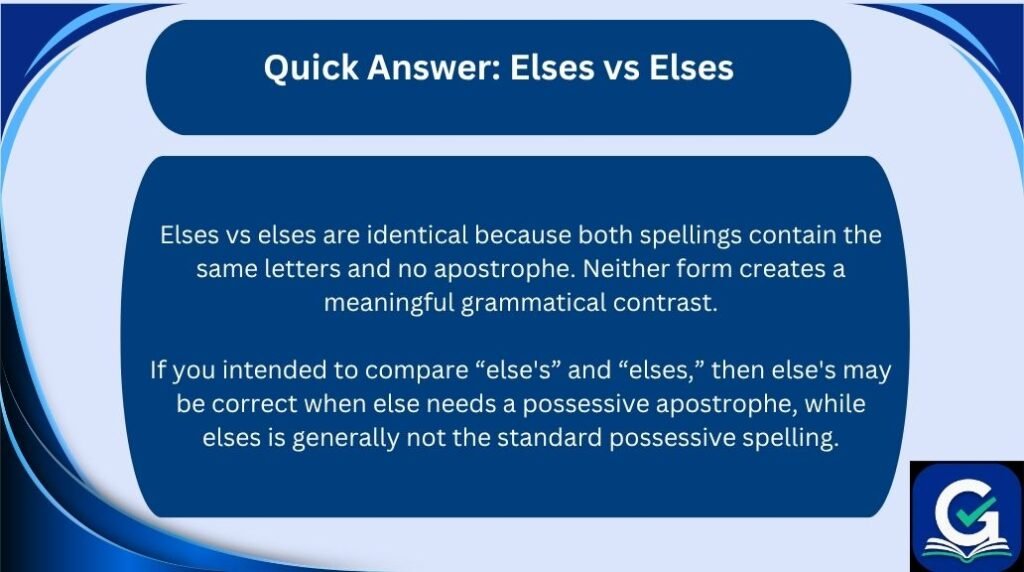
Elses vs elses are identical because both spellings contain the same letters and no apostrophe. Neither form creates a meaningful grammatical contrast.
If you intended to compare “else’s” and “elses,” then else’s may be correct when else needs a possessive apostrophe, while elses is generally not the standard possessive spelling.
For example:
- Correct: Someone else’s phone was ringing.
- Incorrect: Someone elses phone was ringing.
- Correct: Is there anything else you need?
- Incorrect: Is there anything elses you need?
The apostrophe matters because it can signal possession.
Understanding the Basics of Elses vs Elses
Before discussing the grammar, it helps to separate the spelling issue from the punctuation issue.
When people search for elses vs elses, they may be trying to determine whether elses should contain an apostrophe. In standard English, else is normally used without an added s when it means “another,” “additional,” or “different.”
Examples include:
- someone else
- anyone else
- nobody else
- anything else
- somewhere else
- what else
- who else
The form else’s can occur when else is functioning in a possessive construction.
Basic comparison table
| Form | Type | Meaning | Example | Correct/Incorrect |
|---|---|---|---|---|
| else | Adverb/adjective | Additional, different, or otherwise | What else do you need? | Correct |
| else’s | Possessive form | Belonging to someone or something else | Someone else’s idea worked. | Correct in context |
| elses | Nonstandard spelling in ordinary usage | Usually intended as else’s | Someone elses idea worked. | Incorrect |
| elses vs elses | Identical search/spelling forms | No actual spelling distinction | The two forms are identical. | Not a grammatical contrast |
The key point is simple: adding an “s” to else does not normally create the possessive form.
You generally need an apostrophe:
else → else’s
What Does “Else” Mean?
The word else is a flexible English word. It commonly refers to something additional, different, or beyond what has already been mentioned.
Consider these examples:
- What else would you like?
- Who else is coming?
- Do you need anything else?
- Let’s go somewhere else.
- Nobody else knew about the meeting.
In each sentence, else adds the idea of something or someone different or additional.
“Someone else”
One of the most common structures is someone else.
Example:
Someone else answered the phone.
Here, else means another person.
It does not need an apostrophe because the sentence is not expressing possession.
“Anything else”
Another common structure is anything else.
Example:
Would you like anything else?
Here, else means anything additional.
Again, no apostrophe is needed.
“Who else?”
The same rule applies to questions.
Who else wants to join us?
The meaning is “Who other than the people already mentioned wants to join us?”
There is no possessive relationship, so who else is correct.
When Is “Else’s” Correct?
The possessive form else’s is possible when you need to show that something belongs to another person or entity represented by else.
For example:
Someone else’s jacket is on the chair.
The jacket belongs to someone else.
The structure is:
someone + else + ‘s + noun
So:
- someone else’s jacket
- someone else’s opinion
- someone else’s responsibility
- someone else’s decision
- someone else’s mistake
Example: Someone else’s idea
Consider:
We used someone else’s idea.
The word else’s indicates possession. The idea belongs to another person.
Without the apostrophe:
We used someone elses idea.
This is not standard written English.
Example: Someone else’s responsibility
That is someone else’s responsibility.
The responsibility belongs to another person.
The apostrophe helps readers immediately understand the grammatical relationship.
Why “Elses” Is Usually Incorrect
The form elses often appears because people hear the possessive phrase else’s and assume that the apostrophe is unnecessary.
That is a spelling mistake.
English possessives frequently use apostrophes. For a singular noun, the basic pattern is usually:
noun + ‘s
For example:
- John’s car
- Sarah’s book
- the teacher’s desk
- the company’s policy
Similarly, when else participates in a possessive construction, the written form can be:
else’s
For example:
Someone else’s car is blocking the driveway.
The apostrophe tells the reader that the car belongs to someone else.
The Difference Between “Else” and “Else’s”
The difference is easier to understand when you look at function.
Else
Use else when you mean:
- another
- additional
- different
- otherwise
Examples:
What else can we do?
Is anyone else coming?
Let’s try somewhere else.
Else’s
Use else’s when you need a possessive construction.
Examples:
Someone else’s bag is here.
I borrowed someone else’s notes.
We followed someone else’s instructions.
A simple test is to ask:
Does something belong to someone or something else?
If the answer is yes, a possessive construction may be required.
A Simple Possessive Test Tip
Test Tip 💡
Try replacing else’s with “belongs to someone else.”
For example:
This is someone else’s phone.
Can you say:
This phone belongs to someone else.
Yes.
That means the possessive meaning is present, so else’s is appropriate.
Now consider:
What else do you want?
Can you replace else with “belongs to someone else”?
No.
Therefore, there is no possessive meaning, and else is correct.
This test works well for many everyday sentences.
Case Study: A Workplace Email
Imagine that an employee sends this email:
Hi Mark,
I found someone elses report on my desk. I think it may belong to another department.
Thanks,
Daniel
There is a spelling problem in the sentence.
The corrected version is:
Hi Mark,
I found someone else’s report on my desk. I think it may belong to another department.
Thanks,
Daniel
Why?
The report belongs to someone else. Therefore, the possessive form else’s is needed.
Now consider a different sentence:
Is there anything else you need from me?
Here, else is correct because the writer is asking whether the person needs anything additional.
These examples show why context matters more than pronunciation.
Grammar Rules Behind Elses vs Elses
The central grammar rule is based on the difference between an ordinary use of else and a possessive construction.
Merriam-Webster identifies else as an adverb and adjective and gives common constructions such as “someone else” and “anything else.”
The word is extremely common in expressions such as:
- somebody else
- somebody else’s
- someone else
- someone else’s
- anyone else
- anyone else’s
- nobody else
- nobody else’s
- anything else
- anything else’s
Notice what changes.
Compare:
Someone else is responsible.
and:
Someone else’s mistake caused the problem.
In the first sentence, else simply identifies another person.
In the second sentence, else’s introduces possession.
Grammar pattern
The basic patterns look like this:
someone + else
Someone else called.
someone + else + ‘s + noun
Someone else’s phone rang.
This is why simply writing elses is not an appropriate substitute for else’s in standard English.
Is “Else” a Noun?
This is an important point because some confusion comes from treating else like an ordinary noun.
In standard modern English, else commonly functions as an adverb and adjective. Merriam-Webster’s usage examples include constructions such as “someone else” and “anything else.”
For example:
What else do you want?
Here, else modifies the question’s meaning by indicating something additional.
Similarly:
Nobody else knew.
Here, else identifies people other than those already considered.
Because else does not normally behave like a regular countable noun, elses is not generally formed as a normal plural.
You would not ordinarily write:
There were several elses in the room.
That is not standard everyday English.
Can “Elses” Ever Appear?
In rare circumstances, a writer may use an unusual form like elses when discussing the word itself, creating a linguistic or metalinguistic context.
For example, someone studying unusual word formations might theoretically write:
The text contains several forms of “else.”
Even there, it is usually clearer to place the word in quotation marks or explain the intended grammatical category.
In ordinary writing, however, elses should not be treated as the plural of else.
This is why writers should not assume that every English word can simply receive -s to create a plural.
Words behave differently depending on their grammatical category.
Common Mistakes With Elses vs Elses
Several factors can lead to confusion around elses vs elses.
1. Fast typing
When people type quickly, they often leave out apostrophes.
For example:
someone elses opinion
may be typed instead of:
someone else’s opinion
The meaning may still be understandable, but the written grammar is incorrect.
2. Autocorrect
Autocorrect can also create problems.
A keyboard may recognize elses as a sequence of letters and fail to add the punctuation that the writer intended.
Because autocorrect systems vary, writers should always proofread important documents.
3. Lack of knowledge
Some people simply have not learned how possessives work.
If someone knows that someone else is correct, they may assume that adding an s creates a possessive:
someone elses book
But English possessives are usually marked with an apostrophe:
someone else’s book
4. Pronunciation
In everyday speech, else’s and elses may sound extremely similar because the apostrophe is punctuation, not a separate spoken sound.
That can make the difference difficult to notice when learning English.
Writing requires a separate decision about punctuation.
Similar Grammar Confusions
The elses vs elses problem is part of a much larger pattern of English spelling and punctuation confusion.
| Confusing Forms | Correct Use | Example |
|---|---|---|
| its / it’s | its = possession; it’s = it is/it has | The dog wagged its tail. |
| your / you’re | your = possession; you’re = you are | You’re holding your phone. |
| their / they’re | their = possession; they’re = they are | They’re in their office. |
| whose / who’s | whose = possession; who’s = who is/who has | Whose bag is this? |
| there / their / they’re | Place, possession, contraction | They’re waiting over there. |
| else / else’s | Additional/different vs. possessive | Someone else’s book is here. |
These mistakes are common because spoken English does not always make punctuation differences obvious.
Usage in Everyday Conversation
In everyday conversation, else appears constantly.
Examples include:
What else should we buy?
Who else is coming?
Do you want anything else?
Let’s meet somewhere else.
Is there anything else I should know?
These sentences all use else without an apostrophe.
Possessive constructions are also common:
That’s someone else’s seat.
I think this is someone else’s umbrella.
We accidentally took someone else’s bag.
In casual speech, people usually understand the meaning from context. In writing, however, punctuation makes the relationship clearer.
Usage in Professional Writing
Professional writing requires greater attention to spelling and punctuation.
Consider:
We used someone elses data.
This looks careless in a report.
The correct version is:
We used someone else’s data.
The same applies to:
- someone else’s research
- someone else’s proposal
- someone else’s account
- someone else’s document
- someone else’s responsibility
Correct punctuation supports professionalism.
A missing apostrophe may seem like a tiny error, but repeated punctuation mistakes can affect how polished a document appears.
Usage in Creative Writing
Creative writing gives authors more flexibility, but standard grammar still matters unless a deliberate stylistic choice is being made.
For example:
She wondered what else the night had planned.
Here, else is correct.
Another example:
She had stepped into someone else’s story.
Here, else’s expresses possession.
A novelist might intentionally use unconventional spelling to represent a character’s speech, but that is different from making an accidental spelling error.
If the unusual form is intentional, context should make that clear.
Usage in Social Media and Texting
Texting and social media often use relaxed punctuation.
You might see:
anyone elses coming?
or:
is this someone elses?
These forms are common online, but they are not recommended for formal writing.
A better version is:
Is anyone else coming?
or:
Is this someone else’s?
Casual digital communication often removes apostrophes, capital letters, and punctuation. That does not mean those omissions are grammatically correct.
For posts, comments, and informal texts, readers may overlook minor errors. For applications, business messages, academic work, and professional profiles, correct grammar is much more important.
Why Elses vs Elses Matters
At first glance, elses vs elses may seem like a tiny spelling issue. But understanding the underlying grammar helps you avoid a wider class of writing mistakes.
Clarity in communication
Apostrophes can communicate possession.
Compare:
someone else
with:
someone else’s laptop
The first identifies another person. The second shows ownership.
Professionalism
A correctly written sentence creates a stronger impression in professional communication.
Compare:
I reviewed someone elses proposal.
with:
I reviewed someone else’s proposal.
The second version is cleaner and more polished.
Accuracy in digital communication
Digital communication moves quickly. Emails, messages, comments, and documents are often written under time pressure.
That makes proofreading especially useful.
A useful reminder
If something belongs to someone else, remember the apostrophe.
That short rule can prevent many common mistakes.
The Difference Between Else, Else’s, and Elsewhere
Another useful way to understand else is to compare it with related expressions.
Else
Means additional or different.
Is there anything else?
Else’s
Can express possession.
Someone else’s coat is here.
Elsewhere
Means in or to another place.
We should look elsewhere.
These forms are related in spelling and meaning, but they have different grammatical functions.
Merriam-Webster’s treatment of else includes meanings connected with something additional or different, while elsewhere functions as a separate word meaning another place.
Understanding these distinctions makes the word much easier to use.
Does “Else” Have a Plural Form?
Normally, no.
The word else is not generally pluralized as elses in ordinary English.
You would say:
other possibilities
rather than:
elses
You would say:
other people
rather than:
elses
You would say:
different options
rather than:
elses
This is another reason the spelling elses should raise a warning during proofreading.
If you see elses in your sentence, stop and ask what you actually mean.
Do you mean:
- else?
- else’s?
- others?
- other?
- elsewhere?
Choosing the correct word is more important than simply adding an s.
A Practical Editing Method
If you are unsure about elses vs elses, use this three-step method.
Step 1: Read the whole sentence
Do not judge the word by itself.
For example:
I found someone elses notebook.
The surrounding words show that the notebook belongs to someone.
Step 2: Ask whether possession exists
Does the notebook belong to someone else?
Yes.
Therefore:
someone else’s notebook
Step 3: Check the apostrophe
If possession is intended, make sure the possessive form is punctuated correctly.
This gives:
someone else’s notebook
This method works quickly and is useful during proofreading.
Special Exception: Names, Labels, and Word Discussions
There can be unusual situations where a form that looks like elses appears as part of a name, label, username, product title, or other proper designation.
For example, a company, website, username, or fictional character could theoretically use Elses as a creative name.
In such cases, the word is functioning as a proper name rather than ordinary English grammar.
The same principle applies to intentionally stylized writing.
If a brand officially uses an unusual spelling, writers should reproduce the official name accurately.
However, that does not make elses the standard possessive form of else.
In normal American English, use the grammatical form that fits the sentence.
Quick Recap Checklist
Use this checklist whenever you are uncertain about elses vs elses.
| Question | If Yes → Use |
|---|---|
| Do you mean “additional” or “different”? | else |
| Do you mean another person or thing? | else |
| Does something belong to someone else? | else’s |
| Are you simply adding an “s” to make else plural? | Usually do not use elses |
| Are you discussing the word itself? | Use quotation marks or explain the context |
| Is it a special name or brand? | Follow the official spelling |
Practice Example 1
Wrong: I borrowed someone elses pen.
Correct: I borrowed someone else’s pen.
Why? The pen belongs to someone else.
Practice Example 2
Wrong: What elses do we need?
Correct: What else do we need?
Why? The question asks for something additional.
Practice Example 3
Wrong: Is anyone elses coming?
Correct: Is anyone else coming?
Why? Else means another person or additional person in this context.
Quick Ways to Remember the Rule
Here are a few memory tricks. 🧠
Remember: “Else” means more or different
What else?
Think:
What more?
Remember: “Else’s” shows ownership
Someone else’s phone.
Think:
The phone belongs to someone else.
Remember: “Elses” is usually a warning sign
If you type:
elses
stop and reread the sentence.
You may actually need:
else
or:
else’s
This simple habit can eliminate many punctuation mistakes.
Why Apostrophes Matter
Apostrophes are small punctuation marks, but they often carry important grammatical information.
Compare:
The teacher’s desk.
The desk belongs to the teacher.
Now compare:
someone else’s desk
The desk belongs to someone else.
Without the apostrophe:
someone elses desk
the intended possessive relationship is not marked according to standard English spelling conventions.
This is similar to other possessive constructions:
- John’s car
- Maria’s phone
- the student’s book
- someone else’s idea
The apostrophe helps readers process the sentence quickly and accurately.
FAQs
1. Is “elses” a correct English word?
Elses is not normally used as a standard plural or possessive form of else in everyday American English. If you intend possession, the usual written form is else’s.
2. What is the difference between “else” and “else’s”?
Else generally means additional, different, or otherwise. Else’s can indicate possession, as in “someone else’s car.”
3. Is “someone elses” correct?
No. In standard English, write someone else’s when you mean that something belongs to another person.
Correct:
Someone else’s phone is ringing.
4. Should I write “anything else” or “anything else’s”?
It depends on the meaning. Use anything else when you mean something additional:
Do you need anything else?
Use anything else’s only when a possessive meaning is actually required in a grammatical construction.
5. Why do people write “elses” instead of “else’s”?
The mistake often happens because the apostrophe is easy to miss during fast typing. Pronunciation also contributes because the apostrophe itself is not a separate spoken sound. Autocorrect and unfamiliarity with possessive punctuation can also contribute to the error.
6. Is “elses vs elses” actually a spelling comparison?
Not as written. The two forms are exactly identical. The useful comparison is usually else vs. else’s or else’s vs. elses.
Conclusion
The biggest lesson from elses vs elses is that punctuation can change the grammatical role of a word. As written, the two sides of elses vs elses are identical, so there is no genuine spelling difference to choose between. In most everyday sentences, you will need either else or else’s, depending on what you mean.
Use else when you are talking about something additional, different, or another person or thing:
What else do you need?
Use else’s when you need to show possession:
Someone else’s bag is on the table.
Avoid treating elses as a normal plural or as a replacement for else’s. When in doubt, read the complete sentence and ask whether you are describing something additional or showing ownership. That quick check will usually reveal the correct form.
Remember: “else” adds another possibility, while “else’s” can show ownership—small apostrophe, big difference. 🔎

I’m Amelia Parker, an English language writer at Gramfino, focused on making difficult language topics easier to understand.
I write about grammar, vocabulary, word usage, and everyday English to help readers communicate clearly.
[…] pattern true → truly, you will know which form to choose whenever this question comes up. Elses vs Elses | Skill Set vs Skillset | Dwarfs vs […]
[…] knowing the correct form will help you communicate clearly and confidently. Truly vs Truely | Elses vs Elses | Skill Set vs […]